Evidence 551 | July 1, 2026
Book of Moses Evidence: High and Lifted Up
Post contributed by
Scripture Central
Abstract
Various extrabiblical sources validate the ascent imagery connected to Enoch and his people in the Book of Moses.According to Genesis 5:24, “Enoch walked with God: and he was not; for God took him.” A similar idea is expressed in Hebrews 11:5: “By faith Enoch was translated that he should not see death; and was not found.” Notice, however, that the text never specifically mentions anything about Enoch being high, lifted up, or taken up into heaven. Although somewhat implied, those ideas are not emphasized or made explicit in the biblical record.1 By way of contrast, the Book of Moses dwells repeatedly and directly on themes of earthly and heavenly ascent, both in connection to Enoch himself and to his followers.
One example of earthly ascent arises shortly after Enoch’s prophetic calling, where it is reported that he “went forth in the land, among the people, standing upon the hills and the high places” and that the people “came forth to hear him, upon the high places” (Moses 6:37–38). In the next chapter, Enoch states that “there came a voice out of heaven, saying—Turn ye, and get ye upon the mount Simeon. And it came to pass that I turned and went up on the mount; and as I stood upon the mount, I beheld the heavens open, and I was clothed upon with glory” (Moses 7:2–3).2
Similar mountain imagery is associated with the Zion community that Enoch led. According to Moses 7:17–18, “the Lord blessed the land, and they were blessed upon the mountains, and upon the high places, and did flourish. And the Lord called his people Zion.” As stated in D&C 76:66–67, the righteous “are they who are come unto Mount Zion, and unto the city of the living God, the heavenly place, the holiest of all. These are they who have come to an innumerable company of angels, to the general assembly and church of Enoch.”
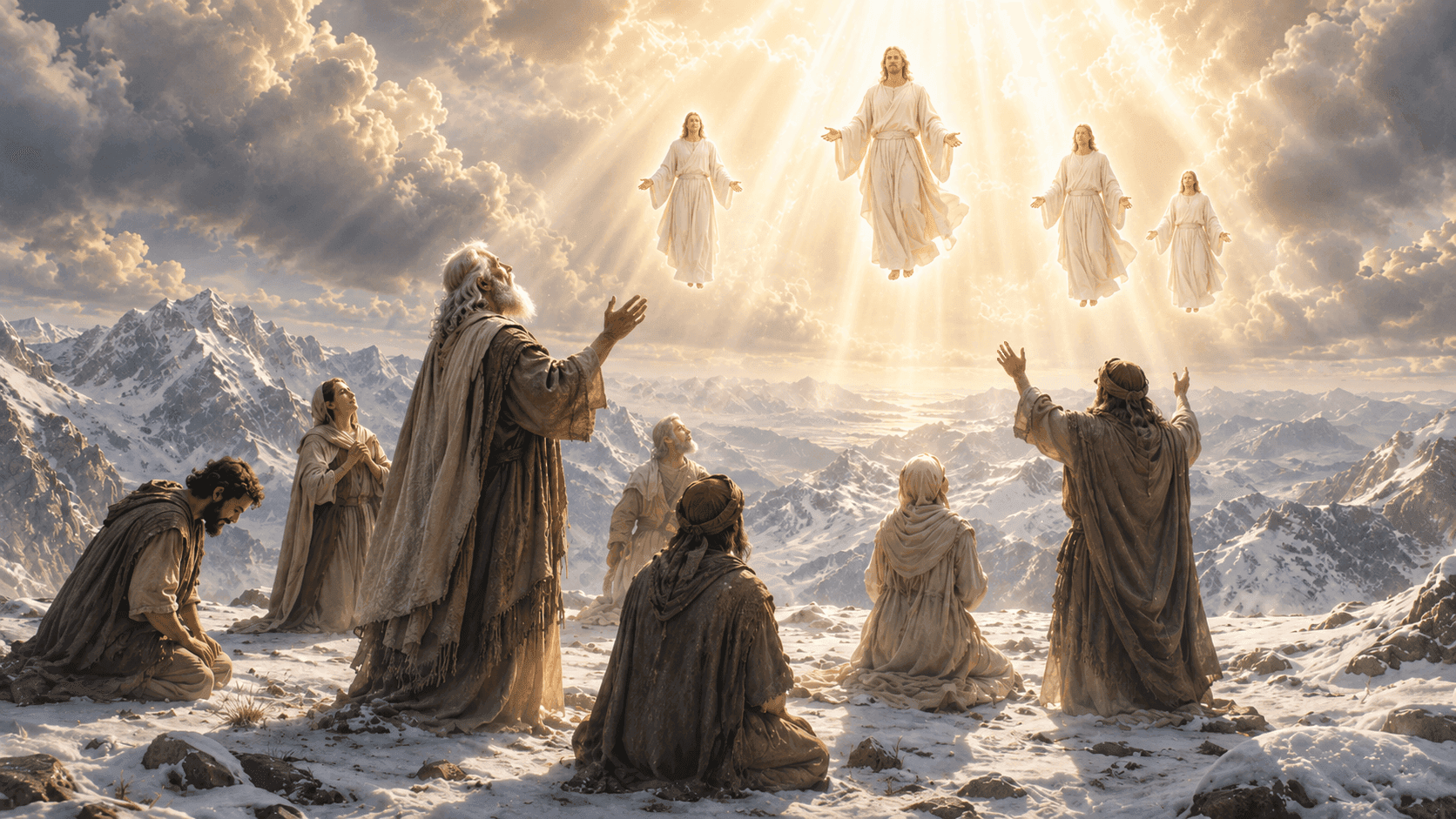
Enoch and his people are also described as being lifted or taken up into the heavens: “And after that Zion was taken up into heaven, Enoch beheld, and lo, all the nations of the earth were before him; And there came generation upon generation; and Enoch was high and lifted up, even in the bosom of the Father” (Moses 7:23–24). Many others were also “caught up by the powers of heaven into Zion” (Moses 7:27). The end of the Enoch narrative emphasizes these points one final time: “And Enoch and all his people walked with God, and he dwelt in the midst of Zion; and it came to pass that Zion was not, for God received it up into his own bosom; and from thence went forth the saying, Zion is Fled” (Moses 7:69).3 This backdrop gives thematic significance to the Lord’s early statement in Moses 7:53: “whoso cometh in at the gate and climbeth up by me shall never fall.”4
Relevant ascension imagery is also found in JST Genesis 14:32, in which Enoch’s people “were translated and taken up into heaven.” Two verses later, the text states that the people of Melchizedek also “obtained heaven, and sought for the city of Enoch which God had before taken, separating it from the earth” (JST Genesis 14:34).
Thus, as depicted in the Book of Moses and other Restoration texts, Enoch’s world is vertically charged. Its hills, mountains, opened heavens, and translated communities all point toward the same upward movement from earthly holiness into divine presence. To a significant extent, similar parallels can be found in a variety of extrabiblical sources.
Enoch’s Elevation in Extrabiblical Sources
According to Hugh Nibley, “Joseph Smith’s preoccupation with mountains in his Enoch account would appear suspicious were it not that the other Enoch texts have the same obsession.”5 For example, mountains are mentioned more than 50 times in 1 Enoch alone. One important mountain scene comes from an angel’s explanation to Enoch recorded in 1 Enoch 25:3: “This tall mountain which you saw whose summit resembles the throne of God is (indeed) his throne, on which the Holy and Great Lord of Glory, the Eternal King, will sit when he descends to visit the earth with goodness.”6 This mountain was situated among seven others, all of which were compared to thrones. There was also a fragrant tree in their midst, comparable to the Tree of Life from the Eden narrative (1 Enoch 24:3–6). Concerning this sacred elevated space, God said he specifically “prepared” it “for the righteous people” (1 Enoch 25:7).7
Various sources also comment on Enoch’s heavenly ascent, whether in connection to his visions or to him being permanently translated. One example can be seen in 1 Enoch 14–15, in which Enoch enters into the presence of the Lord’s heavenly dwelling:
in the vision, the winds were causing me to fly and rushing me high up into heaven. … And the Lord called me with his own mouth and said to me, “Come near to me, Enoch, and to my holy Word.” And he lifted me up and brought me near to the gate, but I (continued) to look down with my face. But he raised me up and said to me with his voice, “Enoch.” I (then) heard, “Do not fear, Enoch, righteous man, scribe of righteousness; come near to me and hear my voice.” (1 Enoch 14:9, 24–15:1)8
Much later, Enoch reports that certain beings “seized me by my hand and took me from the generations of the earth, lifted me up into a high place, and showed me a high tower above the earth, and all the hills were firm” (1 Enoch 87:4).9
Related imagery is prevalent in 2 Enoch, where Enoch’s ascent is developed into an extended journey through multiple heavenly realms. The book opens by declaring, “There was a wise man and a great artisan whom the LORD took away. And he loved him so that he might see the highest realms” (2 Enoch 1:1).10 The text also repeatedly mentions that angelic beings escorted Enoch upward through the heavens, as seen in the following examples:
- “And they took me up onto their wings, and carried me up to the first heaven, and placed me on the clouds” (2 Enoch 3:1)11
- “And those men took me and they carried me up to the fourth heaven” (2 Enoch 11:1)12
- “And Michael, the LORD’s archistratig, lifted me up and brought me in front of the face of the LORD” (2 Enoch 22:6)13
- “For tomorrow morning I shall go up to the highest heaven, into the highest Jerusalem” (2 Enoch 55:2)14
- “And the angels hurried and grasped Enoch and carried him up to the highest heaven, where the Lord received him and made him stand in front of his face for eternity” (2 Enoch 67:2)15
One can also turn to 3 Enoch, in which Enoch is depicted in his glorious form as the angel Metatron. Early in the text, a heavenly initiate known as Rabbi Ishmael asks Metatron, “why, then, do they call you ‘Youth’ in the heavenly heights” (3 Enoch 4:1).16 At another point, Metatron reports that “the Holy One … bore me up on the stormy wings of the Šekināh to the highest heaven and brought me into the great palaces in the height of the heaven of ‘Arabot” (3 Enoch 7:1).17 Several chapters later, Metatron is described as the “Prince of the Divine Presence, the glory of highest heaven” (3 Enoch 13:1).18 The title “glory of highest heaven” is repeatedly given to him throughout the text.19 An account from the Jewish Zohar echoes these sentiments: “The Holy One, blessed be He, removed Enoch from earth and raised him to the supernal heights and delivered into his charge all the celestial treasuries.”20
Islamic sources also emphasize Enoch’s elevated status, as captured very clearly in the Quran: “And We raised him to a lofty station” (19:57).21 Although brief, this statement is significant because it makes Enoch’s elevation explicit rather than merely implied. Many Islamic traditions about Enoch (who is known in such sources as the prophet Idris) quote this passage from the Quran or expound upon its meaning.22
Zion’s Elevation in Extrabiblical Sources
Extrabiblical sources also mention that Enoch’s followers dwelled in elevated earthly settings or that they ascended into the heavens as Enoch himself had done. One tradition—which is particularly pronounced in a Christian text known as the Cave of Treasures—depicts Adam’s righteous posterity, including the generation led by Enoch, as dwelling on a holy mountain. This text reports that after Adam’s death, the “generations of Seth’s children separated themselves from the children of Cain the murderer. At that time Seth … led them and made them ascend the glorious mountain where Adam lay buried. But Cain and all his offspring remained in the plain below where Cain had slain Abel” (Cav. Tr. 6:22–24).23 The story then recounts the efforts of the righteous patriarchs among Seth’s posterity to persuade their people not to descend from the holy mountain and mix with the children of Cain. Various strains of this tradition can be found in Jewish, Christian, and Islamic sources.24
Other traditions suggest that Enoch’s followers ascended with him into the heavens. One relevant account comes from the Book of Jasher. It describes how a startlingly large number of people—approximately 800,000—journeyed with Enoch, knowing that he was going to be taken into heaven. At one point, Enoch warned them to “return to your tents, lest you may die; but they were not willing to return, and they went with him.”25 The mention of tents here is interesting because we also observe people leaving their tents to visit Enoch at an elevated setting in Moses 6:38: “And they came forth to hear him, upon the high places, saying unto the tent-keepers: Tarry ye here and keep the tents, while we go yonder to behold the seer.”
After seeing how persistent the people were in following him, Enoch eventually gave up trying to dissuade them: “And they urged so much to go with him, that he ceased speaking to them; and they went after him and would not return.” The fate of Enoch’s followers is emphasized even further when the kings of the land sent out a search party to find them, which happens to involve a location filled with snow: “And all those kings went to the place and they found the earth there filled with snow, and upon the snow were large stones of snow, and one said to the other, come, let us break through this snow and see, perhaps the men that remained with Enoch are dead.” Although not definitive, the landscape may suggest an elevated setting, such as a mountaintop, where snow would be particularly deep.
In this version of the story (at least as reflected in its underlying Hebrew), the bodies of Enoch’s followers are tragically found beneath the snow. However, another version of the story, recorded in Bet ha-Midrash, does not state whether the bodies of Enoch’s followers were ultimately found.26 According to that version, it is simply reported that the people “hunted for Enoch and found him not because he had gone up into the sky.”27 Based on the currently available evidence, it is uncertain why these versions differ on this point.28 At the very least, these accounts both depict a large company of Enoch’s followers leaving their ordinary dwellings, following him toward the place of his heavenly departure (perhaps in a mountain setting), ignoring warnings that they might die, and seeking to accompany him beyond the limits of mortal life. These details resonate strongly with the Book of Moses, except in that account Enoch’s followers unambiguously succeed in following him into heaven.
Another potentially significant parallel comes from the Book of Giants, which speaks of a conflict between the giants and a mysterious group of heavenly adversaries. In one fragment, the speaker—likely one of the giants—declares, “I made war against them, but [I was] not [strong enough, and] I was [not] able to prevail against them, because my adversaries … dwell [in heave]n, and they reside in holy places.”29 This passage does not explicitly identify these heavenly opponents as Enoch’s followers. Even so, as suggested by Jeffrey Bradshaw, they can be meaningfully compared with the “sons of God” in Moses 7:21, members of a righteous Zion community who dwelt in a “City of Holiness,” were eventually “taken up into heaven,” and defeated their enemies with divine power (Moses 7:19–21).30
In Moses 7:69 we learn that “Zion was not, for God received it up into his own bosom; and from thence went forth the saying, Zion is Fled.” Bradshaw has viewed this as a “poignantly ironic echo” of a passage from the Mandaean Ginza, where Enoch’s enemies lament that “by fleeing and hiding, these men … have gone up higher than us.”31 The resemblance is not merely verbal. In both accounts, the “flight” of Enoch and his righteous associates is interpreted as divine elevation, placing them beyond the reach of hostile powers.
Another account that involves a righteous group fleeing or hiding from enemies in an antediluvian context can be seen in the Apocryphon of John. In its retelling of the story of Noah, it reports that a group of righteous people “hid themselves in a place, not only Noah, but also many other people from the immovable race. They went into a place and hid themselves in a luminous cloud.”32 As interpreted by Nibley, this group was “carried away to heaven in a cloud of light.”33
A similar account is found in the Apocalypse of Adam, in which Adam instructs his son Seth about the impending flood. In this context, Adam declares that “great angels will come on high clouds to bring those men to the place where the spirit of life dwells [. . . 7 lines missing] from heaven to earth. [But] the whole [multitude] of flesh will be left behind in the [waters]” (Apoc. Adam 3:4–5).34 This imagery—in which angels come to collect the righteous into a heavenly realm while leaving the wicked to perish in the flood—is very reminiscent of Moses 7:27: “And Enoch beheld angels descending out of heaven, bearing testimony of the Father and Son; and the Holy Ghost fell on many, and they were caught up by the powers of heaven into Zion. And it came to pass that the God of heaven looked upon the residue of the people, and he wept.”35
Related imagery may also be present in 3 Enoch, which describes how God’s glorious presence or Šekinah—a concept that overlaps significantly with the Zion motif of Moses 7—was taken up into heaven.36 After commenting on the wickedness present in the days of Enosh,37 the text states that the Holy One “took up his Šekinah from the earth, from their midst. Then the ministering angels came, and the cohorts of the hosts, and the armies of ‘Arabot, one thousand companies strong, and myriads of hosts. They took trumpets and seized horns and surrounded the Šekinah with psalms and songs, and it ascended to the heavenly heights” (3 Enoch 5:13–14).38 Interestingly, the passage then quotes from Psalm 47:5 which, in its broader context, may hint at God preparing a heavenly inheritance for his people.39
In addition to these pre-flood ascension narratives, David Larsen has tracked subtle consistencies and recurring themes surrounding the generic communal ascension motif in a variety of Jewish and Christian sources, demonstrating that the Enoch account in the Book of Moses is a remarkably authentic example. He also highlights elements of communal ascent in the Old and New Testaments, but they are typically less obvious in those sources.40
Conclusion
Across a wide range of ancient and medieval traditions, Enoch is repeatedly associated with mountains, high places, heavenly journeys, angelic escorts, divine enthronement, and exaltation into the presence of God. The Book of Moses thus fits very well within the broader corpus of Enochic stories, where sacred height and heavenly ascent are among the prophet’s most characteristic features.
Even more important, Smith’s revelation extends this pattern from Enoch to Zion itself. Rather than ascending merely as an isolated visionary, Enoch instead gathers and sanctifies a people who eventually share in his heavenly destiny. This communal dimension finds points of contact in traditions about Adam’s righteous posterity dwelling on a holy mountain, as well as in accounts of Enoch’s followers seeking to accompany him in his heavenly ascent. Other extrabiblical sources more directly depict a righteous people being caught up into heaven before the flood, sometimes with the aid of angelic beings, much like the account in the Book of Moses.
If Joseph Smith had simply been relying on the Bible for his story about Enoch, the degree to which it emphasizes earthly and heavenly ascents would be rather surprising. This is especially so when it comes to the collective ascent of Zion, a detail which is never hinted at in biblical texts nor depicted in 1 Enoch (one of the few Enochic sources that was potentially available in 1830).41
When taken together, these parallels suggest the Book of Moses is not merely adding imaginative detail to the spare biblical account of Enoch. Instead, it presents a richly developed version of the Enoch tradition that resonates with patterns of ascent scattered across Jewish, Christian, and Islamic sources. In this regard, it comes across as both believably ancient and divinely inspired.
David J. Larsen, “Group Ascension to Heaven in the Scriptures and in Early Judaism and Christianity,” in The Temple: Symbols, Sermons, and Settings, ed. Stephen D. Ricks and Jeffrey M. Bradshaw (Interpreter Foundation and Eborn Books, 2023), 216–227.
Jeffrey M. Bradshaw and David J. Larsen, In God’s Image and Likeness 2: Enoch, Noah, and the Tower of Babel (The Interpreter Foundation and Eborn Books, 2014), 140.
David J. Larsen, “Enoch and the City of Zion: Can an Entire Community Ascend to Heaven?” BYU Studies Quarterly 53, no. 1 (2014): 25–37.
Hugh Nibley, Enoch the Prophet, The Collected Works of Hugh Nibley, Volume 2 (FARMS, 1986), 22–23, 264–265.
Genesis
Genesis 5:24
JST Genesis 14:32
JST Genesis 14:34
Hebrews
Hebrews 11:5
3 Nephi
3 Nephi 20:22
3 Nephi 27:14–15
3 Nephi 28:7
Moses
Moses 6:37–38
Moses 7:2–3
Moses 7:17–18
Moses 7:19–21
Moses 7:23–24
Moses 7:27
Moses 7:53
Moses 7:55
Moses 7:69
Doctrine and Covenants
Doctrine and Covenants 76:66–67
- 1. For a discussion of the biblical verses connected to Enoch and the extent to which they may imply a heavenly ascent, see Shaul Bar, “Enoch and Elijah: Ascent to Heaven?” Jewish Bible Quarterly 51, no. 4 (2023): 238–239.
- 2. For more on this event, see Scripture Central, “Book of Moses Evidence: Enoch Clothed with Glory,” Evidence 500 (June 25, 2025); Scripture Central, “Book of Moses Evidence: The Name and Role of Mahijah/Mahujah,” Evidence 528 (January 15, 2026).
- 3. This chapter also describes the “Son of Man lifted up on the cross, after the manner of men” (Moses 7:55). See Jeffrey M. Bradshaw and David J. Larsen, In God’s Image and Likeness 2: Enoch, Noah, and the Tower of Babel (The Interpreter Foundation and Eborn Books, 2014), 140: “The parallel between Enoch being lifted up in this verse and the Son of Man being ‘lifted up on the cross, after the manner of men’ in Moses 7:55 is noteworthy. In addition, there may be some connection between the idea of being ‘lifted up’ and initiation into the heavenly mysteries.” See also 3 Nephi 27:14–15: “And my Father sent me that I might be lifted up upon the cross; and after that I had been lifted up upon the cross, that I might draw all men unto me, that as I have been lifted up by men even so should men be lifted up by the Father, to stand before me, to be judged of their works, whether they be good or whether they be evil—And for this cause have I been lifted up; therefore, according to the power of the Father I will draw all men unto me, that they may be judged according to their works.”
- 4. See Scripture Central, “Book of Moses Evidence: Climbing Up at the Gate,” Evidence 540 (April 8, 2026).
- 5. Hugh Nibley, Enoch the Prophet, The Collected Works of Hugh Nibley, Volume 2 (FARMS, 1986), 22–23.
- 6. Translation by E. Isaac, “1 (Ethiopic Apocalypse of) Enoch,” in The Old Testament Pseudepigrapha, 2 vols., ed. James H. Charlesworth (Doubleday, 1983–85), 1:26.
- 7. Translation by Isaac, “1 (Ethiopic Apocalypse of) Enoch,” 26.
- 8. Translation by Isaac, “1 (Ethiopic Apocalypse of) Enoch,” 21.
- 9. Translation by Isaac, “1 (Ethiopic Apocalypse of) Enoch,” 64.
- 10. Long Recension. Translation by Frances I. Anderson, “2 (Slavonic Apocalypse of) Enoch,” in The Old Testament Pseudepigrapha, 1:102; formatting slightly adjusted.
- 11. Translation by Anderson, “2 (Slavonic Apocalypse of) Enoch,” 110.
- 12. Translation by Anderson, “2 (Slavonic Apocalypse of) Enoch,” 120.
- 13. Translation by Anderson, “2 (Slavonic Apocalypse of) Enoch,” 138.
- 14. Translation by Anderson, “2 (Slavonic Apocalypse of) Enoch,” 182; formatting slightly adjusted.
- 15. Translation by Anderson, “2 (Slavonic Apocalypse of) Enoch,” 194. For more on Enoch standing before the face of the Lord, see Scripture Central, “Book of Moses Evidence: Enoch Stood Before God’s Face,” Evidence 519 (November 5, 2025).
- 16. Translation by Philip Alexander, “3 (Hebrew Apocalypse of) Enoch,” in The Old Testament Pseudepigrapha, 1:258. For more on Enoch’s status as a “youth” or “lad,” see Scripture Central, “Book of Moses Evidence: Enoch the Lad,” Evidence 480 (February 6, 2025).
- 17. Translation by Philip Alexander, “3 (Hebrew Apocalypse of) Enoch,” 262.
- 18. Translation by Philip Alexander, “3 (Hebrew Apocalypse of) Enoch,” 265.
- 19. See 3 Enoch 15:1; 16:1; 17:1; 18:1; 24:1.
- 20. Zohar l.56b; as cited in John C. Reeves and Annette Yoshiko Reed, Enoch from Antiquity to the Middle Ages, vol. 1 (Oxford University Press, 2018), 168.
- 21. For various translations of this verse, see https://myislam.org/surah-maryam/ayat-57/.
- 22. See Reeves and Reed, Enoch from Antiquity to the Middle Ages, 67, 69, 98, 107, 126, 133–134, 139, 158, 186, 188–189.
- 23. Translation by Alexander Toepel, “The Cave of Treasures: A New Translation and Introduction,” in Old Testament Pseudepigrapha: More Noncanonical Scriptures, vol. 1, ed. Richard Bauckham, James R. Davila, and Alexander Panayotov (Eerdmans, 2013), 545.
- 24. See Scripture Central, “Book of Moses Evidence: The Seed of Cain,” Evidence 548 (June 10, 2026).
- 25. Sefer ha-Yashar; or, The Book of Jasher (M. M. Noah and A. S. Gould, 1840), 8.
- 26. Curiously, a similar omission is found in English translations of the text. See Sefer ha-Yashar; or, The Book of Jasher (M. M. Noah and A. S. Gould, 1840), 8; Sefer Ha-Yashar: The Book Jashar, trans. Edward B. M. Browne (United States Publishing Company, 1876), 33.
- 27. Nibley, Enoch the Prophet, 253. Nibley here is citing Bet ha-Midrash, 6 vols. (Jerusalem: Wahrmann Books, 1967), 4:131. As explained by David Larsen, “Although the text does not explicitly depict this large company ascending into heaven together with Enoch, it does state that when the kings of the land came to find these thousands of followers of Enoch, they were not found and were thought to be dead.” David J. Larsen, “Enoch and the City of Zion: Can an Entire Community Ascend to Heaven?” BYU Studies Quarterly 53, no. 1 (2014): 25–37.
- 28. One significant question is whether the short account of the “Life of Enoch” found in Bet ha-Midrasch (produced by the 19th-century Jewish scholar Adolf Jellinek) is based directly on the Book of Jasher itself or whether it was derived from a separate and slightly different version of the story. Either way, it is significant that the account devotes so much attention to the persistence of Enoch’s followers. They continue after him despite his repeated warnings that they may die, and eventually Enoch ceases trying to dissuade them at all. This buildup creates an expectation that the fate of these devotees will be profound. A conclusion in which they are all simply found dead beneath the snow is possible, and such a story could serve to emphasize Enoch’s unique status or that his followers should have heeded his counsel. However, such an ending is also somewhat anticlimactic and doesn’t seem to follow naturally from the reported details. In contrast, if there was an ancient tradition in which Enoch’s followers mysteriously disappeared at the time of his departure, that would much better account for the narrator’s interest in describing their stalwart intention to follow him. It should also be pointed out that similar ambiguities and divergent traditions swirl around the departures of other translated beings, such as Moses, Elijah, and even Alma from the Book of Mormon. See, for example, Scripture Central, “Book of Mormon Evidence: Translation of Moses,” Evidence 129 (December 23, 2020); Bar, “Enoch and Elijah: Ascent to Heaven?” 237–244. This means that even if the omission of the finding of the dead bodies in Jellinek’s account was due to a scribal error on his part (perhaps as he copied or closely adapted his account directly from the Book of Jasher), that still wouldn’t definitively settle the issue. For various reasons, scholars often entertain or assume alternative versions of stories or traditions, even if hypothetical variants are not available for verification.
- 29. Loren T. Stuckenbruck, “The Aramaic Book of Giants,” in Old Testament Pseudepigrapha: More Noncanonical Scriptures, vol. 2, ed. James R. Davila and Richard Bauckham (William B. Eerdmans, 2025), 81. A similar battle, in which a few heavenly beings confront demons and earthly giants, is reported in the Manichean version: “demons saw those angels and were (very) afraid and concerned.” In a later portion, it states that “two hundred demons fought a hard battle with the f[our angel]s, until the [ange]ls [poured?] fire, naphtha a[nd …and] sulphur [over them].” Prods Oktor Skjærvø, “The Book of Giants (Iranian Manichean Version),” in Old Testament Pseudepigrapha: More Noncanonical Scriptures, 154–155.
- 30. See Jeffrey M. Bradshaw, Enoch and the Gathering of Zion: The Witness of Ancient Texts for Modern Scripture (Interpreter Foundation, with Scripture Central and Eborn Books, 2021), 49. For the significance of the title “sons of God,” see pp. 24–29.
- 31. Bradshaw, Enoch and the Gathering of Zion, 49; bolds not in original. The translation is from Bradshaw, who is deriving his text from Jacques P. Migne, “Livre D’Adam,” in Dictionnaire des Apocryphes, ed. Jacques P. Migne, 2 vols. (Paris, France: Jacques P. Migne, 1856), 170. In the same section of text, Enoch’s adversaries also declared, “In vain we have tried murder and fire against them; nothing has been able to reach them. They are now beyond the reach of our blows” (translation via ChatGPT from the following French: En vain nous avons essayé contre eux le meurtre et le feu; rien n’a pu les atteindre. Ils sont maintenant à l’abri de nos coups). This parallels the promise made to Enoch in Moses 6:32: “do as I have commanded thee, and no man shall pierce thee.” See Scripture Central, “Book of Moses Evidence: Enoch’s Divine Comfort and Protection,” Evidence 520 (November 21, 2025).
- 32. Frederik Wisse, “The Apocryphon of John,” in The Nag Hammadi Library in English, ed. James M. Robinson, 3rd rev. ed. (HarperSanFrancisco, 1990), 121.
- 33. Nibley, Enoch the Prophet, 24. This imagery of communal hiddenness mirrors a description of Enoch himself in 1 Enoch 12:1: “Before these things (happened) Enoch was hidden, and no one of the children of the people knew by what he was hidden and where he was. And his dwelling place as well as his activities were with the Watchers and the holy ones; and (so were) his days.” Translation by Isaac, “1 (Ethiopic Apocalypse of) Enoch,” 19.
- 34. Translation by G. Macrae, “Apocalypse of Adam,” in The Old Testament Pseudepigrapha, 1:713.
- 35. The phrase “powers of heaven” may be significant, as powers are specifically associated with orders of angelic beings in Enochic literature. See, for example, 1 Enoch 18:14–15: “(Then) the angel said (to me), ‘This place is the (ultimate) end of heaven and earth: it is the prison house for the stars and the powers of heaven.’” In this context, the “stars” are clearly angelic beings. Likewise, in 1 Enoch 20:1, a manuscript variant reads: “These are the names of the angels of the powers.” George W. E. Nickelsburg and James C. VanderKam, 1 Enoch 1: A Commentary on the Book of 1 Enoch Chapters 1–36, 81–108, ed. Klaus Baltzer (Fortress Press, 2001), 294 (note 1a). Another relevant passage can be found in 1 Enoch 91:15–16: “Then, after this matter, on the tenth week in the seventh part, there shall be the eternal judgment; and it shall be executed by the angels of the eternal heaven—the great (judgment) which emanates from all of the angels. The first heaven shall depart and pass away; a new heaven shall appear; and all the powers of heaven shall shine forever sevenfold.” One can also turn to the use of this term in 3 Nephi 20, in which the “powers of heaven” will dwell in the midst of the people, just as Christ will, in the context of the New Jerusalem prophecy: “and it shall be a New Jerusalem. And the powers of heaven shall be in the midst of this people; yea, even I will be in the midst of you.” Likewise, Christ declared that “I shall come in my glory with the powers of heaven” (3 Nephi 28:7). When read in context, these passages suggest that the “powers of heaven” in Moses 7:27 are most likely angelic beings who had been given authority and power from on high to facilitate the ascension of Zion. Very similar imagery is found in an eschatological context in 1 Enoch 100:4–5, which seems to echo the salvation of the righteous at the time of the great flood: “In those days, the angels shall descend into the secret places. They shall gather together into one place all those who gave aid to sin. And the Most High will arise on that day of judgment in order to execute a great judgment upon all the sinners. He will set a guard of holy angels over all the righteous and holy ones, and they shall keep them as the apple of the eye until all evil and all sin are brought to an end. From that time on the righteous ones shall sleep a restful sleep, and there shall be no one to make them afraid.” Translation by Isaac, “1 (Ethiopic Apocalypse of) Enoch,” 81. See also 1 Enoch 105:1–2.
- 36. It should be clarified, however, that 3 Enoch never implies the Šekinah is comprised of a community of righteous believers. For more on this motif, specifically in connection to the recurring theme of weeping throughout Moses 7, see Scripture Central, “Book of Moses Evidence: Themes of Weeping,” Evidence 525 (December 23, 2025).
- 37. See Scripture Central, “Book of Moses Evidence: Wickedness in the Days of Enos,” Evidence 506 (August 6, 2025).
- 38. Translation by Philip Alexander, “3 (Hebrew Apocalypse of) Enoch,” in The Old Testament Pseudepigrapha, 1:260–261.
- 39. See Psalm 47:4–5: “He shall choose our inheritance for us, the excellency of Jacob whom he loved. Selah. God is gone up with a shout, the Lord with the sound of a trumpet.”
- 40. See David J. Larsen, “Group Ascension to Heaven in the Scriptures and in Early Judaism and Christianity,” in The Temple: Symbols, Sermons, and Settings, ed. Stephen D. Ricks and Jeffrey M. Bradshaw (Interpreter Foundation and Eborn Books, 2023), 215–235; David J. Larsen, “Enoch and the City of Zion: Can an Entire Community Ascend to Heaven?” BYU Studies Quarterly 53, no. 1 (2014): 25–37.
- 41. The plausibility of Joseph Smith’s accessing 1 Enoch is a matter of ongoing debate and discussion among scholars. See Jeffrey M. Bradshaw and Ryan Dahle, “Could Joseph Smith Have Drawn on Ancient Manuscripts When He Translated the Story of Enoch?: Recent Updates on a Persistent Question,” Interpreter: A Journal of Latter-day Saint Faith and Scholarship 33 (2019): 308–311; Colby Townsend, “Revisiting Joseph Smith and the Availability of the Book of Enoch,” Dialogue 53, no. 3 (2020): 41–71.