Evidence #525 | December 23, 2025
Book of Moses Evidence: Themes of Weeping
Post contributed by
Scripture Central
Abstract
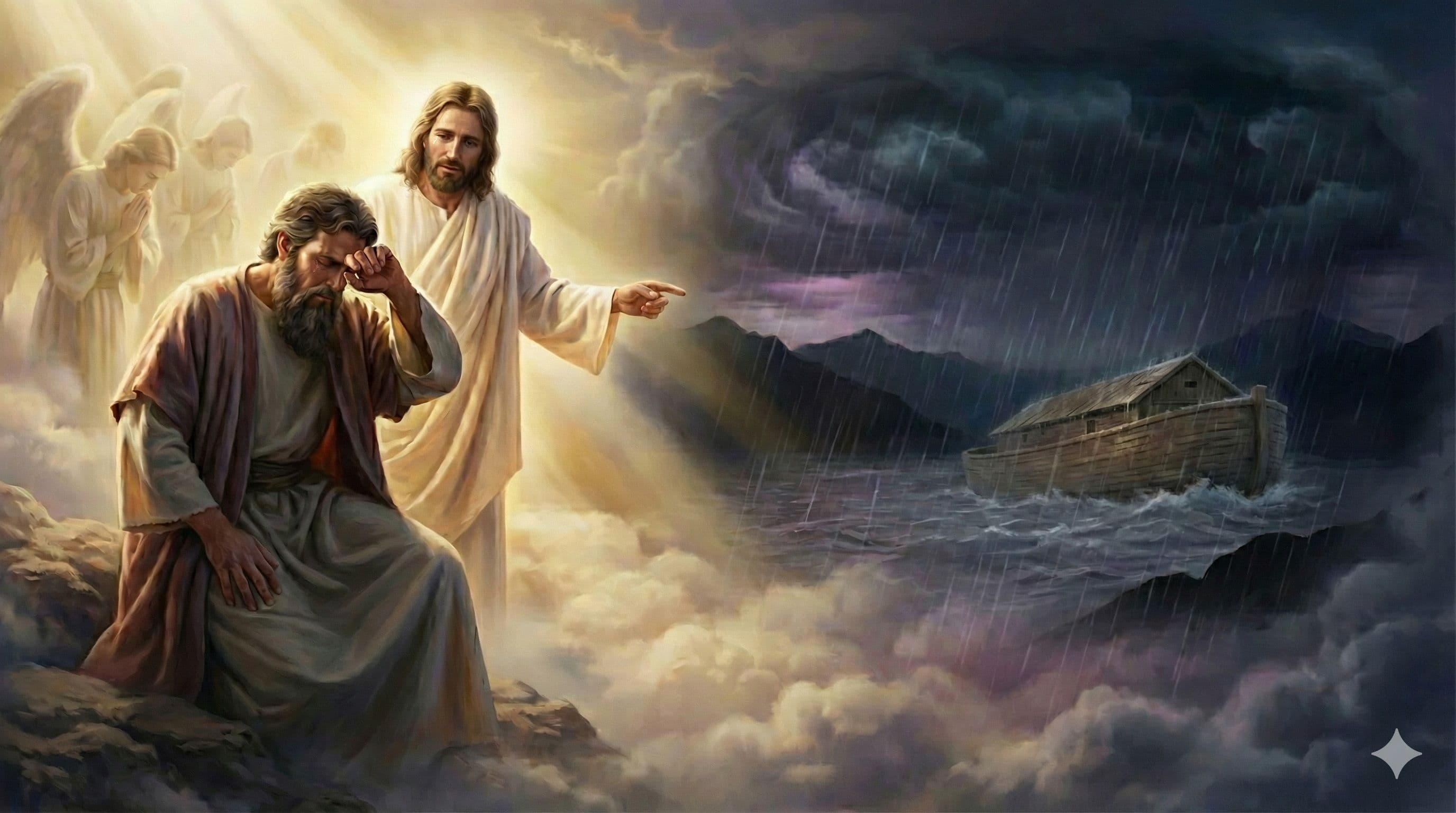
The Book of Moses depicts four different entities—Enoch, God, the heavens, and the earth—as weeping or mourning. These same four voices lament in similar contexts in a variety of extrabiblical Enochic sources.Weeping is one of the most pronounced themes in the seventh chapter of the Book of Moses. Multiple different entities—including Enoch, God, the heavens, and the earth—all weep or mourn in some sort of anguish or lamentation (Moses 7:28–58). Each of these parties likewise weep in extrabiblical Enochic sources.1 These weeping figures will each be discussed in the sections below, along with their intertextual parallels.
The Weeping of Enoch
As part of a revelation from God, Enoch learned that although Zion would be taken up to heaven, those who remained would be cursed and destroyed. After witnessing both God and the heavens weep for the suffering of the wicked, Enoch himself “looked upon their wickedness, and their misery, and wept” (Moses 7:41). Enoch likewise “had bitterness of soul, and wept” upon seeing in vision the future destruction of the flood (Moses 7:44). Later, “when Enoch heard the earth mourn, he wept” in response to its lamentation (Moses 7:49). Enoch “wept and cried unto the Lord” one final time after witnessing the destruction that would take place in later periods of the world’s history, in connection to imprisoned spirits and also the death and suffering of the Son of Man (Moses 7:58).
An account of Enoch’s weeping can also be seen in a revelatory song recorded in the early history of Christ’s restored Church in Revelation Book 2. According to its lyrics, Enoch “gazed upon nature and the corruption of man and mourned their sad fate and wept and cried with a loud voice and heaved forth his sighs.”2 Enoch’s weeping in these specific contexts aligns very well with traditions outside the Bible.
The book of 1 Enoch reports that Enoch was given a heavenly record which contained “all the deeds of humanity … for all the generations of the world.”3 After reading this heavenly text, Enoch stated, “I wept on account of the children of the people upon the earth” (1 Enoch 81:2–4).4 A couple chapters later, Enoch related a visionary dream to his son Methuselah, in which Enoch foresaw the impending flood: “I saw the earth being swallowed up in to the great abyss.” Enoch was so distraught that he began crying out in his sleep, after which his grandfather woke him and asked, “What happened to you that you are crying aloud like this … and why are you lamenting in this manner?” (1 Enoch 83:4–6).5
Later still, Enoch saw in vision the future suffering of the house of Israel, which was compared to sheep who were killed and destroyed at different times. This prompted Enoch “to weep and cry aloud on account of those sheep” (1 Enoch 89:69).6 After the vision, Enoch stated, “I wept with a great weeping, and my tears could not stop, till I had no more endurance left, but flowed down on account of what I had seen until everything should come and be fulfilled” (1 Enoch 90:40–41).7 Finally, when Enoch gave counsel to his children, he pronounced a series of woes upon sinners. He described them as those who “would induce my eyes like a cloud of waters; that I may weep over you, pouring my tears over you like a cloud of waters, so I would rest from the sorrow of my heart!” (1 Enoch 95:1).8
In 2 Enoch, Enoch reported, “I saw a darkness greater than earthly darkness. And there I perceived prisoners under guard, hanging up, waiting for the measureless judgment. And those angels have the appearance of darkness itself, more than earthly darkness” (2 Enoch 7:1). After witnessing this scene of judgment, Enoch stated, “I felt very sorry for them; and those angels bowed down to me and said to me, ‘Man of God, pray for us to the LORD!’” (2 Enoch 7:4).9 A similar description is given in the appendix to 2 Enoch: “I arrived at the place of judgment, and I saw hell open. And I saw there something more, like a prison, judgment unmeasured. … And I sighed and I wept over the perdition of the impious (2 Enoch Appendix).10
These accounts closely resemble Enoch’s sorrow over imprisoned spirits in Moses 7:57–58, in which the same cluster of elements (weeping + darkness + imprisonment + judgment) all turn up in a short block of text: “And as many of the spirits as were in prison came forth, and stood on the right hand of God; and the remainder were reserved in chains of darkness until the judgment of the great day. And again Enoch wept and cried unto the Lord.”11 The weeping in 2 Enoch also echoes the sighing and weeping combination in the song from Revelation Book 2, where Enoch “wept and cried with a loud voice and heaved forth his sighs.”12
Enoch was also shown a comprehensive vision in 2 Enoch, which included the creation of the world (2 Enoch 24–30) and even the fall of Satan (2 Enoch 29:3–6).13 Near the end of the vision, God explained that “all the world will be reduced to confusion by iniquities …. And that is why I shall bring down the flood onto the earth” (2 Enoch 34:2–3).14 When Enoch returned from his heavenly vision, he gave a “mournful admonition … to his sons; with weeping and great sorrow he spoke to them” (2 Enoch 39 heading).15 He then immediately explained, “I have been sent today to you from the lips of the LORD, to speak to you whatever has been and whatever is now and whatever will be until the day of judgment” (2 Enoch 39:5).16 Based on the context, it would appear that Enoch’s sorrow was evoked, at least in part, by the wickedness and destruction he witnessed in his expansive vision, just as was the case in 1 Enoch and the Book of Moses.17
Another interesting account comes from a gnostic text known as the Apocalypse of Paul. In it, the Apostle Paul met an “old man” at the gates of Paradise who “shed tears” and was “sighing and weeping.” Much like Enoch questioned how God could weep, Paul asked, “Father, why do you weep?” The old man answered, “Because we are hurt by humans and they greatly trouble us. There are many good things which the Lord has prepared and His promise is great, but many do not accept them.” When Paul finally asked his angelic guide who the old man was, the angel explained, “This is Enoch, the scribe of righteousness.”18
In the Cologne Mani-Codex, Enoch stated, “I am Enoch the righteous. My sorrow was great, and a torrent of tears (streamed) from my eyes because I heard the insult which the wicked ones uttered.” Who these insults were specifically directed at (whether at Enoch, God, a community of righteous followers, etc.) isn’t clear. Enoch’s angelic guide then stated that he was sent to provide Enoch a comprehensive revelation: “I was sent … that we might show you all the deeds and reveal to you the place (appointed) for the pious, and to show you the place (appointed) for the impious, and what sort of place of punishment the lawless are experiencing.”19 This portrays Enoch as once again weeping in response to wicked behavior in close proximity to an expansive vision of divine judgment.20
The Weeping of God
Rather than being spontaneous or independent, Enoch’s weeping in the Book of Moses was in response to God’s own weeping: “And it came to pass that the God of heaven looked upon the residue of the people, and he wept.” Before Enoch joined in the lament, he first had to overcome his shock at a deity exhibiting such deep commiseration. “How is it that thou canst weep,” asked Enoch, “seeing thou art holy, and from all eternity to all eternity?” (Moses 7:28–29).21 Several passages later, after elaborating on the expansive nature of God’s creations and divine attributes, Enoch again asked, “How is it thou canst weep?” (Moses 7:31).
Unlike Enoch’s mere startlement and desire to understand God’s capacity to weep, the Christian world of Joseph Smith’s day would have largely rejected it outright. Daniel C. Peterson describes this scene from the Book of Moses as “a striking portrayal and one quite inconsistent with the notions of God’s ‘impassibility’ developed in high Christian theology, according to which God should have no such emotions.”22 That isn’t to say that the scriptural canon itself depicts God as without feeling. Displays of divine emotion are, in fact, scattered throughout both the Old and New Testaments.23 The real culprit seems to have been certain tenets of Greek philosophy that were adopted into Christianity’s earliest creedal formulations, leading prominent theologians to consistently metaphorize any canonical displays of divine passion.24 Summarizing the mainstream Christian perspective, Peterson writes,
The Unmoved Mover does not weep. Indeed, he cannot be affected in any way by anything that humans or his other creatures do since he is “pure act” (never effect) and “pure form” (never matter). Furthermore, conflicting emotions within God are inconceivable on the common theological theory that God is utterly “simple,” or indivisible—that he is, in the familiar phrase, “without body, parts, or passions.”25
In contrast to their Christian counterparts, the “ancient rabbis, not yet under the domination of Greek-inspired philosophical theology, were much more willing to entertain the possibility of genuine emotion, even weeping, in God, though they still found it difficult to imagine.”26 What is so remarkable about the Jewish literature is that it repeatedly associates Metatron (Enoch in his glorified angelic form) with stories of God weeping.
For example, after the angel Metatron showed Rabbi Ishmael a vision of suffering sinners in 3 Enoch, the souls of the patriarchs Abraham, Isaac, and Jacob asked, “Lord of the Universe, how long will you sit upon your throne, as a mourner sits in the days of his mourning, with your right hand behind you, and not redeem your sons and reveal your kingdom in the world?” (3 Enoch 44:7).27 Metatron further explained that God’s right hand (functioning as a metaphor for his active presence and protection of the world) “wept, and five rivers of tears flowed from its five fingers, and, falling into the Great Sea, made the whole world quake” (3 Enoch 48A:4).28
An early rabbinic text, known as Midrash Tanchuma, describes God grieving at the imminent death of Moses. In this account, the Lord explained his weeping to Metatron with a parable:
At that time Metatron came and fell on his face. He said to Him, “Master of the world, [as] in Moses’ life he belonged to You, so in his death he belongs to You.” The Holy One, blessed be He, said to him, “Let me give you a parable. To what is the matter comparable? To a king who had a son. Now on each and every day, his father was angry with him and sought to kill him because he did not maintain respect for the father; but his mother rescued him from his hand. One day his mother died and the king wept. His servants said to him, ‘Our lord king, why are you weeping?’ He said to them, ‘It is not over my wife alone that I am weeping, but for my son; for many times when I was angry with him and wanted to kill him, did she rescue him from my hand?’” So also did the Holy One, blessed be He, say to Metatron, “It is not over Moses alone that I am weeping, but over him and over Israel, for look at how many times that they angered Me, and I was angry with them; but he stood in the breach before Me to turn back My anger from destroying them.”
This text is interesting, not only because the Lord felt a need to explain his sorrow to Metatron, but also because Metatron implicitly mirrored the servants in the parable who asked the king “why are you weeping?”29 This resembles Enoch’s stirring and repeated question to God in the Book of Moses: “How is it that thou canst weep?” (Moses 7:29, 31).
Another relevant account comes from the introduction to the Jewish Zohar, in which a rabbi named Hiya saw a heavenly realm where many righteous beings dwelled.
At the head of them all he saw the chief of the winged angels [i.e., Metatron], who approached him and solemnly declared that he had heard ‘from behind the curtain’ that the King [God] visits each day and remembers his gazelle [a metaphor for the glory of Zion/Israel] which is trodden in the dust, and that at the moment He does so He strikes the three hundred and ninety heavens so they all quake and tremble before Him: for her fate He sheds tears hot as burning fire, which fall into the great sea.30
Based on several factors, it can be confidently assumed that “the chief of the winged angels” is none other than Metatron, and the “king” is surely the king of heaven, even God himself, who shed tears and caused the very heavens to shake.31
A striking parallel comes from an early Jewish midrash known as Eikhah Rabbah in which Metatron directly expressed concern about God’s weeping and even offered to weep in his place:
At that moment, the Holy One blessed be He was weeping and saying: Woe is Me for what I have done. I rested My Divine Presence below for the sake of Israel. Now that they have sinned, I have returned to My original place. … At that moment, Metatron came and fell on his face and said before Him: ‘Master of the universe, I will weep but You shall not weep.’ He said to him: ‘If you do not allow Me to weep now, I will enter a place into which you have no authorization to enter, and I will weep.”32
Intriguingly, some Islamic accounts depict Metatron as indeed fulfilling that very role—acting as a stand-in for God in this same context of weeping over the loss of his people and destruction of the temple, as recorded in the book of Jeremiah.33 One such text reads:
Now they say the night of the festival Kibūr, which is the tenth day of (the month) of Tishrīn al-Awwal; i.e., October, Metatron stands up—according to them, this expression means “the little Lord” (God is high above such impieties!)—(and) he slowly intones, while he is standing and pulling at his hair and weeping, “Woe is me, for I have destroyed my house and orphaned my sons and my daughters! My stature is bent down, and I will not raise it until I rebuild my house and bring back my sons and daughters to it!”34
All of this can help provide context for a very interesting manuscript variant in 1 Enoch. In the version of this text potentially available to Joseph Smith in 1830 (translated by Richard Laurence in 1821), there is discussion of the souls of the righteous crying out unto the Lord in redress for the blood that was being shed among mankind. This turns up in close association with the earth itself crying out for the same reason (which will be discussed in greater depth in a subsequent section). Yet there is no mention of God participating in this scene. However, there is a manuscript variant that does contain this imagery, as preserved in Ephraim Isaac’s 1983 translation of 1 Enoch. These two translations, which each present material from 1 Enoch 9, are contrasted with one another in the following chart, with the key phrases bolded and the crucial variant underlined:35
Laurence’s 1821 Translation | Isaac’s 1983 Translation |
The women likewise have brought forth giants. Thus has the whole earth been filled with blood and with iniquity. And now behold the souls of those who are dead cry out, and complain even to the gate of heaven. Their groaning ascends; nor can they escape from the unrighteousness which is committed on earth. | As for the women, they gave birth to giants to the degree that the whole earth was filled with blood and oppression. And now behold, the Holy One will cry, and those who have died will bring their suit up to the gate of heaven. Their groaning has ascended (into heaven), but they could not get out from before the face of the oppression that is being wrought on earth. |
This variant appears in the Ethiopic manuscript from the Kebran monastery, upon which Isaac based most of his translation of 1 Enoch. In a footnote explaining this addition, Isaac notes, “This phrase [‘the Holy One will cry’] is attested neither in other Ethiopic manuscripts nor in the Greek fragments.”36 Since this is a unique reading, one may understandably question its ancient provenance. On the other hand, because this is a theologically sensitive matter, it isn’t hard to imagine why a preference may have emerged to redact this particular detail, even if it was present in very early traditions.
It is certainly intriguing, though, that a manuscript variant of 1 Enoch presents the Holy One (i.e., God) as crying out in response to the petitioning souls of the dead, whose groaning lamentation had reached the gate of heaven. While the passage doesn’t explicitly describe God as “weeping,” as seen in Moses 7, the context suggests that his outburst is empathetically mirroring the sorrow of mankind, as well as the earth itself. This manuscript variant thus dovetails very nicely with both the Book of Moses and early Jewish traditions on this point. At the same time, there is no way Joseph Smith could plausibly have known about this variant in 1830.
The Weeping of the Heavens
In the Book of Moses, God wasn’t the only divine being to weep at the sorrow and suffering of mankind. The hosts of heaven wept with him, prompting Enoch to ask, “How is it that the heavens weep, and shed forth their tears as the rain upon the mountains?” (Moses 7:28). Later, the Lord himself explained concerning the wicked, “Satan shall be their father, and misery shall be their doom; and the whole heavens shall weep over them, even all the workmanship of mine hands; wherefore should not the heavens weep, seeing these shall suffer?” (Moses 7:37; cf. D&C 76:26). In the next verse, Enoch learned that “these which thine eyes are upon shall perish in the floods; and behold, I will shut them up; a prison have I prepared for them. … Wherefore, for this shall the heavens weep, yea, and all the workmanship of mine hands” (Moses 7:40). Once again, this tracks well with the noncanonical Enoch literature.
In 3 Enoch, after witnessing the Lord mourning upon his throne and after hearing the sinful deeds of Israel read in their presence, the souls of Abraham, Isaac, and Jacob also “began to weep.” The angel Michael likewise “cried out and lamented in a loud voice.” (3 Enoch 44:10).37 These beings were all part of the heavenly host in a story narrated by Enoch in his form as the angel Metatron.
A similar element turns up in Eikhah Rabbah. After Metatron offered to weep so that God wouldn’t weep, God eventually declared to the prophet Jeremiah, “Go and call Abraham, Isaac, Jacob, and Moses from their graves, as they know how to weep.” The account then describes how the departed souls of Moses and these patriarchs were all “screaming and weeping” when they learned of the destruction of the temple. In addition, when the “ministering angels” saw the lamentation of Abraham, “they too composed lamentations standing in rows.” Eventually, even the spirit of the matriarch Rachel joined the sad chorus, which the rabbinic commentator connects with Jeremiah 31:15: “Thus saith the Lord; A voice was heard in Ramah, lamentation, and bitter weeping; Rachel weeping for her children refused to be comforted for her children.”38 Curiously, Rachel’s bitter weeping and refusal to be comforted closely matches Enoch’s own sentiments in Moses 7:44: “And as Enoch saw this, he had bitterness of soul, and wept over his brethren, and said unto the heavens: I will refuse to be comforted.”39
Perhaps the most relevant and compelling parallel involving heavenly weeping in an Enoch-related narrative comes from an Islamic source known as Biḥār al-anwār. Concerning a group of gigantic warriors, the text reports, “They shed blood to the point that their deeds made the earth and the heavens weep. (They were) boastful, deluded by the size of their bodies and their corporeal greatness and their powerful strength and their assets for war.”40 Because of its direct mention of Enoch and a discernable relationship with the Manichaean Book of Giants, this account clearly reflects an Enochic setting.41 It also obviously resembles the Book of Moses, in which Enoch confronted the “giants of the land” and other wicked men who were involved in “wars and bloodshed” (Moses 7:15–16), and whose deeds likewise made “the heavens weep” (Moses 7:28).
The Weeping of the Earth
The final party to the pervasive weeping in the Book of Moses is the earth, whose anthropomorphic mourning and lamentation in response to the wickedness of mankind is poignantly expressed in Moses 7:48–49:
And it came to pass that Enoch looked upon the earth; and he heard a voice from the bowels thereof, saying: Wo, wo is me, the mother of men; I am pained, I am weary, because of the wickedness of my children. When shall I rest, and be cleansed from the filthiness which is gone forth out of me? When will my Creator sanctify me, that I may rest, and righteousness for a season abide upon my face? And when Enoch heard the earth mourn, he wept, and cried unto the Lord, saying: O Lord, wilt thou not have compassion upon the earth? Wilt thou not bless the children of Noah?
Another round of earth-related mourning can be seen in Moses 7:56, given in the context of the destruction which occurred at Christ’s crucifixion and death: “the heavens were veiled; and all the creations of God mourned; and the earth groaned; and the rocks were rent.”
Turning to the pseudepigrapha, in 1 Enoch it is reported that there were wicked giants in the land, eating the people and drinking their blood. “And then the earth brought an accusation against the oppressors” (1 Enoch 7:6). The text also reports that “there were many wicked ones and they committed adultery and erred, and all their conduct became corrupt” (1 Enoch 8:2). After these depravities, various angels “observed carefully from the sky and they saw much blood being shed upon the earth and all the oppression being wrought upon the earth. And they said to one another, ‘The earth, (from) her empty (foundation), has brought the cry of their voice unto the gates of heaven’” (1 Enoch 9:1–2).42 While the earth itself isn’t directly weeping or mourning in these passages, it is conveying the lamentation of the dead—which amounts to very similar imagery.
A similar detail, presented in a similar context of violence and bloodshed, is reported in the extant fragments of the Aramaic Book of Giants. Concerning the deeds of the people, Enoch declared:
9 “through your fornication on the earth, and it (the earth) has [risen up ag]ainst y[ou and is crying out]
10 And raising a complaint against you [and ag]ainst the deeds of your sons[
11 The corruption that you have committed on it (the earth)
12 Has reached Raphael. Behold, destruct[ion will come upon all who are in the heavens and who are on the earth,]43
This appears to be essentially the same setting in which the earth is said to weep in Biḥār al-anwār: “They shed blood to the point that their deeds made the earth and the heavens weep.”44 As discussed previously, this Islamic text is very likely drawing upon the Manichean Book of Giants (which only has survived in a fragmentary form).
Also of interest, in the epilogue of this same Manichean text, is an admonition to view the earth as an anthropomorphic mother figure: “And regard the earth as a mother, [who produces?] trees and sprigs with/by two […]; water and fruit, milk [and … as …]! Do not harm (your) brother an[d] the clever [hearer] who, like [the leaves] of juniper [is …].”45 Based on the immediate context, it appears that conceptualizing the earth as a motherly figure is connected to a prohibition against harming others (who are compared to trees that grow upon the earth). This association is rather striking because the Book of Moses likewise depicts the earth as a mother figure that is pained at the violence of her children: “And it came to pass that Enoch looked upon the earth; and he heard a voice from the bowels thereof, saying: Wo, wo is me, the mother of men; I am pained, I am weary, because of the wickedness of my children” (Moses 7:48).
As can be seen, these accounts are exceptionally close to each other and to the Book of Moses. It isn’t just that the earth laments in each text.46 It is the fact that it does so in the context of immorality and bloodshed in a narrative that specifically involves the prophet Enoch in an antediluvian setting. Even if one were to conclude that the mourning of the earth in the Book of Moses was strictly in response to a later period of world history, the narrative is still grounded in and develops from the context of wickedness at the time of the flood.47 The manner in which the Book of Moses and Manichean Book of Giants both depict the earth as a mother figure in this context of pre-flood violence is also quite notable.
Weeping Caused by Separation from the Divine
Zion, as portrayed in the Book of Moses, is a multi-faceted concept. In addition to being the name of a holy city and righteous community, it was also a symbol of the Lord’s presence and glory.48 It held the connotation of sacred space occupied by a sanctified people. Zion can therefore be favorably compared to holy structures or sites such as the tabernacle and temple, which were also viewed as dwelling places of the Lord. With this in mind, the loss of Zion, due to it being taken into heaven, entailed the loss of God’s glory and presence on the earth, as well as a loss of righteousness and divine peace. The following passages demonstrate how extensively this theme is developed throughout Moses 7:
- “Surely Zion shall dwell in safety forever. But the Lord said unto Enoch: Zion have I blessed, but the residue of the people have I cursed” (Moses 7:20)
- “Zion, in process of time, was taken up into heaven. And the Lord said unto Enoch: Behold mine abode forever” (Moses 7:21)
- “And after that Zion was taken up into heaven, Enoch beheld, and lo, all the nations of the earth were before him” (Moses 7:23)
- “they were caught up by the powers of heaven into Zion” (Moses 7:27–28)
- “thou hast taken Zion to thine own bosom” (Moses 7:31)
- “through faith I am in the bosom of the Father, and behold, Zion is with me” (Moses 7:47)
- “And there shall be mine abode, and it shall be Zion, which shall come forth out of all the creations which I have made” (Moses 7:64)
- “it came to pass that Zion was not, for God received it up into his own bosom” (Moses 7:69)
- “and from thence went forth the saying, Zion is Fled” (Moses 7:69)
Other passages establish Zion as a place where the Lord’s presence could dwell or abide:
- “Zion, in process of time, was taken up into heaven. And the Lord said unto Enoch: Behold mine abode forever” (Moses 7:21)
- “And there shall be mine abode, and it shall be Zion” (Moses 7:64)
- “he dwelt in the midst of Zion” (Moses 7:69)
Together, these textual data help explain why the bouts of weeping in the Book of Moses are sometimes accompanied by a longing for rest.49 All of these details are significant because the portrayals of weeping by various parties in extrabiblical sources often involve the sorrow of divine separation and pining for rest or reunion, typically after the loss of holy individuals or sacred sites.
Notably, this tradition is grounded in the Creation narrative itself. Rabbinic sources held that the lower waters of the heavenly firmament wept on the second day of creation, due to their being divided from the upper waters. As portrayed in Bereshit Rabbah, “The lower waters separated from the upper only with weeping.”50 Commentary in Tikkunei Zohar notes that “this debate which is for the sake of Heaven is because the lower waters are crying, and saying: ‘We want to be before the King.’”51 As noted by several scholars, “the partition that divided the upper and lower divisions of the waters was an allusion to the veil that divided off the Holy of Holies in the temple. Because of their separation, the lower waters no longer enjoyed the glory of the direct presence of God.”52 The weeping of these primordial waters thus conceptually aligns with the weeping of the heavens for the loss of Zion in Moses 7.
Separation from the divine is also lamented in 3 Enoch. To Rabbi Ishamael, Metatron declared, “Come and I will show you the right hand of the Omnipresent One, which has been banished behind him because of the destruction of the Temple.” In this text, God’s right hand is a symbol of God’s creative power and glorious presence. “From it all kinds of brilliant lights shine, and by it the 955 heavens were created” (3 Enoch 48A:1). However, the reader soon learns that “the right hand of the Omnipresent One wept, and five rivers of tears flowed from its five fingers, and, falling into the Great Sea, made the whole world quake” (3 Enoch 48A:4).53 This weeping was due to the loss of the temple and of there being “none righteous in that generation, none pious on the earth, no righteousness in men’s hands, no one like Moses, no intercessor like Samuel, who could entreat the omnipresent One for salvation” (3 Enoch 48A:5).54
A similar theme shows up in Devarim Rabbah. In response to the death of Moses and the departure of his spirit from the earth, various parties began to weep and lament over his separation from mankind:
The Holy One blessed be He began weeping: “Who will rise up for me against the wicked? Who will take a stand for me against the evildoers?” (Psalms 94:16). And the Divine Presence says: “There has not arisen another prophet in Israel like Moses” (Deuteronomy 34:10). The heavens weep and say: “The pious one is lost from the land” (Micah 7:2). The earth weeps and says: “The upright among men is no more” (Micah 7:2). When Joshua sought his master but did not find him, he was weeping and saying: “Help, Lord, for the faithful man is no more, for trustworthiness has disappeared from among men” (Psalms 12:2). The ministering angels say: “He executed the righteousness of God” (Deuteronomy 33:21), and Israel said: “And His ordinances with Israel” (Deuteronomy 33:21). These and those were saying: “May he come in peace, may they rest on their resting places, one who walks in his uprightness” (Isaiah 57:2).55
As the preeminent prophet of Israel, the loss of Moses was more than just the loss of a man. His separation from the earth symbolized the loss of the divine presence and of righteousness among men, as articulated in the various laments given by the different weeping parties. This chorus of weeping obviously tracks very well with the Book of Moses, both in the identity of the participants as well as in the theme of separation.
Another relevant account comes from Eikhah Rabbah, which was cited previously as an example of Enoch (in his form as the angel Metatron) offering to weep in God’s place. However, in this reexamination, the thing to notice is that the weeping has to do with God withdrawing his presence from the earth due, once again, to the destruction of the Jerusalem temple:
At that moment, the enemies entered the Sanctuary and burned it. Once it was burned, the Holy One blessed be He said: I no longer have an abode on the earth; … At that moment, the Holy One blessed be He was weeping and saying: Woe is Me for what I have done. I rested My Divine Presence below for the sake of Israel. Now that they have sinned, I have returned to My original place. Heaven forbid that I have become a laughingstock to the nations and a mockery to the people. At that moment, Metatron came and fell on his face and said before Him: ‘Master of the universe, I will weep but You shall not weep.’”56
As the account goes on, a chorus of heavenly beings (the departed spirits of Abraham, Isaac, Jacob, and Moses, as well as ministering angels and the spirit of the matriarch Rachel) all weep over the tragedy of divine separation, as God no longer had an “abode” upon earth, since it was withdrawn to heaven.
According to Zohar Zhemot, there was a secret location in the “lower Paradise” in Eden where no one could enter “except the Messiah, whose abode is in Paradise.” After establishing the sacred nature of this location, and that the Lord’s divine presence or shekinah was there (which is symbolized by a bird flying or hovering over the garden sanctuary), the text reports that various entities wept over the loss of “God’s Sanctuary” (i.e., the Jerusalem temple):
The Messiah enters that abode, lifts up his eyes and beholds the Fathers (Patriarchs) visiting the ruins of God’s Sanctuary. He perceives mother Rachel, with tears upon her face; the Holy One, blessed be He, tries to comfort her, but she refuses to be comforted (Jer. 31, 14). Then the Messiah lifts up his voice and weeps, and the whole Garden of Eden quakes, and all the righteous and saints who are there break out in crying and lamentation with him.
When the crying and weeping resound for the second time, the whole firmament above the Garden begins to shake, and the cry echoes from five hundred myriads of supernal hosts, until it reaches the highest Throne.57
Another interesting account comes from a text known as Ma‘aseh r. Joshua b. Levi. When an Enoch figure known as Rabbi Joshua was given a tour of the heavens, he was shown a certain realm of the Garden of Eden in which the following transpired:
Elijah of blessed memory would take the head of the Messiah and let it rest in his lap. He would say to him: “Be quiet! For the appointed time is close!” The ancestors of the world and of the tribes and Moses and Aaron and David and Solomon and each and every king of Israel and from the lineage of David would come to him every Monday, Thursday, Sabbath, and festival day and weep with him and encourage him and say to him: “Be quiet and rely on your Creator, for the appointed time is close!” And also Qorah and his congregation, and Dathan and Abiram, and Absalom would come to him every Wednesday and ask him: “How long until the appointed time for miraculous events? How long before you turn to resurrect us and to bring us up from the depths of the earth?” He would say to them: “Go to your ancestors!” And when they would hear this, they would never ask the ancestors. When I entered before the Messiah b. David, he asked me and said to me: “How does Israel fare in the world from which you came?” I said to him: “They hope for you (to come) every day, constantly.” He at once raised his voice in weeping.58
This account is fascinating, not merely because it features the Messiah weeping with the angels in a heavenly setting, but because it closely mirrors the longing of Enoch, in the Book of Moses, who repeatedly asked about the timing of the coming of the Messiah so the earth could rest.59
In summary, these Jewish sources repeatedly depict, God, angels, prophets, and other entities as weeping for the loss of righteous saints and holy sanctuaries, leaving the world deprived of holiness and God’s divine presence. This thematically mirrors the chorus of weeping in the Book of Moses over the loss and separation of Zion, which was both a holy community and a sacred space where God’s glorious presence could abide on earth.
Weeping Induces Cosmic Shaking
As the reader may have noticed, another curious resonance within this tradition is the shaking of the cosmos that resulted from divine weeping. Without belaboring the contextual details, here are several related examples, some of which have already been covered in the sources above:
- “the right hand of the Omnipresent One wept, and five rivers of tears flowed from its five fingers, and, falling into the Great Sea, made the whole world quake”60
- “Thereupon the Messiah fell a-quaking, and he cried aloud, and the heavens quivered, and the great sea quaked and the Leviathan trembled, and the world was shaken to its foundations”61
- “Then the Messiah lifts up his voice and weeps, and the whole Garden of Eden quakes … When the crying and weeping resound for the second time, the whole firmament above the Garden begins to shake”62
In each of these texts, it was the weeping of God or the Messiah that caused the shaking of the heavens and the earth. Yet there is also a precedent for prophetic weeping to do the same. In Devarim Rabbah (cited previously as an example of multi-party lament due to divine separation), we read that Moses entered into a state of stubborn mourning when he learned that he was going to die and the Lord would take his spirit:
When Moses saw that his sentence had been sealed, he decreed a fast upon himself, drew a small circle, stood within it, and said: ‘I am not moving from here until You void this decree.’ At that moment, what did Moses do? He donned sackcloth, wrapped himself in sackcloth, covered himself with ashes, and stood in prayer and supplication before the Holy One blessed be He, until the heavens, the earth, and the order of Creation shook violently.63
Remarkably, cosmic shaking also attended Enoch’s weeping and refusal to be comforted in the Book of Moses: “wherefore Enoch knew, and looked upon their wickedness, and their misery, and wept and stretched forth his arms, and his heart swelled wide as eternity; and his bowels yearned; and all eternity shook” (Moses 7:41).64 It should be pointed out, once again, that Enoch’s weeping mirrored that of God and the heavens. His ability to so affect the cosmos in this context may suggest that, as part of his theophany, he had been inducted into the divine council of heavenly beings.65
Jeremiah’s Weeping Tradition Traced to Mesopotamia
Although multi-party weeping is a rarity among biblical writings, there is one text—the book of Jeremiah—that resonates fairly strongly with the Book of Moses. One resemblance comes from several occasions in which Jeremiah mentions that the earth mourned (Jeremiah 4:28; 12:4; 23:10). In his treatment of Jeremiah’s writings, J. J. M. Roberts identifies three additional voices of lamentation: (1) “the voice of the people,” (2) “the voice of the city or state personified as a woman and seen as the mother of her people,” and (3) what has been traditionally viewed as “the voice of the prophet.”66 However, when it comes to the last voice, Roberts argues that the key verses “contain certain features that suggest the speaker is Yahweh himself, not his prophetic spokesman.”67 Thus, much like the Book of Moses, Jeremiah portrays a chorus of divine weeping.
To bolster his thesis that God was involved in the weeping, Roberts points to similar expressions of grief from divinities in early traditions from Mesopotamia. “If the argument of this paper is sound,” writes Roberts, “the ancient Near Eastern lament tradition offered the prophet Jeremiah very striking anthropomorphic imagery for expressing God’s passionate involvement with his people, and Jeremiah exploited that possibility to the full.”68 Daniel Peterson has supported and amplified this thesis with his own analysis,69 and Andrew Skinner has likewise tracked the divine weeping motif to a Mesopotamian milieu.70
Although not obvious, this proposed direction of Mesopotamian influence favors the antiquity of the Book of Moses, since it also hails from an earlier epoch of human history and also because several extrabiblical Enochic traditions have been independently traced to Mesopotamian myths.71 Thus, it may not be coincidental that the example of weeping in the Bible which most resembles the weeping in the Book of Moses can likely be traced back to a setting which, according to many scholars, gave birth to much Enochic lore.
What is so fascinating, and what Joseph Smith almost certainly wouldn’t have known, is that Jewish traditions frequently depict Metatron—Enoch in his angelic form—as a notable participant in Jeremiah’s lament scene (as portrayed in various sources in previous sections of this article). We can therefore discern that the lament imagery in the book of Jeremiah has multiple points of contact with Enochic traditions that Smith would likely have never suspected. The point here is that if Smith randomly borrowed the unique multi-party weeping motif from Jeremiah’s writings for his made-up Enochic tale, he unknowingly selected some very appropriate material.
Conclusion
The Bible contains accounts of prophets expressing grief or mourning.72 It also sometimes depicts the earth itself as mourning.73 So, at least when viewed generically and in isolation, the mere fact that these entities weep and mourn in the Book of Moses is not especially significant. Far more unusual are portrayals of God or the heavens as weeping. While God certainly expresses sorrow or grief in a number of biblical passages, depictions of him outright weeping seem to only be present in the book of Jeremiah.74 And, even then, it is doubtful that this interpretation would have been obvious to Joseph Smith, seeing that Christian exegetes had a long history of either not detecting or intentionally ignoring God’s role in that regard.75 As for the weeping of the heavens, there doesn’t appear to be any biblical texts that directly or unambiguously depict such a scene.76
What is especially unique to Moses 7 is the way these constituent voices all clearly and unambiguously weep and mourn as part of a sustained theme in a single literary unit. No biblical text depicts a truly comparable chorus of repeated bouts of lamentation by these parties. The book of Jeremiah provides the closest analog, but, as already mentioned, it doesn’t transparently depict the weeping of either God or the heavens.
Most importantly, no biblical texts ever depict Enoch, in particular, as a weeping prophet. Nor do they associate Enoch or his writings with the weeping of God, the heavens, or the earth.77 The elaborate weeping complex in the Enoch narrative in Moses 7 is therefore highly unique and unlikely to be derived from the biblical corpus. It should also be pointed out that a multi-party lament of this scale is not invoked in any other setting in Joseph Smith’s own revelations.78
That being the case, it is truly astonishing that each of the lamenting voices in Moses 7 is portrayed as weeping in very similar contexts in extrabiblical Enochic texts. In several of these sources, more than one of these voices weep in the same literary unit, just as arises in the Book of Moses. Yet, as shown in the following chart, Moses 7 provides the most complete portrayal of this weeping tradition, suggesting that it wasn’t derived from any single source.79
Text | Enoch/Metatron Weeping | God Weeping | Heavens Weeping | Earth Weeping/Mourning |
1 Enoch | X | [X] | X | |
3 Enoch | X | X | ||
Eikhah Rabbah | X | X | X | |
Biḥār al-anwār | X | X | ||
Book of Moses | X | X | X | X |
Based on the available historical and literary evidence, it is virtually impossible that Joseph Smith could have known that each of these lamenting voices would eventually turn up in extrabiblical Enochic traditions. With the exception of 1 Enoch, none of the sources highlighted throughout this article would likely have been available to him, either because they hadn’t yet been discovered by Western scholars or because they were obscure and hadn’t been translated or published in English.
It is true that Smith could possibly have learned about the weeping and lamentation of both Enoch and the earth from 1 Enoch, but his access to all the relevant passages in that text seems highly doubtful.80 More importantly, the English translations of 1 Enoch available in Smith's day didn't feature the weeping of either God or the heavens—both of which play a prominent role in the Book of Moses. It should also be noted that the God portrayed in 1 Enoch is not only unsympathetic but downright vindictive towards sinners, even going so far as to rejoice at their destruction (1 Enoch 94:11). This contrasts sharply with the compassionate God portrayed throughout the Book of Moses and actually better mirrors the attitude of Satan and his angels in Moses 7:26.81
Other factors make the environmental derivation hypothesis increasingly implausible. It seems unlikely, for instance, that Smith would have depicted God as weeping in the first place, since that idea contravened standard Christian assumptions of the day.82 Nor would he have known that his portrayal of a weeping God would resonate so well with early Mesopotamian myths and that various aspects of Enochic lore are likewise grounded in that same milieu. Nor would he have known that the weeping in the book of Jeremiah—the closest analog to the Book of Moses—likely appropriated that earlier Near Eastern weeping tradition. Nor would he have known that rabbinic commentators regularly included Metatron (Enoch in his angelic form) as part of a multi-party lament scene in connection with Jeremiah’s writings. Nor would he have known that the weeping caused by divine separation in these same Metatron-relevant scenes would correlate so well with the loss of Zion in Moses 7. Nor would he have known that cosmic shaking is sometimes connected to divine weeping in such sources or that the imagery of the earth as a mother figure was present in ancient Enochic lore, in connection to antediluvian violence.
Overall, the combination of distinct lamenting voices in Moses 7 comes across as remarkably authentic. Since neither sheer luck nor environmental influence can plausibly account for the full chorus of weeping in this text and the abundant parallels with each party’s lamentation in extrabiblical sources, this weeping complex supports the genuine antiquity and miraculous translation of the Book of Moses.
Jeffrey M. Bradshaw, Enoch and the Gathering of Zion: The Witness of Ancient Texts for Modern Scripture (Interpreter Foundation, with Scripture Central and Eborn Books, 2021), 119–135.
Jeffrey M. Bradshaw, Jacob A. Rennaker and David J. Larsen, “Revisiting the Forgotten Voices of Weeping in Moses 7: A Comparison with Ancient Texts,” Interpreter: A Journal of Latter-day Saint Faith and Scholarship 2 (2012): 41–71.
Terryl L. Givens and Fiona Givens, The God Who Weeps: How Mormonism Makes Sense of Life (Ensign Peak, 2012).
Daniel C. Peterson, “On the Motif of the Weeping God in Moses 7,” Revelation, Reason, and Faith: Essays in Honor of Truman G. Madsen, ed. Donald W. Parry, Daniel C. Peterson and Stephen D. Ricks (FARMS, 2002), 285–317.
Andrew C. Skinner, “Joseph Smith Vindicated Again: Enoch, Moses 7:48, and Apocryphal Sources,” in Reason, Revelation, and Faith: Essays in Honor of Truman G. Madsen, edited by Donald W. Parry, Daniel C. Peterson and Stephen D. Ricks (FARMS, 2002), 365–381.
Moses 7:28–29
Moses 7:31
Moses 7:37
Moses 7:40
Moses 7:41
Moses 7:44
Moses 7:48–49
Moses 7:56
Moses 7:57–58
- 1. A number of studies have been conducted on this topic by Latter-day Saint scholars, and many of the insights in this article either directly or indirectly draw upon their prior discussions of this theme. See Hugh Nibley, Enoch the Prophet, The Collected Works of Hugh Nibley, Volume 2 (FARMS, 1986), 5–7, 12, 43, 68–69, 189–190, 206, 267–268; Jed L. Woodworth, “Extra-biblical Enoch texts in early American culture,” in Archive of Restoration Culture: Summer Fellows’ Papers 1997–1999, ed. Richard Lyman Bushman (Joseph Fielding Smith Institute for Latter-day Saint History, 2000), 190–192; Daniel C. Peterson, “On the Motif of the Weeping God in Moses 7,” Revelation, Reason, and Faith: Essays in Honor of Truman G. Madsen, ed. Donald W. Parry, Daniel C. Peterson and Stephen D. Ricks (FARMS, 2002), 285–317; Andrew C. Skinner, “Joseph Smith Vindicated Again: Enoch, Moses 7:48, and Apocryphal Sources,” in Reason, Revelation, and Faith: Essays in Honor of Truman G. Madsen, edited by Donald W. Parry, Daniel C. Peterson and Stephen D. Ricks (FARMS, 2002), 365–381; Eugene England, “The Weeping God of Mormonism,” Dialogue 35, no. 1 (2002): 63–80; Jeffrey M. Bradshaw, Jacob A. Rennaker and David J. Larsen, “Revisiting the Forgotten Voices of Weeping in Moses 7: A Comparison with Ancient Texts,” Interpreter: A Journal of Latter-day Saint Faith and Scholarship 2 (2012): 41–71; Terryl L. Givens and Fiona Givens, The God Who Weeps: How Mormonism Makes Sense of Life (Ensign Peak, 2012); Jeffrey M. Bradshaw and David J. Larsen, “Ancient Affinities Within the LDS Book of Enoch, Part Two,” Interpreter: A Journal of Latter-day Saint Faith and Scholarship 4 (2013): 56–58; Jeffrey M. Bradshaw and David J. Larsen, In God’s Image and Likeness 2: Enoch, Noah, and the Tower of Babel (The Interpreter Foundation and Eborn Books, 2014). 106–114; Jeffrey M. Bradshaw, Matthew L. Bowen, and Ryan Dahle, “Textual Criticism and the Book of Moses: A Response to Colby Townsend’s ‘Returning to the Sources,’ Part 1 of 2,” Interpreter: A Journal of Latter-day Saint Faith and Scholarship 40 (2020): 104–122; Scripture Central with Jeffrey M. Bradshaw, “Enoch’s Grand Mission: A Chorus of Weeping,” Book of Moses Essay 25 (October 16, 2020); Scripture Central with Jeffrey M. Bradshaw, “Enoch’s Grand Vision: The Complaining Voice of the Earth,” Book of Moses Essay 26 (October 24, 2020); Scripture Central with Jeffrey M. Bradshaw, “Enoch’s Grand Vision: The Weeping Voice of the Heavens,” Book of Moses Essay 27 (October 31, 2020); Scripture Central with Jeffrey M. Bradshaw, “Enoch’s Grand Vision: The Weeping of Enoch,” Book of Moses Essay 28 (November 7, 2020); Scripture Central with Jeffrey M. Bradshaw, “Enoch’s Grand Vision: The Earth Shall Rest,” Book of Moses Essay 29 (November 14, 2020); Jeffrey M. Bradshaw, Enoch and the Gathering of Zion: The Witness of Ancient Texts for Modern Scripture (Interpreter Foundation, with Scripture Central and Eborn Books, 2021), 122–135; Jeffrey M. Bradshaw, The First Days and the Last Days (The Interpreter Foundation and Eborn Books, 2021), 173–178.
- 2. Revelation Book 2, p. 48, The Joseph Smith Papers, accessed October 30, 2025; minor edits were made to this quotation. According to note 26: “No other version of this item exists, though the text was later adapted into a hymn and published. An undated broadside of the hymn states that it was ‘sung in tongues’ by David W. Patten and ‘interpreted’ by Sidney Rigdon. (‘Mysteries of God,’ CHL.) This item was never canonized.”
- 3. This all-encompassing revelation to Enoch is mirrored in Moses 7:67: “And the Lord showed Enoch all things, even unto the end of the world.” It also aligns with the emphasis on written records in Moses 6:5–8, 46.
- 4. Translation by E. Isaac, “1 (Ethiopic Apocalypse of) Enoch,” in The Old Testament Pseudepigrapha, 2 vols., ed. James Charlesworth (Doubleday, 1983–1985), 1:59.
- 5. Translation by Isaac, “1 (Ethiopic Apocalypse of) Enoch,” 61. Although the text doesn’t outright state it at this point, the context more than suggests Enoch was weeping in response to learning of mankind’s wicked deeds and suffering. In the next verse, after learning the details of the dream from Enoch, Mahalalel stated, “You have seen in your dream a powerful vision—all the sins of the whole world as it was sinking into the abyss and being destroyed with great destruction” (1 Enoch 83:7).
- 6. Translation by Isaac, “1 (Ethiopic Apocalypse of) Enoch,” 68.
- 7. Translation by Isaac, “1 (Ethiopic Apocalypse of) Enoch,” 71.
- 8. Translation by Isaac, “1 (Ethiopic Apocalypse of) Enoch,” 76.
- 9. Longer recension. Translation by Frances I. Anderson, “2 (Slavonic Apocalypse of) Enoch,” in The Old Testament Pseudepigrapha, 1:112–114.
- 10. Translation by Frances I. Anderson, “2 (Slavonic Apocalypse of) Enoch,” 220. Note that the appendix is believed to be a later medieval text derived from various earlier sources, including 2 Enoch.
- 11. See also Scripture Central, “Book of Moses Evidence: Theme of Darkness,” Evidence 479 (January 31, 2025); Scripture Central, “Book of Moses Evidence: Hell Was ‘Prepared’,” Evidence 510 (September 3, 2025).
- 12. Revelation Book 2, p. 48, The Joseph Smith Papers, accessed October 30, 2025.
- 13. See also Scripture Central, “Book of Moses Evidence: A New Creation Account,” Evidence 487 (March 26, 2025); Scripture Central, “Book of Moses Evidence: Satan’s Origin Story,” Evidence 493 (May 7, 2025).
- 14. Long recension. Translation by Anderson, “2 (Slavonic Apocalypse of) Enoch,” 158.
- 15. Long recension. Translation by Anderson, “2 (Slavonic Apocalypse of) Enoch,” 162.
- 16. Long recension. Translation by Anderson, “2 (Slavonic Apocalypse of) Enoch,” 162. See also Scripture Central, “Book of Moses Evidence: Enoch’s Divine Power of Speech,” Evidence 504 (July 23, 2025).
- 17. We get one example in the vision itself where Enoch expressed sorrow: “And I saw all those from the age of my ancestors, with Adam and Eve. And I sighed and burst into tears. And I said concerning their disreputable depravity, ‘Oh how miserable for me is my incapacity and that of my ancestors!” (2 Enoch 41:1–2). Long recension. Translation by Anderson, “2 (Slavonic Apocalypse of) Enoch,” 166. Enoch later shed tears again, but this seems to have been more in response to his imminent departure to heaven: “Here Enoch shows his sons and with tears speaks to them: ‘My children, the hour for me to go up to heaven has arrived. Behold, the angels are standing in front of me’” (2 Enoch 55 heading). Long recension. Translation by Anderson, “2 (Slavonic Apocalypse of) Enoch,” 182.
- 18. Apocalypse of Paul §20 (ed. James); as cited in John C. Reeves and Annette Yoshiko Reed, Enoch from Antiquity to the Middle Ages (Oxford University Press, 2018), 48.
- 19. See Cologne Mani Codex 58.16–60.12 (ed. Koenen–Römer); as cited in Reeves and Reed, Enoch from Antiquity to the Middle Ages, 171.
- 20. This mirrors the divine judgment of both the wicked and the righteous in Moses 7:19: “But the Lord said unto Enoch: Zion have I blessed, but the residue of the people have I cursed.”
- 21. It should be noted that there is some variation in the early manuscripts of this passage. The current (2013) edition of Moses 7:28 closely follows the original manuscript, which clearly depicts God as weeping. See Old Testament Revision 1, pp. 16–17, The Joseph Smith Papers, accessed October 31, 2025. However, revisions were made to a subsequent manuscript that removed God as the one who weeps and replaced him with Enoch. See Old Testament Revision 2, p. 21, The Joseph Smith Papers, accessed October 31, 2025: “And it came to pass, that
the God of Heaven<Enock> look<12/>ed upon the residue of the people & wept. And <he>Enoch bore record of it Saying how is it the heavens weep<beheld and <lo!> the heavens wept also> & shed forth their tears as the rain upon the Mountains And Enoch Said unto the heavens how is it that thou canst weep.” Even if one were to accept these edits as being superior to the original, it would hardly matter since subsequent verses make it abundantly clear that God is being singled out as the entity in the heavens who was weeping (see Moses 7:29–31). For further discussion of this matter, see Jeffrey M. Bradshaw, Matthew L. Bowen, and Ryan Dahle, “Textual Criticism and the Book of Moses: A Response to Colby Townsend’s ‘Returning to the Sources,’ Part 1 of 2,” Interpreter: A Journal of Latter-day Saint Faith and Scholarship 40 (2020): 104–122. - 22. Peterson, “On the Motif of the Weeping God in Moses 7,” 286.
- 23. In the Bible, God is depicted as exhibiting a range of emotions, from anger and wrath to love and joy. Some examples of God or Christ specifically exhibiting sorrow or grief can be seen in Genesis 6:6; Judges 10:16; Jeremiah 31:20; Isaiah 42:14; Luke 19:41–44; John 11:35; Hebrews 5:7.
- 24. Peterson, “On the Motif of the Weeping God in Moses 7,” 286-288.
- 25. Peterson, “On the Motif of the Weeping God in Moses 7,” 286. See also Eugene England, “The Weeping God of Mormonism,” Dialogue 35, no. 1 (2002): 63–80
- 26. Peterson, “On the Motif of the Weeping God in Moses 7,” 295.
- 27. Translation by Philip Alexander, “3 (Hebrew Apocalypse of) Enoch,” in The Old Testament Pseudepigrapha, 1:295. This mirrors the repeated questions by various parties in the Book of Moses, all given in the wake of God’s divine weeping, about the timing of the Lord’s redemption. See Moses 7:45 (“When shall the day of the Lord come? When shall the blood of the Righteous be shed, that all they that mourn may be sanctified and have eternal life?”); Moses 7:48 (“When shall I rest, and be cleansed from the filthiness which is gone forth out of me? When will my Creator sanctify me, that I may rest, and righteousness for a season abide upon my face?”); Moses 7:54 (“When the Son of Man cometh in the flesh, shall the earth rest?”); Moses 7:58 (“When shall the earth rest?”).
- 28. Translation by Alexander, “3 (Hebrew Apocalypse of) Enoch,” 301.
- 29. The context suggests that Metatron was perplexed by the Lord’s display of emotion since the Lord was the Creator of Moses, who belonged to the Lord in both life and death. Likewise, Enoch’s surprise at God’s weeping in the Book of Moses was partially due to his status as the creator (see Moses 7:30).
- 30. See Zohar, Introduction 10:55–56, online at sefaria.org; bracketed text not in the original. Note that this passage is likely interacting with the same tradition expressed in 3 Enoch 48A, mentioned previously.
- 31. Other Jewish texts likewise depict Metatron as holding a prominent status over the angelic hosts, as seen in 3 Enoch 4:1; 8:2; 9:3; 12:1; 13:1. He is also depicted elsewhere as revealing secrets from behind the heavenly curtain of the throne and of being concerned with the loss of the shekinah upon the earth (see 3 Enoch 5; 45). It therefore isn’t surprising that a later Jewish commentary directly identifies this chief angel with Metatron (see Sulam on Zohar, Introduction 56:1). The Sefaria community translation of Zohar, Introduction 10:55 also makes the same equivalence.
- 32. See Eikhah Rabbah, Petichta 24, online at sefaria.org. For a much later retelling of this same episode, see Tze’enah Ure’enah, Megillot, Lamentations, The Destruction of the Temple 32, online at sefaria.org. This passages is also quoted in Peterson, “On the Motif of the Weeping God in Moses 7,” 296.
- 33. See Jeremiah 10:19–20; 31:4–9.
- 34. Ibn Ḥazm, Kitāb al-fiṣal fī’l-milal wa’l-ahwā’ wa’l-niḥal; as cited in Reeves and Reed, Enoch from Antiquity to the Middle Ages, 269. A very similar account, taken from Masʿudi, Murūj al-dhahab wa-maʿādin al-jawhar, is given on page 268. Note that these Islamic sources are decrying Metatron’s elevated status as one who is essentially like God. For more on this concept in Jewish sources, see Andrei A. Orlov, The Enoch-Metatron Tradition, Texts and Studies in Ancient Judaism 107 (Mohr Siebeck, 2005), 136–142.
- 35. See Richard Laurence, The Book of Enoch The Prophet (Oxford, 1821), 8–9; Isaac, “1 (Ethiopic Apocalypse of) Enoch,” 17. Note that the chapter and versification system in these translations differ from one another. In Laurence’s translation, this passage is found in 1 Enoch 9:8–12. In Isaac’s translation it is found in 1 Enoch 9:9–10.
- 36. Isaac, “1 (Ethiopic Apocalypse of) Enoch,” 17 (note 9r).
- 37. Translation by Alexander, “3 (Hebrew Apocalypse of) Enoch,” 296.
- 38. Eikhah Rabbah, Petichta 24, online at sefaria.org.
- 39. While Joseph Smith could possibly have come across the relevant passage in Jeremiah 31:15, one wonders how he would have ever known that it would be used in conjunction with Metatron’s own weeping in this rabbinic tradition.
- 40. Majlisī, Biḥār al-anwār (ed. Tehran), 95:463.1–464.8; as cited in Reeves and Reed, Enoch from Antiquity to the Middle Ages, 327–328.
- 41. See the commentary in Reeves and Reed, Enoch from Antiquity to the Middle Ages, 327–328: “Particularly arresting is the thirteenth extract wherein we find a possible reference to ‘Sahm the giant and his fellow giants’ who persisted in ‘infidelity and unbelief and continued to engage in fornication and deviant behavior, and they subjugated My servants and devastated My communities.’ The passage goes on to depict the mayhem inflicted upon earth by these rogue tyrants …. The only other narrative setting which features the characters Enoch and a giant named Sahm within a social context of violent destruction and bloodshed is the Manichaean Book of Giants, and therefore this specific extract may preserve some valuable textual residue from that compilation. The form of the appellation ‘Sahm’ (shm) is identical to the way it occurs in some Arabic accounts and seems to reflect the spelling of the name as it occurs in the Sogdian fragments of the Book of Giants.”
- 42. Translation by Isaac, “1 (Ethiopic Apocalypse of) Enoch,” 16. Andrew Skinner, drawing on the translation of 1 Enoch made by R. H. Charles, has argued that there is a notable difference between 1 Enoch and the Book of Moses: “In Moses 7 the earth itself complains of and decries the wickedness of the people, while the 1 Enoch texts emphasize the cries of men ascending to heaven.” Skinner, “Joseph Smith Vindicated Again,” 377. Skinner uses this discrepancy to argue that the Book of Giants has a somewhat stronger relationship to the Book of Moses than 1 Enoch. While that line of reasoning may be valid based on more modern translations of 1 Enoch, the translation potentially accessible to Joseph Smith actually portrays the earth itself as making the lament: “The earth deprived of her children has cried even to the gate of heaven.” Laurence, The Book of Enoch The Prophet, 7.
- 43. Loren T. Stuckenbruck, “The Aramaic Book of Giants,” in Old Testament Pseudepigrapha: More Noncanonical Scriptures, vol. 2, ed. (William B. Eerdmans, 2025), 74.
- 44. Majlisī, Biḥār al-anwār (ed. Tehran), 95:463.1–464.8; as cited in Reeves and Reed, Enoch from Antiquity to the Middle Ages, 327–328.
- 45. Prods Oktor Skjærvø, “The Book of Giants: Iranian Manichean Version,” in Old Testament Pseudepigrapha: More Noncanonical Scriptures, 161.
- 46. Other biblical passages personify the earth and even treat it as a mother figure, just as does the Book of Moses. See, for example, Genesis 4:10; Isaiah 24:4; 66:7–8; Jeremiah 12:4; Hosea 4:3. See also Sirach 40:1.
- 47. It may be tempting to view the earth’s lament as being primarily in response to the “days of wickedness and vengeance” at the time of Christ (Moses 7:47), since this verse immediately precedes the description of the earth’s complaint (Moses 7:48). However, after Enoch witnessed this weeping, he immediately connected it back to Noah: “O Lord, wilt thou not have compassion upon the earth? Wilt thou not bless the children of Noah? … [and] have mercy upon Noah and his seed, that the earth might never more be covered by the floods” (Moses 7:49–50). It therefore may be that the mourning of the earth had a very broad context, encompassing the earth’s sorrow over the accumulation of human depravity from the time of Adam to the Second Coming. Another possible reading is that the earth experienced a temporary reprieve and cleansing when the earth was covered by water during the days of Noah. Under this interpretation, Enoch would have been afraid that the Lord would once again cleanse the earth through total destruction. Yet, even under that view, the mourning and complaint of the earth in the latter days would implicitly mirror a previous bout of mourning that must have taken place before the flood, which led to the cleansing of the earth by torrents of rain from heaven. Thus, under either reading, the lamentation of the earth is closely linked to, and narratively follows, the wickedness of the antediluvian period.
- 48. As noted in Moses 7:17–18, “the glory of the Lord, which was upon his people …. And the Lord called his people Zion.”
- 49. See Moses 7:48 (“When shall I rest, and be cleansed from the filthiness which is gone forth out of me? When will my Creator sanctify me, that I may rest, and righteousness for a season abide upon my face?”); Moses 7:54 (“When the Son of Man cometh in the flesh, shall the earth rest?”); Moses 7:58 (“And again Enoch wept and cried unto the Lord, saying: When shall the earth rest?”); Moses 7:61 (“And the day shall come that the earth shall rest, but before that day the heavens shall be darkened”); Moses 7:64 (“And there shall be mine abode, and it shall be Zion, which shall come forth out of all the creations which I have made; and for the space of a thousand years the earth shall rest”). This repeated concept is also playing off of the meaning of Noah’s name. See Matthew Bowen, “‘This Son Shall Comfort Us’: An Onomastic Tale of Two Noahs,” Interpreter: A Journal of Latter-day Saint Faith and Scholarship 23 (2017): 263–298; Terrence L. Szink, “The Vision of Enoch: Structure of a Masterpiece,” Journal of the Book of Mormon and Restoration Scripture 17, nos. 1–2 (2008): 13‒14, 18.
- 50. Bereshit Rabbah 5:5, online at sefaria.org. For much more information on this motif, as well as its connection to the creation themes in the story of the Flood, see Bradshaw, Rennaker and Larsen, “Revisiting the Forgotten Voices of Weeping in Moses 7,” 64–69.
- 51. Tikkunei Zohar 19b:16, online at sefaria.org. See also Rabbeinu Bahya, Vayikra 2:13:4: “This is confirmed by Bereshit Rabbah 5,5 according to which the ‘lower’ waters were called ‘crying waters’ as they accepted the separation from the upper waters only after shedding salty tears. … The reason they cried was that they were saying ‘woe to us that we did not merit to ascend to the celestial regions where we would be close to our Creator.’ In fact they were so upset that they dared to split ‘the deep’ and threatened to ascend with their intrinsic power. G’d became angry at them and forced them back to their realm.”
- 52. Bradshaw, Rennaker and Larsen, “Revisiting the Forgotten Voices of Weeping in Moses 7,” 65.
- 53. Translations by Alexander, “3 (Hebrew Apocalypse of) Enoch,” 300–301.
- 54. Translation by Alexander, “3 (Hebrew Apocalypse of) Enoch,” 301.
- 55. Devarim Rabbah 11:10, online at sefaria.org.
- 56. Eikhah Rabbah, Petichta 24:25, online at sefaria.org.
- 57. Zohar Shemot 13:109–110, online at sefaria.org.
- 58. Ma‘aseh r. Joshua b. Levi; as cited in Reeves and Reed, Enoch from Antiquity to the Middle Ages, 206–207.
- 59. See Moses 7:45 (“When shall the day of the Lord come? When shall the blood of the Righteous be shed, that all they that mourn may be sanctified and have eternal life?”); Moses 7:48 (“When shall I rest, and be cleansed from the filthiness which is gone forth out of me? When will my Creator sanctify me, that I may rest, and righteousness for a season abide upon my face?”); Moses 7:54 (“When the Son of Man cometh in the flesh, shall the earth rest?”); Moses 7:58 (“When shall the earth rest?”).
- 60. 3 Enoch 48A:4. Translation by Alexander, “3 (Hebrew Apocalypse of) Enoch,” 301.
- 61. Zohar Introduction 10:59, online at sefaria.org.
- 62. Zohar Shemot 13:109–110, online at sefaria.org.
- 63. Devarim Rabbah 11, online at sefaria.org.
- 64. Enoch refused to be comforted just a few verses later: “And as Enoch saw this, he had bitterness of soul, and wept over his brethren, and said unto the heavens: I will refuse to be comforted” (Moses 7:44).
- 65. See Scripture Central, “Book of Moses Evidence: Enoch Stood Before God’s Face,” Evidence 519 (November 5, 2025).
- 66. J. J. M. Roberts, “The Motif of the Weeping God in Jeremiah and Its Background in the Lament Tradition of the Ancient Near East,” Old Testament Essays 5 (1992): 362–363.
- 67. Roberts, “The Motif of the Weeping God,” 363. As further support for God’s weeping in Jeremiah’s writings, Roberts points to the fact that the Jewish rabbis frequently made this very assumption in their commentaries. See Roberts, “The Motif of the Weeping God,” 363, 372. And, indeed, this can be observed in several of the rabbinic sources previously cited throughout this article.
- 68. Roberts, “The Motif of the Weeping God,” 371–372.
- 69. Peterson, “On the Motif of the Weeping God in Moses 7,” 285–317.
- 70. See Skinner, “Joseph Smith Vindicated Again,” 365–381.
- 71. See, for example, George W. E. Nickelsburg and James C. VanderKam, 1 Enoch 1: A Commentary on the Book of 1 Enoch Chapters 1–36, 81–108, ed. Klaus Baltzer (Fortress Press, 2001), 61: “Numerous scholars have rightly argued that the Enochic traditions bear the imprint of Mesopotamian cosmology and religious thought.” Many studies since that time have continued to bear out this conclusion.
- 72. For examples of prophets or Israelite leaders weeping in biblical texts, see 2 Samuel 12:21–22; Job 16:20; Isaiah 22:4. Clear examples of Christ weeping can be seen in Luke 19:41–44, John 11:35, and Hebrews 5:7. As for God himself (whether speaking of Heavenly Father or the premortal Jehovah), the scriptural data becomes less clear.
- 73. See, for example, Isaiah 24:4; 33:9; Jeremiah 4:28; 12:4; Hosea 4:3; Joel 1:10–12; Romans 8:22.
- 74. For examples of scriptures that depict God as expressing grief or sorrow, see Genesis 6:6; Judges 10:16; Psalm 78:40.
- 75. See Roberts, “The Motif of the Weeping God,” 363–364.
- 76. The passages that come closest to this idea describe the heavens as being dark (Isaiah 13:10; Jeremiah 4:28) or as shaking (Haggai 2:6–7) in the context of wickedness or calamities. But it doesn’t appear that they ever explicitly weep or mourn.
- 77. The closest we get is a portrayal of God’s sorrow in Genesis 6:5–6: “And God saw that the wickedness of man was great in the earth, and that every imagination of the thoughts of his heart was only evil continually. And it repented the Lord that he had made man on the earth, and it grieved him at his heart.” However, this terse description of mere grief (an internal emotion) hardly compares to the effusive external display of weeping depicted in the Book of Moses.
- 78. For instance, concerning just Enoch’s own lamentation, Bradshaw argues, “Similar accounts of weeping are not associated with comparable figures in the Prophet’s own translations and revelations.” Bradshaw, Enoch and the Gathering of Zion, 129. That isn’t to say that no other passages in Smith’s revelations depict multiple parties as weeping. Yet there is nothing quite like the sustained weeping motif from four different parties as seen in the Book of Moses, especially where the prophet joins in the chorus of weeping in the similitude of God and the heavens. Perhaps the closest analog can be found in 3 Nephi 8–10, in which the people mourn, Christ laments, the earth shakes, and the blood of the prophets metaphorically cry out of the earth for justice. However, technically speaking, Christ doesn’t actually weep in this scene. Neither do the heavens or the earth. Neither does a particular prophet. Thus, while certainly relevant, this scene falls short of being truly analogous. Moreover, it seems quite plausible that this lament scene in the Book of Mormon is derived from a text like the Book of Moses. See Noel B. Reynolds, “The Brass Plates Version of Genesis,” Interpreter: A Journal of Latter-day Saint Faith and Scholarship 34 (2020): 63–96; Jeff Lindsay and Noel B. Reynolds, “‘Strong Like unto Moses’: The Case for Ancient Roots in the Book of Moses Based on Book of Mormon Usage of Related Content Apparently from the Brass Plates,” Interpreter: A Journal of Latter-day Saint Faith and Scholarship 44 (2021): 1–92; Jeff Lindsay, “Further Evidence from the Book of Mormon for a Book of Moses-Like Text on the Brass Plates,” Interpreter: A Journal of Latter-day Saint Faith and Scholarship 61 (2024): 415–494; Jeff Lindsay, “Parallels between the Book of Moses and the Book of Mormon, Part 1: Details of Their Distribution and Relationships to the JST,” Interpreter: A Journal of Latter-day Saint Faith and Scholarship 67 (2025): 275–320; Jeff Lindsay, “Parallels between the Book of Moses and the Book of Mormon, Part 2: The Updated List of 146 Parallels,” Interpreter: A Journal of Latter-day Saint Faith and Scholarship 67 (2025): 321–370.
- 79. This chart only includes texts in which multiple relevant parties weep and in which Enoch or Metatron play a direct role (either in the story itself or by narrating the account). Other texts highlighted throughout this article—such as 2 Enoch, Devarim Rabbah, and Zohar Zhemot—were excluded either because they only feature one of the weeping parties or because Enoch or Metatron weren’t immediately present. The presence of God’s weeping in 1 Enoch is bracketed because it is based on a manuscript variant that is not reflected in the English translation of this text available in 1830.
- 80. For several reasons, it seems quite unlikely that Smith ever accessed Richard Laurence’s full English translation of 1 Enoch. See Jeffrey M. Bradshaw and Ryan Dahle, “Could Joseph Smith Have Drawn on Ancient Manuscripts When He Translated the Story of Enoch?: Recent Updates on a Persistent Question,” Interpreter: A Journal of Latter-day Saint Faith and Scholarship 33 (2019): 308–311. Much more plausible, although unproven, is the possibility of Smith encountering a brief summary or short excerpt of 1 Enoch through some secondary source, either in print or by word of mouth. See Colby Townsend, “Revisiting Joseph Smith and the Availability of the Book of Enoch,” Dialogue 53, no. 3 (2020): 41–71. The problem is that the chances of Smith stumbling across and noticing the weeping of either party—much less both parties (Enoch and the earth)—is significantly reduced under the latter scenario. Most of the attention to 1 Enoch focused on the opening section known as the Book of Watchers (1 Enoch 1–36). While the lament of the earth can be found in this range of chapters, the weeping of Enoch doesn’t surface until much later in the Dream Visions (1 Enoch 83–90), which seems far less likely to have been floating around in Smith’s immediate environment.
- 81. See Jeffrey M. Bradshaw, “Moses 6–7 and the Book of Giants: Remarkable Witnesses of Enoch’s Ministry,” Interpreter: A Journal of Latter-day Saint Faith and Scholarship 48 (2021): 187–190. See also See Scripture Central, “Book of Moses Evidence: Demonic Laughter and Righteous Weeping” (forthcoming).
- 82. For the unique theological power and significance of this aspect of the Book of Moses, see Terryl L. Givens and Fiona Givens, The God Who Weeps: How Mormonism Makes Sense of Life (Ensign Peak, 2012).