Evidence #528 | January 15, 2026
Book of Moses Evidence: The Name and Role of Mahijah/Mahujah
Post contributed by
Scripture Central
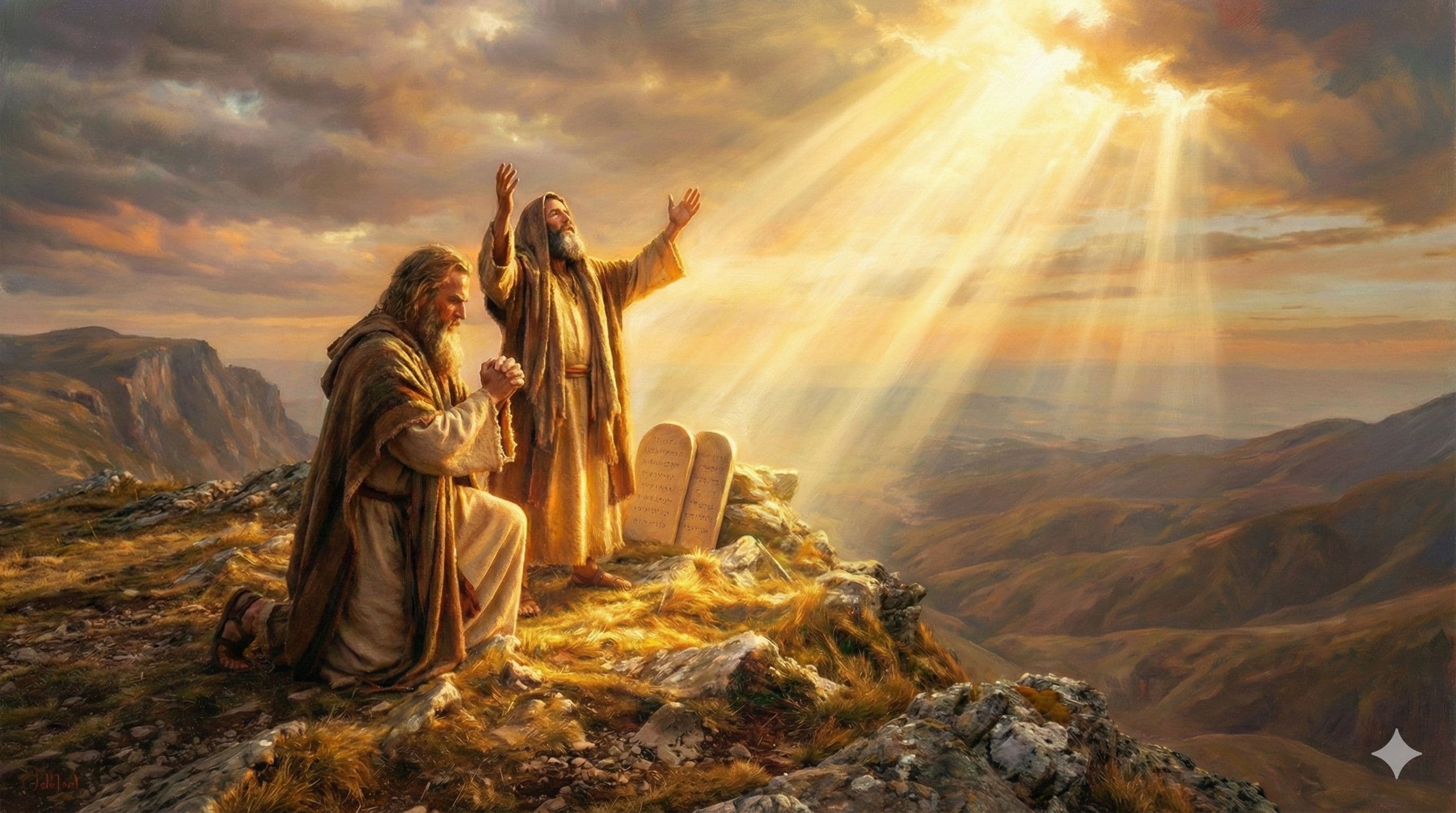
Abstract
In Moses 6–7, the name and role of a character called Mahijah/Mahujah line up remarkably well with a figure known as Mahaway in the Book of Giants.When Enoch began to fulfill his prophetic commission to preach to the people, “fear came on all them that heard him; for he walked with God. And there came a man unto him, whose name was Mahijah, and said unto him: Tell us plainly who thou art, and from whence thou comest?” (Moses 6:39–40). Although Mahijah appears only briefly in Joseph Smith’s account, his status as the only other named figure in the Enoch narrative suggests he held a position of significance in the full backstory.1
In the next chapter, Enoch declared, “As I was journeying, and stood upon the place Mahujah, and cried unto the Lord, there came a voice out of heaven, saying—Turn ye, and get ye upon the mount Simeon” (Moses 7:2). As formatted in the current (2013) edition, it appears that Mahujah is the name of a location. Yet in the original manuscript, known as Old Testament Revision 1 (OT1), a different interpretation arises. The text reads, “Enoch began to prophecy saying unto the people, that as I was journeying and stood in the place Mahujah and I cried unto the Lord there came a voice out of heaven saying turn ye and get ye upon the Mount Simeon.”2 Notice the significant change:
2013 Edition: “upon the place Mahujah, and cried unto the Lord”
OT1: “upon the place Mahujah and I cried unto the Lord”
The inclusion of “and I” in OT1 seems to require Mahujah to be understood as a personal name rather than a place name.3 Assuming the OT1 transcription is correct, it would strongly suggest that Mahujah is simply a variant of the name Mahijah which was mentioned earlier in Moses 6:40.4 In other words, both names would refer to the same individual.5
Similar Name Variants in Genesis 4:18
One might assume that the OT1 manuscript simply can’t be correct, since it would be unexpected for the same name to show up in two different forms in the same text. But that assumption is unreliable. One possibility is that Mahijah was deliberately changed to Mahujah, similar to how Abram was changed to Abraham in Genesis 17:5.6
However, the discrepancy might also result from the perpetuation of an ancient scribal error.7 This explanation is particularly enticing because analogous variants turn up in Genesis 4:18, where the name Mehujael is immediately followed by Mehijael in the underlying Hebrew of the Masoretic text.8 Although these biblical names aren’t precisely the same as Mahijah and Mahujah from the Book of Moses, the similarity in the underlying variants is still rather striking, suggesting that they may stem from a related ancient tradition.9
It also seems unlikely that Joseph Smith would have been aware of these differing name forms in Genesis 4:18. This is because the translators of the King James Bible opted to only use the name Mehujael in their rendering of this passage, effectively erasing the underlying variant. As explained by Jeffrey Bradshaw and David Larsen,
Because the KJV renders both variants identically, Joseph Smith would have had to access and interpret the Hebrew text to see both versions of the name. But there is no evidence that he or anyone else associated with the translation of Moses 6–7 knew how to read Hebrew or, for that matter, even had access to a Hebrew Bible. Joseph Smith did not begin his Hebrew studies until early 1836, after he engaged Joshua Seixas as a teacher in Kirtland, Ohio.10
For those seeking a non-miraculous explanation for this startling consistency in variants, it may be tempting to assume that Smith learned of them through some other source in his environment. Colby Townsend, for instance, has proposed that Smith derived the requisite knowledge by accessing a biblical commentary written by Adam Clarke, which contains a table of biblical names that show differences in the underlying Hebrew. The names Mehijael and Mehujael show up at the top of the list, with an explanation that both names show up together in Genesis 4:18.11
One significant challenge for this theory is that, contrary to the conclusions of some recent studies, there doesn’t appear to be any evidence that Smith had an intimate awareness of Clarke’s commentary in 1830, much less that he specifically drew upon it to aid his JST project.12 Yet even if Smith ever did stumble across Clarke’s table, it would make very little sense for him to latch on to these particular names and adapt them in the manner that he did.13
On a separate front, Townsend has suggested, based on his analysis of certain spelling and penmanship features in OT1, that the name Mahijah in Moses 6:40 may actually have been written as Mahujah. If that were the case, the naming variant would be eliminated, along with any proposed connection to antiquity that it may suggest.14 However, a close review of Townsend’s proposal shows that it also lacks supporting evidence. One can always speculate that any dictated name in Joseph Smith’s revelations was possibly misspelled by a scribe, but the original manuscript strongly favors the presence of Mahijah rather than Mahujah in Moses 6:40.15
The attempts to downplay or remove the presence of the Mahijah/Mahujah variant in the Book of Moses have therefore proven ineffectual. At the same time, the very fact that such efforts have been made at all suggests the parallel may indeed function as meaningful evidence supporting the text’s antiquity. If the resonance between Mahijah/Mahujah in the Book of Moses and Mehijael/Mehujael in the underlying variants of Genesis 4:18 didn’t constitute an unexpectedly validating parallel, there would be little need for those skeptical of Smith’s prophetic calling to seek out a plausible source of environmental derivation.
Parallels with Mahaway in the Book of Giants
There is, however, an even stronger case for the antiquity of these names in the Book of Moses. This comes from their close resemblance to Mahaway, a unique figure who appears in both the Aramaic and Manichean versions of the Book of Giants. Because these texts were unknown to modern scholars until the 20th century and because this particular figure isn’t present in any other extant Enochic traditions, it makes it very difficult to imagine that Smith derived this parallel from his 19th-century environment. What makes the correspondence especially persuasive is that the resemblance extends beyond the names themselves to the narrative role each figure fulfills. Hugh Nibley was the first Latter-day Saint scholar to recognize the significance of this parallel.16 Subsequent studies, most notably those by Jeffrey Bradshaw and various collaborators, have strengthened the case even further.17
The Narrative Role of Mahijah/Mahujah in the Book of Moses
When Enoch began to fulfill his prophetic commission to preach in the Book of Moses, the people declared, “there is a strange thing in the land; a wild man hath come among us. And it came to pass when they heard him, no man laid hands on him; for fear came on all them that heard him; for he walked with God” (Moses 6:38–39).18 The fact that these men might have “laid hands on” Enoch, if it hadn’t been for some type of divine protection that he received, suggests that their attitude toward him was adversarial.19 Yet something about Enoch or his message seems to have been quite intimidating to them.
As described by Bradshaw and Larsen, it is at this narrative juncture when “out of nowhere appears Mahijah, the only named character besides Enoch himself in Joseph Smith’s story of Enoch.”20 What did Mahijah do? He posed questions to Enoch on behalf of the people: “Tell us plainly who thou art, and from whence thou comest?” (Moses 6:40). He thus comes across as something of a designated spokesperson among Enoch’s fearful enemies.
After explaining his identity and origin, Enoch mentioned that “a book of remembrance we have written among us, according to the pattern given by the finger of God” (Moses 6:46). Based on various lines of evidence, this book not only seems to have contained genealogical information but also likely featured prophecies about the future.21 Right after this book is mentioned, the text reports that “the people trembled, and could not stand in [Enoch’s] presence” (Moses 6:47).22
In the next chapter, Mahujah (which, as noted previously, seems most likely to be a variant spelling of Mahijah) prayed with Enoch at some unspecified location or place, when a voice was heard out of heaven (Moses 7:2).23 This suggests that Mahijah/Mahujah attained some type of familiar or congenial relationship with Enoch.
The Narrative Role of Mahaway in the Book of Giants
The story of Mahaway in the Book of Giants has multiple parallels with this account. Most conspicuous is Mahaway’s role as an intermediary between Enoch and a violent group of giants.24 The narrative reports that some of the giants had disturbing dreams regarding the consequences of their violent crimes, and Mahaway was twice sent on a journey to Enoch on their behalf in order to obtain an oracular interpretation.25 As explained by Jen Wilkens, “Mahaway is the messenger par excellence of the giants both in the Enochic tradition from Qumran and in Manichaeism.”26
One also gets the sense that the giants were afraid of Enoch and his message. In the Manichean version, it is reported that some of the more wicked giants, when they encountered Enoch, were “[worried] and much afraid.”27 Likewise, in the Aramaic text, Enoch’s message, as mediated by Mahaway, caused his hearers to “tremble.”28 Another fragment mentions that the giants “prostrated and wept.” Although the context isn’t clear, several scholars have interpreted this as the giants “bowing and weeping before Enoch.”29
Interestingly, rather than just verbally telling Mahaway what to convey to the giants, Enoch instead recorded his message on two separate tablets. Thus, the giants’ fear and discomfort is also related to an inscribed record. Written texts also play a role in the dreams of the giants, as demonstrated in the following passage: “And behold, [ boo]ks were opened and judgment was spoken, and the judgment of [the Great One] was [wr]itten [in a book], and (it was) signed with a signature .[…] over every living being and flesh … Here is the end of the dream’ […] All the giants became afraid.”30 All these details echo the fear of Enoch’s listeners in Moses 6:38, as well as their “trembling” and inability to stand in Enoch’s presence in Moses 6:46–47 after the mention of a written record called the “book of remembrance.”
The Book of Giants also implies that Mahaway may have developed some type of close or personal relationship with Enoch through various interactions. The Aramaic text reads: “they called Mahaway, and he came to the as[sem]bly of[ the …] giants. And they sent him to Enoch, …] bw and said to him, ‘Go [to him …] . […] the place is familiar to you because you heard his voice the first time.’”31 Although difficult to decipher in its fragmentary form, this mention of a familiar “place” and hearing a “voice” is interesting, as it somewhat parallels Enoch’s interaction with Mahujah in OT1: “as I was journeying and stood in the place Mahujah and I cried unto the Lord, there came a voice out of heaven” (Moses 7:2). The Manichean version of the Book of Giants contains a similar complex of ideas:
[Mahaway said:] … Then, from heaven above came a voice. It called me and said: “You, son of Virōgdād, the order for you is exactly this: You [h]ave seen more than enough! Do not die prematurely now! Return quickly [from] here!” And then, besides this, I heard the voice of the apostle Enoch from the south. But I did no[t] see him in person. Then, very affectionately, he called out my name. And down from [heaven] (the voice) s[aid]: “[O son] of [Virōgdād], now … Ow[n] […] [small lacuna] [W]hy? The door of the enclosed [s]un will open up. The [sp]lendor and heat of the sun will descend. It will burn your wings; you will catch fire and die.” Then, at that time, upon hearing the voice I shook (or: beat) my wings and quickly descended fr[o]m heaven. Again I looked back. Dawn had [br]oken. The sun with its splendor was rising on the bluish mountain. And again from above came a voice. It conferred the words of the apostle Enoch. It said: “I call you, o son of Virōgdā[d], I know [th]is: you are [l]ike some of them.32
This imagery, in which Mahaway repeatedly hears a voice from heaven in connection to Enoch as part of some type of revelatory experience, again resonates well with Moses 7:2.33 Moreover, according to Wilkens, “It has to be underscored that Enoch’s voice calls out Mahaway’s name very affectionately in lines 12–13. One is tempted to postulate an emotional relationship between this particular giant and Enoch. The former obviously is not as corrupted as his fellows.”34 This characterization of Mahaway as having a favorable relationship with Enoch again fits the scene of Mahujah praying with Enoch when the voice from heaven was heard in Moses 7:2.
Thus, on multiple levels, the brief descriptions of Mahijah/Mahujah in the Book of Moses parallel the account of Mahaway in the Book of Giants. Both characters (1) sought out Enoch and presumably made a journey either with Enoch or to reach him, or perhaps both, (2) acted as intermediaries between Enoch and an adversarial group, (3) posed questions or made requests to Enoch, (4) were associated with a record that caused fear among Enoch’s enemies, (5) apparently developed a close or familiar relationship with Enoch, and (6) experienced a voice from heaven in connection with Enoch.
In addition to these fascinating parallels, Bradshaw has demonstrated that, as a whole, the Book of Giants shares a number of other significant—and, in several cases, unique—similarities with the Book of Moses when viewed in the broader context of Enochic studies. These involve not merely the contents of each text but also the sequence of the arrangement. After an extensive analysis, comparing the Book of Moses to not only the Book of Giants but also other Enochic works, Bradshaw explains,
Considering the relative brevity of [the Book of Giants], the number of currently identified thematic resemblances to Moses 6–7 is remarkable. Although the combined fragments of the Qumran [Book of Giants] scarcely fill three pages in the English translation of Florentino García Martínez, the results indicate that this single text contains eighteen, fully three-fifths, of the thirty proposed thematic resemblances of the combined ancient Enoch literature to the Book of Moses Enoch account. These resemblances range from general themes in the storyline to specific occurrences of rare terms or phrases in appropriate contexts.35
Some of the more notable and specific items of resemblance include the use of the distinctive term “wild man,”36 the mention of wild beasts (and very likely the “roaring” of these beasts) after a battle,37 and the inability of Enoch’s adversaries to harm a group of beings who dwelt in holy places or heavenly realms.38 In short, the similar roles and characteristics of Mahijah/Mahujah from the Book of Moses and from Mahaway in the Book of Giants must be seen as part of a larger cluster of parallels between these texts, several of which are, like the characters themselves, unique within the extant corpus of Enochic literature.
Parallel Names
As for the names of these characters, the actual degree of similarity can be difficult for lay readers to recognize. One concern, as noted by several scholars, is that when it comes to the name Mahaway in the Book of Giants, “the vowels in the English transliteration … are at present largely a matter of conjecture, since no vowels appear in the Aramaic text.”39 Another challenge is that “the English letters j, y, and i are variously used to represent the Semitic letter yod. Thus, in English translations of the Book of Giants, we see several variants of the same name: Mahaway (the most common), Mahawai, Mahway, and Mahuy—or, with the y transliterated with a j, as is frequently done with other names containing a yod in the King James Bible—Mahuj.”40
In its most basic transliterated form, the name Mahaway can be represented by the consonants MHWY (corresponding to the following Aramaic letters: mem–heh–waw–yod). Unfortunately, we don’t have the underlying text of the Book of Moses, so we can’t be sure what letters in ancient scripts are being represented by the English transliteration of its names. Nevertheless, if we assume an underlying Semitic script, it seems most likely that Mahijah represents either MHYY(H) or MḤYY(H) and that Mahujah represents either MHWY(H) or MḤWY(H).
One uncertainty in these proposed spellings comes from the fact that Semitic languages have two distinct H-sounds—represented by the letters heh (H) and ḥeth (Ḥ)—that are often collapsed into a single H in English transliterations. The first instance of the letter H in the names Mahijah and Mahujah could appropriately reflect either of these ancient Semitic letters (heh or ḥeth), but without access to the underlying text it is impossible to know which one is actually being represented.41
Another unknown involves the final H in each name. As explained by Bradshaw, Bowen, and Dahle,
The Book of Moses names terminate with an h in their English spellings. This makes them different from both the names in both Genesis 4:18 and in the Book of Giants. That said, it is impossible to know from the manuscript evidence alone whether the “-jah” termination of the Book of Moses names was meant to stand for the name of the God of Israel (Psalm 68:4), or if the h on the end of the English version of the name is present for some other reason. For example, given the prevalence of “-jah” terminations in Old Testament names (e.g., Elijah), it would not be surprising that an English-speaking scribe who heard the JST Genesis name pronounced during the dictation process would have written the name with an h at the end to make the spelling conform to this common naming convention.42
The important point here is that it is quite plausible that the name Mahujah—MHWY(H) or MḤWY(H)—from the Book of Moses could be a precise linguistic match with Mahaway—MHWY—from the Book of Giants. We can’t be certain, but the door is very much open for that possibility.43 The same equivalence doesn’t seem likely for the variant of Mahijah—MHYY(H) or MḤYY(H)—but this name is still very similar. Assuming that Mahijah and Mahujah are actually just variant names given to the same individuals in the Book of Moses (similar to Mehujael and Mehijael in Genesis 4:18), the distinction ultimately wouldn’t matter anyway. The plausibility of one of the two variants being a precise match with Mahaway in the Book of Giants is all that is logically needed.
Validating Precedents
Importantly, even if both of the names in the Book of Moses were to contain an Ḥ (which is different than the H in Mahaway) and even if both forms of the name were to have an additional H at the end, this outcome still wouldn’t invalidate a proposed linguistic connection. This is partly because the Semitic letters heh (H) and ḥeth (Ḥ) are both visually and audibly similar to one another, which has led to them occasionally being confused or conflated in both ancient and modern texts.44 This may be one of the reasons that scholars have been willing to countenance the possibility of Mahaway from the Book of Giants being related to Mehujael in Genesis 4:18, despite the difference of heh (H) vs. ḥeth (Ḥ) in their spellings.45
However, the truth is that scholars with linguistic training generally give a decent amount of latitude for names with similar sounds and spelling in ancient texts to share a historical relationship, even if the names don’t constitute a precise match.46 Crucially, when names with similar spellings turn up in similar stories or traditions and are assigned to characters who have similar identities or perform very similar narrative roles, the case for such names holding a non-random relationship becomes not only plausible but quite compelling. An example of this can be seen in an angel identified as Semyaz in 1 Enoch, but who is also called Semyaza or Sami’azaz in some of the variant manuscripts of this text.47 This is a chief among the Watchers, a group of angelic beings who entered into forbidden relations with mortal women and helped sire a race of violent giants. A similar angel, called Shemihazah, plays a parallel role in the Aramaic version of the Book of Giants, while the name shows up as Shahmīzād in the Manichean version of the same text.48 A version of the name is also featured in later medieval text known as the Midrash of Shemhazai and Azael.49 As explained by Annette Reed, in this work “Shemiḥazah and ʿAsael in Aramaic, reappear as Shemḥazai and ʿAzael in Hebrew, alongside many tropes and traditions known from the Book of Giants as well as Jubilees and the Book of the Watchers.”50
To be clear, these named characters and the texts that feature them are not precisely the same. Minor variations in spelling naturally occurred as the tradition was copied, borrowed, adapted, reinterpreted, or translated into different languages. Even within differing recensions of the same text, variant forms of the name sometimes crop up. The actual storylines themselves likewise have differences, some of them quite substantial.51 Nevertheless, the similarities in these characters—both in the spelling of their names and in their narrative roles and identities—are still so striking that there can hardly be any doubt that they are historically related and stem from a shared ancient tradition. This general line of reasoning is pervasive in pseudepigraphic studies, generally, and could be demonstrated for a number of different characters within Enochic traditions.
This is also essentially the same rationale that Latter-day Saint scholars are employing for the names of Mahijah and Mahujah in the Book of Moses. It isn’t merely that each name variant is similar to Mahaway from the Book of Giants, nor is it just that Mahujah could be a precise linguistic match with Mahaway. Rather, the compelling force of the argument lies in the fact that this viable linguistic match involves figures who share a number of parallel roles and characteristics, which are themselves embedded in parallel Enochic narratives set in a similar antediluvian context. This is the type of powerful convergence of onomastic and narrative data that should give anyone pause before they conclude the Book of Moses is a work of 19th-century fiction.
Explanatory Theories from Non-Latter-day Saint Scholars
Interestingly, this remarkable parallel has indeed caused some consternation for those who do not accept Joseph Smith’s revelatory claims. During his time as a doctoral student, Latter-day Saint scholar Gordon Thomasson was privileged to listen to a lecture from Matthew Black, an Aramaic scholar who helped pioneer research on the Book of Giants. At the end of the lecture, Thomasson had a discussion with Black and shared some of the parallels between the Book of Moses and Enochic traditions from the Qumran and Ethiopic sources. As told by Thomasson,
He [Black] became quiet. When I got to Mahujah (Moses 7:2), he raised his hand in a “please pause” gesture and was silent.
Finally, he acknowledged that the place-name of Mahujah could not have come from 1 Enoch. He then formulated a hypothesis, consistent with his lecture, that a member of one of the esoteric groups he had described previously must have survived into the nineteenth century, and hearing of Joseph Smith, must have brought the group’s Enoch texts to New York from Italy for the Prophet to translate and publish.52
Black later visited BYU and had several interactions with Hugh Nibley. By letter, Nibley had corresponded with Black before the visit and asked him about the Mahujah/Mahijah connection. However, when Black arrived, he was reticent to say anything about the matter. Only near the end of their time together did Black finally offer the following remark: “Well, someday we will find out the source that Joseph Smith used. Someday we’ll find it; we’ll find it, don’t worry.”53
Black’s response to the issue, as reported by two separate sources, is fascinating. On one hand, he seems to have taken the parallel quite seriously. He didn’t attempt to explain it away as a trivial coincidence or downplay the linguist resemblance. Instead, he apparently felt compelled, in his mind, to assume this detail was somehow derived from Smith’s 19th-century environment, despite the fact that no Enoch texts known to have been available at that time would have been helpful in this regard.
It should be pointed out that Black’s prediction that a non-revelatory source for this parallel would one day be found has yet to be fulfilled. As noted by Bradshaw, Dahle, and Bowen, “During the intervening years, no documentary evidence has surfaced that bears out Black’s unsupported hypothesis that Joseph Smith somehow obtained access to an Enoch manuscript like the Book of Giants from an esoteric religious group in Europe.”54 If anything, as time has gone on and as the historical record has become increasingly transparent through the mass digitization of modern and early modern texts, Black’s conjecture has become increasingly unlikely.
Perhaps this is why other scholars, such as Salvatore Cirillo, have not even attempted to trace this name to Joseph Smith’s immediate environment. Like Black, Cirillo does not dismiss the textual feature out of hand. In fact, in a Master’s Thesis which he completed at Durham University, he concedes that the close resemblance of these names combined with their parallel narrative roles may indeed constitute “a substantial similarity.”55 In Cirillo’s own words, “The emphasis that Smith places on Mahijah’s travel to Enoch is eerily similar to the account of Mahaway to Enoch in the [Book of Giants]. Like Mahijah, Mahaway travels to Enoch to ask him a question at which point the narrative shifts and Enoch responds in a vision or speech.”56
Instead of speculating about some unknown group conveying an unknown Enoch text to Smith (as Black did), Cirillo instead implies that Smith derived the narrative role of Mahijah from 1 Enoch, where both Methuselah and Noah (Enoch’s son and great grandson) made somewhat analogous journeys to ask Enoch a question.57 However, much like Black’s conjecture, Cirillo’s thesis has minimal explanatory power.
The first concern is that he takes it for granted that Smith had access to 1 Enoch and specifically to the portions of 1 Enoch that relay these journeys. Not only is that supposition unproven, but it seems historically unlikely.58 Cirillo also fails to recognize that, when it comes to narrative roles, the match between Mahijah/Mahujah in the Book of Moses and Mahaway in the Book of Giants is stronger than the parallels derived from the accounts of Methuselah or Noah in 1 Enoch.59
Most importantly, even if Smith had access to the specific portions of 1 Enoch containing the journeys of Methuselah and Noah, it would still require an enormous stroke of luck for him to settle upon the names of Mahijah and Mahujah, and then to place these names in a narrative context that fits Mahaway’s role in the Book of Giants better than either Methuselah or Noah do from 1 Enoch, and then also to fabricate a number of other remarkable—and in some instances unique—parallels with the Book of Giants in the surrounding narrative.60 Thus, the theories of both Black and Cirillo have to appeal to multiple layers of coincidence and improbable assumptions in order to explain this textual feature.
Yamahuel
It has long been assumed that the only analog to Mahijah/Mahujah in the Book of Moses is Mahaway from the Book of Giants. However, in recent years, another potentially relevant figure, known as Yamahuel, has been identified in an Islamic Enochic source called Pseudo-Masʿūdī.61 In it, Yamahuel is a king among the enemies of Enoch (who is known as Idris in Islamic texts). When a Satan figure called Iblis comes among the people, Yamahuel interrogates him. The relevant passages are given below, followed by an analysis of potential parallels with the Book of Moses and Book of Giants.
It is said that at the time when Idrīs (upon whom be peace!) was born, the grip of idol-worship had weakened among the descendants of Cain, and one of the more esteemed of their idols—those to which they offered worship and to which they were addicted and would make sacrifices—collapsed. At that time their king was Yamaḥuel. So they assembled themselves before him in order to confer with him about what had happened. Iblīs (i.e., Satan) came among them in the form of an old man who had an abundance of white hair. Now white hair among them was a marvelous thing: they had never seen it before, because white hair did not exist before this (time) and would not appear among them until after Noah (upon whom be peace!) and after the Flood. It is said that the first to have white hair was Abraham (upon whom be peace!). He (i.e., the king) then said: “O Lord! What is this?!?” He (Iblīs) answered: “(White hair is) a marker of dignity.” He (the king) responded: “O God! Increase my dignity!”
(Others) say that Iblīs came to them (the idolatrous descendants of Cain) in the shape of a spiritual entity with two wings. He told their king Yamaḥuel that Mahalalel (sic!) had fathered a child who was going to foment opposition to divinity and to kingship, and that he would cause their corruption, (this being the meaning) “of (the collapse of) that idol of yours about which you are concerned.” Then Yamaḥuel said: “Can you bring about his demise?” He (Iblīs) answered: “I will endeavor to do so.” But God assigned for Idrīs angels to protect him, and when Iblīs and some of those who were with him from his forces came (to do Idrīs harm), they kept them from harming him. … His father put him unharmed in the temple, and he taught him the writings.62
At first glance, this Yamahuel may look like he has little to do with Mahijah/Mahujah from the Book of Moses or from Mahaway from the Book of Giants. But a deeper analysis will reveal a number of interesting points of resemblance.
The first matter to consider is the form of the name. John Reeves and Annette Reed provide the following explanation in a footnote when Yamahuel is first introduced into the narrative: “Printed edition reads يمحويل. Manuscript variants are محويل and مخويل. The figure intended seems to be Meḥuyael (מחויאל) b. ‘Irad from the Cainite genealogy in Gen 4:18.”63 This emphasizes the point, made previously, that scholars are generally willing to assume relationships between names despite minor variations in form. The fact that the authors view Yamahuel as likely relating to Mehujael from Genesis 4:18 is significant, since scholars have likewise suggested that Mahijah/Mahujah from the Book of Moses and Mahaway from the Book of Giants may be different forms of this same biblical name. This reinforces the point, made earlier, that minor variations in names do not preclude historical relationships.
As far as narrative roles are concerned, there are both significant differences as well as intriguing similarities. One major difference is that Yamahuel in the Islamic account doesn’t directly interact with Enoch, at least not in the portion of the narrative preserved in this account. Another difference is that, compared to Mahijah/Mahujah and Mahaway, Yamahuel seems to be quite antagonistic toward Enoch, even seeking for a way to destroy him. This contrasts with the less hostile, and perhaps even affectionate, interactions between Enoch and Mahijah/Mahujah in the Book of Moses and between Enoch and Mahaway in the Book of Giants.
On the other hand, there are a number of notable parallels to consider among these accounts, some of which specifically involve the main figures under examination (Yamahuel, Mahijah/Mahujah, and Mahaway) while others have to do with the surrounding narrative contexts:
- Each figure (Yamahuel, Mahijah/Mahujah, and Mahaway) is associated with a wicked group that is adversarial toward Enoch.
- Each figure (Yamahuel, Mahijah/Mahujah, and Mahaway) seems to be a prominent figure or spokesperson among Enoch’s enemies.
- Each figure (Yamahuel, Mahijah/Mahujah, and Mahaway) is primarily portrayed as asking questions.64
- In the Book of Moses and Pseudo-Masʿūdī, a Satan figure comes among men, presenting himself as a being worthy of admiration or worship.65
- In the Book of Moses and Pseudo-Masʿūdī, Enoch’s enemies are unable to harm him, due to his divine protection. This element is also echoed by the giants’ inability to harm a group of otherworldly beings in the Book of Giants.66
- In the Book of Moses and Pseudo-Masʿūdī, it is stated that Enoch received righteous instruction from his father.67
- In the Book of Moses and Pseudo-Masʿūdī, emphasis is given on righteous figures learning to write in the context of parental instruction.
As can be seen, there seems to be more going on here than just a similarity of names. Instead, each character has a similar identity and functions in a similar way in narratives with several non-generic parallels. This isn’t to suggest that the stories are identical. They obviously aren’t, and the differences shouldn’t be overlooked. But neither should the similarities. In this type of context—where the details about these figures in each account are either brief or highly fragmentary and where one would expect differences to arise over time as stories are adapted in different contexts—parallels would seem to count more than differences.68
What can be said with confidence is that there is now another known figure with a name similar to Mahijah/Mahujah from the Book of Moses that plays a notable role in an extant Enochic tradition. While this character’s name and role is not quite as similar to Mahijah/Mahujah as Mahaway is from the Book of Giants, he is still a prominent leader among Enoch’s adversaries and his primary role is still to ask questions. When the other contextual parallels are included as part of the analysis, the case for the character in this account being part of a shared tradition becomes even stronger. As explained by Jeffrey Bradshaw and Ryan Dahle, this appears to be an instance where a later medieval text “may corroborate or provide additional details about Enoch traditions in more ancient accounts.”69
Conclusion
Multiple lines of evidence support the antiquity of the name and role of Mahijah/Mahujah in the Book of Moses. The first supporting data comes from the way that these name variants resemble Mehijael and Mehujael in the underlying Hebrew of Genesis 4:18. Since Joseph Smith didn’t know Hebrew and was unlikely to have derived this information from secondary sources (such as Adam Clarke’s Bible commentary), these variants point towards a shared ancient tradition.
On the other hand, it must be recognized that genuine ancient names often undergo minor alterations as they get copied or adapted into different languages and traditions. In this case, both Mahijah and Mahujah in the Book of Moses drop the “-el” ending found in the Masoretic version of the names, resulting in a form of the name (especially the Mahujah variant) that is consistent with Mahaway from the Book of Giants. When this similarity in names is viewed in conjunction with parallels pertaining to each character’s role and the broader narrative settings of these stories, the evidence for a genuine historical relationship becomes quite compelling. Mahijah/Mahujah and Mahaway both functioned as intermediaries between Enoch and a group of adversaries, set in a context of antediluvian wickedness and violence. Moreover, both figures apparently became close with Enoch and had a revelatory experience with him, involving hearing a voice from heaven at a certain location. When viewed collectively, these and other parallels form an impressive convergence of data that is difficult for naturalistic theories to explain.70
It should be emphasized that no Enochic text known to exist in Joseph Smith’s environment would have provided a plausible source of derivation for these details. Neither the Aramaic nor the Manichean versions of the Book of Giants were available to Western scholars until the 20th century, many decades after the Book of Moses was translated.71 And while the account of Yamahuel in Pseudo-Masʿūdī provides an analog for how the name and role of this character could have been adapted over time, it has comparatively weaker parallels. Moreover, much like the versions of the Book of Giants, such an obscure Islamic source almost certainly wouldn’t have been available to Smith in English in 1830.
This situation has left those skeptical of Smith’s prophetic calling without a plausible alternative explanation. Cirillo’s thesis that Smith extrapolated the relevant details from somewhat analogous accounts in 1 Enoch and then somehow guessed the names of Mahijah/Mahujah out of the blue is far from adequate. Aside from not addressing the considerable luck that would still be needed for Smith to use these particular names in this context, Cirillo’s theory fails to explain the additional and superior parallels between Smith’s account and the Book of Giants. It also rests on the highly questionable assumption that Smith had access, in the first place, to the relevant portions of 1 Enoch.
Black’s thesis, although it better accounts for why Smith may have used the names Mahijah and Mahujah in his Enoch text, may be even more difficult to believe. It is impossible to disprove that an unknown esoteric group secretly transmitted arcane Enochic information to Joseph Smith, but Black failed to account for just how extraordinarily fortuitous such a scenario would be. What are the chances (1) that Smith would happen upon a group that possessed genuinely ancient information about Mahijah/Mahujah that nearly a century later would help validate his made-up Enoch story, (2) that this group would be willing to share this specific information with him, (3) that they would never publish the source themselves or draw attention to its details in any public way, (4) that they would never reveal their relation to Smith, (5) that neither Smith nor any of his associates would ever provide any hint that such a group ever interacted with him, and (6) that Smith would never in his lifetime draw attention to the genuine antiquity of these details, which he presumably would have included in the first place to make his text more believable? It is rather telling when a prominent Enoch scholar, in order to explain this feature of the Book of Moses, has to invoke an unknown esoteric group who for unknown reasons provided an unknown Enochic source to Joseph Smith and then disappeared without a trace. As the improbable assumptions multiply, the theory becomes increasingly untenable.72
Overall, the combined name and role of Mahijah/Mahujah in the Book of Moses may be the single most impressive item of evidence favoring the text’s antiquity. While it may not provide definitive proof of Joseph Smith’s prophetic calling, it comes very close to a “smoking gun” type of confirmation of his revelatory claims. This is especially true when this extraordinary parallel is viewed alongside many dozens of other resemblances between the Book of Moses and extant Enochic traditions, both generally and within the Book of Giants in particular.
Jeffrey M. Bradshaw, Enoch and the Gathering of Zion: The Witness of Ancient Texts for Modern Scripture (Interpreter Foundation, with Scripture Central and Eborn Books, 2021), 64–65, 87–93.
Jeffrey M. Bradshaw, “Moses 6–7 and the Book of Giants: Remarkable Witnesses of Enoch’s Ministry,” Interpreter: A Journal of Latter-day Saint Faith and Scholarship 48 (2021): 95–312.
Jeffrey M. Bradshaw, Matthew L. Bowen, and Ryan Dahle, “Textual Criticism and the Book of Moses: A Response to Colby Townsend’s ‘Returning to the Sources,’ Part 1 of 2,” Interpreter: A Journal of Latter-day Saint Faith and Scholarship 40 (2020): 99–162.
Jeffrey M. Bradshaw, Matthew L. Bowen, and Ryan Dahle, “Where Did the Names Mahaway and Mahujah Come From? A Response to Colby Townsend’s ‘Returning to the Sources,’ Part 2 of 2,” Interpreter: A Journal of Latter-day Saint Faith and Scholarship 40 (2020): 181–242.
Jeffrey M. Bradshaw and Ryan Dahle, “Could Joseph Smith Have Drawn on Ancient Manuscripts When He Translated the Story of Enoch?: Recent Updates on a Persistent Question,” Interpreter: A Journal of Latter-day Saint Faith and Scholarship 33 (2019): 315–320.
Gordon C. Thomasson, “Matthew Black and Mircea Eliade Meet Hugh Nibley,” Interpreter: A Journal of Latter-day Saint Faith and Scholarship 45 (2021): 71–80.
Jeffrey M. Bradshaw and David J. Larsen, In God’s Image and Likeness 2: Enoch, Noah, and the Tower of Babel (The Interpreter Foundation and Eborn Books, 2014), 42–49, 69, 72, 90, 94–96, 127–130.
Hugh Nibley, Enoch the Prophet, The Collected Works of Hugh Nibley, Volume 2 (FARMS, 1986), 276–281.
Moses 6:40
Moses 7:2
- 1. See Moses 6:26–7:69. While other figures, such as Adam and Satan, are named in this account, Enoch and Mahijah/Mahujah are the only characters who actively play a role in the immediate narrative.
- 2. Old Testament Revision 1, p. 15, The Joseph Smith Papers, accessed November 24, 2025; bracketed text silently omitted.
- 3. The original passage could be interpreted in at least two different ways. OT1 Reading #1: “As I was journeying and stood in the place [that] Mahujah and I cried unto the Lord, there came a voice out of heaven saying turn ye and get ye upon the Mount Simeon.” OT1 Reading #2: “As I was journeying and stood in the place, Mahujah and I cried unto the Lord. There came a voice out of heaven, saying—Turn ye, and get ye upon the mount Simeon.” Under the first reading, “Mahijah and I” become part of a relative clause describing which place Enoch was standing. In such constructions, the relative pronoun that is sometimes omitted in standard English phrasing. It could be compared to everyday statements such as “I went to the place [that] Bill and I like to fish” or “I found the place [that] Sally and I first met”—with the omitted “that” being placed in brackets. In contrast, under the second reading, “Mahujah and I” form a compound subject. Although strictly possible, this reading is rather odd because it creates some syntactic choppiness while also treating the generic term “place” as a stand-alone location of significance without an antecedent. Nevertheless, there are reasons this reading could be valid. See Jeffrey M. Bradshaw, Enoch and the Gathering of Zion: The Witness of Ancient Texts for Modern Scripture (Interpreter Foundation, with Scripture Central and Eborn Books, 2021), 91–92. The issue of whether Mahujah should be interpreted as a name or a place is discussed at length in Salvatore Cirillo, “Joseph Smith, Mormonism, and Enochic Tradition” (Master’s Thesis, Durham University, 2010), 97–103.
- 4. For reasons to sometimes privilege readings in OT1 over later edits or changes, see Jeffrey M. Bradshaw, Matthew L. Bowen, and Ryan Dahle, “Textual Criticism and the Book of Moses: A Response to Colby Townsend’s ‘Returning to the Sources,’ Part 1 of 2,” Interpreter: A Journal of Latter-day Saint Faith and Scholarship 40 (2020): 120–122. This line of reasoning parallels the scholarly rationale for often privileging the original manuscript of the Book of Mormon over later versions of the text.
- 5. Even if Mahujah were the name of place, it would seem more than coincidental that the place name would correspond so closely to the personal name mentioned earlier, as aside from Enoch this is the only other named character in these chapters.
- 6. For more on this possibility, see Bradshaw, Enoch and the Gathering of Zion, 92–93.
- 7. Such a scribal error is entirely plausible and could have occurred on more than one occasion in antiquity. At least in standard forms of Hebrew, the only difference in the variant names is that the character transliterated as “u” is a vav and the character transliterated as “i” is a yod. The two Hebrew letters are nearly identical in shape, except that the yod has a slightly shorter tail (compare מְחוּיָאֵל vs. מְחִיּיָאֵל). So, the scribe may very well have intended to write the longer vav for Mehujael both times but just didn’t drag his pen down enough in one instance, making it look like Mehijael (or vice versa). In turn, later scribes may not have been entirely certain which version was correct, so both variants might get intentionally perpetuated to transparently preserve the ambiguity. It seems unlikely Joseph Smith would have known that these specific Hebrew letters were commonly confused by ancient scribes.
- 8. The way these names turn up so close together leaves no doubt that the variant spellings refer to the same individual. See Jeffrey M. Bradshaw and David J. Larsen, In God’s Image and Likeness 2: Enoch, Noah, and the Tower of Babel (The Interpreter Foundation and Eborn Books, 2014), 95.
- 9. For an in-depth treatment of the resemblance of these names, see Jeffrey M. Bradshaw, Matthew L. Bowen, and Ryan Dahle, “Where Did the Names Mahaway and Mahujah Come From? A Response to Colby Townsend’s ‘Returning to the Sources,’ Part 2 of 2,” Interpreter: A Journal of Latter-day Saint Faith and Scholarship 40 (2020): 207–211.
- 10. Bradshaw and Larsen, In God’s Image and Likeness 2, 43–44.
- 11. See Colby Townsend, “Returning to the Sources: Integrating Textual Criticism in the Study of Early Mormon Texts and History,” Intermountain West Journal of Religious Studies 10, no. 1 (2019): 83–84.
- 12. For publications attempting to establish that Joseph Smith utilized Clarke’s writings, see Thomas A. Wayment and Haley Wilson-Lemmón, “A Recovered Resource: The Use of Adam Clarke’s Bible Commentary in Joseph Smith’s Bible Translation,” Journal of Mormon History 45, no. 3 (July 2019): 1–32; Colby Townsend, “Early Nineteenth-Century Biblical Scholarship and the Production of The Book of Mormon,” Journal of the Bible and its Reception 12, no. 1 (2025): 57–84. For reviews strongly pushing back against these claims, see Kent P. Jackson, “Some Notes on Joseph Smith and Adam Clarke,” Interpreter: A Journal of Latter-day Saint Faith and Scholarship 40 (2020): 15–60; Kent P. Jackson, “Adam Clark and Isaiah in the Book of Mormon,” Interpreter: A Journal of Latter-day Saint Faith and Scholarship 66 (2025): 131–150.
- 13. If Smith wanted to use Clarke as an authoritative scholarly source to bolster the case for the realism and historical believability of his fictional work, why would he pick out these particular name variants from Clarke’s commentary but then drop the “-el” suffix? That would be like taking one step forward (making one name comply with an underlying Hebrew variant) and then taking two steps backward (making both names omit a suffix that appears to be present in the underlying Hebrew). Perhaps even more telling is the fact that Moses 5:43—the verse that directly corresponds to Genesis 4:18, where the names were derived from in Clarke’s chart—happens to not contain the variant that Clarke identified. Instead, the names are rendered in the OT1 version of Moses 5:43 as Mehujael and Mahujael. See Old Testament Revision 1, p. 10, The Joseph Smith Papers, accessed December 2, 2025. Thus, on multiple levels, the proposal that Smith was borrowing these particular names from this particular table seems unconvincing. For further reasoning along these lines, see Bradshaw, Bowen, and Dahle, “Where Did the Names Mahaway and Mahujah Come From? A Response to Colby Townsend’s ‘Returning to the Sources,’ Part 2 of 2,” 203–207.
- 14. The variant would be eliminated because the name would be uniformly rendered as Mahujah in both Moses 6:40 as well as Moses 7:2.
- 15. See Bradshaw, Bowen, and Dahle, “Textual Criticism and the Book of Moses: A Response to Colby Townsend’s ‘Returning to the Sources,’ Part 1 of 2,” 122–131. It should also be noted that scribes are unlikely to confuse the sound of an “i” in Mahijah and the sound of the “u” in Mahujah. These vowels, as they are situated in these names, represent distinctly different sounds in English.
- 16. See Hugh Nibley, Enoch the Prophet, The Collected Works of Hugh Nibley, Volume 2 (FARMS, 1986), 276–281.
- 17. See, for example, Jeffrey M. Bradshaw, “Moses 6–7 and the Book of Giants: Remarkable Witnesses of Enoch’s Ministry,” Interpreter: A Journal of Latter-day Saint Faith and Scholarship 48 (2021): 95–312; Bradshaw, Enoch and the Gathering of Zion, 64–65, 87–93; Bradshaw, Bowen, and Dahle, “Where Did the Names Mahaway and Mahujah Come From? A Response to Colby Townsend’s ‘Returning to the Sources,’ Part 2 of 2,” 181–242; Bradshaw, Bowen, and Dahle, “Textual Criticism and the Book of Moses: A Response to Colby Townsend’s ‘Returning to the Sources,’ Part 1 of 2,” 99–162; Jeffrey M. Bradshaw and Ryan Dahle, “Could Joseph Smith Have Drawn on Ancient Manuscripts When He Translated the Story of Enoch?: Recent Updates on a Persistent Question,” Interpreter: A Journal of Latter-day Saint Faith and Scholarship 33 (2019): 315–320.
- 18. See Scripture Central, “Book of Moses Evidence: Enoch’s Prophetic Commission,” Evidence 485 (March 12, 2025); Scripture Central, “Book of Moses Evidence: Enoch the ‘Wild Man’,” Evidence 516 (October 15, 2025); Scripture Central, “Book of Moses Evidence: Enoch Stood Before God’s Face,” Evidence 519 (November 5, 2025).
- 19. See Scripture Central, “Book of Moses Evidence: Enoch’s Divine Comfort and Protection,” Evidence 520 (November 21, 2025).
- 20. Bradshaw and Larsen, In God’s Image and Likeness 2, 42.
- 21. See Moses 6:5–8: “a book of remembrance was kept, in the which was recorded, in the language of Adam, for it was given unto as many as called upon God to write by the spirit of inspiration; And by them their children were taught to read and write, having a language which was pure and undefiled. Now this same Priesthood, which was in the beginning, shall be in the end of the world also. Now this prophecy Adam spake, as he was moved upon by the Holy Ghost, and a genealogy was kept of the children of God.” When read in context, it seems significant that Adam’s inspired prophecy of the future is embedded within this discussion of recordkeeping, suggesting perhaps that they are connected in some manner. This proposal is significantly bolstered when the Book of Moses is viewed in conjunction with other Enoch traditions regarding Adam’s prophecies of the future and his reception of a record from heaven that told of future events. See Scripture Central, “Book of Moses Evidence: Adam’s Prophecy,” Evidence 508 (August 20, 2025).
- 22. Precisely what portion of his speech made the audience afraid is never specified, but the immediate context suggests it may have had something to do with what was contained in the written record itself.
- 23. This is relying on the reading in OT1 mentioned previously.
- 24. On this point, see Bradshaw, Enoch and the Gathering of Zion, 6: “One potential point of confusion that should [be] cleared up here is that the main characters in the Book of Giants are not really giants. The word in the title that is translated as ‘giants’ is gibborim, a term that is better understood as meaning ‘mighty heroes’ or ‘warriors.’ … Why is this important? Because it means that [the Book of Giants], like the Book of Moses, is mainly concerned with Enoch’s dealings with wicked people—the all-too-human gibborim.”
- 25. See Loren T. Stuckenbruck, “The Aramaic Book of Giants,” in Old Testament Pseudepigrapha: More Noncanonical Scriptures, vol. 2, ed. James R. Davila and Richard Bauckham (William B. Eerdmans, 2025), 62–63.
- 26. Jen Wilkens, “Remarks on the Manichaean Book of Giants,” in Ancient Tales of Giants from Qumran and Turfan: Contexts, Traditions, and Influences, ed. Matthew Goff, Loren T. Stuckenbruck, and Enrico Morano (Mohr Siebeck, 2016), 227.
- 27. Loren T. Stuckenbruck, The Book of Giants from Qumran (Mohr Siebeck, 1997), 109.
- 28. Stuckenbruck, The Book of Giants from Qumran, 197. Stuckenbruck explains: “The conversation between ’Ohyah and Mahaway may be reconstructed on the basis of 6Q8 1 as follows: After Mahaway has delivered a message (a dream vision or dream interpretation?) to ’Ohyah (or before all the giants?), ’Ohyah responds by declaring rhetorically that the message leaves them no choice but to be afraid (1.3). … Hence it is likely that 6Q8 1 preserves an account of a growing conflict between Mahaway who, on the one hand, has received and mediated a piece of divine communication and ’Ohyah who, on the other hand, feels threatened by the substance of what the message contains.”
- 29. Stuckenbruck, The Book of Giants from Qumran, 75. This interpretation is based on parallels with the Manichean version of the Book of Giants. It also dovetails nicely with the account in 1 Enoch, in which Enoch’s adversaries, after hearing his message, “were all frightened, and fear and trembling seized them” (1 Enoch 13:3). Translation by E. Isaac, “1 (Ethiopic Apocalypse of) Enoch,” in The Old Testament Pseudepigrapha, 2 vols., ed. James H. Charlesworth (Doubleday, 1983–1985), 19. A somewhat related idea turns up in a later Jewish text known as the Midrash of Shemhazai and Azael: “At the time that the decision for the coming of the Deluge into the world was reached, the Holy One, blessed be He, dispatched Metatron [Enoch in his angelic form] as a messenger to Shemhazai. He reported to him: ‘The Holy One, blessed be He, is planning to destroy the world.’ Shemhazai arose and loudly wept and lamented, and grieved for the world and for his sons.” This translation is provided by John Reeves as part of the course material for one of his classes. For further interaction with this work, see John C. Reeves, Jewish Lore in Manichaean Cosmogony: Studies in the Book of Giants Traditions (Hebrew Union College Press, 1992), 84–88. It should be noted, however, that despite these supporting parallels, Stuckenbruck disagrees with the interpretation of Enoch’s enemies directly bowing before him in the Aramaic Book of Giants, based on what he sees as insufficient evidence that Enoch ever directly encountered the giants in this version of the story (see p. 76). Considering the highly fragmentary nature of the text, however, it is impossible to determine at this point which reading is correct.
- 30. Stuckenbruck, “The Aramaic Book of Giants,” 81.
- 31. Stuckenbruck, “The Aramaic Book of Giants,” 76.
- 32. Wilkens, “Remarks on the Manichaean Book of Giants,” 227–228.
- 33. This isn’t to suggest that the parallel is precise. In the Book of Moses, Enoch and Mahijah/Mahujah jointly heard a voice from heaven (Moses 7:2), whereas in the Manichean Book of Giants the source of the voice seems to be both from Enoch and another heavenly entity. Nevertheless, there is enough commonality to suspect a shared tradition may be at play.
- 34. Wilkens, “Remarks on the Manichaean Book of Giants,” 226–227.
- 35. Jeffrey M. Bradshaw, “Moses 6–7 and the Book of Giants: Remarkable Witnesses of Enoch’s Ministry,” Interpreter: A Journal of Latter-day Saint Faith and Scholarship 48 (2021): 200–201.
- 36. See Scripture Central, “Book of Moses Evidence: Enoch the ‘Wild Man’,” Evidence 516 (October 15, 2025).
- 37. See Scripture Central, “Book of Moses Evidence: The Roar of Lions,” Evidence 517 (October 22, 2025).
- 38. See Scripture Central, “Book of Moses Evidence: Enoch’s Divine Comfort and Protection,” Evidence 520 (November 21, 2025).
- 39. Bradshaw, Bowen, and Dahle, “Where Did the Names Mahaway and Mahujah Come From? A Response to Colby Townsend’s ‘Returning to the Sources,’ Part 2 of 2,” 186.
- 40. Bradshaw, Bowen, and Dahle, “Where Did the Names Mahaway and Mahujah Come From? A Response to Colby Townsend’s ‘Returning to the Sources,’ Part 2 of 2,” 186.
- 41. This paragraph closely follows the explanation provided in Bradshaw, Bowen, and Dahle, “Where Did the Names Mahaway and Mahujah Come From? A Response to Colby Townsend’s ‘Returning to the Sources,’ Part 2 of 2,” 186.
- 42. Bradshaw, Bowen, and Dahle, “Where Did the Names Mahaway and Mahujah Come From? A Response to Colby Townsend’s ‘Returning to the Sources,’ Part 2 of 2,” 210.
- 43. See Bradshaw, Bowen, and Dahle, “Where Did the Names Mahaway and Mahujah Come From? A Response to Colby Townsend’s ‘Returning to the Sources,’ Part 2 of 2,” 207–211.
- 44. See Bradshaw, Bowen, and Dahle, “Where Did the Names Mahaway and Mahujah Come From? A Response to Colby Townsend’s ‘Returning to the Sources,’ Part 2 of 2,” 188–190.
- 45. See Józef Tadeusz Milik and Matthew Black, eds., The Books of Enoch: Aramaic Fragments from Qumran Cave 4 (Clarendon Press, 1976), which argues that the name Mahawai is “perhaps transformed, Gen. 4:18, into mḥwy’l, son of ‘Irad.”
- 46. When addressing this concern specifically in relation to the names of Mahijah and Mahujah, David Calabro writes, “Very often in pseudepigraphal traditions, you get names that sound similar (or sometimes not even similar), just garbled a bit. It’s frequent in Arabic forms of biblical names: Ibrahim for ‘Abraham’ (perhaps influenced by Elohim or some other plural Hebrew noun), Isa for Yasu ‘Jesus,’ etc. So Mahujah, Mahijah, Mehujael/ Mehijael, and [Mahaway] could all be connected, with something getting mixed up in transmission.” See Bradshaw, Bowen, and Dahle, “Where Did the Names Mahaway and Mahujah Come From? A Response to Colby Townsend’s ‘Returning to the Sources,’ Part 2 of 2,” 219; note that this quotation comes from a personal communication between Calabro and the authors of the study.
- 47. See Isaac, “1 (Ethiopic Apocalypse of) Enoch,” 15. For the variant spellings, see footnotes 6a and 6m.
- 48. See Stuckenbruck, “The Aramaic Book of Giants,” 74, Prods Oktor Skjaervo, “The Book of Giants (Iranian Manichean Version),” in Old Testament Pseudepigrapha: More Noncanonical Scriptures, vol. 2, 141.
- 49. See John C. Reeves, Jewish Lore in Manichaean Cosmogony: Studies in the Book of Giants Traditions (Hebrew Union College Press, 1992), 84–88, 143n.167. For convenience, Reeves has provided an English translation of the Midrash of Shemhazai and Azael as a resources for one of his courses. For further discussion of this text and its connections with earlier Enochic traditions, see Ken M. Penner, “Did the Midrash of Shemhazai and Azael Use the Book of Giants?” in Sacra Scriptura: How “Non-Canonical” Texts Functioned in Early Judaism and Early Christianity, ed. James H. Charlesworth, Lee Martin McDonald, and Blake Jurgens (T&T Clark, 2014), 15–45; For more on the myth of Shemihazah, generally, see George W. E. Nickelsburg and James C. VanderKam, 1 Enoch 1: A Commentary on the Book of 1 Enoch Chapters 1–36, ed. Klaus Baltzer (Fortress Press, 2012), 165–172.
- 50. Annette Yoshiko Reed, “Fallen Angels and the Afterlives of Enochic Traditions in Early Islam,” 1st Nangeroni Meeting of the Early Islamic Studies Seminar (June 15–19, 2015), 10. One can also see this name surface in Targum Jonathan Genesis 6:4: “Schamchazai and Uzziel, who fell from heaven, were on the earth in those days; and also, after the sons of the Great had gone in with the daughters of men, they bare to them: and these are they who are called men who are of the world, men of names.” J. W. Etheridge, trans., The Targums of Onkelos and Jonathan ben Uzziel on the Pentateuch (London: Longman, Green, Longman, and Roberts, 1862), 177.
- 51. See, for example, Bradshaw, “Moses 6–7 and the Book of Giants,” 115: “In contrast to the small role given them in [the Book of Giants], these two characters [Shemiḥazah and Baraq’el] are well represented in 1 Enoch.”
- 52. Gordon C. Thomasson, “Matthew Black and Mircea Eliade Meet Hugh Nibley,” Interpreter: A Journal of Latter-day Saint Faith and Scholarship 45 (2021): 74. Note that this event occurred long before the relatively recent discovery that Mahujah is likely just a variant of the personal name Mahijah, rather than a place name.
- 53. Hugh Nibley, Teachings of the Pearl of Great Price (FARMS, 2004), lecture 21.
- 54. Bradshaw, Bowen, and Dahle, “Where Did the Names Mahaway and Mahujah Come From? A Response to Colby Townsend’s ‘Returning to the Sources,’ Part 2 of 2,” 212.
- 55. Cirillo, “Joseph Smith, Mormonism, and Enochic Tradition,” 104.
- 56. Cirillo, “Joseph Smith, Mormonism, and Enochic Tradition,” 105. It should be noted, however, that Cirillo is somewhat misrepresenting the Book of Moses in these statements. In Mahijah’s first recorded encounter with Enoch, the text merely says that “there came a man unto him, whose name was Mahijah” (Moses 6:40). Although we can infer that a journey must have been made, nothing about the journey itself is particularly emphasized (as Cirillo claimed). In the next chapter, a journey is mentioned again, but it isn’t specifically the journey of Mahujah. Instead, Enoch reported: “As I was journeying and stood in the place, Mahujah and I cried unto the Lord” (Moses 7:2). It therefore isn’t clear if Mahujah journeyed with Enoch or if Enoch journeyed and met Mahujah at a specific location. Either way, this wouldn’t constitute Mahujah undertaking a journey specifically to meet with Enoch. If such a journey took place, the text doesn’t report or emphasize it.
- 57. Cirillo, “Joseph Smith, Mormonism, and Enochic Tradition,” 105–106.
- 58. For several reasons, it seems quite unlikely that Smith ever accessed Richard Laurence’s full English translation of 1 Enoch. See Jeffrey M. Bradshaw and Ryan Dahle, “Could Joseph Smith Have Drawn on Ancient Manuscripts When He Translated the Story of Enoch?: Recent Updates on a Persistent Question,” Interpreter: A Journal of Latter-day Saint Faith and Scholarship 33 (2019): 308–311. Much more plausible, although unproven, is the possibility of Smith encountering a brief summary or short excerpt of 1 Enoch through some secondary source, either in print or by word of mouth. See Colby Townsend, “Revisiting Joseph Smith and the Availability of the Book of Enoch,” Dialogue 53, no. 3 (2020): 41–71. The problem is that the chances of Smith encountering the journeys of Noah and Methuselah are significantly reduced under the latter scenario. Most of the attention to 1 Enoch in Smith’s day focused on the opening section known as the Book of Watchers (1 Enoch 1–36). The journey of Noah doesn’t take place until the Book of Parables (1 Enoch 65–67) and Methuselah’s journey isn’t reported until the Epistle of Enoch (1 Enoch 106–107).
- 59. The latter individuals indeed took journeys to ask Enoch questions, but, unlike Mahijah/Mahujah and Mahaway, they did not mediate between Enoch and a group of his adversaries. Noah didn’t fulfill any mediating role at all, and Methuselah only journeyed on behalf of his son Lamech.
- 60. One must also wonder why, instead of just using the stories as presented in 1 Enoch, Smith would have felt the need to make such a major adaptation in the first place. If he was seeking to make his text seem more historically authentic by grounding it in an extant Enochic tradition, it would make little sense for him to then substantially obscure the connection by so drastically altering and abbreviating the details of this journey.
- 61. See Jeffrey M. Bradshaw and Ryan Dahle, “Could Joseph Smith Have Drawn on Ancient Manuscripts When He Translated the Story of Enoch?: Recent Updates on a Persistent Question,” Interpreter: A Journal of Latter-day Saint Faith and Scholarship 33 (2019): 321–322.
- 62. Pseudo-Mas‘ūdī, Akhbār al-zamān wa-min abādat al-hidhthān; as cited in John C. Reeves and Annette Yoshiko Reed, Enoch from Antiquity to the Middle Ages, vol. 1 (Oxford University Press, 2018), 157–158.
- 63. See Pseudo-Mas‘ūdī, Akhbār al-zamān wa-min abādat al-hidhthān; as cited in Reeves and Reed, Enoch from Antiquity to the Middle Ages, 157–158.
- 64. It could also be noted that there are additional parallels between Mahijah’s questioning of Enoch and Yamahuel’s questioning of Iblis. Enoch and Iblis can almost be viewed as literary foils, as both of them represent mysterious otherworldly travelers who came among the people. See Scripture Central, “Book of Moses Evidence: Enoch the ‘Wild Man’,” Evidence 516 (October 15, 2025).
- 65. The Islamic account states that “Iblīs (i.e., Satan) came among them in the form of an old man who had an abundance of white hair.” Likewise, after Mahijah posed questions to Enoch, he stated that “Satan hath come among the children of men, and tempteth them to worship him” (Moses 6:49). For more on this topic, see Scripture Central, “Book of Moses Evidence: Satan’s Deceptions,” Evidence 489 (April 10, 2025).
- 66. See Scripture Central, “Book of Moses Evidence: Enoch’s Divine Comfort and Protection,” Evidence 520 (November 21, 2025).
- 67. See Scripture Central, “Book of Moses Evidence: Enoch, a Student of Righteousness,” Evidence 483 (February 26, 2025).
- 68. This principle can be illustrated by using the account of Zeezrom in the Book of Mormon as a case study. As the reader might recall, Zeezrom is introduced into the narrative as an antagonistic lawyer who poses hostile questions to Alma and Amulek (Alma 10:31–11:46). Yet, throughout the story, their relationship changes. Zeezrom eventually advocates on their behalf (Alma 14:6–7). Later, still, he is converted and joins them in their missionary work (Alma 15:3–12). Imagine, however, if only brief portions of this story were to be preserved and adapted in various traditions over time, each using a slightly different form of the name Zeezrom and with each retelling introducing new details or embellishments. Under such a scenario, identifying differences in Zeezrom’s role or narrative function would have little disconfirming value, since each fragment of the tradition would only preserve a small snippet of his overall character arc. On the other hand, any identified parallels in names, historical context, and narrative role would still be significant. Something similar may very well be happening with the Enochic accounts featuring Yamahuel, Mahujah, and Mahaway.
- 69. Bradshaw and Dahle, “Could Joseph Smith Have Drawn on Ancient Manuscripts When He Translated the Story of Enoch?” 321.
- 70. For instance, even if one were to assume that Joseph Smith borrowed the name Mahujael from Genesis 4:18, that wouldn’t explain why his account has the Mahijah/Mahujah variant, analogous to what is found in the underlying Hebrew of that Masoretic passage. Perhaps Smith was lucky enough to randomly make up these variants or stumble across them in a work like Adam Clarke’s commentary, but that still wouldn’t explain why Smith dropped the “-el” endings to his names, transforming them so they bear a remarkable similarity to Mahaway from the Book of Giants. Perhaps one might assume that Smith was lucky enough to guess or derive these variants from his environment and fortuitously drop the “-el” ending, but that would still leave unexplained how Smith knew to establish Mahijah/Mahujah as someone who sought out Enoch and had a revelatory experience with him, paralleling the role of Mahaway in the Book of Giants. Perhaps Smith was lucky enough to stumble across portions of 1 Enoch which contain stories of other figures who journeyed to Enoch and then randomly assigned that role to a figure he named Mahijah/Mahujah, but that still wouldn’t explain how Smith knew to embed his story with additional and even more striking parallels to the Book of Giants. These include items such as the status of Mahijah/Mahujah as an intermediary between Enoch and an adversarial group or the description of a record that caused fear among Enoch’s enemies.
- 71. See Stuckenbruck, The Book of Giants from Qumran, vii.
- 72. One might try to turn the tables in this argument and assert that Latter-day Saints are essentially doing the same thing as Black. After all, there is also no hard historical evidence that the Book of Moses existed as an ancient text (outside of the text’s remarkable parallels with other ancient traditions and literary practices). Believers therefore have to invoke historically unverified groups and scribes who produced and preserved this and other ancient Restoration texts. However, it must be understood that there is a significant asymmetry in these arguments. It is one thing to appeal to unknown groups and individuals in antiquity or throughout the Middle Ages, where the historical information is exceedingly sparse and highly fragmentary. In such situations it is nigh to impossible to prove a negative with any degree of confidence. And modern pseudepigraphic scholarship is essentially built on the assumption that such groups must have existed. This stands in sharp contrast to Joseph Smith and his modern information environment. As a prominent historical and religious figure, we have a very good understanding of his specific background and relative education. We know where he lived and what types of ideas were generally available in his area. And, most importantly, we have a very good idea of what texts would have been generally accessible in his day. This is due to the advent of the printing press, making many more copies of texts available, as well as the mass digitization of such texts in recent decades. Thus, we can very confidently rule out the possibility that any English speaker in Smith’s environment would have had access to the Book of Giants. The chances that Smith, in particular, had unique access to such an obscure text seems particularly unlikely, due to his poverty and lack of education. Attempting to make similar disconfirming claims for texts like the Book of Moses is unwarranted, since they don’t involve a specific known individual in modern times and the information environment in antiquity is so drastically limited by comparison.