Evidence #540 | April 8, 2026
Book of Moses Evidence: Climbing Up at the Gate
Post contributed by
Scripture Central
Abstract
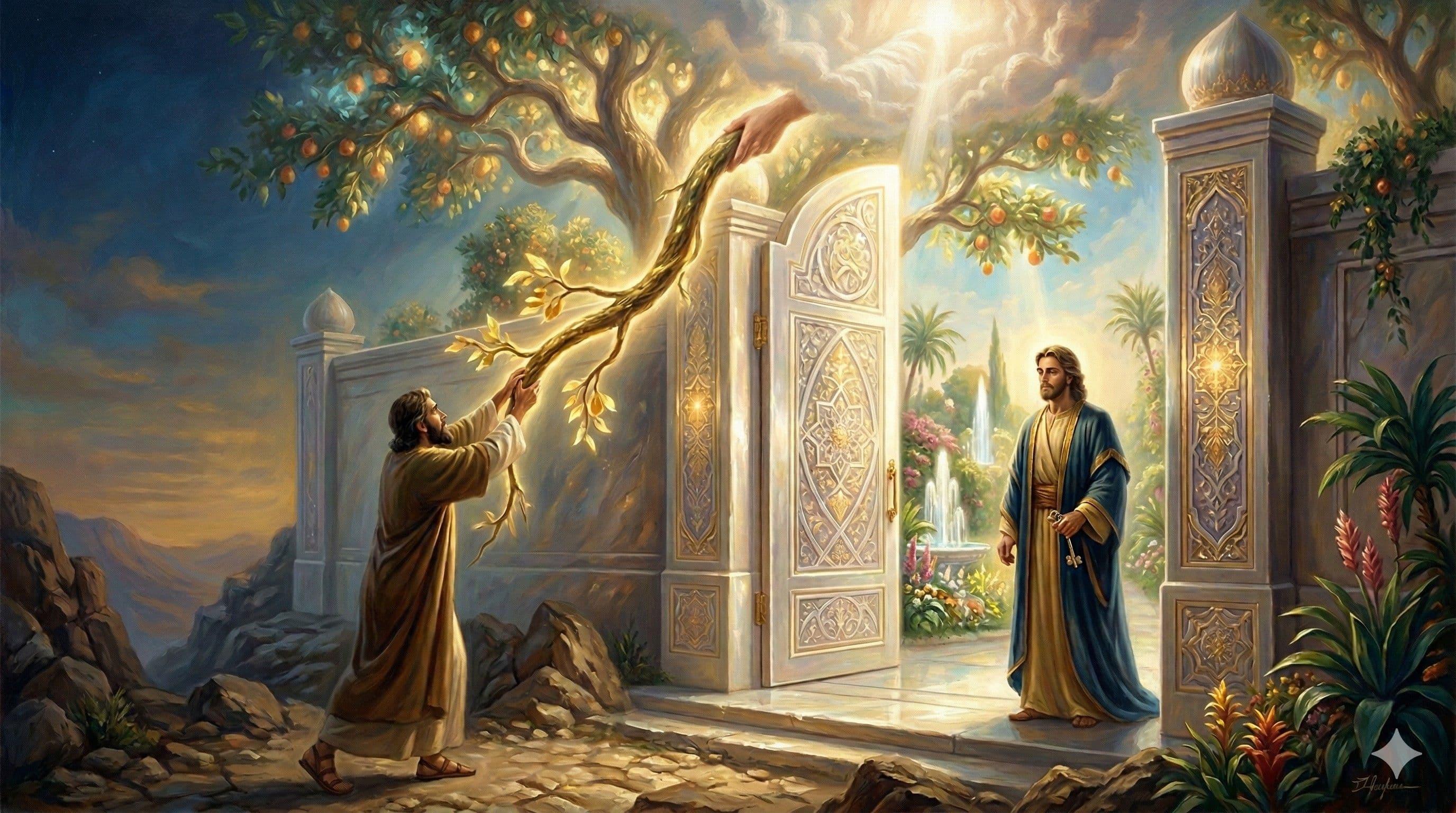
Moses 7:53 states that “whoso cometh in at the gate and climbeth up by me shall never fall.” This imagery, although it corresponds to passages in the Gospel of John, resonates just as strongly, if not more so, with ancient and medieval Enochic sources.In a conversation with Enoch in Moses 7:53, the Lord declared, “I am Messiah, the King of Zion, the Rock of Heaven, which is broad as eternity; whoso cometh in at the gate and climbeth up by me shall never fall.” Related imagery turns up in several biblical passages as well as extrabiblical sources.
Biblical Parallels
Perhaps the most important biblical parallel comes from Christ’s statements in John 10:1–7:
Verily, verily, I say unto you, He that entereth not by the door into the sheepfold, but climbeth up some other way, the same is a thief and a robber. But he that entereth in by the door is the shepherd of the sheep. To him the porter openeth; and the sheep hear his voice: and he calleth his own sheep by name, and leadeth them out. … Then said Jesus unto them again, Verily, verily, I say unto you, I am the door of the sheep. All that ever came before me are thieves and robbers: but the sheep did not hear them. I am the door: by me if any man enter in, he shall be saved, and shall go in and out, and find pasture.1
Like Moses 7:53, this passage involves (1) a door/gate, (2) the need to specifically “climb” or ascend to a point of entry, (3) the idea of a correct or approved mode of entry, and (4) the necessity for Christ to help individuals pass through the gate. This imagery seems to be closely related to a statement found in John 1:51: “Hereafter ye shall see heaven open, and the angels of God ascending and descending upon the Son of man” (John 1:51). Although somewhat ambiguous, the language suggests that the Son of Man himself is the medium of ascent or descent.
With these close parallels in hand, it could be assumed that Moses 7:53 is merely borrowing these concepts from the New Testament. It must be understood, however, that some of the core imagery may actually derive from a much earlier period. It is widely believed, for instance, that John 1:51 is itself alluding back to Jacob’s vision at Bethel recorded in Genesis 28:12–18:
And he dreamed, and behold a ladder set up on the earth, and the top of it reached to heaven: and behold the angels of God ascending and descending on it. And, behold, the Lord stood above it, and said, I am the Lord God of Abraham thy father, and the God of Isaac: … And Jacob awaked out of his sleep, and he said, Surely the Lord is in this place; and I knew it not. And he was afraid, and said, How dreadful is this place! this is none other but the house of God, and this is the gate of heaven. And Jacob rose up early in the morning, and took the stone that he had put for his pillows, and set it up for a pillar, and poured oil upon the top of it.
When John 1:51 is read with this backdrop in place, Christ can be seen as describing himself as the medium (a “ladder” or, in some translations, a “stairway”) that was described in Jacob’s vision. Another connection involves the stone which Jacob used as a pillow and which he set apart as a monumental pillar. This may correlate to Christ’s earlier description of Simon in John 1:42: “And when Jesus beheld him, he said, Thou art Simon the son of Jona: thou shalt be called Cephas, which is by interpretation, A stone.” One might also recall that gate imagery, as well as a dichotomy of heaven and earth, is associated with Peter’s name in Matthew 16:18: “And I say also unto thee, That thou art Peter, and upon this rock I will build my church; and the gates of hell shall not prevail against it. And I will give unto thee the keys of the kingdom of heaven: and whatsoever thou shalt bind on earth shall be bound in heaven: and whatsoever thou shalt loose on earth shall be loosed in heaven.” All of this is to say that there are reasons to see John 1 as resonating on multiple levels with Genesis 28.2
Remarkably, Moses 7 also parallels Jacob’s vision in Genesis 28, as both texts involve (1) the concept of angels or other beings ascending and descending between heaven and earth, (2) an emphasis on a rock, and (3) gate imagery. These parallels can be seen in the following chart:
Moses 7 | Genesis 28 |
27 And Enoch beheld angels descending out of heaven, bearing testimony of the Father and Son; and the Holy Ghost fell on many, and they were caught up by the powers of heaven into Zion. 53 And the Lord said: Blessed is he through whose seed Messiah shall come; for he saith—I am Messiah, the King of Zion, the Rock of Heaven, which is broad as eternity; whoso cometh in at the gate and climbeth up by me shall never fall; wherefore, blessed are they of whom I have spoken, for they shall come forth with songs of everlasting joy. | 11 And he lighted upon a certain place, and tarried there all night, because the sun was set; and he took of the stones of that place, and put them for his pillows, and lay down in that place to sleep. 12 And he dreamed, and behold a ladder set up on the earth, and the top of it reached to heaven: and behold the angels of God ascending and descending on it. 17 And he was afraid, and said, How dreadful is this place! this is none other but the house of God, and this is the gate of heaven. 18 And Jacob rose up early in the morning, and took the stone that he had put for his pillows, and set it up for a pillar, and poured oil upon the top of it. |
Concerning the imagery of the rock or stone in Genesis 28 and its connection to John 1, Raymond Brown explains, “In Jewish literature … a mystique grew up about this rock as the first stone created by God and the one which He spread out to form the world. The application to John would be that in [John 1:51] Jesus has replaced the rock of Bethel, and this would be an instance of the theme of Jesus the rock who makes Simon the rock [John 1:41–42].”3 The imagery of the Messiah as the “Rock of Heaven” in Moses 7:53 (perhaps as a counterpart to the foundation stone of the earth) is therefore reasonably at home in this complex of ideas.4
The larger point is that Moses 7:53 does not appear to be a straightforward borrowing of ideas from John’s gospel. Instead, when read in context, it seems that Moses 7 simultaneously parallels John 1 and 10, as well as Genesis 28, which seems to provide the backdrop for the imagery in John’s own writings. Whatever the nature of the intertextual relationships and dependencies may be among these texts, Moses 7:53 appears to hold a variant of this complex of ideas.5
Support from Extrabiblical Sources
On top of this data, it is fascinating that the imagery of Moses 7:53 has several parallels with extrabiblical Enochic sources. The first and perhaps most obvious relationship comes from the element of heavenly ascent. Each of the major Enochic works (1 Enoch, 2 Enoch, and 3 Enoch) features Enoch (or Enoch in his capacity as the angel Metatron) as either making or facilitating some sort of heavenly journey. In several instances, these ascents also involve one or more heavenly gates.
One striking example can be seen in 1 Enoch 14–15, in which Enoch enters into the presence of the Lord’s heavenly dwelling:
And the Lord called me with his own mouth and said to me, “Come near to me, Enoch, and to my holy Word.” And he lifted me up and brought me near to the gate, but I (continued) to look down with my face. But he raised me up and said to me with his voice, “Enoch.” I (then) heard, “Do not fear, Enoch, righteous man, scribe of righteousness; come near to me and hear my voice.” (1 Enoch 14:24–15:1)6
Notice, in this passage, that it is specifically the Lord who lifts or raises Enoch up in close proximity to the gate. Related imagery is prevalent in 2 Enoch, except in this case angelic beings (identified merely as “men”) escort Enoch through the heavens and their associated gates:
- “And they took me up onto their wings, and carried me up to the first heaven, and placed me on the clouds” (2 Enoch 3:1)7
- “And those men carried me to the northern region; and they showed me there a very frightful place” (2 Enoch 10:1)8
- “And those men took me and they carried me up to the fourth heaven” (2 Enoch 11:1)9 “The angels picked Enoch up and set him down in the East, at the solar gates” (2 Enoch 13:1)10
- “And then those men carried me away to the west of the heaven, and they showed me six large open gates” (2 Enoch 14:1)11
- “And the angels hurried and grasped Enoch and carried him up to the highest heaven, where the Lord received him and made him stand in front of his face for eternity” (2 Enoch 67:2)12
These passages may actually correlate better with a statement in Moses 7:27, which depicts angels descending and then the righteous ascending: “And Enoch beheld angels descending out of heaven, bearing testimony of the Father and Son; and the Holy Ghost fell on many, and they were caught up by the powers of heaven into Zion.” The phrase “powers of heaven” may be significant, as powers are specifically associated with orders of angelic beings in Enochic literature.13 It thus may be that Moses 7:27 is declaring that righteous people were caught up into heaven through the ministration of angelic beings (much like Enoch was in 2 Enoch).14
In 3 Enoch, the Lord himself again plays a direct role as the gatekeeper. In this text, an initiate known as Rabbi Ishmael is escorted into the heavenly realm by Enoch-Metatron. At one point in the initial stages of his vision, Rabbi Ishmael explains that “the Holy One, blessed be he, opened to me gates of Šekinah, gates of peace, gates of wisdom, gates of strength, gates of might, gates of speech, gates of song, gates of sanctifying praise, gates of chant” (3 Enoch 1:11).15 At a later point, Enoch-Metatron is himself let into the holy sanctuaries by the Lord:
Before the Holy One, blessed be he, set me to serve the throne of glory, he opened for me 300,000 gates of understanding, 300,000 gates of prudence, 300,000 gates of life, 300,000 gates of grace and favor, 300,000 gates of love, 300,000 gates of Torah, 300,000 gates of humility, 300,000 gates of sustenance, 300,000 gates of mercy, 300,000 gates of reverence. (3 Enoch 8:1)16
The imagery of heavenly gates, in general, is pervasive in Enochic literature and can be found in a number of other pseudepigraphic texts as well.17
Enoch and the Angel of Death
Several Islamic sources feature a particularly relevant tradition in which Enoch (identified as Idris) is given a tour of the otherworldly realms by an angelic escort called the Angel of Death. In the early stages of the story, Idris is first given a taste of death (i.e., he is allowed to experience death temporarily) or else he is shown a vision of hell. This corresponds well with Enoch’s vision of the devil and his angels in Moses 7:24–26.18 After this, Idris asks to be shown Paradise and finds some way to trick the Angel of Death into letting him stay there. These stories are typically given in connection to a passage in the Quran that involves the elevation of Idris to the heavens: “We raised him to a lofty place” (Q 19:57).19
Here is an excerpt from one intriguing version of the story found in Qiṣaṣ al-anbiyā’ (Stories of the Prophets):
One day [Idris] approached the Angel of Death and said to him: “Are you able to introduce me into Paradise so that I might look at it?” The Angel of Death replied to him: “Paradise is prohibited for all people! No person who belongs to this world can enter it before death, because the people of Paradise never die. However, your request is for God Alone. I will carry you and seat you by the path of Riḍwān, the Keeper of Paradise. Then ask him about your request.”
So he did this. Then Riḍwān and the angels who were with him approached, and they looked at Idris, and they asked the Angel of Death: “Who is this?” He replied: “This is the prophet Idris, one of the inhabitants of the earth. He wants to have a look at the inhabitants of Paradise in order to increase his effort in worshiping his Lord.” Riḍwān responded: “That is for my Lord Most High (to decide).” Then God Most High revealed (this message) to Riḍwān: “I know what my servant Idris wants. I therefore have commanded one of the branches of the tree (named) Tuba to hang down toward him. He should cling to it, and it will bring him into Paradise.”
Then he entered it, after he had taken his seat on the uppermost part of the tree. When he had entered Paradise, he beheld the wonders from among the amenities which it contained. Riḍwān said to him: “Now come out!” But he answered: “Could one who goes into it (ever) come out? … I have now entered into Paradise, and I can never depart from it!”20
The manner of Idris’s entry into Paradise is especially interesting. The text states that the Lord himself commanded a branch of the Tuba tree to hang down so that Idris could climb onto it, and that it then brought him into that sacred realm. The Tuba tree (also known as the Tree of Bliss) has a rich history in Islamic lore. It is essentially a composite tree (combining several different tree motifs) that symbolizes the bliss of the afterlife. Noble Reat explains:
The Tree of Bliss in Ibn ‘Arabî’s plan grows inverted from the primum mobile [highest concentric sphere in a geocentric cosmology], with its roots in the Abode of Allâh, its trunk spanning all the seven levels of Paradise, and its inscribed branches penetrating each of the individual mansions of bliss. Note that Ibn ‘Arabî names the seventh region of Paradise the Garden of Eden, so the Tree of Bliss, like the Jewish Tree of Life, grows in the centre of Eden according to his cosmology.21
The fact that this paradisiacal tree was inverted may be significant. Its roots were believed to reside in the highest heavenly realm—the very “Abode of Allâh”—and its branches grew downward from there. Thus, by commanding one of these branches to extend down to Idris, it was as if God himself was facilitating Idris’s upward mobility, somewhat analogous to giving him a ladder (similar to Genesis 28:12). The account in Qiṣaṣ al-anbiyā’ thus resonates uniquely well with the imagery of Moses 7:53 (“whoso cometh in at the gate and climbeth up by me shall never fall”).
One can also compare this account to the visions of the Tree of Life mentioned in the Book of Mormon, in which a sacred tree is seen as a representation of Christ and in which an iron rod (representing the word of God) is provided to help travelers reach their destination.22 In Lehi’s visionary dream, the righteous “did press forward through the mist of darkness, clinging to the rod of iron, even until they did come forth and partake of the fruit of the tree” (1 Nephi 8:24). This echoes the language used in Qiṣaṣ al-anbiyā’: “I therefore have commanded one of the branches of the tree (named) Tuba to hang down toward him. He should cling to it, and it will bring him into Paradise.” Some details in Lehi’s dream suggest the Tree of Life was situated at an elevated location, similar to the Tuba tree.23
Another relevant analog comes from a text known as the History of the Rechabites. It tells of a heavenly initiate named Zosimus who was allowed to enter a paradisiacal realm:
And then I prayed to the LORD to deal with me as it pleases his will. And suddenly two luxuriant and very stately trees, larger than (any) I had ever seen, appeared on the shore of the sea. And then one of the trees bent itself down and I securely grasped its branches. And it stretched out toward the height (of heaven) and lifted me up and carried me in its summit until the cloud was beneath (me). And also that other tree bent itself down toward it; and the one from here curved its summit and held me out to the one which was from the other side. And descending, it dropped me in the midst of it. And thus by God’s guidance I passed over the great ocean and the cloud. (History of the Rechabites 3:1–4)24
Evidence suggests that at least portions of this text are Jewish in origin and that they could have developed long before the rise of Islam.25 That being the case, it may be difficult to determine precisely where and when this imagery of sacred trees facilitating heavenly ascent first developed.
“Shall Never Fall”
Some Islamic accounts emphasize that Idris was allowed to permanently stay in Paradise once he entered there, despite the protests from angelic gatekeepers. This may correspond with the final component of Moses 7:53: “whoso cometh in at the gate and climbeth up by me shall never fall.” One Islamic source reads:
He (Idris) said to him: “I have another request for you.” He replied, “What is it?” He said: “(I want) you to carry me up to heaven in order to see it and the Garden.” … So he led him to the Garden. He asked for it to be opened, and its gates were opened for him. Then he went into it. The Angel of Death said to him, “Depart, so that you might return to your abode.” But he attached himself to a tree and replied, “I shall not leave it!” God sent an angel to adjudicate between them. The angel said to him: “Why won’t you leave?” He responded, “Because God Most Exalted has said: ‘Every soul will taste death’ (Q 3:185), and I have already tasted it. The Most Exalted also has said: ‘There is not one of you but will descend to it (i.e., Hell)’ (Q 19:71), and I have already descended to it. The Most Exalted also has said: ‘And they will not be expelled (from Paradise)’ (Q 15:48)—I do not have to leave!” God Most Exalted said to the Angel of Death, “Let him be, for with My permission he entered the Garden and by My command he does not have to leave.”26
Another account simply declares,
And a tale is told about [Idris] encountering the Angel of Death. He asked God that He grant him a taste of death; afterwards, he asked God that He grant permission for him to enter Paradise, and He did so. He never departed from Paradise. God raised him up, and he was 150 years old (when this happened).27
In yet another account, Idris stated, “It does not seem to me that [God] would permit a human being to enter Paradise and then have him come out from it. So I will not exit from it until God Himself, may He be blessed and exalted, makes me leave it!”28 This idea is also echoed in several Book of Mormon passages, in which those who enter into heaven are said to “go no more out.”29
Another relevant verse may be Jude 1:24: “Now unto him that is able to keep you from falling … be glory and majesty, dominion and power, both now and ever.” This chapter is, of course, famous for its earlier mention of Enoch in Jude 1:14. Although these ideas show up in the same chapter, they are far enough removed from one another that most readers wouldn’t assume a connection. Only after reviewing Jude’s statement in light of the Book of Moses and extrabiblical Enochic lore does its potential significance become more apparent.
Cluster of Parallels in Ma‘aseh R. Joshua b. Levi
A Jewish text known as Ma‘aseh R. Joshua b. Levi provides a close analog to the Islamic stories of Idris escaping death. Just like Idris, Rabbi Joshua was escorted through the heavenly realms by the Angel of Death. When he got close to the paradisiacal garden, “R. Joshua suddenly leaped from (the top of) the wall and fell within Gan Eden. The Angel of Death grabbed the hem of his shawl and said to him: ‘Come out from there!’ But R. Joshua swore that he would never exit, and the Angel of Death did not possess the authority to enter inside it.” This caused the angels in heaven to complain to the Holy One, declaring, “He has taken his portion in Gan Eden by force!” Nevertheless, due to his righteous oath-keeping practices, Rabbi Joshua was permitted by the Lord to remain in Eden.30
What is so fascinating about this account is that the very next paragraph abruptly and somewhat unexpectedly alludes to the Lord’s covenant in connection to the flood:
Elijah of blessed memory traveled with R. Joshua b. Levi. He went and found R. Shimon b. Yoḥai who was sitting on thirteen thrones of gold. He said to him: “Are you ben Levi?” He said to him: “Yes.” He said to him: “Has the rainbow appeared during your lifetime?” He said to him: “Yes.” He said to him: “If so, you cannot be ben Levi!” But the matter was not so, for the rainbow had never appeared during his lifetime. Why then did he say it had appeared? He did not wish to claim merit for himself. But why did they ask about the rainbow? Because it was (the sign of) a covenant between the Holy One, blessed be He, and the earth: every time that it appeared, the Holy One, blessed be He, exercised mercy with regard to the earth and the created beings.
This newly introduced topic parallels the covenant found in verses that immediately precede the key statement in Moses 7:53:
49 And when Enoch heard the earth mourn, he wept, and cried unto the Lord, saying: O Lord, wilt thou not have compassion [i.e., mercy] upon the earth? Wilt thou not bless the children of Noah?
50 And it came to pass that Enoch continued his cry unto the Lord, saying: I ask thee, O Lord, in the name of thine Only Begotten, even Jesus Christ, that thou wilt have mercy upon Noah and his seed, that the earth might never more be covered by the floods.
51 And the Lord could not withhold; and he covenanted with Enoch, and sware unto him with an oath, that he would stay the floods; that he would call upon the children of Noah;
52 And he sent forth an unalterable decree, that a remnant of his seed should always be found among all nations, while the earth should stand;
53 And the Lord said: Blessed is he through whose seed Messiah shall come; for he saith—I am Messiah, the King of Zion, the Rock of Heaven, which is broad as eternity; whoso cometh in at the gate and climbeth up by me shall never fall
Another parallel with the story of Rabbi Joshua comes from the chorus of weeping that arises just a few paragraphs later, as it closely resembles the theme of weeping throughout Moses 7.31 This text therefore offers a cluster of elements related to Moses 7 that can be seen as mutually reinforcing.
Conclusion
There can be little doubt that the imagery in Moses 7:53 is connected in some way to John 10:1–7 and John 1:51. These passages involve (1) a door/gate, (2) the need to specifically “climb” or ascend to a point of entry, (3) the idea of a correct or approved mode of entry, and (4) a necessity for Christ to help individuals ascend through the gate. At first glance, this could look like simple New Testament borrowing on the part of Joseph Smith, perhaps to give his Enoch revelation a familiar biblical “ring” to its language.
That explanation, however, becomes complicated by the fact that Moses 7:53 seems to also interact with Jacob’s vision recorded in Genesis 28, which provides the backdrop imagery for John 1:51.32 What is truly remarkable is how similar imagery surfaces repeatedly in extrabiblical Enochic traditions. Enoch’s heavenly ascent, in which angels lifted or carried him up through otherworldly realms, is pervasive in each of the major Enochic books (1 Enoch, 2 Enoch, 3 Enoch). So too is the presence of gates and thresholds, which sometimes require divine authorization or help to navigate. In several accounts, God himself plays an active role in helping Enoch or an Enoch figure ascend to or through these points of entry.
Perhaps most striking are the Islamic sources that portray the prophet Idris (Enoch) as gaining entrance into the Paradise of heaven. These accounts depict an angelic escort who first carries Idris up to a sacred paradisiacal realm. In several accounts, divine beings at the gate question whether Idris has authorization to be there. In some versions, Idris then abruptly enters without their permission, which scandalizes the angelic gatekeepers. God himself then gives Idris special permission to access the garden. In one account, God commands a branch of a heavenly tree to bow down so Idris can climb on to it. Finally, it is repeatedly emphasized that once Idris entered this realm, he would never have to depart from it and descend back to earth (or reexperience death or hell).
These accounts thus comprehensively interact with the imagery in Moses 7:53 (“whoso cometh in at the gate and climbeth up by me shall never fall”), as well as John 1 and 10, in a way that the other major Enochic texts do not quite match. Yet, unlike the New Testament passages, the Islamic sources specifically involve an Enoch figure. Since it seems implausible that Smith was familiar with these obscure sources in 1830, it is hard to imagine how he would have ever known to apply this specific New Testament imagery to Enoch.
The Jewish account of Ma‘aseh R. Joshua b. Levi provides additional corroboration. The way Rabbi Joshua tricks the Angel of Death into letting him enter Eden resonates so closely with the Islamic accounts of Idris that there can really be no question about the relationship between these texts. As noted by John Reeves and Annette Reed, these figures seem to “assimilate,” so that Rabbi Joshua may be viewed as the direct counterpart to Idris (Enoch).33 With this conceptual equivalence at play, it is fascinating that the story of Rabbi Joshua gaining entrance to Eden is found in immediate connection to an emphasis on God’s covenant to not destroy the earth by a flood, as this very same detail shows up in the immediate context of Moses 7:53.
In summary, while the short statement in Moses 7:53 may initially seem unremarkable, it resonates on multiple levels with a variety of Enochic sources. The nuances of these relationships help support the authenticity of the Book of Moses and suggest that Smith’s Enoch revelation wasn’t merely derived from the Bible or his own 19th-century environment.
Jeffrey M. Bradshaw, Enoch and the Gathering of Zion: The Witness of Ancient Texts for Modern Scripture (Interpreter Foundation, with Scripture Central and Eborn Books, 2021), 136–138.
Jeffrey M. Bradshaw and Ryan Dahle, “Could Joseph Smith Have Drawn on Ancient Manuscripts When He Translated the Story of Enoch?: Recent Updates on a Persistent Question,” Interpreter: A Journal of Latter-day Saint Faith and Scholarship 33 (2019): 326.
Jeffrey M. Bradshaw and David J. Larsen, In God’s Image and Likeness 2: Enoch, Noah, and the Tower of Babel (The Interpreter Foundation and Eborn Books, 2014), 156.
Bible
Genesis 28:12–18
John 1:51
John 10:1–7
Jude 1:24
Book of Mormon
Alma 7:25
Alma 29:17
Alma 34:36
Helaman 3:30
3 Nephi 28:40
Book of Moses
Moses 7:53
- 1. The parallel is made even more explicit in other translations that use “gate” instead of “door.” See https://biblehub.com/john/10-9.htm.
- 2. On some level or another, the stone at Bethel may be associated with seeing devices used in ancient times, such as the biblical Urim and Thummim as well as the Nephite interpreters, which also may relate to Peter’s association with a stone. For more on this topic, see Shon D. Hopkin, “Peter, Stones, and Seers,” in The Ministry of Peter, the Chief Apostle, ed. Frank F. Judd Jr., Eric D. Huntsman, and Shon D. Hopkin (BYU Religious Studies Center and Deseret Book, 2014), 103–125.
- 3. Raymond Brown, The Gospel According to John, The Anchor Bible Series (Doubleday, 1966), 91. Note that Brown doesn’t fully accept this interpretation (or several others that have been put forward to explain John 1:51), but neither does he entirely dismiss it either. He explains, “No one of these variations is particularly convincing. However, in the theme that they have in common they are probably correct; whether it is as the ladder, the shekinah, the Merkabah, Bethel, or the rock, the vision means that Jesus as Son of Man has become the locus of divine glory, the point of contact between heaven and earth” (p. 91).
- 4. For further discussion of these elements, see Jeffrey M. Bradshaw, Enoch and the Gathering of Zion: The Witness of Ancient Texts for Modern Scripture (Interpreter Foundation, with Scripture Central and Eborn Books, 2021), 136–138.
- 5. Although the main components of the key phrase in Moses 7:53 can be found elsewhere, the specific wording and context are unique.
- 6. Translation by E. Isaac, “1 (Ethiopic Apocalypse of) Enoch,” in The Old Testament Pseudepigrapha, 2 vols., ed. James H. Charlesworth (Doubleday, 1983–85), 1:21.
- 7. Translation by Frances I. Anderson, “2 (Slavonic Apocalypse of) Enoch,” in The Old Testament Pseudepigrapha, 1:110.
- 8. Anderson, “2 (Slavonic Apocalypse of) Enoch,” 118.
- 9. Anderson, “2 (Slavonic Apocalypse of) Enoch,” 120.
- 10. Anderson, “2 (Slavonic Apocalypse of) Enoch,” 122.
- 11. Anderson, “2 (Slavonic Apocalypse of) Enoch,” 124.
- 12. Anderson, “2 (Slavonic Apocalypse of) Enoch,” 194.
- 13. See, for example, 1 Enoch 18:14–15: “(Then) the angel said (to me), ‘This place is the (ultimate) end of heaven and earth: it is the prison house for the stars and the powers of heaven.’” In this context, the “stars” are clearly angelic beings. Likewise, in 1 Enoch 20:1, a manuscript variant reads: “These are the names of the angels of the powers.” George W. E. Nickelsburg and James C. VanderKam, 1 Enoch 1: A Commentary on the Book of 1 Enoch Chapters 1–36, 81–108, ed. Klaus Baltzer (Fortress Press, 2001), 294 (note 1a). Another relevant passage can be found in 1 Enoch 73:15–16: “Then, after this matter, on the tenth week in the seventh part, there shall be the eternal judgment; and it shall be executed by the angels of the eternal heaven—the great (judgment) which emanates from all of the angels. The first heaven shall depart and pass away; a new heaven shall appear; and all the powers of heaven shall shine forever sevenfold.” One can also turn to the use of this term in 3 Nephi 20, in which the “powers of heaven” will dwell in the midst of the people, just as Christ will, in the context of the New Jerusalem prophecy: “and it shall be a New Jerusalem. And the powers of heaven shall be in the midst of this people; yea, even I will be in the midst of you.” Likewise, Christ declared that “I shall come in my glory with the powers of heaven” (3 Nephi 28:7). When read in context, these passages suggest that the “powers of heaven” are most likely angelic beings who have been given authority and power from on high.
- 14. This reading is especially inviting because of the mention of angels first descending out of heaven.
- 15. Translation by Philip Alexander, “3 (Hebrew Apocalypse of) Enoch,” in The Old Testament Pseudepigrapha, 1:256.
- 16. Alexander, “3 (Hebrew Apocalypse of) Enoch,” 263.
- 17. The instances of gates in Enochic texts are too numerous to list here. But gates found in other pseudepigraphic documents can be seen in Charlesworth, The Old Testament Pseudepigrapha, 349, 511–512, 663–664, 670–671, 674–676, 789, 795, 888–889, 899, 915, 995.
- 18. See Scripture Central, “Book of Moses Evidence: Demonic Laughter and Righteous Weeping,” Evidence 526 (December 31, 2025); Scripture Central, “Book of Moses Evidence: Hell Was ‘Prepared’,” Evidence 510 (September 3, 2025).
- 19. Compare with Genesis 5:24.
- 20. Kisā’ī, Qiṣaṣ al-anbiyā’ (ed. Eisenberg); as cited in John C. Reeves and Annette Yoshiko Reed, Enoch from Antiquity to the Middle Ages (Oxford University Press, 2018), 197–198.
- 21. Noble Ross Reat, “The Tree Symbol in Islam,” Studies in Comparative Religion 9, no. 3. (1975), 19.
- 22. See Jeanette W. Miller, “The Tree of Life, a Personification of Christ,” Journal of Book of Mormon Studies 2, no. 1 (1993): 93–106; Scripture Central, “Book of Mormon Evidence: Nephi and Asherah,” Evidence 427 (November 8, 2023); Scripture Central, “Book of Mormon Evidence: Iron Rod and Word of God,” Evidence 73 (September 19, 2020).
- 23. See David Calabro, “Lehi’s Dream and the Garden of Eden,” Interpreter: A Journal of Latter-day Saint Faith and Scholarship 26 (2017): 274.
- 24. J. H. Charlesworth, “History of the Rechabites,” in The Old Testament Pseudepigrapha, 2:451.
- 25. The dating of this text is quite uncertain. While Charlesworth tentatively places the finalized version of the text in approximately the sixth century A.D., he suggests that “sections of this document are Jewish or heavily influenced by Jewish traditions, and that they may antedate the second century A.D.” Charlesworth, “History of the Rechabites,” 445.
- 26. Wahb apud Tha‘labī, ‘Arā’is al-majālis fī qiṣaṣ al-anbiyā; as cited in John C. Reeves and Annette Yoshiko Reed, Enoch from Antiquity to the Middle Ages (Oxford University Press, 2018), 194. A very similar account comes from Pseudo-Aṣma‘ī, Nihāyat al-arab fī akhbār al-Furs wa’l-‘Arab (ed. Dānish-Pazhūh) on pages 191–192.
- 27. Pseudo-Mas‘ūdī, Akhbār al-zamān wa-man abādat al-hidthān; as cited in Reeves and Reed, Enoch from Antiquity to the Middle Ages, 198.
- 28. Pseudo-Aṣma‘ī, Nihāyat al-arab fī akhbār al-Furs wa’l-‘Arab (ed. Dānish-Pazhūh); as cited in Reeves and Reed, Enoch from Antiquity to the Middle Ages, 191–192.
- 29. See Alma 7:25; 29:17; 34:36; Helaman 3:30; 3 Nephi 28:40. See also Revelation 3:12: “Him that overcometh will I make a pillar in the temple of my God, and he shall go no more out.”
- 30. Ma‘aseh R. Joshua b. Levi; as cited in Reeves and Reed, Enoch from Antiquity to the Middle Ages, 203–205.
- 31. Scripture Central, “Book of Moses Evidence: Themes of Weeping,” Evidence 525 (December 23, 2025).
- 32. This more sophisticated three-way relationship may cause one to question whether Smith was responsible for this content, considering his apparently modest knowledge of the Bible in 1830. See Scripture Central, “Book of Mormon Evidence: Joseph Smith’s Education,” Evidence 1 (September 19, 2020).
- 33. Reeves and Reed, Enoch from Antiquity to the Middle Ages, 208.