Evidence #526 | December 31, 2025
Book of Moses Evidence: Demonic Laughter and Righteous Weeping
Post contributed by
Scripture Central
Abstract
The Book of Moses contrasts the laughter of demonic angels with the weeping of righteous figures. Several extrabiblical sources also pair these elements together, sometimes in contexts remarkably similar to the Book of Moses.Themes of Laughter and Weeping in Restoration Texts
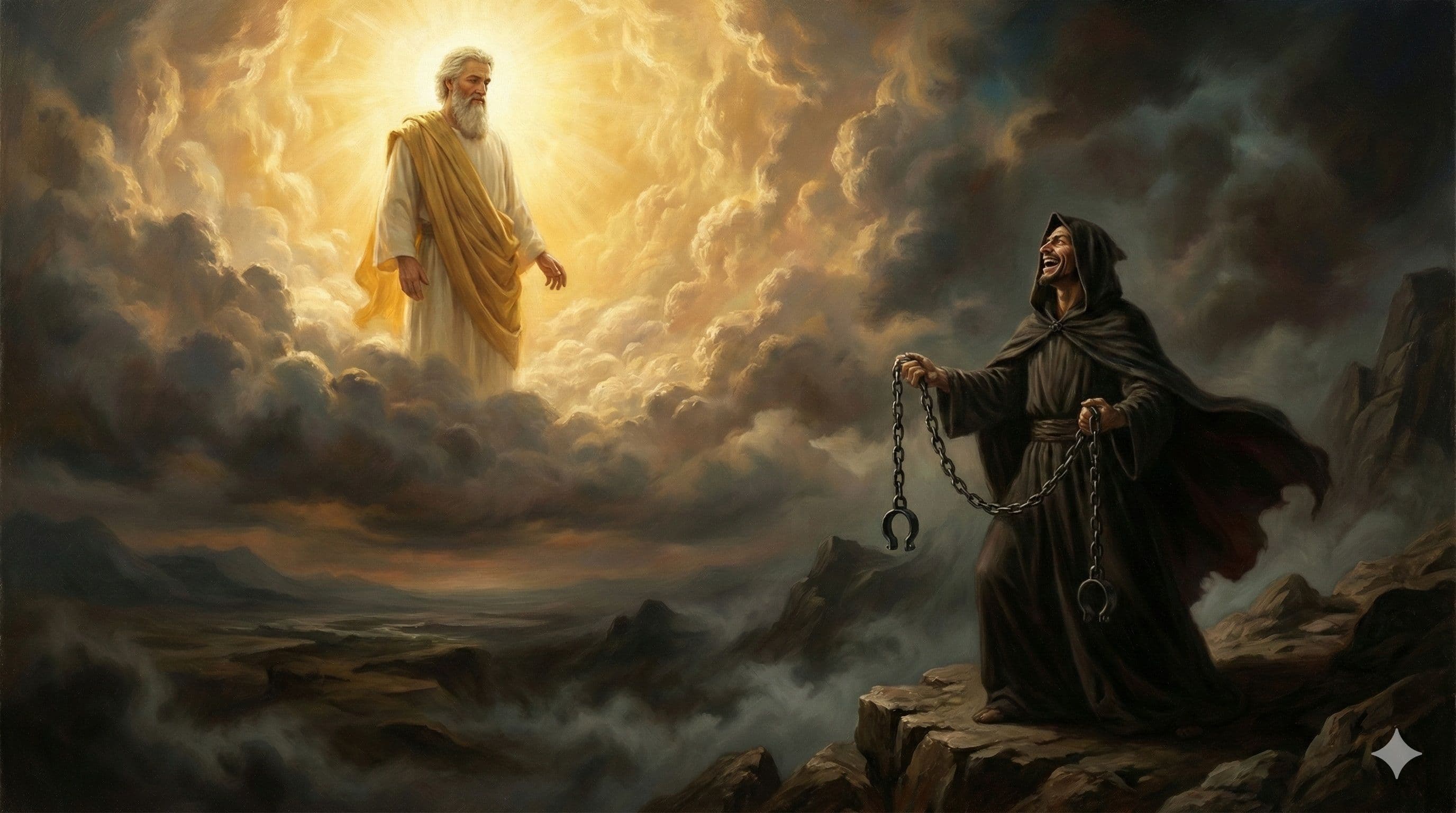
In one of Enoch’s visions in the Book of Moses, he was shown a vision of future events that would transpire upon the earth. After witnessing that the righteous among mankind would be taken up into heaven, Enoch “beheld Satan; and he had a great chain in his hand, and it veiled the whole face of the earth with darkness; and he looked up and laughed, and his angels rejoiced” (Moses 7:24–26).
A very similar description can be found in 3 Nephi 9:1–2. The passages are so similar, in fact, that it suggests the Book of Mormon is either closely paraphrasing the Book of Moses or that the language in each text derives from some other unknown source:1
Moses 7 | 3 Nephi 9 |
25 And he saw angels descending out of heaven; and he heard a loud voice saying: Wo, wo be unto the inhabitants of the earth. 26 And he beheld Satan; and he had a great chain in his hand, and it veiled the whole face of the earth with darkness; and he looked up and laughed, and his angels rejoiced. | 1 And it came to pass that there was a voice heard among all the inhabitants of the earth, upon all the face of this land, crying: 2 Wo, wo, wo unto this people; wo unto the inhabitants of the whole earth except they shall repent; for the devil laugheth, and his angels rejoice, because of the slain of the fair sons and daughters of my people; |
Also of interest is that the evil laughter in each text is contrasted with those who weep when witnessing the suffering or destruction of God’s children. In the Book of Moses, we read that “the God of heaven looked upon the residue of the people, and he wept; and Enoch bore record of it, saying: How is it that the heavens weep, and shed forth their tears as the rain upon the mountains?” (Moses 7:28). Moreover, “Enoch looked upon the earth; and he heard a voice from the bowels thereof, saying: Wo, wo is me, the mother of men; … And when Enoch heard the earth mourn, he wept” (Moses 7:49). Thus, God, the heavens, the earth, and Enoch himself all joined in a chorus of weeping and lamentation for those who suffered and were slain.2
Likewise, in the Book of Mormon, we read of the “howling and weeping” of the more righteous people who were spared (3 Nephi 8:23; cf. 9:13; 10:8). This weeping is closely associated with the “dreadful groanings” of the earth in 3 Nephi 10:8–10. Moreover, from heaven, the lamentation of God could be heard: “O ye people of the house of Israel, who have fallen; … how oft would I have gathered you as a hen gathereth her chickens, and ye would not” (3 Nephi 10:5). The thematic resonance between the two texts is therefore unmistakable.
Similar imagery—which combines the elements of both laughter and weeping—can be found in several ancient and medieval traditions. The following sections highlight parallels between the Book of Moses and these extrabiblical sources.
The Sybilline Oracles
One example comes from the Sibylline Oracles, in which Noah directed the following rebuke at the wicked in his day: “You do not bewail each other, cruel ones, but laugh. You will laugh with a bitter smile when this comes to pass, I say, the terrible and strange water of God … then also the entire world of innumerable men will die. But as for me, how much will I lament, how much will I weep in my wooden house, how many tears will I mingle with the waves.”3
While this text doesn’t feature the laughter of Satan or his angels, it does portray wicked mortals laughing, as well as the weeping of a righteous prophet. The way that Noah’s “tears will mingle with the waves” resonates particularly well with the “tears as the rain upon the mountains” in Moses 7:28. Overall, the laughing and weeping in each text is meaningful, due to the fact that Noah was a contemporary of Enoch and because their emotive responses were each directed towards those who would be destroyed in the flood.
2 Enoch
In 2 Enoch, the Lord addressed Methuselah (identified as Methusalom) as follows: “Listen, Methusalom! I am (the LORD), the God of your father Enoch” (2 Enoch 70:3). The Lord then instructed him to call forth his son Nir (the brother of Noah) and “tell him everything that will happen (to him) in his days, for the time is drawing near for the destruction of all the earth, and of every human being and of everything that moves on the earth” (2 Enoch 70:4).4 We are therefore presented with a pre-flood setting and a vision of the future very similar to that described in the Book of Moses, in which the Lord told Enoch, “Look, and I will show unto thee the world for the space of many generations” (Moses 7:4).
In 2 Enoch, the Lord then began to describe the wickedness of the people: “And nation will wage war against nation. And all the earth will be filled with blood” (2 Enoch 70:5–6). Likewise, in the Book of Moses, Enoch was shown specific wars that would transpire between nations, and “from that time forth there were wars and bloodshed among them” (Moses 7:16).
With this similar context established, both texts then invoke the motif of demonic laughter or delight. In 2 Enoch we read that the wicked will “abandon their Creator” and “the adversary will make himself great and will be delighted with their deeds”—meaning the war, bloodshed, and idolatry of the people (2 Enoch 70:6).5 Satan likewise “laughed, and his angels rejoiced” in Moses 7:26. Both texts then remark on the weeping or grieving of the visionary and the blessings and salvation promised to Noah. After this, both Enoch and Methusalom predicted another time of destruction that would transpire in the future. Parallels between these sections are highlighted in the chart below.
Moses 7 | 2 Enoch 70 |
42 And Enoch also saw Noah, and his family; that the posterity of all the sons of Noah should be saved with a temporal salvation; 44 And as Enoch saw this, he had bitterness of soul, and wept over his brethren 45 And it came to pass that Enoch looked; and from Noah, he beheld all the families of the earth; 52 And he sent forth an unalterable decree, that a remnant of [Noah’s] seed should always be found among all nations, while the earth should stand; 61 And the day shall come that the earth shall rest, but before that day the heavens shall be darkened, and a veil of darkness shall cover the earth; and the heavens shall shake, and also the earth; and great tribulations shall be among the children of men, but my people will I preserve; | 10 Then I will preserve the son of your son Lamekh, his first son, Noe [i.e., Noah]. And from his seed I will raise up another world, and his seed will exist forever, until the second destruction when once again mankind will have committed sin in front of my face. 11 [recension A] And Methusalom, getting up from his sleep, grieved greatly over the dream. |
Thus, not only do the Book of Moses and 2 Enoch both contrast demonic laughter or delight with righteous weeping, but they do so, once again, in a fairly similar context.
Qiṣaṣ al-anbiyā’
Perhaps the strongest resemblance to the Book of Moses, at least pertaining specifically to the demonic laughter motif, comes from an Islamic source called Qiṣaṣ al-anbiyā’ (Stories of the Prophets). In it, an angelic guide known as the Angel of Death gives a tour of hell to the prophet Idris (the name given to Enoch in Islamic sources):
Idrīs then said to the Angel of Death: “Are you able to position me over Jahannam (i.e., Hell) so that I can see into it?” He responded: “Why would you want (to do) that? Jahannam contains horrors which you could not endure, so why should I do that? However, I will carry you to a spot close to it. God knows best why you request this!” So the Angel of Death carried him in order to position him by the path of Mālik, the Keeper of the Fire. When Mālik saw him standing there, his face broke into a grin, and the soul of Idrīs was at the point of departing from his body. So God revealed (this message) to Mālik, saying: “By My Might and Greatness, my servant Idrīs will never see anything as terrible as that grin of yours! Go back to him and carry him and position him on the border of Jahannam so that he can see what is in it.”6
The resemblance between this account and the Book of Moses is startling, not only because each text is about Enoch but because the element of demonic mirth shows up specifically in the context of Enoch/Idris being shown a vision of hell! In the Book of Moses, Satan “looked up and laughed” (Moses 7:26), whereas in the Islamic account Mālik looked at Idris and “broke into a grin.” According to John Reeves and Annette Reed, “Mālik is almost certainly the biblical Molech, the chthonic god to whom children were sacrificed with fire.”7 This demonic being therefore provides a suitable analog to Satan and his angels in the Book of Moses.
Each source also describes the suffering of imprisoned beings that Enoch/Idris witnessed, as well as the disturbing nature of the vision. These parallel elements are highlighted in the chart below:8
Moses 7 | Qiṣaṣ al-anbiyā’ |
26 And he beheld Satan; and he had a great chain in his hand, and it veiled the whole face of the earth with darkness; and he looked up and laughed, and his angels rejoiced. 39 And that which I have chosen hath pled before my face. Wherefore, he suffereth for their sins; inasmuch as they will repent in the day that my Chosen shall return unto me, and until that day they shall be in torment; 41 And it came to pass that the Lord spake unto Enoch, and told Enoch all the doings of the children of men; wherefore Enoch knew, and looked upon their wickedness, and their misery, and wept and stretched forth his arms, and his heart swelled wide as eternity; and his bowels yearned; and all eternity shook. 44 And as Enoch saw this, he had bitterness of soul, and wept over his brethren, and said unto the heavens: I will refuse to be comforted; but the Lord said unto Enoch: Lift up your heart, and be glad; and look. | So Mālik returned to him, took hold of him [Idris], and positioned him on the border of Jahannam. Then Mālik called out to the keepers of Jahannam so that they might rake through it layer by layer, and Idris looked at these horrors, the chains, the punishments, the fires, the tar, the snakes, and the scorpions. Had God Most High not fortified him, he would have lost his mind. Afterwards Mālik carried him to the place where he had been before, and the Angel of Death came to him and carried him back to the earth. From then on he lived serving God and growing gray: he could not sleep or enjoy the taste of food out of fear of the punishment of God Most High which his own eyes had witnessed. |
Devarim Rabbah 11
A final parallel comes from a rabbinic source known as Devarim Rabbah. In a number of ways, this text parallels the Islamic account given above, as well as the Book of Moses. Except, in this case, the exchange is between Moses and an evil angelic being known as Samael. In the context of Moses’s impending death, Samael asked himself, “When will the end arrive, the moment when Moses will die, so I can descend and take his soul from him?”9 This mirrors the function of the Angel of Death in the Islamic account given above, who was sent to extract the soul of Enoch/Idris.
Of particular interest is the pleasure that Samael took in imagining the moment of Moses’s death. The narrator states:
To what is the matter comparable? It is to a person who happened upon the feast of a bride and groom, and that person was anticipating and saying: “When will their rejoicing arrive and I will rejoice in it?” So, the wicked Samael was anticipating Moses’s soul, and saying: “When will Mikhael weep and I will fill my mouth with laughter?”10
In other words, much like the anticipation and rejoicing that transpires before a marriage, Samael was going to rejoice and laugh at the death of Moses. This laughter from a wicked angel is then immediately contrasted with the weeping of the righteous angel Mikhael (Michael), much like the weeping and laughing in the Book of Moses are connected to death and suffering.11
In Devarim Rabbah, additional bouts of weeping and mourning come from Moses, God, the heavens, and the earth, followed by a plea for rest, which compares well with the chorus of weeping on Moses 7. The fact that both Moses and Enoch make stubborn refusals to God and that their disconsolate mourning shakes eternity itself is especially intriguing.12
Lest one dismiss these resemblances, due to the fact that Moses is featured in one text and Enoch in the other, it should be understood that these two figures are often paired together in extrabiblical traditions. According to Andrei Orlov, in many rabbinic and Hekhalot texts, Moses is depicted as “a typical seer, a junior replica of the patriarch Enoch, whom he faithfully, along with other visionaries like Rabbi Ishmael, imitates in his ascension, reception of secrets, struggles with the angelic opposition, and mediation of the celestial revelation.”13 It would therefore be appropriate to assume that elements in one account may shed light on the other, especially when multiple points of resemblance turn up together in similar contexts.
Joseph Smith’s Potential Access to Sources
Could Joseph Smith have derived this laughter/weeping motif from Enoch-related sources in his 19th-century environment? That seems unlikely. While there are certainly many instances of weeping and lamentation in the Bible, there do not appear to be any examples of the weeping of the righteous juxtaposed specifically with demonic laughter.14 Most importantly, these ideas don’t turn up together in connection to the prophet Enoch. The same is true for 1 Enoch.15 These works can therefore be confidently ruled out as plausible sources of derivation.
As for the other sources highlighted throughout this article, most of them wouldn’t have been accessible to Joseph Smith in 1830.16 The one exception is the Sibylline Oracles, which had been available in an English translation for more than a century before 1830.17 Yet, not only was this a fairly obscure text, it arguably holds the least significant parallels with the Book of Moses. Unlike Qiṣaṣ al-anbiyā’, the account from the Sibylline Oracles is not specifically about Enoch’s vision of hell. And in contrast to 2 Enoch and Devarim Rabbah, it has fewer corroborating contextual parallels. Thus, while it fits well as a supporting piece in the broader picture of evidence painted by these extrabiblical texts, the Sibylline text holds limited value as a singular source of derivation.
It is possible that Smith could have encountered these concepts from texts outside the scope of this study. But, even if he had, one would wonder what motivated him to include them as part of his story of Enoch. He wouldn’t have known they fit well in an Enochic context unless he encountered them in an Enochic source.
Conclusion
Overall, the elements of demonic rejoicing and righteous weeping found in Moses 7 provide valuable support for Joseph Smith’s prophetic calling. Not only is this combined motif present in various extrabiblical sources, but it repeatedly arises in settings that have contextual parallels with the Book of Moses. Of particular significance is the account from Qiṣaṣ al-anbiyā’, as it specifically depicts a demonic figure laughing as part of Enoch’s vision of hell, just as seen in Moses 7:26. Because of the remarkably similar context in each text, this parallel seems especially unlikely to be due to random chance or lucky guesswork.
On a different front, the way these elements in Moses 7 are closely mirrored in 3 Nephi 9 helps showcase the often-sophisticated interrelationships among Restoration texts. In this case and in many others, the evidence for ancient origins dovetails nicely with the surprising complexity of Joseph Smith’s revelations, providing yet another reason to conclude that they came forth through miraculous means.18
Jeffrey M. Bradshaw, Enoch and the Gathering of Zion: The Witness of Ancient Texts for Modern Scripture (Interpreter Foundation, with Scripture Central and Eborn Books, 2021), 119–135.
Jeffrey M. Bradshaw and David J. Larsen, In God’s Image and Likeness 2: Enoch, Noah, and the Tower of Babel (The Interpreter Foundation and Eborn Books, 2014), 141.
Jeffrey M. Bradshaw, Jacob A. Rennaker, and David J. Larsen, “Revisiting the Forgotten Voices of Weeping in Moses 7: A Comparison with Ancient Texts,” Interpreter: A Journal of Latter-day Saint Faith and Scholarship 2 (2012): 41–71.
Daniel C. Peterson, “On the Motif of the Weeping God in Moses 7,” Revelation, Reason, and Faith: Essays in Honor of Truman G. Madsen, ed. Donald W. Parry, Daniel C. Peterson and Stephen D. Ricks (FARMS, 2002), 285–317.
Relevant Scriptures
Moses 7:24–26
- 1. For analysis of the Book of Mormon’s interactions with the Book of Moses, see Noel B. Reynolds, “The Brass Plates Version of Genesis,” Interpreter: A Journal of Latter-day Saint Faith and Scholarship 34 (2020): 63–96; Jeff Lindsay and Noel B. Reynolds, “‘Strong Like unto Moses’: The Case for Ancient Roots in the Book of Moses Based on Book of Mormon Usage of Related Content Apparently from the Brass Plates,” Interpreter: A Journal of Latter-day Saint Faith and Scholarship 44 (2021): 1–92, esp. 56; Jeff Lindsay, “Further Evidence from the Book of Mormon for a Book of Moses-Like Text on the Brass Plates,” Interpreter: A Journal of Latter-day Saint Faith and Scholarship 61 (2024): 415–494; Jeff Lindsay, “Parallels between the Book of Moses and the Book of Mormon, Part 1: Details of Their Distribution and Relationships to the JST,” Interpreter: A Journal of Latter-day Saint Faith and Scholarship 67 (2025): 275–320.
- 2. See Scripture Central, “Book of Moses Evidence: Themes of Weeping,” Evidence 525 (December 23, 2025).
- 3. Translation by J. J. Collins, “Sibylline Oracles,” in The Old Testament Pseudepigrapha, 2 vols., ed. James H. Charlesworth (Doubleday, 1983–1985), 1:339.
- 4. Translation by Frances I. Anderson, “2 (Slavonic Apocalypse of) Enoch,” in The Old Testament Pseudepigrapha, 1:201.
- 5. Anderson, “2 (Slavonic Apocalypse of) Enoch,” 200.
- 6. Kisā’ī, Qiṣaṣ al-anbiyā’ (ed. Eisenberg); as cited in John C. Reeves and Annette Yoshiko Reed, Enoch from Antiquity to the Middle Ages (Oxford University Press, 2018), 197. For a comparable account, see Jazāʾirī, Qiṣaṣ al-anbiyāʾ (ed. ʿAqil); as cited in Reeves and Reed, Enoch from Antiquity to the Middle Ages, 199–200: “The Prophet of God, may God bless him, once said: A certain angel once enjoyed a particular status, but later God cast him from heaven to earth. He came to Idrīs and said: ‘Could you please intercede with your Lord on my behalf?’ So he prayed three nights without stopping, and he fasted during their days without stopping; then he made appeal to God at daybreak for the angel. As a result God permitted him to re-ascend to heaven. The angel then said to him: ‘Would you like for me to repay you? Then make a request!’ So he said: ‘You can show me the Angel of Death, for he is high over humanity, and I cannot enjoy anything while remembering him.’ He extended his wing (and) then said: ‘Climb on!’ Then he ascended with him and he looked for the Angel of Death in the heaven over the inhabited world. It has been said that he continued to ascend, and he (finally) met with him between the fourth and the fifth heavens. He said to the Angel of Death: ‘Why do I see you frowning at me?’ He said: ‘I am surprised, for I was beneath the Shadow of the Throne when I was ordered to collect the soul of Idrīs between the fourth and the fifth heavens!’ When Idrīs heard this, he jumped off the wing of the angel, and the Angel of Death collected his soul ‘at once’ (مكانه). This then is the meaning of His Most Exalted Word: ‘Mention in the book Idrīs, for he was a truthful one, a prophet; and We raised him to a lofty “place” (مكانا)’ (Q 19:56–7).”
- 7. Reeves and Reed, Enoch from Antiquity to the Middle Ages, 197n117.
- 8. Kisā’ī, Qiṣaṣ al-anbiyā’ (ed. Eisenberg); as cited in Reeves and Reed, Enoch from Antiquity to the Middle Ages, 197.
- 9. Devarim Rabbah 11, online at sefaria.org.
- 10. Devarim Rabbah 11, online at sefaria.org.
- 11. Other textual evidence indicates that Samael aligns well with the Satan archetype. As the narrator explained earlier in the account, the “wicked angel Samael was the head of all the accusing angels.” Devarim Rabbah 11, online at sefaria.org.
- 12. For more details on how this account resonates with the theme of weeping in the Book of Moses, see Scripture Central, “Book of Moses Evidence: Themes of Weeping,” Evidence 525 (December 23, 2025).
- 13. Andrei A. Orlov, The Enoch-Metatron Tradition (Mohr Siebeck, 2005), 300. Orlov believes these resemblances stem primarily from an ancient polemical debate over which prophet should have primacy. While assuming such a rivalry seems warranted in many respects, this conflation of characters and attributes would be especially understandable if resemblances between Moses and Enoch were already present in the earliest traditions about each figure, as is seen in the Book of Moses. In that text, parallels between these figures include their face-to-face interactions with God, their visions of the creation, their visions of hell, their status as sons of God, their being transfigured with glory before the Lord, and so forth.
- 14. For some examples of laughter of the wicked, sometimes contrasted with weeping, see Lamentations 2:15–18; Psalm 22:6–7; 35:14–19. Note, however, that these wicked figures are not specifically Satan or his demonic followers.
- 15. Although there is ongoing debate about the plausibility of Joseph Smith ever accessing 1 Enoch (or portions of it), this source was potentially available at the time, having been translated into English by Richard Laurence in 1821. See Jeffrey M. Bradshaw and Ryan Dahle, “Could Joseph Smith Have Drawn on Ancient Manuscripts When He Translated the Story of Enoch?: Recent Updates on a Persistent Question,” Interpreter: A Journal of Latter-day Saint Faith and Scholarship 33 (2019): 305–374, esp. 308–311; For reasons to be cautious in assuming it was implausible for Joseph Smith to have learned anything about 1 Enoch, see Colby Townsend, “Revisiting Joseph Smith and the Availability of the Book of Enoch,” Dialogue 53, no. 3 (2020): 41–71.
- 16. 2 Enoch simply wouldn’t have been available to Joseph Smith, as it was unknown to Western scholars in 1830. Qiṣaṣ al-anbiyā’ and Devarim Rabbah were obscure texts and would not have been available in English at the time.
- 17. See John Floyer, The Sibylline Oracles Translated from the Best Greek Copies (London: Printed by R. Bruges for J. Nicholson, 1713), 9. It is technically possible that Smith could have accessed Sibylline Oracles, seeing that an English translation was available at the time. See John Floyer, The Sibylline Oracles Translated from the Best Greek Copies (London: Printed by R. Bruges for J. Nicholson, 1713), 9.
- 18. For analyses of the Book of Mormon’s complex interactions with the Book of Moses, see Noel B. Reynolds, “The Brass Plates Version of Genesis,” Interpreter: A Journal of Latter-day Saint Faith and Scholarship 34 (2020): 63–96; Jeff Lindsay and Noel B. Reynolds, “‘Strong Like unto Moses’: The Case for Ancient Roots in the Book of Moses Based on Book of Mormon Usage of Related Content Apparently from the Brass Plates,” Interpreter: A Journal of Latter-day Saint Faith and Scholarship 44 (2021): 1–92, esp. 56; Jeff Lindsay, “Further Evidence from the Book of Mormon for a Book of Moses-Like Text on the Brass Plates,” Interpreter: A Journal of Latter-day Saint Faith and Scholarship 61 (2024): 415–494; Jeff Lindsay, “Parallels between the Book of Moses and the Book of Mormon, Part 1: Details of Their Distribution and Relationships to the JST,” Interpreter: A Journal of Latter-day Saint Faith and Scholarship 67 (2025): 275–320. For exploration of the many complex features within the Book of Mormon itself, see the “Complexity” theme online at scripturecentral.org/evidence. As for Joseph Smith’s education and literary capacity leading up to the translation of the Book of Mormon and Book of Moses, see Scripture Central, “Book of Mormon Evidence: Joseph Smith’s Education,” Evidence 1 (September 19, 2020); Scripture Central, “Book of Moses Evidence: Comparing Contemporary Authors,” Evidence 106 (November 2, 2020).