Evidence #562 | October 22, 2026
Book of Moses Evidence: Methuselah’s Glory
Post contributed by
Scripture Central
Abstract
The description of Methuselah taking “glory unto himself” in Moses 8:3 is supported by ancient Enochic traditions. These sources also shed light on whether the phrase reflects positively or negatively on Methuselah’s character.In the eighth chapter of the Book of Moses, a somewhat puzzling statement is made about Methuselah taking “glory unto himself”:
And it came to pass that Methuselah, the son of Enoch, was not taken, that the covenants of the Lord might be fulfilled, which he made to Enoch; for he truly covenanted with Enoch that Noah should be of the fruit of his loins. And it came to pass that Methuselah prophesied that from his loins should spring all the kingdoms of the earth (through Noah), and he took glory unto himself. And there came forth a great famine into the land, and the Lord cursed the earth with a sore curse, and many of the inhabitants thereof died. (Moses 8:2–4)
Negative Views of Seeking Glory
Several commentators have viewed this to mean that Methuselah was, to some extent, guilty of sinful pride. Concerning Methuselah’s character, Orson Pratt declared:
Was he a good man? I have no doubt but what he was a very good man in many respects, but he had his failings and his faults like many other good men. He took glory unto himself. About what? He understood by the promise of God that his seed should remain on the earth until the end should come, and it was a little too much for him, it overcame him, and he boasted in his own strength, took glory unto himself; nevertheless not enough to destroy the promise made to him in regard to the eternal order of the Priesthood.1
Hugh Nibley held a similar understanding, declaring that “Methuselah boasted about his line as something special.”2 Jeffrey Bradshaw and David Larsen likewise describe Methuselah as “vaunting” himself in this context.3 Such interpretations are understandable, considering that many scriptural passages warn against glorying in oneself, as seen in the following examples:
- “He that speaketh of himself seeketh his own glory: but he that seeketh his glory that sent him, the same is true, and no unrighteousness is in him.” (John 7:18)
- “And I seek not mine own glory: there is one that seeketh and judgeth.” (John 8:50)
- “Of such an one will I glory: yet of myself I will not glory, but in mine infirmities.” (2 Corinthians 12:5)
- “Nor of men sought we glory” (1 Thessalonians 2:6)
- “Nevertheless, in this I do not glory, for I am unworthy to glory of myself.” (Mosiah 23:11)
- “I do not glory of myself, but I glory in that which the Lord hath commanded me.” (Alma 29:9)
- “In me he shall have glory, and not of himself” (Doctrine and Covenants 24:11)
The origin of this idea may be traced back to a fundamental distinction between Christ and Satan in the premortal council. In his own words, God explained that Satan desired “that I should give unto him mine own power.” Satan also demanded, “give me thine honor” (Moses 4:1, 3). In contrast, Jesus humbly declared, “Father, thy will be done, and the glory be thine forever” (Moses 4:2).
The implication is that Satan was cast out of heaven largely because he sought his own glory. He thus became the archetype for all who pridefully seek personal gain through unholy means. Modeling this attitude, Cain “gloried in his wickedness” and “gloried in that which he had done” by slaying Abel (Moses 5:31–33). It therefore isn’t surprising that taking glory to oneself holds a persistently negative connotation within the scriptural canon. This type of prideful self-promotion is sometimes referred to as seeking the “glory of the world.”4
Positive Views of Seeking Glory
It must be recognized, however, that there are other passages in which seeking or obtaining glory is divinely approved. In such instances, the distinction often lies in whether one’s glory is sought at the expense of God and others or is obtained in a manner that contributes to their glorification as well.5 This reciprocal relationship is evident in the words of Jesus himself, who petitioned his Father to “glorify thy Son, that thy Son also may glorify thee” (John 17:1). Jesus later declared, “And now, O Father, glorify thou me with thine own self with the glory which I had with thee before the world was” (John 17:5). This principle seems particularly at home in family relationships, where the glory of one generation is closely associated with that of another. As Proverbs 17:6 explains, “Children’s children are the crown of old men; and the glory of children are their fathers.”
D&C 132 develops this theme even further, describing those who enter into the new and everlasting covenant of marriage as being “worthy of a far more, and an exceeding, and an eternal weight of glory” than the ministering angels whom the Father says “cannot … inherit my glory” (D&C 132:16–18). More specifically, the glory promised to those who enter this covenant is associated with the perpetuation of “eternal lives” through eternal seed (D&C 132:11–24; cf. Moses 1:39). As the Lord explains, Abraham received “promises concerning his seed … [that] they should continue” and that “both in the world and out of the world should they continue as innumerable as the stars … and by this law is the continuation of the works of my Father, wherein he glorifieth himself” (D&C 132:30–31). The Lord further declares that “as pertaining to the new and everlasting covenant, it was instituted for the fulness of my glory; and he that receiveth a fulness thereof must and shall abide the law” (D&C 132:6). Within this theological framework, the glory sought and received by the faithful in connection with their eternal posterity does not compete with God’s glory but rather participates in and contributes to its eternal expansion.
A particularly relevant passage comes from D&C 124:18, where the Lord explicitly approves of a righteous individual obtaining glory both for himself and for God: “it is my will that my servant Lyman Wight should continue in preaching for Zion, in the spirit of meekness, confessing me before the world; and I will bear him up as on eagles’ wings; and he shall beget glory and honor to himself and unto my name.” This passage is especially instructive because it associates personal glory with meekness and faithful service, demonstrating that the two are not inherently incompatible. The word “beget” is also noteworthy, given its connotations of offspring and the prominence of seed and posterity in D&C 132.
Finally, Paul likewise describes the pursuit of personal glory as a legitimate aspiration when undertaken through righteousness: “[God] will render to every man according to his deeds: To them who by patient continuance in well doing seek for glory and honour and immortality, eternal life: But unto them that are contentious, and do not obey the truth, but obey unrighteousness, indignation and wrath” (Romans 2:6–8).
Reassessing the Character of Methuselah
With this broader scriptural backdrop in place, the account of Methuselah may be reassessed from a new perspective, in which taking glory unto himself could be viewed either positively or negatively depending on the surrounding context.
There are some aspects of the narrative that could potentially be viewed as reflecting poorly on his character. One might wonder, for instance, why Methuselah didn’t ascend into heaven with Enoch and his righteous Zion community. Was this because he wasn’t righteous himself? Bradshaw and Larsen warn against that conclusion: “Although it is tempting to conclude that Methuselah ‘was not taken’ with those of the city of Enoch before the Flood because of his vaunting, the only reason explicitly given in scripture is ‘that the covenants of the Lord might be fulfilled … that Noah should be of the fruit of [Enoch’s] loins.’”6 If anything, the stated purpose in Moses 8:2 is positive rather than negative, as it presents Methuselah as the instrument through which the Lord’s covenant would be fulfilled.
On another front, it could be concluded that the famine and curse reported in Moses 8:4 somehow resulted from Methuselah’s personal wickedness, since those outcomes are reported immediately after he is mentioned. Yet without stronger clarifying data, this interpretation is also quite speculative. Such generalized consequences seem more indicative of growing wickedness among the people at large than the pride of a single individual. One could, perhaps, suppose that Methuselah influenced others to become wicked, but that becomes a slippery slope of assumptions. This is partly because the Book of Moses elsewhere juxtaposes righteous patriarchs and their followers with growing wickedness, without implying any causal relationship between them.7 When counterexamples are duly considered, the mere proximity of Methuselah’s actions to subsequently negative developments does little to establish that he was personally responsible for them.8
Overall, a careful review of the passage demonstrates that nothing in its surrounding context explicitly characterizes Methuselah as wicked. We are left only with potentially unfavorable inferences, depending on how one reads the text. This ambiguity may itself be somewhat unexpected if the passage was intended to expose a moral failing of this early patriarch.
Yet the evidence is not limited to competing inferences about Methuselah’s character. The very sentence in which he took “glory unto himself” describes him exercising the gift of prophecy: “And it came to pass that Methuselah prophesied that from his loins should spring all the kingdoms of the earth (through Noah), and he took glory unto himself.” Although scripture contains numerous examples of false prophets and false prophecies, Methuselah’s prediction is clearly presented as true and divinely inspired within the broader narrative. His prophecy therefore constitutes the legitimate exercise of a spiritual gift, providing direct and favorable evidence concerning his character.9
Earlier, we saw that scripture not only permits personal glorification but sometimes presents it as a promised blessing that may be righteously pursued, especially in connection to posterity. Thus, perhaps by remaining on the earth to fulfill the covenant of the Lord, Methuselah appropriately obtained for himself the same type of glory that was promised to Abraham and all righteous saints whose posterity will eventually become innumerable, as outlined in D&C 132.10
A final piece of evidence comes from the favorable portrayal of Methuselah in D&C 107, the only other scriptural text that gives any hint as to his character. This revelation states that “Noah was ten years old when he was ordained under the hand of Methuselah” (D&C 107:52). It further reports: “Three years previous to the death of Adam, he called Seth, Enos, Cainan, Mahalaleel, Jared, Enoch, and Methuselah, who were all high priests, with the residue of his posterity who were righteous, into the valley of Adam-ondi-Ahman, and there bestowed upon them his last blessing” (D&C 107:53).11
Taken together, these details portray Methuselah as a righteous priesthood leader who helped perpetuate the sacred order established by Adam. It is not implausible, then, that the glory Methuselah took unto himself might also have something to do with his priestly role or responsibility after Enoch was taken up to heaven.12 Concerning the authority needed to perform sacred priesthood ordinances, D&C 124:34 declares, “therein are the keys of the holy priesthood ordained, that you may receive honor and glory.” The imagery culminates in D&C 76:56–57, where those who enter into the celestial kingdom are described as “priests and kings, who have received of his fulness, and of his glory; And are priests of the Most High, after the order of Melchizedek, which was after the order of Enoch, which was after the order of the Only Begotten Son” (D&C 76:56–57).13
In the final analysis, the textual evidence may not be fully decisive, but a strong case can be made for viewing the otherwise surprising statement in Moses 8:3 in a positive light. For various possible reasons, what the Lord favorably said of Lyman Wight could reasonably apply to Methuselah: “he shall beget glory and honor to himself and unto my name” (D&C 124:18). Whether this glory involved his ordination as a high priest or his lineage through Noah remains unclear. Whatever the correct interpretation may be—whether positive or negative—there certainly seems to be something going on in the backstory of this puzzling comment. This opens up the possibility that extrabiblical sources could shed further light on this matter.
Parallels with 1 Enoch
One relevant account is contained in the final chapters of 1 Enoch, which tell of the birth of Noah. Enoch opens the narrative by explaining that “my son, Methuselah, took a wife for his son Lamech, and she became pregnant by him and bore him a son [Noah]” (106:1).14 However, the son exhibited strange and frightening qualities:
And his body was white as snow and red as a rose; the hair of his head as white as wool and his dendema beautiful; and as for his eyes, when he opened them the whole house glowed like the sun—(rather) the whole house glowed even more exceedingly. And when he arose from the hands of the midwife, he opened his mouth and spoke to the Lord with righteousness. And his father, Lamech, was afraid of him and fled and went to Methuselah his father; and he said to him, “I have begotten a strange son: He is not like an (ordinary) human being, but he looks like the children of the angels of heaven to me; his form is different, and he is not like us. His eyes are like the rays of the sun, and his face glorious.” (1 Enoch 106:2–5)15
When Methuselah subsequently sought out Enoch to learn the meaning of the child’s extraordinary appearance, Enoch explained: “Now, make known to your son Lamech that the son who has been born is indeed righteous; and call his name Noah, for he shall be the remnant for you; and he and his sons shall be saved from the corruption which shall come upon the earth” (1 Enoch 106:18).16
One need not assume that all the details of this account are historically accurate to recognize its resonance with Moses 8:2–3. Joseph Smith’s revelation depicts Methuselah taking glory unto himself in immediate connection with his prophetic knowledge that Noah would preserve his lineage and become the progenitor of future generations. It is therefore fascinating that 1 Enoch not only describes how Noah brought glory to his household but also how Methuselah was commissioned by Enoch to relay his prophecy concerning Noah’s righteousness and salvific role (1 Enoch 106:18–107:3).
Parallels with 2 Enoch
The parallels with 2 Enoch may be even more significant. The relevant account transpires shortly after Enoch was taken up into heaven (2 Enoch 68:3). This mirrors the discussion of Methuselah in the Book of Moses, which likewise takes place just after Enoch and his Zion community were translated (Moses 7:69). In 2 Enoch, those who remained on earth assembled together for a festival celebration surrounding the sacred altar where Enoch had ascended. The setting is therefore one of priestly ceremony. To more fully appreciate the significance of this narrative, the entirety of 2 Enoch 69 is given below. Note that the name Methuselah is rendered as Methusalam in this account.
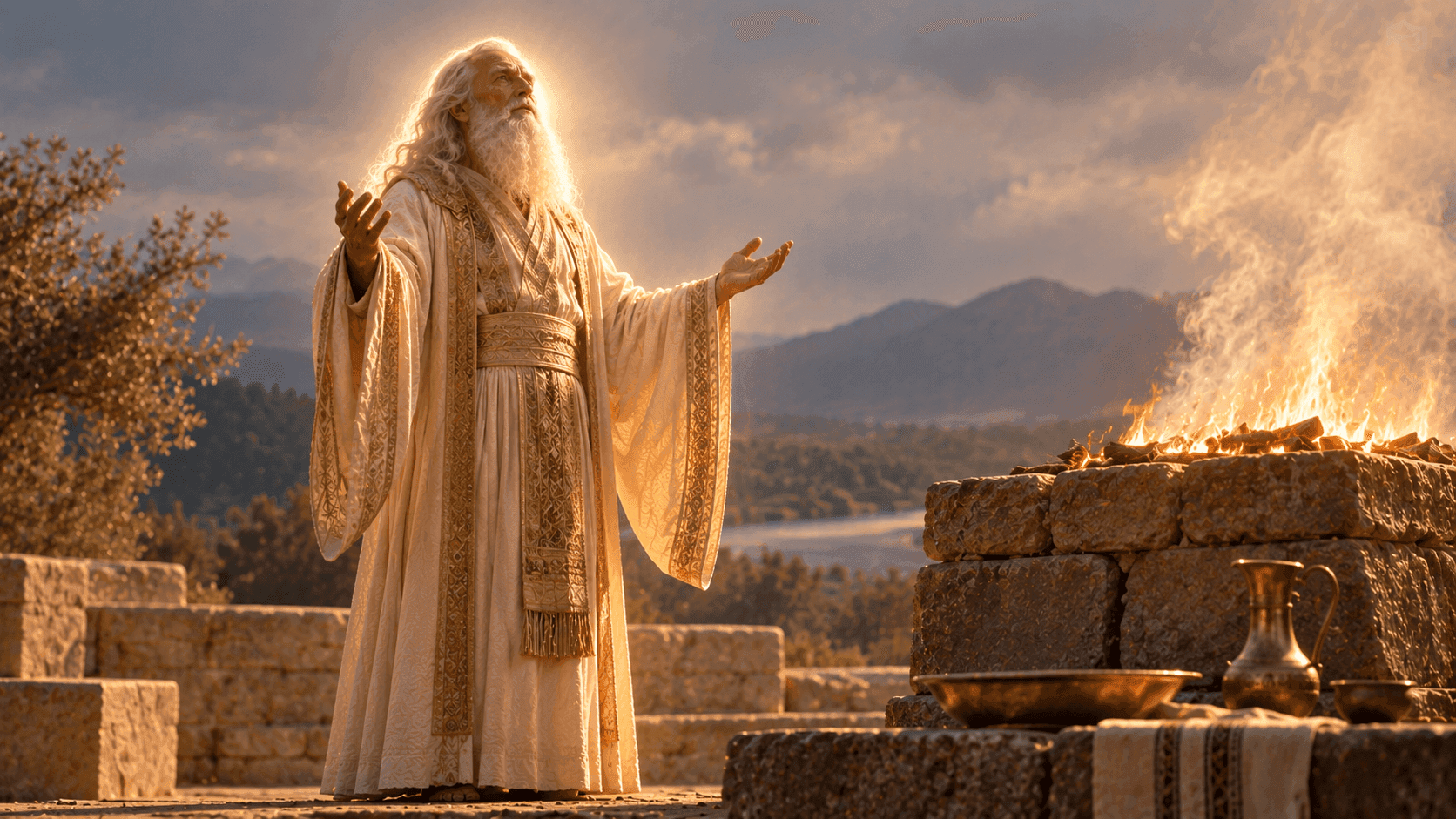
And on the third day, in the time of the evening, the elders of the people spoke to Methusalam, saying, “Stand in front of the face of the LORD and in front of the face of all the people and in front of the face of the altar of the LORD, and you will be glorified in your people.” And Methusalam answered his people: “Wait, O men, until (the LORD), the God of my father Enoch, shall himself raise up for himself a priest over his own people.” And the people waited until that night in vain at the place Akhuzan. And Methusalam remained near the altar and prayed to the LORD and said, “O LORD, the only One of the whole world, who has taken away my father Enoch, you raise up a priest for (your) people, and give their heart understanding to fear your glory and to perform everything in accordance with your will.” Methusalam fell asleep, and the LORD appeared to him in a night vision and said to him, “Listen, Methusalam! I am the LORD, the God of your father Enoch. Give heed to the voice of these people and stand in front of my altar, and I shall glorify you in front of the face of all the people, and you will be glorified all the days of your life, and I shall bless you.” And Methusalam got up from his sleep and blessed the LORD who had appeared to him. And the elders of the people hurried to Methusalam, and the LORD God directed Methusalam’s heart to give heed to the voice of the people. And he said to them, “The LORD God is the one who has given grace to these people in front of my eyes today.” And Sarkhasan and Kharmis and Zazas, the elders of the people, hurried and attired Methusalam in the designated garments and placed a blazing crown on his head. And the people hurried, and they brought sheep and oxen and some birds, all of them having passed inspection, for Methusalam to sacrifice in the name of the LORD and in the name of the people. And Methusalam came up to the LORD’s altar, and his face was radiant, like the sun at midday rising up, with all the people in procession behind him. And Methusalam stood in front of the altar of the LORD, with all the people standing around the place of sacrifice. And when the elders of the people had taken sheep and oxen, they tied their four legs together, and placed them at the head of the altar. And they said to Methusalam, “Pick up the knife! And slaughter them in the required manner in the face of the LORD.” And Methusalam stretched out his hands to heaven and he called out to the LORD thus, saying, “Accept (me), O LORD! Who am I, to stand at the head of your place of sacrifice and over the head of these people? And now, O LORD, look upon your servant and (on) all these people. Now all the inquiries, let them come to pass! And give a blessing to your servant in front of the face of all the people, so that they may realize that you are the one who has appointed (me) to be priest over your people.” And it happened, when Methusalam had prayed, that the altar was shaken, and the knife rose up from the altar, and leaped into Methusalam’s hand in front of the face of all the people. And the people trembled and glorified God. And Methusalam was honored in front of the face of the LORD and in front of the face of all the people from that day. (2 Enoch 69:1–19)17
A significant detail within this narrative is Methuselah’s uncertainty about what to do after Enoch’s departure, as well as his discomfort in simply assuming authority of his own accord. Even though the people encouraged him to become Enoch’s priestly successor, he wasn’t seeking that office and wisely waited for God to give him permission to take that mantle upon himself.18 Then, in a nighttime vision, God promised, “I shall glorify you in front of the face of all the people, and you will be glorified all the days of your life” (2 Enoch 69:5). The next day, Methuselah’s face became “radiant, like the sun at midday rising up” (2 Enoch 69:10), signaling that he was indeed chosen of the Lord.19
The text therefore presents the very type of situation in which Methuselah could be favorably described as taking “glory unto himself,” as stated in Moses 8:3. In one sense, it was God who filled him with glory. But, in another sense, he still had to seek and receive that glory unto himself by standing at the altar and faithfully waiting upon the Lord in the presence of the people.20 Part of the ceremony also included the act of donning priestly regalia. Methuselah presented himself to the people, who then “attired” him “in the designated garments and placed a blazing crown on his head” (2 Enoch 69:8). By submitting to this change of clothes—including the radiant crown—he can be viewed as symbolically taking upon himself the glory of the Lord, in preparation to becoming both a priest and a king in the holy order of the priesthood.21
It may be recalled that a similar type of glory was previously bestowed upon Enoch:
And the LORD said to Michael, “Go, and extract Enoch from [his] earthly clothing. And anoint him with my delightful oil, and put him into the clothes of my glory.” And so Michael did, just as the LORD had said to him. He anointed me and he clothed me. And the appearance of that oil is greater than the greatest light, and its ointment is like sweet dew, and its fragrance myrrh; and it is like the rays of the glittering sun. And I looked at myself, and I had become like one of his glorious ones, and there was no observable difference. (2 Enoch 22:8–10)22
Within the Book of Moses, Enoch was likewise “clothed upon with glory” as he received a heavenly vision (Moses 7:3).23 Thus, the glory that Methuselah received has a meaningful analog with Enoch in each text, thereby establishing a precedent for viewing Methuselah’s own glorification in a favorable light.24
Parallels between 1 Enoch 106–107 and 2 Enoch 69–71
Some scholars have suggested that several details concerning the birth of Noah in 1 Enoch 106–107 may actually relate to the story of Methuselah’s glorious coronation and its aftermath in 2 Enoch 69–71. Andrei Orlov, for instance, notes that the “account of the Lord’s revelation to Methuselah about the Flood and Noah in 2 Enoch 70:4–10 might belong to the original Noachic tradition. It shows some similarities with the account of Enoch’s revelation to Methuselah in 1 Enoch 106:15–19.”25
Another similarity involves each figure’s glorious visage. Summarizing the account in 2 Enoch 69, Crispin Fletcher-Louis writes:
On waking from his sleep Methusalam is invested with the priestly garments and “a blazing crown” is set upon his head (69:8). Standing at the altar to make sacrifice Methusalam’s face “was radiant, like the sun at midday rising up (J—recension)/like the morning star when it rises (A—recension)” (69:10). The language echoes that in … 1 Enoch 106:2.26
In other words, just as Methuselah’s “face was radiant, like the sun at midday” (2 Enoch 69:10), so too was Noah described as having “eyes … like the rays of the sun, and his face glorious” (1 Enoch 106:5).
Yet another parallel involves the context of priestly service. The story of Methuselah becoming Enoch’s priestly successor in 2 Enoch 69 is soon followed by an account of the unusual birth of Melchizedek in 2 Enoch 71, who becomes the ultimate priestly archetype. Even as a child, Melchizedek was endowed with priestly glory and credentials: “and behold, the badge of priesthood was on his chest, and it was glorious in appearance” (2 Enoch 71:19).27 When situated in the broader narrative, Melchizedek can be seen as inheriting and then exemplifying the priestly office that began with Enoch and was transferred to Methuselah and his posterity.28 Melchizedek’s radiance thus provides grounds for associating Methuselah’s glory with the distinguished destiny of his posterity.
The connection goes deeper than that, though. Several scholars have pointed out that the miraculous birth of Melchizedek in 2 Enoch 71 holds a strong resemblance to the birth of Noah in 1 Enoch 106. “One cannot fail to notice [a] host of interesting overlaps between the” two works, writes Orlov.29 He further argues that each story’s priestly features help establish their shared Second Temple milieu:
The central evidence here is the priestly features of the miraculous birth of the hero. The main concern of the story of the wondrous birth was sacerdotal; the story is permeated with imagery portraying the newborn as the high priest par excellence. It also has been shown that the mold of the Noachic priestly tradition reflected in 2 Enoch belongs to the same set of conceptual developments reflected in such Second Temple Enochic and Noachic materials as 1 Enoch 106, the Genesis apocryphon, and 1Q19.30
These interrelationships suggest that Noah’s radiance was more than just a remarkable physical characteristic. Instead, it reflects a broader tradition that links divine glory with priestly authority and sacred lineage—a convergence of themes with particular relevance to Moses 8:2–3. As explained by Fletcher-Louis, “These literary features conspire to give the impression that Noah’s birth is meant to portent his future life. His posture of praise anticipates his priestly duties after the flood (cf. Gen 8:20–21). His glorious birth prefigures also the way his life will bring glory to creation just as the high priest glorifies the sanctuary.”31 It is not hard to imagine, then, that Noah’s birth might also have been viewed as bringing glory to his priestly progenitors—especially Methuselah, who specifically remained on earth so that the Lord’s covenant through Noah might be fulfilled.
Conclusion
Nothing in Moses 8:2–3 unambiguously indicates that Methuselah was a wicked man. The only direct evidence concerning his character comes from his appropriate exercise of the gift of prophecy, which immediately precedes the declaration that he “took glory unto himself” (Moses 8:3). Since other scriptural passages indicate that taking glory to oneself can be viewed either positively or negatively, the immediate context seems to favor a positive interpretation.
This reading finds further support in scriptures that associate personal glory with the perpetuation of one’s seed, a theme central to Methuselah’s prophecy in Moses 8:2–3. It is also consistent with Methuselah’s status as a righteous “high priest” (D&C 107:53), since priesthood blessings are likewise associated with honor and glory in Restoration texts. These considerations make a positive interpretation of Methuselah’s glory increasingly plausible.
Even so, the scriptural context alone may not fully resolve the ambiguity of Moses 8:3. This is where ancient Enochic traditions become surprisingly helpful. Not only do such sources strongly favor a positive interpretation of Methuselah’s glory, but they do so in a way that provides meaningful support for the authenticity of the Book of Moses.
The most exceptional evidence derives from the account of Methuselah’s priestly coronation in 2 Enoch 69. In addition to repeatedly and emphatically describing Methuselah as receiving divine glory, it provides precisely the type of context in which he could be positively described as taking “glory unto himself.” As the account continues, a connection also arises between the glory of Methuselah and that of his descendant Melchizedek. In turn, the story of Melchizedek closely overlaps with the miraculous birth of Noah in 1 Enoch 106–107, who likewise exhibited remarkable radiance.
Scholars have independently recognized relationships among these narratives, which collectively preserve a distinctive complex of ideas involving divine glory, priestly succession, sacred lineage, and prophetic foreknowledge of Noah’s extraordinary destiny. Remarkably, these same ideas meaningfully converge around Methuselah in Moses 8:2–3, lending plausibility not only to a positive interpretation of his glory but to the antiquity of the account as a whole.
Aaron P. Schade, “The Rainbow as a Token in Genesis: Covenants and Promises in the Flood Story,” in From Creation to Sinai: The Old Testament through the Lens of the Restoration, ed. Daniel L. Belnap and Aaron P. Schade (BYU Religious Studies Center and Deseret Book, 2021), 115–162.
Aaron P. Schade and Matthew L. Bowen, The Book of Moses: From the Ancient of Days to the Latter Days (BYU Religious Studies Center and Deseret Book, 2021), 363–380.
Jeffrey M. Bradshaw and David J. Larsen, In God’s Image and Likeness 2: Enoch, Noah, and the Tower of Babel (The Interpreter Foundation and Eborn Books, 2014), 223.
Bible
Genesis 8:20–21
Proverbs 17:6
John 7:18
John 8:50
John 17:1
John 17:5
Romans 2:6–8
2 Corinthians 12:5
1 Thessalonians 2:6
Book of Mormon
Mosiah 23:11
Alma 29:9
Doctrine and Covenants
D&C 24:11
D&C 76:56–57
D&C 107:52
D&C 107:53
D&C 124:18
D&C 124:34
D&C 132:6
D&C 132:11–24
D&C 132:16–18
D&C 132:30–31
Pearl of Great Price
Moses 1:39
Moses 4:1–3
Moses 5:31–33
Moses 6:23
Moses 7:3
Moses 7:17
Moses 7:56
Moses 7:69
Moses 8:2–4
- 1. Orson Pratt, “Discourse,” delivered October 8, 1880, reported by John Irvine, Deseret News 31, no. 9 (March 22, 1882): 131.
- 2. Hugh Nibley, “Before Adam,” in Old Testament and Related Studies, ed. John W. Welch, Gary P. Gillum, and Don E. Norton, Volume 1 of The Collected Works of Hugh Nibley (Deseret Book and FARMS, 1986), 79.
- 3. Jeffrey M. Bradshaw and David J. Larsen, In God’s Image and Likeness 2: Enoch, Noah, and the Tower of Babel (The Interpreter Foundation and Eborn Books, 2014), 223.
- 4. See 2 Nephi 27:16; Alma 60:32, 36; Helaman 7:5; Ether 8:7; D&C 10:19.
- 5. Restoration scripture sometimes refers to this as having one’s eye single to the glory of God. See Mormon 8:15; D&C 4:5; 27:2; 55:1; 59:1; 82:19; 88:67.
- 6. Bradshaw and Larsen, In God’s Image and Likeness 2, 223.
- 7. See Moses 5:12–15, 56–58; 6:14–17; 7:16–17, 20–23, 26–28.
- 8. It should also be recognized that the discussion of the curse and famine on the land seems to perform an independent narrative function, as it establishes the need for Noah to “comfort us concerning our work and toil of our hands, because of the ground which the Lord hath cursed” (Moses 8:9). This etiology involves a wordplay in connection to the concept of “comfort.” See Scripture Central, “Book of Moses Evidence: Wordplay on Noah,” Evidence 560 (October 8, 2026). Thus, the discussion of this famine in the time of Methuselah makes narrative sense without attributing it to his personal wickedness.
- 9. The gift of prophecy is elsewhere included among the spiritual qualities of Adam’s righteous lineage (Moses 6:23).
- 10. It might also be recalled that the Son of God himself would come through this line. As stated in Moses 7:53, “Blessed is he through whose seed Messiah shall come.”
- 11. See Scripture Central, “Book of Moses Evidence: Adam’s Prophecy,” Evidence 508 (August 20, 2025).
- 12. Adam himself received honor and distinction in this same setting, specifically in connection with his posterity: “And the Lord administered comfort unto Adam, and said unto him: I have set thee to be at the head; a multitude of nations shall come of thee, and thou art a prince over them forever” (D&C 107:55). This provides a meaningful precedent for understanding Methuselah’s glory in a priestly context.
- 13. With this in mind, it may be significant that Methuselah specifically mentioned that the “kingdoms of the earth” would come through his loins (Moses 8:3). Kingship and glory naturally go hand in hand.
- 14. E. Isaac, “1 (Ethiopic Apocalypse of) Enoch,” in The Old Testament Pseudepigrapha, 2 vols., ed. James H. Charlesworth (Doubleday, 1983–1985), 1:86.
- 15. Isaac, “1 (Ethiopic Apocalypse of) Enoch,” 86. In addition to the tradition of Noah’s radiant face as a newborn child, there is other evidence that connects him with the concept of God’s glory. According to Moses 7:43, “Enoch saw that Noah built an ark; and that the Lord smiled upon it.” When read in the context of other Restoration scripture, this seems to be an idiom for the Lord enlightening Noah with his countenance. See Scripture Central, “Book of Moses Evidence: The Lord ‘Smiled’ upon the Ark,” Evidence 543 (May 6, 2026).
- 16. Isaac, “1 (Ethiopic Apocalypse of) Enoch,” 87.
- 17. Longer recension. F. I. Andersen, “2 (Slavonic Apocalypse of) Enoch,” in The Old Testament Pseudepigrapha, 1:198–200. For more on the imagery of standing before the face of the Lord, see Scripture Central, “Book of Moses Evidence: Enoch Stood Before God’s Face,” Evidence 519 (November 5, 2025).
- 18. For more on Enoch’s own priestly associations, see Scripture Central, “Book of Moses Evidence: Enoch the High Priest,” Evidence 555 (August 12, 2026).
- 19. A similar sign was given in connection to the prophet Abinadi, as he faced King Noah and his priestly court, which itself alludes back to the shining face of Moses. See Scripture Central, “Book of Mormon Evidence: Abinadi’s Disguise,” Evidence 150 (February 9, 2021).
- 20. A somewhat similar manifestation—in which the people witnessed the prophetic mantle fall upon a divinely chosen successor—can be seen in a memorable public address given by Brigham Young after the death of Joseph Smith. See Scripture Central, “Why Did the Mantle of Joseph Smith Fall on Brigham Young? (Doctrine and Covenants 136:3),” KnoWhy 826 (November 20, 2025).
- 21. In a similar manner, according to Restoration doctrine, all who willingly enter into priesthood covenants or accept priesthood callings or ordinations could be said to “take glory unto themselves” in a positive way. For instance, when Hyrum Smith was called to fill the priesthood office that was left vacant by the apostasy of Oliver Cowdery, the Lord admonished him to “receive counsel from my servant Joseph, who shall show unto him [Hyrum] the keys whereby he may ask and receive, and be crowned with the same blessing, and glory, and honor, and priesthood, and gifts of the priesthood, that once were put upon him that was my servant Oliver Cowdery” (D&C 124:95). See also D&C 76:56–57. More generally, the account of Methuselah reflects temple imagery that is familiar to many Latter-day Saints, as they clothe themselves in ceremonial robes and garments in symbolic preparation for their own priesthood covenants and ordinances. See Jeffrey M. Bradshaw, Freemasonry and the Origins of the Latter-day Saint Temple Ordinances (The Interpreter Foundation and Eborn Books, 2022), 119–126.
- 22. Longer recension. Andersen, “2 (Slavonic Apocalypse of) Enoch,” 138.
- 23. See Scripture Central, “Book of Moses Evidence: Enoch Clothed with Glory,” Evidence 500 (June 25, 2025); Scripture Central, “Book of Moses Evidence: Enoch’s Anointing,” Evidence 502 (July 9, 2025).
- 24. We later learn in the Book of Moses that the “fear of the Lord was upon all nations, so great was the glory of the Lord, which was upon his people” (Moses 7:17). The end of the revelation describes saints who “were crowned at the right hand of the Son of Man, with crowns of glory” (Moses 7:56), which parallels the radiant crown given to Methuselah in 2 Enoch 69:8. These additional positive precedents provide further reason to conclude that Methuselah’s glory may have been appropriately sought after and received in Moses 8:3.
- 25. Andrei A. Orlov, The Enoch-Metatron Tradition (Mohr Siebeck, 2005), 311–312.
- 26. Crispin H. T. Fletcher-Louis, All the Glory of Adam: Liturgical Anthropology in the Dead Sea Scrolls, Studies on the Texts of the Desert of Judah 42 (Brill, 2002), 50. See also Orlov, The Enoch-Metatron Tradition, 329.
- 27. Longer recension. Andersen, “2 (Slavonic Apocalypse of) Enoch,” 206.
- 28. For more on this topic, see Scripture Central, “JST Evidence: Enoch and Melchizedek,” Evidence 556 (August 18, 2026).
- 29. Andrei A. Orlov, “The Sacerdotal Traditions of 2 Enoch and the Date of the Text,” in New Perspectives on 2 Enoch: No Longer Slavonic Only, ed. Andrei A. Orlov and Gabriele Boccaccini, with Jason Zurawski (Brill, 2012), 113.
- 30. Orlov, “The Sacerdotal Traditions of 2 Enoch and the Date of the Text,” 114.
- 31. Fletcher-Louis, All the Glory of Adam, 47.