Evidence #556 | August 18, 2026
JST Evidence: Enoch and Melchizedek
Post contributed by
Scripture Central
Abstract
Several similarities between Enoch and Melchizedek in Joseph Smith’s revelations are corroborated by extrabiblical sources.Information about an enigmatic figure named Melchizedek is sparse in the Bible. Genesis describes him as the king of Salem and a “priest of the most high God” who blessed Abraham and received his tithes (Genesis 14:18–20). He is associated again with the priesthood in Psalm 110:4: “Thou art a priest for ever after the order of Melchizedek.” Nearly a dozen more references to Melchizedek are scattered throughout Hebrews 5–7, but these largely allude to and build upon the descriptions in Genesis 14 and Psalm 110.1
What is never mentioned in the Bible is any association between Melchizedek and the prophet Enoch. In contrast, several of Joseph Smith’s revelations pair these figures together, sometimes quite emphatically. One example arises in D&C 84:14–15: “Abraham received the priesthood from Melchizedek, who received it through the lineage of his fathers, even till Noah; And from Noah till Enoch, through the lineage of their fathers.”2 The distance between the two figures collapses in D&C 76:56–58, where intervening generations are skipped and Melchizedek’s priesthood order is directly linked to that of Enoch: “They are they who are priests and kings, who have received of his fulness, and of his glory; And are priests of the Most High, after the order of Melchizedek, which was after the order of Enoch, which was after the order of the Only Begotten Son. Wherefore, as it is written, they are gods, even the sons of God.”
The most significant and sustained connection, however, arises in JST Genesis 14, a lengthy excerpt of which is provided below:
Now Melchizedek was a man of faith, who wrought righteousness; and when a child he feared God, and stopped the mouths of lions, and quenched the violence of fire. And thus, having been approved of God, he was ordained an high priest after the order of the covenant which God made with Enoch, It being after the order of the Son of God; which order came, not by man, nor the will of man; neither by father nor mother; neither by beginning of days nor end of years; but of God; And it was delivered unto men by the calling of his own voice, according to his own will, unto as many as believed on his name. For God having sworn unto Enoch and unto his seed with an oath by himself; that every one being ordained after this order and calling should have power, by faith, to break mountains, to divide the seas, to dry up waters, to turn them out of their course; To put at defiance the armies of nations, to divide the earth, to break every band, to stand in the presence of God; to do all things according to his will, according to his command, subdue principalities and powers; and this by the will of the Son of God which was from before the foundation of the world. And men having this faith, coming up unto this order of God, were translated and taken up into heaven. And now, Melchizedek was a priest of this order; therefore he obtained peace in Salem, and was called the Prince of peace. And his people wrought righteousness, and obtained heaven, and sought for the city of Enoch which God had before taken, separating it from the earth, having reserved it unto the latter days, or the end of the world; And hath said, and sworn with an oath, that the heavens and the earth should come together; and the sons of God should be tried so as by fire. (JST Genesis 14:26–35)
Modern scripture therefore establishes a significant relationship between these figures that is never presented in the Bible itself. As concluded by Frank Judd, “Melchizedek’s ministry was strikingly parallel to Enoch’s.”3 The sections below explore a variety of extrabiblical sources that to some degree or another corroborate the pairing of these individuals in Smith’s revelations.
Enoch and Melchizedek as Translated Beings
As just mentioned, JST Genesis 14:30–32 associates Enoch with the priesthood order of the Son of God and declares that those who had faith like his would be “translated and taken up into heaven.” Immediately following this, the text states that “Melchizedek was a priest of this order; … And his people wrought righteousness, and obtained heaven, and sought for the city of Enoch which God had before taken, separating it from the earth, having reserved it unto the latter days, or the end of the world” (JST Genesis 14:33–34). As pointed out by Kent Jackson, “This new text thus gives us a record of a second translated community.”4
With this in mind, it is fascinating that 2 Enoch—one of the most prominent and lengthy Enochic works—concludes by describing Melchizedek’s translation into paradise. In this origin story, Melchizedek was miraculously conceived by the wife of Nir (Noah’s brother). Melchizedek was then “washed” and “dressed … in the garments of priesthood” (2 Enoch 71:21). Fearing that Melchizedek would be slain by the lawless people of his generation, Nir pled with the Lord concerning the child’s future. The Lord then declared,
But, concerning the child, don’t be anxious, Nir, because in a short while I shall send my archistratig, Michael. And he will take the child, and put him in the paradise of Edem, in the Paradise where Adam was formerly for 7 years, having heaven open all the time up until when he sinned. And this child will not perish along with those who are perishing in this generation, as I have revealed it, so that Melkisedek will be the priest to all holy priests, and I will establish him so that he will be the head of the priests of the future. (2 Enoch 71:28–29)5
“The inference,” according to Charles Gieschen, “is that [Melchizedek] will be hidden in the heavenly realm until the proper moment of his revelation as the priestly deliverer. Such a theme is present in other apocalyptic literature, such as with the Son of Man/Elect One of the Book of Parables (1 Enoch 48:6–7).”6 It is also quite reminiscent of Enoch himself, who is not only translated in Joseph Smith’s revelation but is predicted in Moses 7:62–63 to help usher in a future period of millennial peace and rest.7 The text then gives a somewhat cryptic explanation of Melchizedek’s priesthood lineage as well as his significance to future generations:
Therefore honor [Melkisedek] together with your servants and great priests, with Sit, and Enos, and Rusi, and Amilam, and Prasidam, and Maleleil, and Serokh, and Arusan, and Aleem, and Enoch, and Methusalam, and me, your servant Nir. And behold, Melkisedek will be the head of the 13 priests who existed before. And afterward, in the last generation, there will be another Melkisedek, the first of 12 priests. And the last will be the head of all, a great archpriest, the Word and Power of God, who will perform miracles, greater and more glorious than all the previous ones. He, Melkisedek, will be priest and king in the place Akhuzan, that is to say, in the center of the earth, where Adam was created, and there will be his final grave. (2 Enoch 71:32–35)8
Melchizedek’s association with a location called Akhuzan may be particularly significant, as this was the same place where “Enoch had been taken up to heaven” (2 Enoch 68:5) and where Methuselah petitioned the Lord to establish a successor: “O LORD, the only One of the whole world, who has taken away my father Enoch, you raise up a priest for your people” (2 Enoch 69:4).9 In other words, Melchizedek is conspicuously established as Enoch’s ultimate priesthood successor at the very site where Enoch himself was taken up to heaven and where an earlier priestly successor (Methuselah) was also chosen.10 The fact that Melchizedek was to play a priestly role during different periods of human history may further emphasize his status as a translated being.11
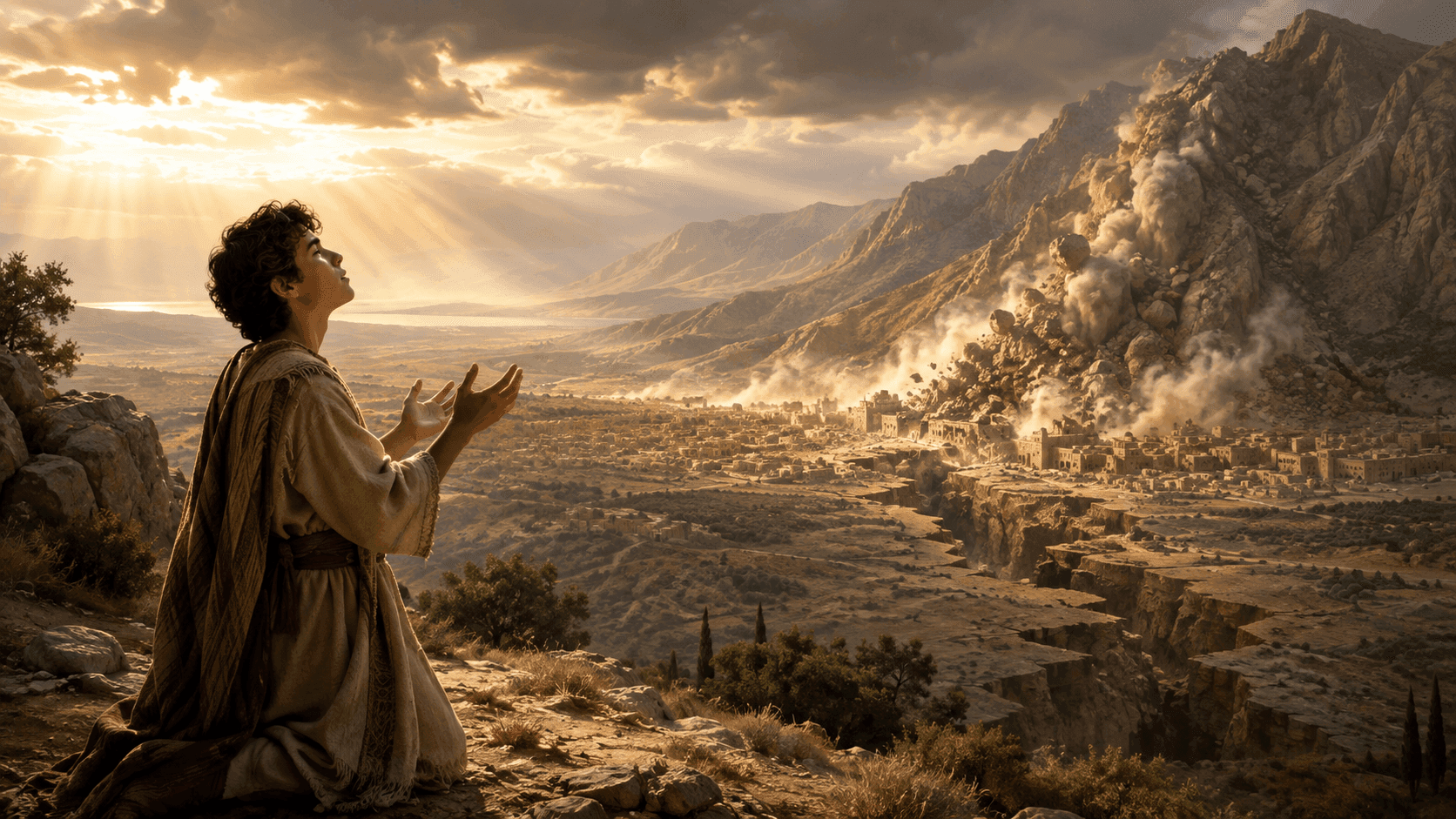
Other traditions offer potentially related accounts of Melchizedek’s withdrawal from human society. One version comes from the Story of Melchizedek, a Greek text attributed to Athanasius of Alexandria (ca. AD 295–373). It depicts Melchizedek as the son of an idolatrous king, named Melchi, who planned to offer up Melchizedek as a sacrifice to the gods, along with hundreds of other boys. After being saved from this fate by his mother, Melchizedek prayed unto the Lord and the entire city of idolaters was destroyed, including his own family. Alarmed at this display of divine justice, Melchizedek “went deep into the forest” on a mountain “and remained there for seven years.”12 Other recensions say the period lasted for 60 years.13 A separate version of the story, recorded in Palaea Historica, records that Melchizedek “got up and went away to Mount Tabor and entered into the northern part of the mountain into a ravine. He remained there for forty years, with no human contact and not leaving that spot.”14
To be sure, these traditions do not describe Melchizedek as being translated into heaven. Nevertheless, his retreat into the wilderness has the flavor of him escaping from mortal society and seems to echo his literal translation in 2 Enoch.15
Enoch and Melchizedek as Wild Men
Somewhat related to the topic of translation is the theme of wildness. Within the Book of Moses, we read that the people gathered to the “high places” to listen to Enoch preach. Upon encountering him they declared, “there is a strange thing in the land; a wild man hath come among us” (Moses 6:38). As presented in a separate evidence article, this description is supported by several ancient and medieval sources.16
Remarkably, Melchizedek is also described as “a wild man” who dwells in a mountain setting in the Story of Melchizedek: “[Melchizedek] returned to the mountain in great fear. He went deep into the forest, and remained there for seven years, naked as when he emerged from his mother’s womb; and his fingernails became a span long, the hair of his head (hung) down to his loins, and his back became like a tortoise-shell. Berries were his nourishment, and his drink was the dew, which he lapped up.” After this, Abraham was told by the Lord, “Saddle your donkey, carry precious clothes and a razor, go up on Mount Tabor, and cry out three times, ‘Man of God!’ And a wild man will rise up. Do not be afraid of him, but shave him, pare his nails, clothe him, and be blessed by him.”17 A similar description is given in Palaea Historica.18
Enoch and Melchizedek as Mediating Priests
Although the Bible clearly establishes Melchizedek’s priestly status, the same is not true for Enoch. This may be significant, seeing that Joseph Smith’s revelations abundantly affirm Enoch’s priestly identity and associations, as do a variety of extrabiblical texts, including 1 Enoch, 2 Enoch, 3 Enoch, and several Jewish sources. Because a separate evidence article explores and evaluates Enoch’s priestly associations, they won’t be further developed here.19
What should be highlighted, however, is the conclusion of 2 Enoch. Not only are Enoch’s priestly credentials overtly established in this text, but there is a very strong sense that Melchizedek is intended to be viewed as Enoch’s archetypal priestly successor. The presence of these two prominent priestly figures in the same work has, in fact, been somewhat puzzling to scholars. Charles Gieschen asks, “How can two priestly mediators of very exalted status like Enoch and Melchizedek share the stage in this document?” After laying out some differences between their personas and identities in the narrative, Gieschen answers: “To return to the theatre analogy: although Enoch spends much time on stage setting up the drama, he exits to heaven before Melchizedek has the stage for the climactic scene and the dramatic final bow.”20 In other words, one figure establishes a precedent and sets up the conditions for the other to follow. This, of course, resonates very strongly with passages like JST Genesis 14:27 and D&C 76:56–58, in which Melchizedek’s priesthood is not only descended from—but is directly linked with—the priesthood order of Enoch.
The book of 3 Enoch, which depicts Enoch in his glorified form as the angel Metatron, is also significant in this regard. After commenting on how “Melchizedek may have been regarded as the high priest of the heavenly Temple,” Philip Alexander notes that a “number of clear parallels between the heavenly Melchizedek of Qumran and the Metatron of 3 Enoch at once suggest themselves: both figures hold exalted, if not pre-eminent, positions among the angels; both are heavenly judges (for Metatron’s court see 3En 16:1), and both, apparently, had earthly lives prior to their exalted, heavenly states.”21
Enoch and Melchizedek as Kings
While Melchizedek’s status as a king is well attested in the Bible, nothing in that text indicates that Enoch was also a king. There are, however, some indications that Enoch attained a type of kingly status in the Book of Moses. The most prominent clue is Enoch’s divine enthronement. When speaking to the Lord, Enoch declared, “thou hast sworn unto me, and commanded me that I should ask in the name of thine Only Begotten; thou hast made me, and given unto me a right to thy throne, and not of myself, but through thine own grace” (Moses 7:59).
Enoch’s enthronement is also well established in a number of extrabiblical traditions.22 For instance, in 3 Enoch 16:2, Metatron (Enoch in his angelic form) describes how one individual “was afraid and trembled … when he saw me seated upon a throne like a king” (3 Enoch 16:2).23 As understood by Joseph Dan, “Metatron sits on it as God sits on His Throne,” leading to the conclusion that Metatron is “almost a miniature version of God Himself.”24
Andrei Orlov has also drawn attention to several aspects of Enoch’s kingly status in 2 Enoch, which seem to be modeled upon Adam. These include the frightening aspects of Enoch’s face, his records and management of the earth and all its features, his care for animals, and allusions to Enoch fulfilling a role analogous to an “earthly king.”25 However, as concluded by Orlov, the text “understands Enoch not as one of the earthly kings, but as the king of the earth.”26
Enoch and Melchizedek Having Power Over the Earth
The Book of Moses establishes that Enoch had divine power given to him, which was actuated through his speech. As recorded in Moses 7:13, Enoch “spake the word of the Lord, and the earth trembled, and the mountains fled, even according to his command; and the rivers of water were turned out of their course.” In JST Genesis 14, Enoch’s power is connected to his priesthood order and thereby extended to all of the faithful who follow after him, including Melchizedek, the only follower mentioned by name:
For God having sworn unto Enoch and unto his seed with an oath by himself; that every one being ordained after this order and calling should have power, by faith, to break mountains, to divide the seas, to dry up waters, to turn them out of their course; To put at defiance the armies of nations, to divide the earth, to break every band, to stand in the presence of God; to do all things according to his will, according to his command, subdue principalities and powers; and this by the will of the Son of God which was from before the foundation of the world. … And now, Melchizedek was a priest of this order. (JST Genesis 14:30–31)
Melchizedek’s association with this priesthood order—and especially its power over the earth—is rather intriguing in light of the account found in the Story of Melchizedek. After being nearly sacrificed to false gods by his father, Melchizedek ascended upon a mountain and offered the following prayer:
“Oh God, the Lord of all, creator of heaven and earth, I beseech you, the only true God. Hear me in this hour and order that for all those who were present at the sacrifice of my brother Melchi the place may become like Hades and devour them.” And God heard Melchizedek, and immediately the earth opened its mouth wide and devoured them, all the family of Melchizedek together with the entire city; neither man, nor altar, nor temple, nor animal, nor any trace of the whole city remained, but everything was swallowed up.27
Conclusion
Based on the Bible alone, there is little reason to associate Enoch and Melchizedek in any intimate way. Enoch is barely described, while Melchizedek appears generations later as the priest-king who blessed Abraham. Joseph Smith’s revelations therefore make a bold move by explicitly and emphatically connecting Melchizedek and Enoch as prominent figures within the same sacred lineage and priesthood order. The fact that non-canonical traditions repeatedly draw the two figures into similar roles, often in ways that dovetail with unique details in Smith’s own revelations, is thus quite remarkable.
Enoch and Melchizedek, for instance, are both associated with withdrawal from ordinary mortal society and, in some traditions, with translation into the heavenly realms.28 Related accounts portray them as unusual wilderness figures, even labeling them as “wild” men. Other parallels involve their shared priestly and royal associations. 2 Enoch presents Melchizedek as the climactic successor within a priestly lineage rooted in Enoch and his descendants, while a variety of other extrabiblical sources independently associate Enoch with specific priestly and royal motifs that mirror the role of Melchizedek and closely parallel details in Smith’s own revelations.29
Perhaps the most vivid and compelling parallel concerns the extraordinary power over nature associated with both figures. Joseph Smith’s revelations explicitly connect Enoch’s divinely empowered speech and control over the natural world—including his ability to move mountains and “divide the earth”—with the priesthood order later identified with Melchizedek. This association finds a particularly distinctive counterpart in the Story of Melchizedek, where Melchizedek’s prayer causes the earth to open up and swallow an idolatrous city.
While no single parallel is conclusive, the cumulative pattern is striking. Points of contact converge around themes of priesthood, mediation, kingship, translation, wildness, and miraculous power over the earth. Taken together, these correspondences meaningfully support the antiquity of Smith’s revelations, as well as the validity of his prophetic calling.
Jeffrey M. Bradshaw and David J. Larsen, In God’s Image and Likeness 2: Enoch, Noah, and the Tower of Babel (The Interpreter Foundation and Eborn Books, 2014), 82–83.
David J. Larsen, “Enoch and the City of Zion: Can an Entire Community Ascend to Heaven?” BYU Studies Quarterly 53, no. 1 (2014): 25–37.
Frank F. Judd, Jr., “Melchizedek: Seeking After the Zion of Enoch,” in Sperry Symposium Classics: The Old Testament, ed. Paul Y. Hoskisson (BYU Religious Studies Center and Deseret Book 2005), 69–82.
Bible
Genesis 14:18–20
JST Genesis 14:26–35
Psalm 110:4
Hebrews 5:6, 10
Hebrews 6:20
Hebrews 7:1, 10–11, 15, 17, 21
Doctrine and Covenants
Doctrine and Covenants 84:14–16
Doctrine and Covenants 76:56–58
Doctrine and Covenants 107:40–57
Book of Moses
Moses 7:62–63
Moses 6:38
Moses 7:3
Moses 7:59
Moses 7:13
Book of Abraham
Abraham 1:2–3
- 1. See Hebrews 5:6, 10; 6:20; 7:1, 10–11, 15, 17, 21.
- 2. See also D&C 107:40–57; Abraham 1:2–3.
- 3. Frank F. Judd, Jr., “Melchizedek: Seeking After the Zion of Enoch,” in Sperry Symposium Classics: The Old Testament, ed. Paul Y. Hoskisson (BYU Religious Studies Center and Deseret Book, 2005), 69–82.
- 4. Kent P. Jackson, “Promises and Priesthood in Genesis,” in Understanding Joseph Smith's Translation of the Bible (BYU Religious Studies Center and Deseret Book, 2022), 61‒70. Although Melchizedek can be viewed as a heavenly figure in Psalm 110, that doesn’t necessarily indicate that he was a translated being. This is because many other figures who died, as nearly all mortals eventually do, are regularly depicted in Jewish traditions as angelic beings in the heavens. Even some biblical texts feature this idea (Luke 16:22–31; Jeremiah 31:15; Matthew 2:17–18). For more exploration of translated communities, see David J. Larsen, “Group Ascension to Heaven in the Scriptures and in Early Judaism and Christianity,” in The Temple: Symbols, Sermons, and Settings, ed. Stephen D. Ricks and Jeffrey M. Bradshaw (Interpreter Foundation and Eborn Books, 2023), 215–235; David J. Larsen, “Enoch and the City of Zion: Can an Entire Community Ascend to Heaven?” BYU Studies Quarterly 53, no. 1 (2014): 25–37.
- 5. Translation by Frances I. Anderson, “2 (Slavonic Apocalypse of) Enoch,” in The Old Testament Pseudepigrapha, 2 vols., ed. James H. Charlesworth (Doubleday, 1983–1985), 1:208 (recension J).
- 6. Charles A. Gieschen, “Enoch and Melchizedek: The Concern for Supra-Human Priestly Mediators in 2 Enoch,” in New Perspectives on 2 Enoch: No Longer Slavonic Only, ed. Andrei A. Orlov, Gabriele Boccaccini, and Jason M. Zurawski (Brill, 2012), 384.
- 7. See Scripture Central, “Book of Moses Evidence: Intertextuality with 1 Enoch and Psalm 85,” Evidence 534 (February 25, 2026); Scripture Central, “Book of Moses Evidence: Greeting Zion with a Kiss,” Evidence 550 (June 24, 2026).
- 8. Anderson, “2 (Slavonic Apocalypse of) Enoch,” 208.
- 9. Anderson, “2 (Slavonic Apocalypse of) Enoch,” 189.
- 10. See Andrei Orlov, “Melchizedek Legend of 2 (Slavonic) Enoch,” Journal for the Study of Judaism 31, no. 2 (2000): 28: “2 Enoch presents Melchizedek as a continuation of the priestly line from Methuselah, son of Enoch, directly to the second son of Lamech, Nir (brother of Noah), and on to Melchizedek. 2 Enoch therefore considers Melchizedek as the grandson of Lamech. This understanding of Melchizedek as the continuation of the priestly line of descendants of Enoch has interesting parallels in rabbinic literature.” Likewise, David Suter has summarized these chapters as containing “a priestly succession narrative dealing with Melchizedek.” David W. Suter, “Excavating 2 Enoch: The Question of Dating and the Sacerdotal Traditions,” in New Perspectives on 2 Enoch, 117.
- 11. For one interpretation of Melchizedek’s ambiguous roles in 2 Enoch 71:32–35, see Harold W. Attridge, “Melchizedek in Some Early Christian Texts and 2 Enoch,” in New Perspectives on 2 Enoch, 397–398. It could be that, in addition to being identified as a historical person, Melchizedek functions in a typological capacity, similar to the figure of Elias in the Latter-day Saint tradition. See George A. Horton Jr., “Elias,” in Encyclopedia of Mormonism, ed. Daniel H. Ludlow, 5 vols. (Macmillan, 1992), 2:449; Jan Francisco, “Elias: Prophet of the Restoration,” Interpreter: A Journal of Latter-day Saint Faith and Scholarship 55 (2023): 197–218. For Enoch’s later role in the eschaton, see Moses 7:62–63.
- 12. Pierluigi Piovanelli, “The Story of Melchizedek,” in Old Testament Pseudepigrapha: More Noncanonical Scriptures, vol. 2, ed. James R. Davila and Richard Bauckham (William B. Eerdmans, 2025), 79.
- 13. See Piovanelli, “The Story of Melchizedek,” 79 n. b.
- 14. William Adler, “Palaea Historica (‘The Old Testament History’),” in Old Testament Pseudepigrapha: More Noncanonical Scriptures, 614–615.
- 15. This proposal is reinforced by several shared details in these accounts. For instance, in 2 Enoch 71:28, Melchizedek was said to be transported into “paradise where Adam was formerly for 7 years.” The text later describes Melchizedek as hiding “for 7 years” at the site of Noah’s ark (2 Enoch 72:6), which matches the amount of time that Melchizedek goes into hiding in the Story of Melchizedek. The location and context of Melchizedek’s retreat from society are also similar, as each text holds that he hid on a mountain and that this is where a righteous man (i.e., Abraham) encountered him. See 2 Enoch 72:6; Story of Melchizedek 36:1–2; Palaea Historica 36:1–3. It follows, then, that Melchizedek’s translation in 2 Enoch and his escape from mortal society in the Story of Melchizedek and Palaea Historica may be related in some manner.
- 16. See Scripture Central, “Book of Moses Evidence: Enoch the ‘Wild Man’,” Evidence 516 (October 15, 2025).
- 17. Piovanelli, “The Story of Melchizedek,” 79–80. The theme of clothing and blessing Melchizedek may be echoed in the clothing motif applied to Enoch in Moses 7:3. See Scripture Central, “Book of Moses Evidence: Enoch Clothed with Glory,” Evidence 500 (June 25, 2025).
- 18. Adler, “Palaea Historica (‘The Old Testament History’),” 614–615: “[Melchizedek] got up and went away to Mount Tabor and entered into the northern part of the mountain into a ravine. He remained there for forty years, with no human contact and not leaving that spot. He ate [wild] plants and drank only water up until the time when Abraham was dispatched to him, in accordance with the Lord God’s instruction to him to saddle his donkey and take fine raiment, and bread and wine and a razor. For this is what the angel of the Lord said to him, ‘Go up to the mountain, stand on the rock, and cry out three times, “Man of God!” And a wild-looking man will come out to you. … You will receive a blessing from him, and you will be blessed, because he is priest of God the Most High; and Melchizedek is the man’s name.’”
- 19. See Scripture Central, “Book of Moses Evidence: Enoch the High Priest,” Evidence 555 (August 12, 2026).
- 20. Gieschen, “Enoch and Melchizedek,” 384–385.
- 21. Translation by Philip Alexander, “3 (Hebrew Apocalypse of) Enoch,” in The Old Testament Pseudepigrapha, 1:249–250. For further discussions of Melchizedek in various ancient texts, see Eric F. Mason, “Melchizedek Traditions in Second Temple Judaism,” in New Perspectives on 2 Enoch, 343–360; Devorah Dimant, “Melchizedek at Qumran and in Judaism: A Response,” in New Perspectives on 2 Enoch, 361–368.
- 22. See Scripture Central, “Book of Moses Evidence: Enoch’s Right to God’s Throne,” Evidence 498 (June 11, 2025).
- 23. Translation by Alexander, “3 (Hebrew Apocalypse of) Enoch,” 268.
- 24. Joseph Dan, The Ancient Jewish Mysticism (MOD Books, 1990), 115–117.
- 25. Andrei A. Orlov, The Enoch-Metatron Tradition, Texts and Studies in Ancient Judaism 107 (Mohr Siebeck, 2005), 216–218. For Enoch’s association with divine “face” imagery in the Book of Moses, see Scripture Central, “Book of Moses Evidence: Enoch Stood Before God’s Face,” Evidence 519 (November 5, 2025).
- 26. Orlov, The Enoch-Metatron Tradition, 217.
- 27. Piovanelli, “The Story of Melchizedek,” 79. For a comparable account, see Adler, “Palaea Historica (‘The Old Testament History’),” 614.
- 28. For more on this topic, see Scripture Central, “Book of Moses Evidence: High and Lifted Up,” Evidence 551 (July 1, 2026).
- 29. See Scripture Central, “Book of Moses Evidence: Enoch the High Priest,” Evidence 555 (August 12, 2026).