Evidence #529 | January 21, 2026
Book of Mormon Evidence: Bayesian Analysis of The Maya
Post contributed by
Scripture Central
Abstract
A study using Bayesian statistical analysis has evaluated numerous correspondences between the Book of Mormon and features described in The Maya, a prominent text on Mesoamerican culture. According to the authors of the study, its results favor a Mesoamerican setting for the Book of Mormon.Since the Book of Mormon was published in 1830, much new research has come to light about the ancient Americas, where Latter-day Saints believe most of the story took place. This is also true specifically of Mesoamerica, a proposed setting that many Latter-day Saint scholars feel best reflects the text’s descriptions.1 In fact, many details of the Nephite record that were once considered to be strange or anachronistic have actually turned out to be surprisingly authentic or plausible, both throughout the Americas generally and in certain parts of Mesoamerica in particular.2
If the Book of Mormon is a genuine history of a real ancient American culture, as Latter-day Saints affirm, this trend towards confirmation is not unexpected.3 If, however, those skeptical of the text’s authenticity are correct and it is a work of nineteenth-century fiction, “then its author was guessing every time he wrote as fact something about the ancient inhabitants of the Americas.”4 This is because the general American public in 1830 knew very little about Mesoamerican culture and history.5 Thus, if Joseph Smith were merely making up the contents of the Book of Mormon, it seems unlikely that his guesswork would very often and very accurately reflect a Mesoamerican setting.6
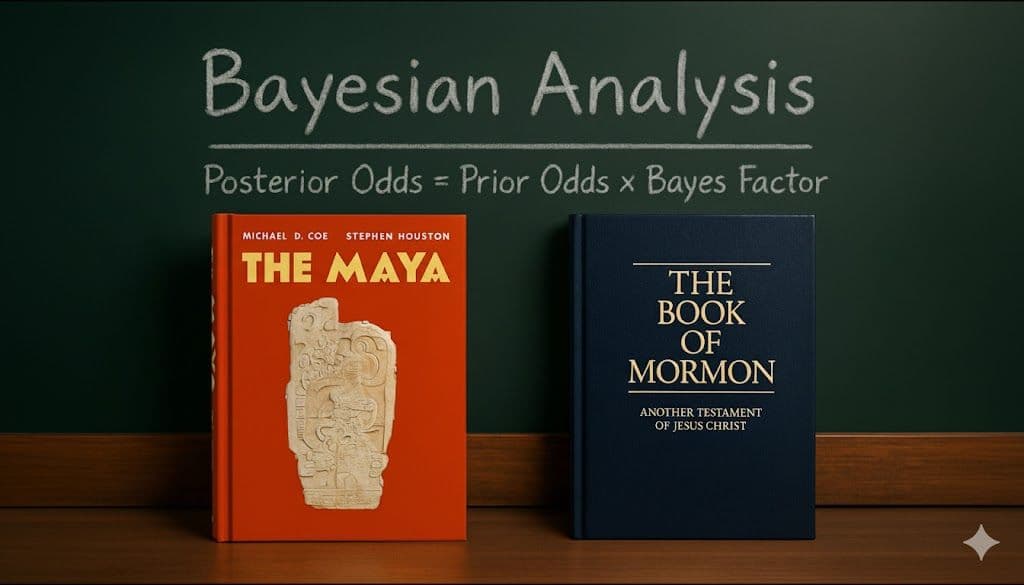
In order to test the Book of Mormon along these particular grounds, Bruce E. Dale and Brian M. Dale (a father and son duo) carried out a study comparing the details found in the Book of Mormon with those described in The Maya. This is a prominent introductory text on Maya culture authored by Michael Coe and Stephen Houston, two eminent scholars in Mesoamerican studies.7 Specifically, the Dales used a Bayesian statistical analysis to help quantify the significance of parallels between the contents of the Book of Mormon and a Mesoamerican setting to see if they could likely have resulted from a series of lucky guesses.
Understanding the Strengths and Limitations of Bayesian Statistics
It is important to understand that Bayesian statistics function somewhat differently than standard statistical models. Traditional frequency-based statistical methods depend on sampling from observable data, and their ability to predict outcomes generally improves with larger sample sizes. For instance, under controlled circumstances during clinical trials, medical professionals may observe the effectiveness of a medical treatment in many thousands of patients. Then, based on that large set of data, the probability of the treatment’s effectiveness may be reliably predicted for future patient use.
In contrast, many decisions we make in our daily lives are based on much more intuitive or informal probability assessments, with comparatively limited amounts of data. Imagine, for instance, that you start to bake a meal for dinner and then the power suddenly turns off. Based on past experience, you may guess there is about a 70% chance the power will turn back on within 20–30 minutes, so you decide to wait it out and hope you can eventually bake the meal before it gets too late. It must be recognized, however, that the 70% figure is just a ballpark estimate based on a fairly limited number of past experiences and an imperfect memory of them.
Bayesian statistics are often used in situations more like the second scenario, where sufficient samples of data from controlled observations are not readily available, either because the data is impossible or impractical to collect. As explained by the Dales, Bayesian statistics offer a practical “approach to the situation in which mathematically well-defined probabilities do not exist.”8
Bayesian analysis is particularly useful when trying to assess the probability of an outcome which depends on many different items of evidence, both pro and con. Under the Bayesian approach, each piece of relevant data must be assigned what is termed a “likelihood ratio,” even if the value of the ratio must, of necessity, be based on an informal or intuitive judgment.
Consistently quantifying intuitive probability estimates in this manner has several advantages. For one thing, it provides transparency and precision concerning the degree of belief that an individual may have about the likelihood of a certain outcome. It would be helpful to know, for example, if an outcome perceived as “unlikely” is believed to have around a 10% probability of occurring or whether it is closer to .001%. Both estimates may technically qualify as “unlikely,” but there is a big difference between 1 in 10 compared to a 1 in 100,000.
Another advantage of Bayesian analysis is that once all the items of evidence in a study are assigned a statistical value, it is easier to compare their significance, relative to one another, in an overall argument. This also allows individuals who hold opposing views to identify specific areas of disagreement within the data that contribute most significantly to any of their differing conclusions. Finally, in the real world, we are constantly updating and necessarily modifying or changing our intuitive beliefs (or degrees of belief) in response to new data and observations. The Bayesian approach can help track and quantify such adjustments over time.
The Dales’ Bayesian Study
In their study, the Dales gathered a large amount of data from the Book of Mormon and compared it to the cultural features presented in The Maya. In total, they identified 131 positive correspondences within six separate categories:9
- Political (33 correspondences)
- Cultural/Social (31 correspondences)
- Religion (19 correspondences)
- Military/Warfare (12 correspondences)
- Physical/Geographical (13 correspondences)
- Technological/Miscellaneous (23 correspondences)
Examples include specific cultural features such as city-state governance, military ambushes, the practice of cannibalism, the construction of large roads, and so forth.10 The authors of the study also included negative evidence (or absences of positive evidence) that, in their judgment, might count against any Book of Mormon connections to an ancient Mesoamerican setting. These were things mentioned in The Maya that in some way might seem to contradict the Book of Mormon’s claims. Yet, in total, they only identified six specific items of negative evidence. These involve Book of Mormon claims regarding “the existence of (1) horses, (2) elephants, (3) iron, (4) steel, (5) copper, and (6) refined gold and silver.”11
With these competing data sets in hand, the authors assigned each item of evidence a likelihood ratio. The statistics get a little bit tricky, but this is essentially a number that expresses how strongly a piece of evidence favors one explanation over another. Imagine, for instance, that you are in your home and notice an encroaching storm front while looking out the window. The clouds are bulging with darkness, and about a mile away you can see a massive wall of rain rapidly coming toward you. This observation would strongly favor the hypothesis that your home will be rained on today over the hypothesis that it won’t be rained on. But how strongly do you believe it will rain? Based on past experience, you might estimate that there is a 99.9% chance that it will rain on your home, meaning there would only be a 0.1% chance that the storm will dissipate before it reaches you.
A raw probability estimate—such as thinking there is about a 99.9% chance of rain—is a belief about how likely a hypothesis is to be true. A likelihood ratio, by contrast, describes how likely any given piece of evidence is under competing hypotheses. In the example above, you would ask yourself two questions:
- How likely would it be to observe this massive wall of rain if it really is going to rain on my home today?
- How likely would it be to observe the same evidence if it were not going to rain on my home today?
If the storm front is something you would expect to see 99.9% of the time when rain is coming but only 0.1% of the time when it is not, then the evidence is 999 times more likely under the “will rain” hypothesis than under the “won’t rain” hypothesis. That ratio—the comparison of how well each hypothesis predicts the same evidence—is the likelihood ratio.
When expressed as a formal equation, values greater than 1 favor the hypothesis in the numerator, while values less than 1 favor the competing hypothesis in the denominator. The farther the ratio is from 1 in either direction, the stronger the evidence for that hypothesis. Determining which hypothesis is placed on the top or bottom is completely arbitrary and doesn’t affect the equation, which in a basic form, looks like this:
Because the authors of the study wished to keep their model both transparent and easy to apply, they grouped evidences into three broad tiers of strength—supportive, positive, and strong—each represented by a designated likelihood ratio:12
- Supportive Evidence: Features in the Book of Mormon that have a “specific” relationship with the contents of The Maya. These features were assigned a likelihood ratio of 0.5, meaning the evidence is judged to be twice as likely under a historical model as under a fictional one.
- Positive Evidence: Features in the Book of Mormon that have a “specific and detailed” relationship with the contents of The Maya. These features were assigned a likelihood ratio of 0.1, meaning the evidence is judged to be ten times as likely under a historical model as under a fictional one.
- Strong Evidence: Features in the Book of Mormon that have a “specific, detailed, and unusual” relationship with the contents of The Maya. These features were assigned a likelihood ratio of 0.02, meaning the evidence is judged to be fifty times as likely under a historical model as under a fictional one.
As can be seen, the hypothesis that favored the authenticity of the Book of Mormon is represented by values in the denominator of the equation. Each item of evidence that counted against the Book of Mormon was also placed in a three-tier system, each one being assigned a likelihood ratio of 2, 10, or 50 (placed in the numerator of the equation). Note that these numbers are the reciprocals of the values used for the supporting positive evidence (0.5, 0.1, 0.02) and indicate that the negative evidence is viewed as two times, ten times, or fifty times more likely if the Book of Mormon is fictional than if it reflects a historical Mesoamerican context.
This three-category framework can be compared to three separate bins that one might use for sorting different types of laundry (such as whites, darks, and colors). At least for most wardrobes, not every item of clothing will perfectly match the category description of the bin into which it is placed, just as each item of evidence in the Dales’ study doesn’t perfectly match its assigned evidential category. While setting up the analysis in this manner undoubtedly sacrifices some precision (for both positive and negative categories of evidence), it also makes it much easier to evaluate both types of evidence against one another.
In order to help compensate for their own biases, the Dales included what they term a “skeptical prior,” which they established as “a billion to one that the Book of Mormon is a work of fiction.”13 This means that, before even considering any positive evidence, the analysis already incorporated a very strong and over-compensating prior assumption that the Book of Mormon is fictional.14
Conclusion
After accounting for all of the positive and negative correspondences—and incorporating their strong skeptical prior—the authors concluded: “We find that the likelihood that the Book of Mormon is fictional is about 1.03 x 10⁻¹¹¹, less than one in a thousand, billion, billion, billion, billion, billion, billion, billion, billion, billion, billion, billion, billion.”15
As might be expected, some have questioned, doubted, or even outright rejected the plausibility of this bold claim. While the Dale’s position hasn’t been disproven, those who strongly feel the Book of Mormon is indeed a work of fiction may find this level of support for its claims as unfathomable. Even those who believe in the text’s divine origins and subscribe to a Mesoamerican geography model may feel uncomfortable with such a strong position.
In light of these and other potential concerns, some important explanations are in order. It must be stressed that this Bayesian study was not grounded in empirical or objective statistical probabilities.16 In every instance, the likelihood ratio assigned to each individual item of evidence was instead derived from the intuitive judgments and assumptions of the authors of the study. Other observers might assign very different ratio estimates to each identified correspondence, whether positive or negative. One could also add or subtract from the total number of correspondences or look to different sources, aside from The Maya, to identify relevant items of evidence.17 Imagine, for instance, if a large body of strongly weighted negative evidence were to be included in the analysis, and if many of the positive items of evidence were discounted out of hand or reduced in significance. At some point, the argument would eventually flip in the other direction—perhaps even very strongly—depending on what types of evidence are allowed into the analysis and how they are subjectively weighted.
This isn’t to say that the Dales’ final conclusion is necessarily wrong but simply that it is based on a subjective sampling of data, as well as a series of subjective probability assessments of that selected data. Ultimately, each individual will have to make up his or her own mind about the value of each item of evidence, as well as what types of evidence should be included in such a study.
Perhaps what is most helpful about the Dales’ Bayesian approach is that it offers a tool which transparently tracks the many items of evidence that they found to be relevant, based on a neutral and authoritative scholarly publication. The study also discloses many intuitive assessments they made about each correspondence, whether pro or con. This establishes a Bayesian framework that others could potentially refine or adapt for their own purposes. For instance, the Dales themselves have conducted a follow-up study which expands upon and reinforces their earlier published results and conclusions.18
Also, on a more basic level, their study has value simply because it highlights many potential correspondences between the Book of Mormon and a Mesoamerican setting. Even if one elected to exclude a number of positive items from the Dales’ list (treating them as non-evidence) or were to give them a very different probability evaluation, there may still be enough significant parallels to make a well-reasoned case in favor of the Book of Mormon’s authenticity, or at least to give those skeptical of its ancient American origins a reason to reassess their disbelief. In conclusion, because the study follows clear procedures and indeed has some merit, it should not be dismissed out of hand. Without ruling out other factors and alternatives yet to be similarly analyzed, the Dales concluded, “Using Dr. Coe’s own book, we find that early Mesoamerica has a very great deal indeed to do with the Book of Mormon.”19
Matthew Roper, “Anachronisms: Accidental Evidence in Book of Mormon Criticisms,” Interpreter: A Journal of Latter-day Saint Faith and Scholarship 65 (2025): 1–280.
Bruce E. Dale and Brian M. Dale, “Joseph Smith: Still the World’s Greatest Guesser (and Getting Better all the Time),” (published in the Scripture Central archive, 2021).
Bruce E. Dale and Brian M. Dale, “Joseph Smith: The World’s Greatest Guesser (A Bayesian Statistical Analysis of Positive and Negative Correspondences Between the Book of Mormon and ‘The Maya’),” Interpreter: A Journal of Latter-day Saint Faith and Scholarship 32 (2019): 77–186.
- 1. Other than accepting that most of the events described in the Book of Mormon took place in the Americas, Scripture Central doesn’t take an official or specific view of Book of Mormon geography and instead treats the matter as a matter of ongoing investigation and scholarly discussion. For an overview of this topic, see Scripture Central, “Where Did the Book of Mormon Happen? (2 Nephi 1:8),” KnoWhy 431 (August 20, 2020). For examples of prominent Latter-day Saint explorations of this setting, see John E. Clark, “Archaeological Trends and Book of Mormon Origins,” BYU Studies Quarterly 44, no. 4 (2005): 83–104; John L. Sorenson, Images of Ancient America: Visualizing Book of Mormon Life (FARMS, 1998); John L. Sorenson, Mormon's Codex: An Ancient American Book (Deseret Book and Neal A. Maxwell Institute for Religious Scholarship, 2013).
- 2. See Matthew Roper, “Anachronisms: Accidental Evidence in Book of Mormon Criticisms,” Interpreter: A Journal of Latter-day Saint Faith and Scholarship 65 (2025): 1–280. In addition to the possibility of the Nephites dwelling in this region, it seems that the Mulekites landed and settled just north of that area. See Scripture Central, “Book of Mormon Evidence: Mulek’s Transoceanic Voyage,” Evidence 466 (October 9, 2024).
- 3. For the most up-to-date works on the Book of Mormon as a real, ancient history, see Gregory Steven Dundas, Mormon’s Record: The Historical Message of the Book of Mormon (Religious Studies Center, Brigham Young University; Deseret Book, 2024); Brant Gardner, Traditions of the Fathers: The Book of Mormon as History (Greg Kofford Books, 2015).
- 4. Bruce E. Dale and Brian M. Dale, “Joseph Smith: The World’s Greatest Guesser (A Bayesian Statistical Analysis of Positive and Negative Correspondences Between the Book of Mormon and ‘The Maya’),” Interpreter: A Journal of Latter-day Saint Faith and Scholarship 32 (2019): 79.
- 5. See Dale and Dale, “World’s Greatest Guesser,” 87.
- 6. Joseph Smith and early Church leaders didn’t learn much about Mesoamerica until years later when they encountered the works of John Lloyd Stephens and Fredrick Catherwood. See Scripture Central, “Book of Mormon Evidence: Advanced Civilization,” Evidence 383 (December 5, 2022).
- 7. The Maya was first published by Coe, as a stand-alone author, in 1966. Stephen Housten joined him as a co-author for the book’s 9th edition in 2015. The tenth edition, published in 2022, is the most recent version of the work. Both authors are eminently respected in the field of Mesoamerican studies and anthropology, with Coe obtaining his PhD from Harvard and Houston earning his from Yale. Interestingly, Houston also held various professorships at BYU (between 1994–2004), during which time he conducted groundbreaking excavations in Guatemala.
- 8. Dale and Dale, “World’s Greatest Guesser,” 81.
- 9. Dale and Dale, “World’s Greatest Guesser,” 88–89; capitalization style altered.
- 10. Each item is described in some detail in Appendix A. See Dale and Dale, “World’s Greatest Guesser,” 97–155.
- 11. Dale and Dale, “World’s Greatest Guesser,” 92. See also Scripture Central, “Book of Mormon Evidence: Horses,” Evidence 388 (January 17, 2023); Scripture Central, “Book of Mormon Evidence: Traditions of Horses and Elephants,” Evidence 243 (September 21, 2021); Scripture Central, “Book of Mormon Evidence: Olmec Iron,” Evidence 35 (September 19, 2020); Scripture Central, “Book of Mormon Evidence: Decorative Iron,” Evidence 356 (July 11, 2022); Scripture Central, “Book of Mormon Evidence: Laban’s Steel Sword,” Evidence 135 (January 4, 2021); Scripture Central, “Book of Mormon Evidence: Nephi’s Steel Bow,” Evidence 132 (January 4, 2021); Scripture Central, “Book of Mormon Evidence: Composition of the Plates,” Evidence 76 (September 19, 2020).
- 12. These descriptions are pulled from various portions of the article. See Dale and Dale, “World’s Greatest Guesser,” 79–81.
- 13. Dale and Dale, “World’s Greatest Guesser,” 88.
- 14. The authors also performed control studies comparing details in The Maya with two other nineteenth-century works, namely the View of the Hebrews and Manuscript Found. Dale and Dale, “Joseph Smith: The World’s Greatest Guesser,” 85, 90–92, 94–96. The works in question were Solomon Spaulding’s Manuscript Found and Ethan Smith’s View of the Hebrews—books that some purport influenced the Book of Mormon. However, this and other studies have shown that these books contain few, if any, real connections to the Book of Mormon and instead contain far more significant differences. Furthermore, these works were found to have little to do with what is known about ancient Mesoamerica under this control study. As explained by the Dales, “In the case of Manuscript Found, our posterior conclusion is much stronger than our prior assumption that this book has little to do with ancient Indian cultures. … In the case of View of the Hebrews, weighing both the positive and negative points of evidence (correspondences) between this book and Coe’s book The Maya, we find that the positive evidences are essentially counterbalanced by the negative evidences.” Dale and Dale, “World’s Greatest Guesser,” 94.
- 15. Dale and Dale, “World’s Greatest Guesser,” 93; italics in original.
- 16. This includes the extensive evaluation of the Book of Mormon’s relationship with The Maya, as well as the control studies involving View of the Hebrews and Manuscript Found.
- 17. It may be helpful, for instance, to compare the Book of Mormon with other modern resources on ancient American civilizations from different regions. See, for example, Timothy R. Pauketat, ed. The Oxford Handbook of North American Archaeology (Oxford University Press, 2012); Helaine Silverman and William H. Isbell, eds. Handbook of South American Archaeology (Springer, 2008). Even locations outside of the Americas may be helpful as control studies.
- 18. See Bruce E. Dale and Brian M. Dale, “Joseph Smith: Still the World’s Greatest Guesser (and Getting Better all the Time),” (published in the Scripture Central archive, 2021).
- 19. Dale and Dale, “World’s Greatest Guesser,” 94.