Evidence #545 | May 20, 2026
Book of Moses Evidence: The Strength of Moses
Post contributed by
Scripture Central
Abstract
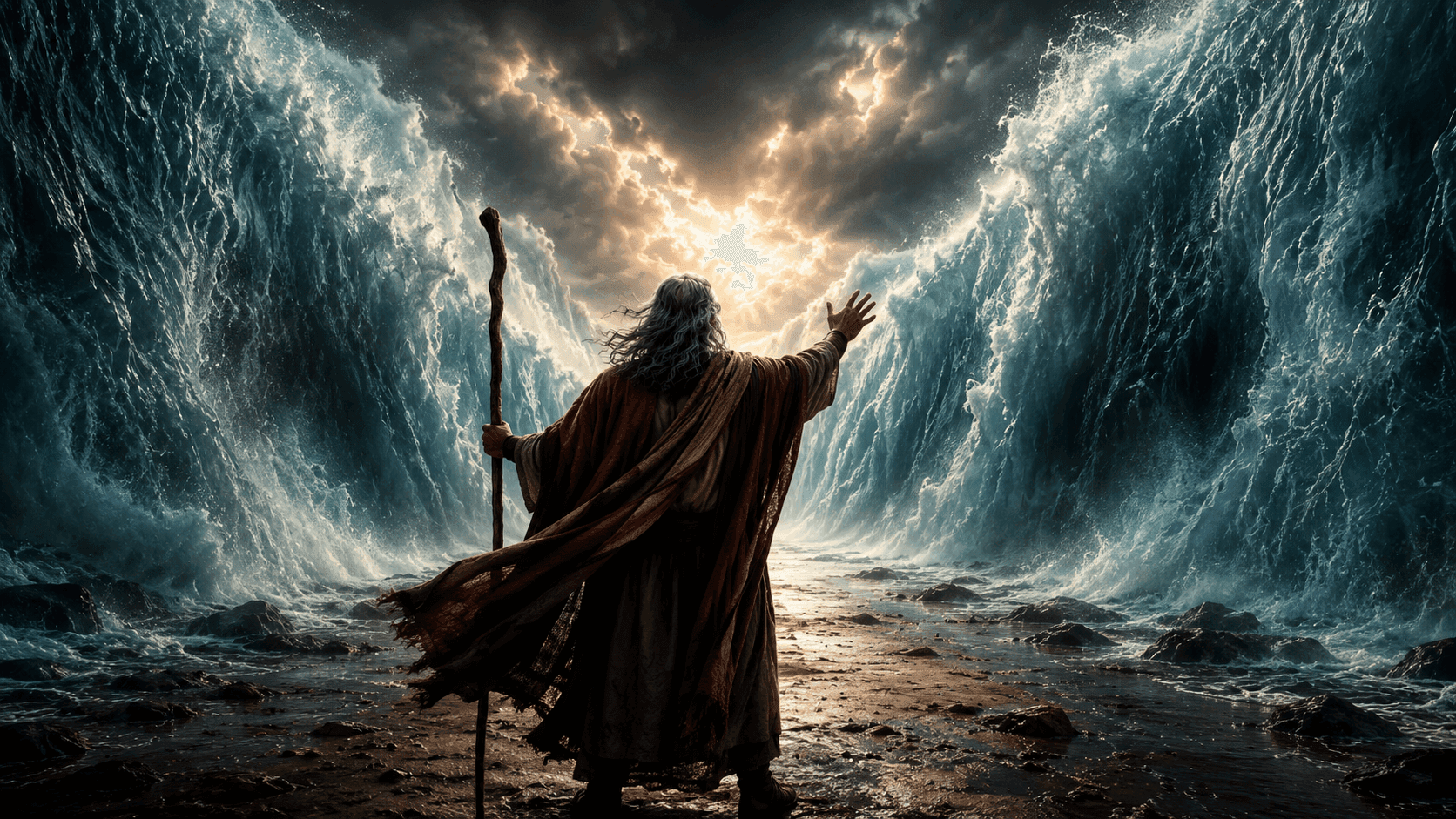
Even though the idea of Moses having unusual divine strength is present in biblical texts, its development in extrabiblical sources has an even stronger resonance with Joseph Smith’s revelations.When Nephi’s brothers expressed doubt and dismay at the prospect of confronting Laban, Nephi declared, “Therefore let us go up; let us be strong like unto Moses; for he truly spake unto the waters of the Red Sea and they divided hither and thither, and our fathers came through, out of captivity, on dry ground, and the armies of Pharaoh did follow and were drowned in the waters of the Red Sea” (1 Nephi 4:2).1 When conducting research related to this passage, Jeff Lindsay became interested in the origin of this imagery. Concerning his efforts to track down the source behind Nephi’s statement, Lindsay reports:
Nephi1 seems to be alluding to a text or tradition about the strength of Moses that would be readily recognized by his brethren. However, nothing from the Old Testament directly supports describing Moses with the adjective “strong.” A search in the King James Version (KJV) for the words strength or strong associated with Moses shows that the Pharaoh was strong (he would use a “strong hand” in Exodus 6:1); that Joshua was commissioned to be strong (see Deuteronomy 31:7, 23; Joshua 1:6– 7); that the sea was strong (see Exodus 14:27), as well as the wind (see Exodus 10:19); and that the Lord would lead Moses “with a strong hand” (Exodus 13:9; cf. Deuteronomy 7:18–19). However, the KJV says nothing about Moses, himself, being strong.2
Lindsay, however, discovered that the Book of Moses provides a statement that very closely matches that given by Nephi. In Moses 1:25 the Lord declared, “Blessed art thou, Moses, for I, the Almighty, have chosen thee, and thou shalt be made stronger than many waters; for they shall obey thy command as if thou wert God” (Moses 1:25). Thus, we have two Restoration texts that describe Moses as being “strong” in connection to his parting the Red Sea. As argued by Lindsay and Noel Reynolds, it seems likely that the Nephites possessed a text like the Book of Moses and that this might very well be the source behind Nephi’s statement.3
Relevant Biblical Passages
It is interesting to note, however, that other biblical passages which went unmentioned (and perhaps unnoticed) by Lindsay also provide a potential basis for Nephi’s statement. One of the most relevant biblical passages is found in the opening verses of Exodus 15, which picks up immediately after the children of Israel successfully traversed the Red Sea: “Then sang Moses and the children of Israel this song unto the Lord, and spake, saying, I will sing unto the Lord, for he hath triumphed gloriously: the horse and his rider hath he thrown into the sea. The Lord is my strength and song” (Exodus 15:1–2). Later, in the same chapter, the song continues: “Thou in thy mercy hast led forth the people which thou hast redeemed: thou hast guided them in thy strength unto thy holy habitation” (Exodus 15:13). While these verses don’t single out Moses as the exclusive beneficiary of the Lord’s strength, they do emphasize that he and the children of Israel jointly received and manifested God’s divine strength in connection to their crossing of the Red Sea.4
Some language in the Psalms also echoes this imagery. One example can be seen in Psalm 74:12–13: “For God is my King of old, working salvation in the midst of the earth. Thou didst divide the sea by thy strength: thou brakest the heads of the dragons in the waters.” Although neither Moses nor the Red Sea are specifically mentioned in this passage, it seems to be a fairly clear allusion to the crossing of the sea in Exodus 14.5 Another relevant passage is found in Psalm 29:10–11: “The Lord sitteth upon the flood; yea, the Lord sitteth King for ever. The Lord will give strength unto his people.” The connection between this passage and the parting of the Red Sea is less certain, but the idea of the Lord giving strength to his people in the context of destructive water is clearer. A series of relevant concepts also turns up in Psalm 77:14–20:
Thou art the God that doest wonders: thou hast declared thy strength among the people. Thou hast with thine arm redeemed thy people, the sons of Jacob and Joseph. Selah. … Thy way is in the sea, and thy path in the great waters, and thy footsteps are not known. Thou leddest thy people like a flock by the hand of Moses and Aaron.
The New Testament contains a relevant passage in the book of Acts, which states that Moses was “mighty in words and deeds” and later that he “shewed wonders and signs in the land of Egypt, and in the Red sea” (Acts 7:22, 36). Although the word “strong” isn’t used here in the KJV, the term “mighty” is a close synonym and is connected to the words of Moses, just as in Moses 1:25.
As shown in this analysis, the notion of Moses being “stronger than many waters” resonates more thoroughly with biblical passages than Lindsay may have noticed. These textual data demonstrate at least the following points:
- God’s strength is repeatedly mentioned in connection to his power over water.
- God’s strength is repeatedly mentioned in connection to the parting of the Red Sea.
- God’s strength is said to have been manifested through Moses and his people (generically) in connection to the parting of the Red Sea.
It is thus possible that Joseph Smith may have, by inference, singled out Moses himself as having unique divine strength in connection to the parting of the Red Sea. On the other hand, it must also be recognized that this network of connections may not be particularly obvious. For instance, Lindsay—who was certainly no stranger to the Latter-day Saint scriptural canon—seems not to have fully noticed these additional intertextual relationships in his study. And it still must be admitted that none of the biblical passages discuss the strength of Moses quite as overtly as Joseph Smith’s Restoration texts do. It therefore may be worth reviewing what extrabiblical sources and traditions say about this matter
Extrabiblical Traditions
Deuteronomy 34:10–12 states the following: “And there arose not a prophet since in Israel like unto Moses, whom the Lord knew face to face, In all the signs and the wonders … And in all that mighty [i.e., strong] hand.”6 Commenting on this passage, a late-medieval rabbi known as Ramban noted that the phrase “in all the strong hand” specifically refers to the “splitting of the Red Sea.”7
In Isaiah 19:4 we read, “And the Egyptians will I give over into the hand of a cruel lord; and a fierce king shall rule over them, saith the Lord, the Lord of hosts.” In this passage, the word “fierce” derives from the Hebrew term ʿaz, which is most often translated as “strong” in the KJV.8 Concerning the “strong king” mentioned in this passage, a Jewish midrash from the early Middle Ages states that “this is Moses, who was king of Torah, which is called strength, where it is stated (in Ps. 29:11), ‘The Lord will grant strength to His people.’”9 The reference to Psalm 29 here is significant, as it is one of the psalms mentioned previously in which the Lord’s strength is connected to his power over water.10
Perhaps the most emphatic and original of such examples can be seen in a text known as Devarim Rabbah. Unlike the sources just cited, this one isn’t simply interpreting an existing biblical passage. Instead, it gives an account of how Moses encountered a wicked angel named Samael who was sent to collect the soul of Moses near the time of his death. The text states that when “Samael saw Moses, a fearful trembling seized him [i.e., Samael].” In response, Moses defiantly declared, “I have greater strength than anyone [else] who comes into the world.” Samael responded by asking, “What is your strength?” Moses then replied by recounting a list of his attributes and accomplishments, including the fact that he had “split the sea into twelve sections.” When Samael persisted in his efforts to take his soul, Moses “smote Samael with all his strength, until he fled from before him.”11
In addition to dwelling on the unusual strength that Moses possessed, the fact that this strength is mentioned in a conversation with a Satan-like figure is quite fascinating. This is because the strength of Moses is emphasized multiple times when he cast Satan out of his presence in Moses 1. One will notice that Satan also trembles in the presence of Moses in the Book of Moses, just as he does in Devarim Rabbah:
And it came to pass that it was for the space of many hours before Moses did again receive his natural strength like unto man; … Nevertheless, calling upon God, he received strength, and he commanded, saying: Depart from me, Satan … And now Satan began to tremble, and the earth shook; and Moses received strength, and called upon God, saying: In the name of the Only Begotten, depart hence, Satan. And it came to pass that Satan cried with a loud voice, with weeping, and wailing, and gnashing of teeth; and he departed hence. (Moses 1:10, 20–22).
These contextual parallels are particularly significant, as they go well beyond what might be derived from any biblical passages.
The Association between “Moses” and “Water”
As a final point, it should be recognized that Moses’s power over the waters in Moses 1:25 may intentionally play off of the etiological explanation of his name in Exodus 2:10:
Moses 1 | Exodus 2 |
25 And calling upon the name of God, he beheld his glory again, for it was upon him; and he heard a voice, saying: Blessed art thou, Moses, for I, the Almighty, have chosen thee, and thou shalt be made stronger than many waters; for they shall obey thy command as if thou wert God. | 10 And the child grew, and she brought him unto Pharaoh’s daughter, and he became her son. And she called his name Moses: and she said, Because I drew him out of the water. |
According to Mark Johnson,
Moses is associated with the motif of water. This motif often uses water in conjunction with deliverance, whether deliverance from the Egyptians by way of crossing the Red Sea or being saved by the gushing of water from a rock in the wilderness. Even Moses’s own name is defined in terms of deliverance from water. Regarding this nomenclative art, Nathan Arp aptly notes, “The Hebrew and Egyptian etymologies come together in the idea of pulling from water—whether that be amniotic water or baptismal water.” Indeed, he correctly observes that “Moses’s name is not an auxiliary ornament of rhetoric, but a guiding component to the story of the Exodus.” Moses made stronger than many waters is not only a prophetic statement, but also another accurate echo of his motif. Being made stronger than many waters also puts Moses in the similitude of God, God’s throne being on many waters (Psalms 29:3, 10).12
Conclusion
It can thus be observed that the descriptions of the strength of Moses in Moses 1:25 and 1 Nephi 4:2 are remarkably appropriate. Not only do these statements appear to play off the meaning behind Moses’s name, but they also have support in biblical and extrabiblical sources. It is possible that Joseph Smith picked up on the themes of divine strength over water in biblical passages and then made them more explicit and emphatic in connection to Moses himself, especially in light of the strength motif seen in Exodus 15.
At the same time, however, it may be that the Book of Moses reflects a genuine ancient tradition that is not wholly dependent on biblical texts as we know them. Support for this latter interpretation comes from the manner in which Moses is more particularly associated with strength in extrabiblical sources, much like he is in the Book of Moses. Especially intriguing are the parallels between Moses 1 and Devarim Rabbah, since they are quite specific and yet aren’t present in any biblical passages.13
Jeff Lindsay and Noel B. Reynolds, “‘Strong Like unto Moses’: The Case for Ancient Roots in the Book of Moses Based on Book of Mormon Usage of Related Content Apparently from the Brass Plates,” Interpreter: A Journal of Latter-day Saint Faith and Scholarship 44 (2021): 1–92.
Mark Johnson, “The Lost Prologue: Reading Moses Chapter One as an Ancient Text,” Interpreter: A Journal of Latter-day Saint Faith and Scholarship 36 (2020): 165–166.
Jeffrey M. Bradshaw, In God’s Image and Likeness 1: Creation, Fall, and the Story of Adam and Eve (The Interpreter Foundation and Eborn Books, 2014), 60–61.
Bible
Exodus 2:10
Exodus 15:1–2
Exodus 15:13
Deuteronomy 34:10–12
Psalm 29:3, 10–11
Psalm 74:12–13
Psalm 77:14–17, 19–20
Isaiah 19:4
Acts 7:22, 36
Book of Mormon
1 Nephi 4:2
Book of Moses
Moses 1:10
Moses 1:20–22
Moses 1:25
- 1. A similar description—but one which uses “power” instead of “strength” to describe Moses—is given in Helaman 8:11–12: “Behold, my brethren, have ye not read that God gave power unto one man, even Moses, to smite upon the waters of the Red Sea, and they parted hither and thither, insomuch that the Israelites, who were our fathers, came through upon dry ground, and the waters closed upon the armies of the Egyptians and swallowed them up? And now behold, if God gave unto this man such power, then why should ye dispute among yourselves, and say that he hath given unto me no power whereby I may know concerning the judgments that shall come upon you except ye repent?”
- 2. Jeff Lindsay and Noel B. Reynolds, “‘Strong Like unto Moses’: The Case for Ancient Roots in the Book of Moses Based on Book of Mormon Usage of Related Content Apparently from the Brass Plates,” Interpreter: A Journal of Latter-day Saint Faith and Scholarship 44 (2021): 5.
- 3. See Noel B. Reynolds, “The Brass Plates Version of Genesis,” Interpreter: A Journal of Latter-day Saint Faith and Scholarship 34 (2020): 63–96; Lindsay and Reynolds, “‘Strong Like unto Moses’,” 1–92; Jeff Lindsay, “Further Evidence from the Book of Mormon for a Book of Moses-Like Text on the Brass Plates,” Interpreter: A Journal of Latter-day Saint Faith and Scholarship 61 (2024): 415–494; Jeff Lindsay, “Parallels between the Book of Moses and the Book of Mormon, Part 1: Details of Their Distribution and Relationships to the JST,” Interpreter: A Journal of Latter-day Saint Faith and Scholarship 67 (2025): 275–320; Jeff Lindsay, “Parallels between the Book of Moses and the Book of Mormon, Part 2: The Updated List of 146 Parallels,” Interpreter: A Journal of Latter-day Saint Faith and Scholarship 67 (2025): 321–370.
- 4. For a similar emphasis on divine strength in a related context, see Scripture Central, “Book of Mormon Evidence: Songs of Moses and Ammon,” Evidence 236 (September 7, 2021).
- 5. This imagery also relates to the dividing of the waters in the creation account in Genesis 1:6–10. See Jeffrey M. Bradshaw, In God’s Image and Likeness 1: Creation, Fall, and the Story of Adam and Eve (The Interpreter Foundation and Eborn Books, 2014), 60–61.
- 6. The word for “mighty” in this passage derives from the Hebrew term ḥāzāq, which is regularly translated as “strong” throughout the KJV.
- 7. Ramban on Deuteronomy 34:12, online at sefaria.org. Note that the phrase “in all the strong hand” is taken from the translation of Ramban provided by Sefaria (which derives from Charles B. Chavel’s work in 1971–1976). This differs slightly from the KJV, which uses the synonymous phrase “and in all that mighty hand.”
- 8. See https://www.blueletterbible.org/lexicon/h5794/kjv/wlc/0-1/.
- 9. Midrash Tanchuma, Bamidbar 3:1, online at sefaria.org.
- 10. When Moses came off Mount Sinai and saw the idolatry of the children of Israel in Exodus 32:19, his “anger waxed hot, and he cast the tables out of his hands, and brake them beneath the mount.” Commenting on this passage, another Jewish midrash declares, “Observe how strong Moses was. … The tablets weighed as much as forty measures of wheat and were made of sapphire, yet they were like some small object in his hand.” Midrash Tanchuma, Ki Tisa 26, online at sefaria.org. This, of course, has nothing to do with parting the Red Sea, nor does it specifically mention that the strength of Moses in this context had anything to do with divine power. Nevertheless, it is yet another example where unusual attention is given to the strength of Moses.
- 11. Devarim Rabbah 11:10, online at sefaria.org.
- 12. Mark Johnson, “The Lost Prologue: Reading Moses Chapter One as an Ancient Text,” Interpreter: A Journal of Latter-day Saint Faith and Scholarship 36 (2020): 165–166. See also Scripture Central, “Book of Moses Evidence: Wordplay on Moses,” Evidence 477 (January 15, 2025).
- 13. For more relationships between the Book of Moses and this text, see Scripture Central, “Book of Moses Evidence: Themes of Weeping,” Evidence 525 (December 23, 2025); Scripture Central, “Book of Moses Evidence: Demonic Laughter and Righteous Weeping,” Evidence 526 (December 31, 2025).