Evidence #550 | June 24, 2026
Book of Moses Evidence: Greeting Zion with a Kiss
Post contributed by
Scripture Central
Abstract
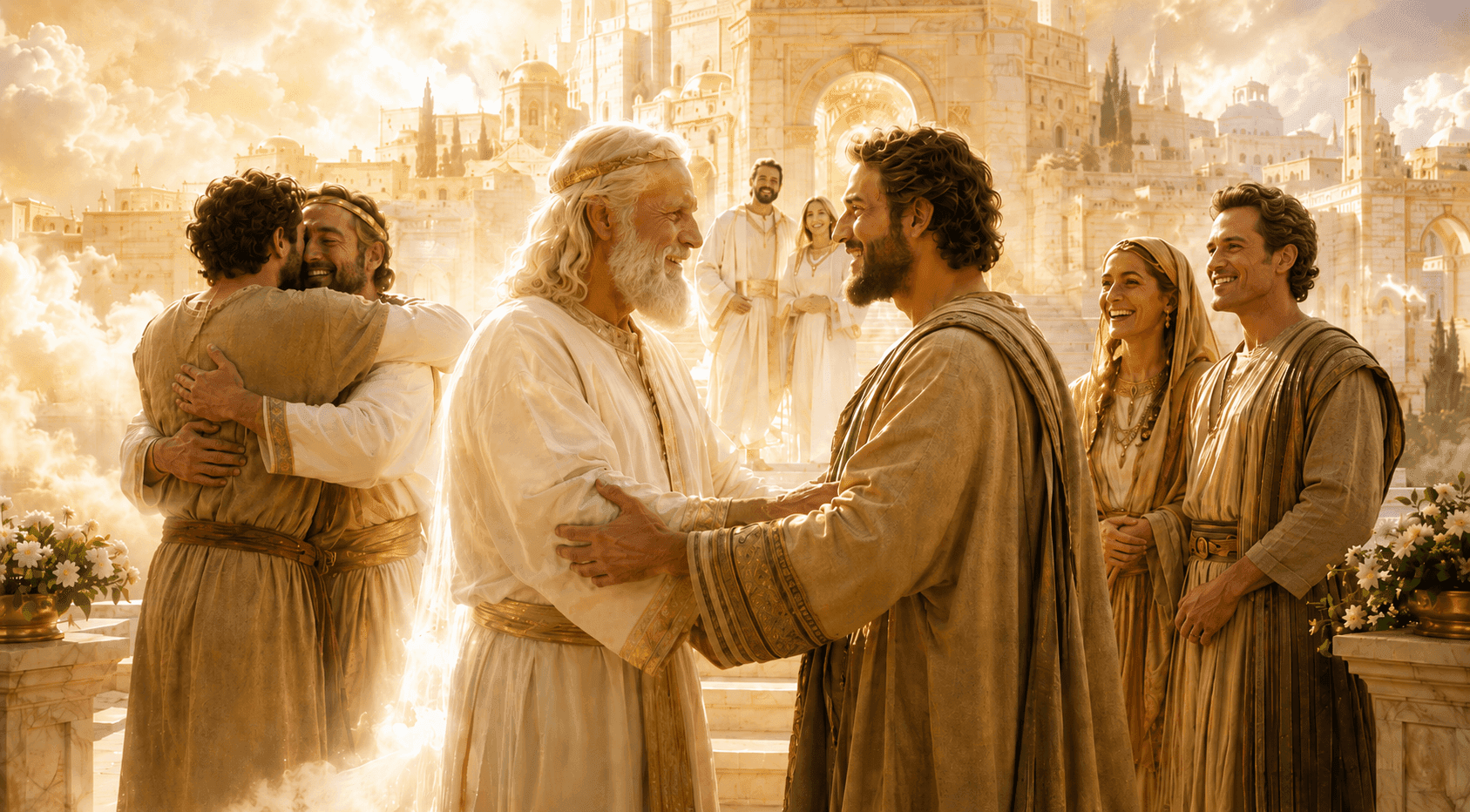
In Moses 7, the imagery of Enoch and his Zion community greeting righteous mortals with a kiss is supported by extrabiblical sources.In his vision recorded in Moses 7, Enoch witnessed that in the latter days his Zion community in heaven would meet with a Zion community on earth at the site of the New Jerusalem: “Then shalt thou and all thy city meet them there, and we will receive them into our bosom, and they shall see us; and we will fall upon their necks, and they shall fall upon our necks, and we will kiss each other” (Moses 7:63).
Greeting one another with a kiss, especially during times of significant departure or reunion, was a long-standing practice in Jewish culture. It is described in the early biblical narratives in Genesis and continues into the writings of the New Testament apostles. That being said, there is nothing in the Bible that associates the prophet Enoch or his people with this type of affectionate greeting. There are, however, several extrabiblical sources that support this idea.
1 Enoch
One significant parallel comes from 1 Enoch 10–11, which, like Moses 7:62–63, describes a condition of earthly bliss and righteousness in the latter days. Although the relevant verses from 1 Enoch do not specifically mention the term “kiss,” they clearly allude to a passage that does: Psalm 85:10–12. Remarkably, Moses 7 quotes and alludes to this very same passage. This complicated three-way relationship is presented in the chart below:
1 Enoch 10–11 | Psalm 85 | Moses 7 |
10:16 Destroy injustice from the face of the earth. And every iniquitous deed will end, and the plant of righteousness and truth will appear forever and he will plant joy. 10:19 And they shall plant pleasant trees upon her—vines. And he who plants a vine upon her will produce wine for plenitude. And every seed that is sown on her, one measure will yield a thousand (measures) and one measure of olives will yield ten measures of presses of oil. 11:2 And peace and truth shall become partners together in all the days of the world, and in all the generations of the world.” | 10 Mercy and truth are met together; righteousness and peace have kissed each other. 11 Truth shall spring out of the earth; and righteousness shall look down from heaven. 12 Yea, the Lord shall give that which is good; and our land shall yield her increase. | 62 And righteousness will I send down out of heaven; and truth will I send forth out of the earth, to bear testimony of mine Only Begotten; his resurrection from the dead; yea, and also the resurrection of all men; and righteousness and truth will I cause to sweep the earth as with a flood, to gather out mine elect from the four quarters of the earth, unto a place which I shall prepare, an Holy City, that my people may gird up their loins, and be looking forth for the time of my coming; for there shall be my tabernacle, and it shall be called Zion, a New Jerusalem. 63 And the Lord said unto Enoch: Then shalt thou and all thy city meet them there, and we will receive them into our bosom, and they shall see us; and we will fall upon their necks, and they shall fall upon our necks, and we will kiss each other |
The convergence is significant because Moses 7 does more than merely echo Psalm 85 in a general way. Instead, it develops the same cluster of images—righteousness, truth, heaven, earth, renewed creation, and latter-day gathering—and then introduces the “kiss” imagery in a distinctly Enochic setting. The fact that 1 Enoch 10–11 independently interacts with the same psalm in its own depiction of end-time righteousness and earthly abundance is truly striking, especially because this portion of 1 Enoch already shares multiple other parallels with Moses 7.1 What makes the connection even more impressive is that Joseph Smith almost certainly would not have detected it in 1830, since the English translations of 1 Enoch available at that time significantly obscured the relationship between 1 Enoch 10–11 and Psalm 85.2
2 Enoch
Another fascinating parallel can be seen in 2 Enoch. It arises in the context of Enoch delivering a final set of teachings to his people, just before his departure into heaven. Aware of Enoch’s imminent ascent, the people consulted together and declared, “‘Let us go, let us kiss Enoch,’ And they came together, up to 2000 men, and they arrived at the place Akhuzan where Enoch was, and his sons. And the elders of the people and all the community came and prostrated themselves and kissed Enoch” (2 Enoch 64:2–3).3
Immediately after this, the people asked for a blessing. Interestingly, Enoch gave them teachings related to the last days of peace and righteousness. Particularly notable is Enoch’s description of all the righteous, and even time itself, being gathered together into one: “But they will constitute a single age. And all the righteous, who escape from the Lord’s great judgment, will be collected together into the great age. And the great age will come about for the righteous, and it will be eternal” (2 Enoch 65:8).4 As was demonstrated previously, Moses 7:62 features a similar emphasis on righteousness in the end times. As for the unification of time, similar imagery arises in Ephesians 1:10 and Doctrine and Covenants 27:13, which not only speak of the “dispensation of the fulness of times” but also a need to “gather together in one all things … both which are in heaven, and which are on earth.”
This backdrop gives the kiss imagery in 2 Enoch added significance. What begins as a farewell gesture at the moment of Enoch’s departure is soon placed within a larger vision of the righteous being gathered into an eternal age. The scene therefore joins separation and reunion, ascent and gathering, in a way that resonates closely with Moses 7:62–63. In both texts, the kiss is not merely an expression of personal affection but belongs to a broader Enochic vision of the righteous being united across the boundary between heaven and earth.
Apocalypse of Paul
A final correspondence arises in an early Christian text known as the Apocalypse of Paul, which provides a first-person account of Paul’s ascension into Paradise. After entering through the gates, Paul is greeted and kissed by a man whom he discovers to be Enoch:
And when I had entered inside the gates of Paradise, an old man came to meet me whose face shone like the sun. And he embraced me and said: “Hail, Paul, O esteemed one of God!” And with a joyful face he kissed me, (but then) he shed tears. And I said to him: “Father, why do you weep?” Sighing and weeping again, he said: “Because we are hurt by humans and they greatly trouble us. There are many good things which the Lord has prepared and His promise is great, but many do not accept them.” And I asked the angel and said: “Lord, who is this?” He answered me: “This is Enoch, the scribe of righteousness.”5
The significance of Enoch’s kiss may be emphasized by the fact that Paul isn’t greeted in this same manner by any of the other named figures that he encounters on his heavenly journey, perhaps suggesting Enoch was particularly known for such a greeting.6 The surrounding details strengthen the connection with Moses 7 even further, since Enoch’s joyful greeting quickly gives way to tears over human wickedness, a theme that resonates closely with the weeping of Enoch, God, and the heavens in Moses 7.7
Another resemblance comes from an emphasis in the Apocalypse of Paul on the blessings which the Lord had “prepared” for the righteous, but which the wicked refuse to accept. The epitome of these “prepared” blessings is realized when Paul, not long after his encounter with Enoch, is shown a holy city where the righteous dwell.8 Although the city is stated to be Jerusalem, it is clearly situated in the heavens.9 One description of the city is particularly significant:
But I went forward and the angel led me and brought me unto the river of honey, and I saw there Esaias and Jeremias and Ezekiel and Amos and Micheas and Zacharias, even the prophets lesser and greater, and they greeted me in the city. I said unto the angel: What is this path? and he said unto me: This is the path of the prophets: every one that hath grieved his soul and not done his own will for God’s sake, when he is departed out of the world and hath been brought unto the Lord God and worshipped him, then by the commandment of God he is delivered unto Michael, and he bringeth him into the city unto this place of the prophets, and they greet him as their friend and neighbour, because he hath performed the will of God.
In a footnote, the translator of this passage notes a similarity to the Apocalypse of Zephaniah: “(The angel) ran unto all the righteous that are there, Abraham, Isaac, Jacob, Enoch, Elias, and David. He conversed with them as a friend with a friend, who talk together.”10 Thus, the greeting of the righteous in the Apocalypse of Paul does not appear to be incidental. It functions as a heavenly act of recognition, by which the newcomer is received into the community of the saved. Those who had welcomed strangers in mortality are here welcomed by the righteous into the city of God. Enoch’s earlier kiss of Paul appears to be an individualized form of this same type of reception imagery, an intimate gesture of kinship and fellowship at the gates of Paradise. All of this aligns very well with the “Holy City” that was “prepared” by the Lord in Moses 7:62–63, a place where the righteous would meet and greet one another with a holy kiss:
And righteousness will I send down out of heaven; and truth will I send forth out of the earth, to bear testimony of mine Only Begotten; his resurrection from the dead; yea, and also the resurrection of all men; and righteousness and truth will I cause to sweep the earth as with a flood, to gather out mine elect from the four quarters of the earth, unto a place which I shall prepare, an Holy City, that my people may gird up their loins, and be looking forth for the time of my coming; for there shall be my tabernacle, and it shall be called Zion, a New Jerusalem. And the Lord said unto Enoch: Then shalt thou and all thy city meet them there, and we will receive them into our bosom, and they shall see us; and we will fall upon their necks, and they shall fall upon our necks, and we will kiss each other;
Conclusion
Since the imagery of an affectionate greeting with a kiss is found throughout the Old and New Testaments, the mere presence of such a kiss in Joseph Smith’s revelations is not, on its own, particularly significant. Ancient Israelite and early Christian readers would have readily understood the kiss as a gesture of kinship, covenantal affection, reconciliation, and joyful reunion. What is significant, however, is the way Moses 7 places this familiar gesture within a distinctively Enochic and eschatological setting, where the heavenly Zion of Enoch descends to meet the earthly Zion of the last days. The two righteous communities embrace one another as members of a single redeemed family.
More specifically, Moses 7 embeds the kiss within a significant complex of ideas, including righteousness descending from heaven, truth springing forth from the earth, the gathering of the elect, the preparation of a holy city, and the reunion of heavenly and earthly communities. These themes converge strikingly with Psalm 85 and 1 Enoch 10–11, where righteousness, truth, peace, fruitfulness, and latter-day renewal appear in closely related ways. The presence of the kiss in Psalm 85, together with the development of this same cluster of ideas in 1 Enoch, strongly suggest that the wording of Moses 7:62–63 does not derive from random biblical borrowing.
The additional parallels from 2 Enoch and the Apocalypse of Paul strengthen this impression. In 2 Enoch, the kiss arises at the moment of Enoch’s departure, soon before his teachings about the future gathering of the righteous into a single eternal age. In the Apocalypse of Paul, Enoch greets Paul with a kiss at the threshold of Paradise, which is connected to a heavenly realm where the righteous are welcomed into the holy city of God.
It can thus be observed that ancient and late antique traditions associate Enoch, heavenly ascent, righteous communities, eschatological reunion, and affectionate greeting in ways that are remarkably congruent with the Book of Moses. These parallels strengthen the case for the authenticity of Smith’s revelation as well as the validity of his prophetic calling.
Jeffrey M. Bradshaw and David J. Larsen, In God’s Image and Likeness 2: Enoch, Noah, and the Tower of Babel (The Interpreter Foundation and Eborn Books, 2014), 161.
Bible
Psalm 85:10–11
Book of Moses
Moses 7:62–63
- 1. It should be noted that both 1 Enoch 10–11 and Psalm 85 only deal with the union of abstractions, such as peace, truth, mercy, and righteousness. While Moses 7 also includes the imagery of truth and righteousness, the merging of these abstract entities is paralleled by the literal union of Zion communities on heaven and earth. The Book of Moses therefore develops these elements in its own unique way, suggesting they are not merely derivative in nature.
- 2. For a much more in-depth treatment of these matters, see Scripture Central, “Book of Moses Evidence: Intertextuality with 1 Enoch and Psalm 85,” Evidence 534 (February 25, 2026).
- 3. Translation by Frances I. Anderson, “2 (Slavonic Apocalypse of) Enoch,” in The Old Testament Pseudepigrapha, 2 vols., ed. James H. Charlesworth (Doubleday, 1983–1985), 190.
- 4. Translation by Anderson, “2 (Slavonic Apocalypse of) Enoch,” 192.
- 5. Apocalypse of Paul §20 (ed. James); as cited in John C. Reeves and Annette Yoshiko Reed, Enoch from Antiquity to the Middle Ages (Oxford University Press, 2018), 48.
- 6. For instance, Paul is immediately afterward met by Elias without any mention of a kiss.
- 7. Scripture Central, “Book of Moses Evidence: Themes of Weeping,” Evidence 525 (December 23, 2025).
- 8. See M. R. James, trans. and ed., “The Apocalypse of Paul,” in The Apocryphal New Testament (Clarendon Press, 1924), 536: “As for me, I have seen great and manifold good things which God hath prepared for all the righteous, and great are the promises of God, but the more part receive them not.” See also p. 537: “But I say unto thee, that when the righteous are gone forth out of the body and shall see the promises and the good things which God hath prepared for them, yet again they shall sigh and cry, saying: Wherefore did we utter a word out of our mouth to provoke our neighbour even for a day? And I asked again and said: Be these the only promises of God? And the angel answered and said unto me: These which now thou seest are for them that are married and keep the purity of their marriage, being continent. But unto the virgins, and unto them that hunger and thirst after righteousness and afflict themselves for the name of the Lord, God will give things sevenfold greater than these, which now I will show thee.” It is at this point that Paul is shown the holy city.
- 9. At one point in his vision, Paul is shown a figure singing and praising the Lord at an altar in the midst of the city. When Paul asks who this being is, the angelic guide explains, “This is David. This is the city of Jerusalem; and when Christ the king of eternity shall come in the fullness (confidence, freedom) of his kingdom, he shall again go before him to sing praises, and all the righteous together shall sing praises.” James, “The Apocalypse of Paul,” 541.
- 10. James, “The Apocalypse of Paul,” 540.