KnoWhy #832 | January 1, 2026
Why are Other People with God When He is Planning the Creation?
Post contributed by
Scripture Central
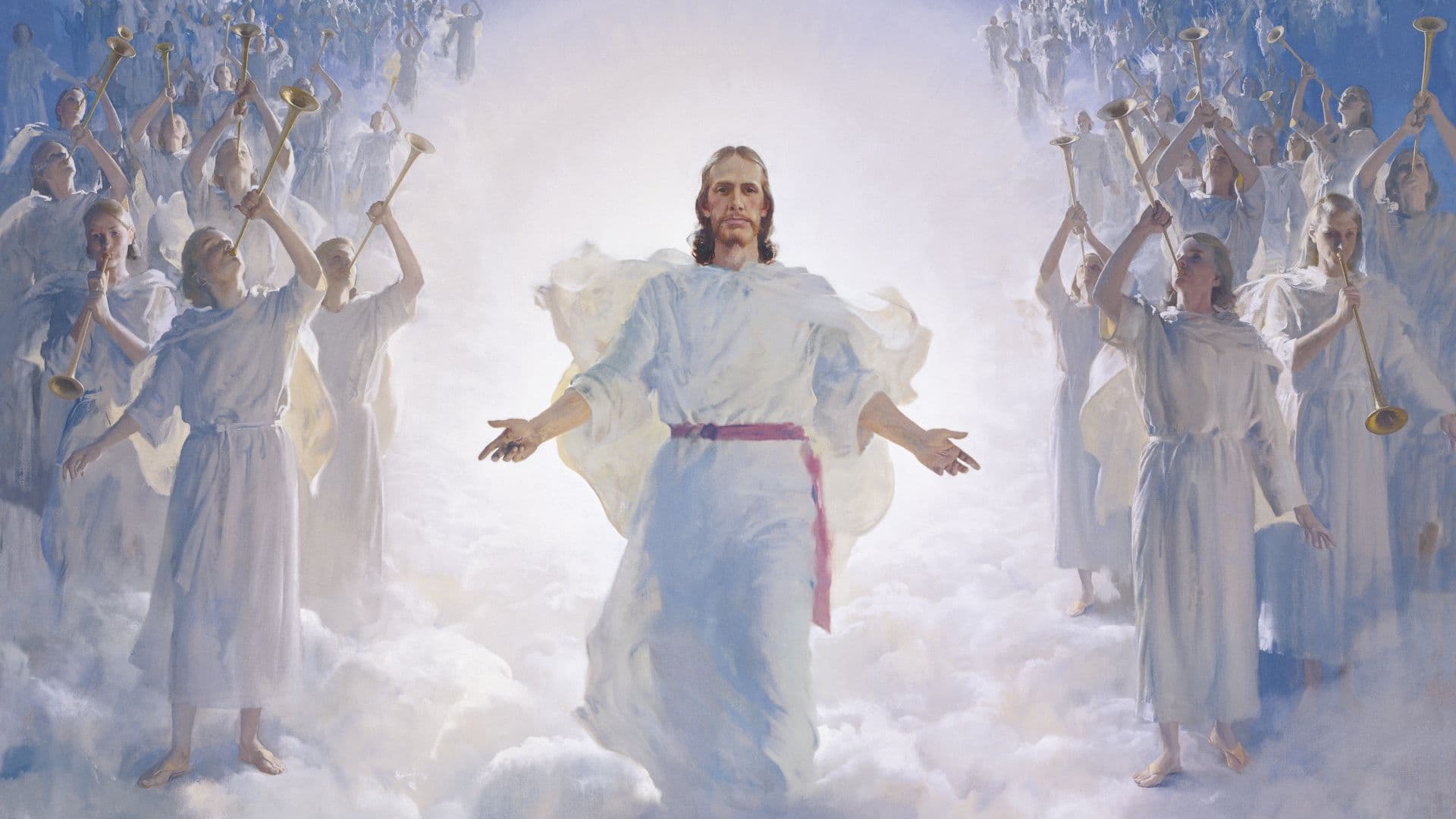
“And God saw these souls that they were good, and he stood in the midst of them …And there stood one among them that was like unto God, and he said unto those who were with him: We will go down … and we will take of these materials, and we will make an earth whereon these may dwell.” Abraham 3:23–24
The Know
Abraham 4 contains an account of the Creation, similar to Genesis 1. However, the immediate context in Abraham 3 indicates that other beings were with God during that event: “And God saw these souls that they were good, and he stood in the midst of them …And there stood one among them that was like unto God, and he said unto those who were with him: We will go down … and we will take of these materials, and we will make an earth whereon these may dwell” (3:23–24). Chapter 4 goes on to express the fulfillment of their plans, “And then the Lord said: Let us go down. And they went down at the beginning, and they, that is the Gods, organized and formed the heavens and the earth” (4:1). One finds something similar in Genesis 1:26–27 in which God says “Let us make man in our image, after our likeness.” Later, in Genesis 3:22 God also says that the human has become “as one of us.” One wonders why the plural words “us” and “our” are used in these passages. Who else might be present with God during creation? One possible explanation for the plural in these verses may come from the ancient idea of the divine council.1 In texts from a place called Ugarit, north of Israel, the head God, named El, is depicted as an elderly father who presides over the other gods of Ugarit. He sits on his throne, surrounded by these divine beings, consulting with them, and then giving his decrees based on the decisions reached during their consultations. This is not unlike an experience that someone might have in reality in a royal court, in which people might observe a king sitting on his throne, consulting with his advisors who surrounded him.2
One finds scenes like this in other parts of the Hebrew Bible as well. 1 Kings 22:19–22 reports the following:
“And he said, Hear thou therefore the word of the Lord: I saw the Lord sitting on his throne, and all the host of heaven standing by him on his right hand and on his left. And the Lord said, Who shall persuade Ahab, that he may go up and fall at Ramoth-gilead? And one said on this manner, and another said on that manner. And there came forth a spirit, and stood before the Lord, and said, I will persuade him. And the Lord said unto him, Wherewith? And he said, I will go forth, and I will be a lying spirit in the mouth of all his prophets. And he said, Thou shalt persuade him, and prevail also: go forth, and do so.”
In this scene, the prophet Micaiah is reporting on what he saw when he witnessed a divine council scene of Yahweh sitting on a throne surrounded by advisors. Yahweh is discussing with these counselors whom he should send to go deceive Ahab so he will be killed. In 22:21–22, one divine being volunteers for the position. The prophet Micaiah can see this scene because he has been allowed to see the divine council in action.3
Jeremiah 23:18, 21–22 also refers to a divine council scene, “For who hath stood in the counsel [council] of the Lord, and hath perceived and heard his word? who hath marked his word, and heard it? … I have not sent these prophets, yet they ran: I have not spoken to them, yet they prophesied. But if they had stood in my counsel [council], and had caused my people to hear my words, then they should have turned them from their evil way.”4 These verses assume that only true prophets, not the false prophets who are running to spread their ideas, are able to see what happens in the divine council and share the results with others.
Zechariah 3 also depicts a divine council scene. In this chapter, Zechariah sees Joshua the high priest standing before Yahweh with an “accuser,” standing nearby (3:1). This accuser is similar to a prosecuting attorney in modern times, but in this case, it is a being from the divine realm. Others, presumably divine beings, are standing in front of Yahweh, and he commands them to give Zechariah new clothes, which they do (3:4).5
Although this is less clear, the divine council may also be implied in Amos 3:7, “Surely the Lord God will do nothing, but he revealeth his secret unto his servants the prophets.” In this verse, the word translated as “secret,” sod, is the word scholars believe has reference to a divine council. It appears that ancient people understood that God always reveals his secret or the plans of his divine council to prophets, so they can effectively guide the people.6
Never miss a KnoWhy
Get Scripture Central's latest research and resources delivered straight to your inbox.
The Why
Although not usually noticed by readers of the Old Testament, recognizing the presence of the divine council subtly changes how readers of the Old Testament understand it. It helps to explain, for example, how one might visualize the role of a prophet. Instead of people who somehow relay messages from God in some vague way, this understanding shows that in many cases they are people who have seen God sitting in council and have come back to humanity to relay the decisions of that council. It helps to explain the authority of prophets as messengers of God and give one reason why ancient Israelites would have trusted their words.
The divine council also subtly changes how one sees God. Rather than a God who exists in divine isolation, the notion of a divine council allows one to see God as surrounded by attendants with whom He interacts. This image of a God who is willing to interact with others can help readers today to see God as a being who could also be willing to interact with, listen to, and relate to humans, something that is crucial for faith.
Finally, it impacts how one sees Christ. In Moses 2:26, Jesus is clearly part of this divine council: “And I, God, said unto mine Only Begotten, which was with me from the beginning: Let us make man in our image, after our likeness; and it was so” (Moses 2:26). This shows the importance of Christ in the process of the creation, and in everything that was to follow in human history.
Stephen O. Smoot, “The Divine Council in the Hebrew Bible and the Book of Mormon,” Studia Antiqua: A Student Journal for the Study of the Ancient World 12, no. 2 (Fall 2013): 1–18.
David E. Bokovoy, “On Christ and Covenants: An LDS Reading of Isaiah’s Prophetic Call,” Studies in the Bible and Antiquity 3 (2011): 29–49.
Stephen D. Ricks, “Heavenly Visions and Prophetic Calls in Isaiah 6 (2 Nephi 16), the Book of Mormon, and the Revelation of John,” in Isaiah in the Book of Mormon, ed. Donald W. Parry and John W. Welch (Provo, Utah: FARMS, 1998), 171–90.
- 1. For an excellent intensive investigation of this issue, see Schäfer, Peter. Two Gods in Heaven : Jewish Concepts of God in Antiquity. Translated by Allison Brown. Princeton, NJ: Princeton University Press, 2020.
- 2. For more on this, see J. H. Eaton, The Psalms: A Historical and Spiritual Commentary with an Introduction and New Translation (London/New York: Continuum, 2005), 296–97.
- 3. For more on this, see Sweeney, Isaiah 1–39, 134–35.
- 4. Walter Brueggemann, The Theology of the Book of Jeremiah (Cambridge, MA: Cambridge University Press, 2007), 58–60.
- 5. See Michael R. Stead, The Intertextuality of Zechariah 1–8, LHBOTS 506 (New York and London: T&T Clark, 2009), 46–47, 88–90, 156–57; Lena-Sofia Tiemeyer, “YHWH, the Divine Beings, and Zechariah 1–6,” in Monotheism in Late Prophetic and Early Apocalyptic Literature: Studies of the Sofja Kovalevskaja Research Group on Early Jewish Monotheism, Vol. III, eds. Nathan MacDonald and Ken Brown (Tübingen: Mohr Siebeck, 2014), 73–101.
- 6. Heinz-Josef Fabry, “sôd,” ThWAT 5:775–82.