Evidence #563 | October 29, 2026
Book of Moses Evidence: Books and Writing
Post contributed by
Scripture Central
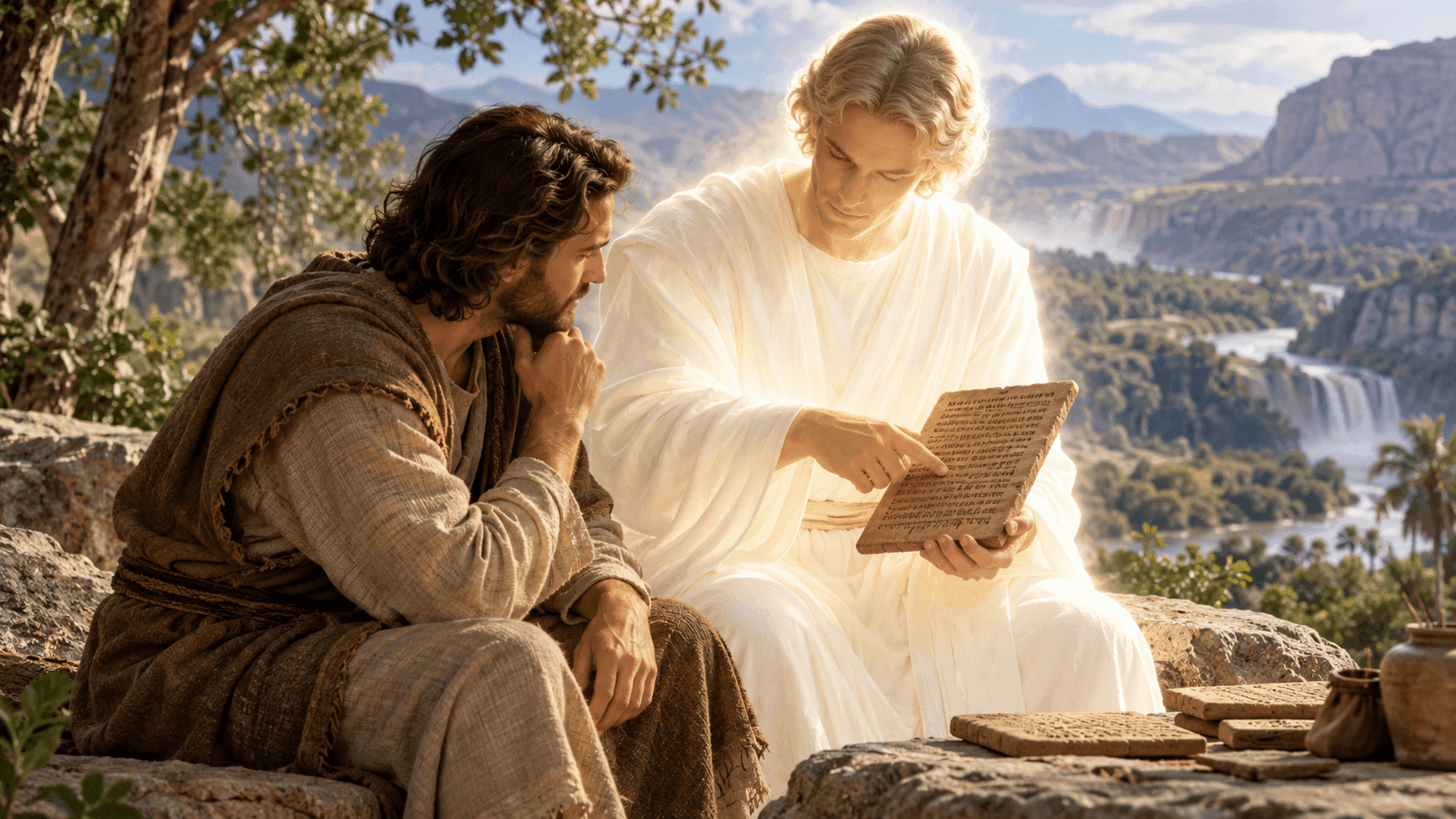
Abstract
The themes and motifs surrounding books and writing in Moses 6 resonate with numerous ancient and medieval traditions.Genesis 5 contains a lengthy genealogical history that begins by declaring, “This is the book of the generations of Adam” (Genesis 5:1). This happens to be the only mention of a book or any other form of writing anywhere in the book of Genesis. From the context, however, it is not fully clear when this genealogical record was created or who wrote it. It might be assumed that it dates all the way back to the pre-flood era. But it could also be understood as a much later genealogical register that preserved, in a written medium, what had only been passed down through oral histories.
The latter interpretation was held by many prominent scholars and theologians during and leading up to Joseph Smith’s day. “As far as appears books were unknown, and letters not in use, until a considerable time after the flood,” wrote Archibald Alexander in 1826.1 Commenting on the five books of Moses in 1811, Joseph Benson concluded, “These Books were, probably, the first that ever were written; for we hear no mention of any Writing in all the Book of Genesis, nor till God bid Moses write.”2 Very similar statements were previously made by Matthew Henry and John Wesley.3 Adam Clarke, commenting in 1836, noted that the prophet Enoch attained an impressively heightened degree of religious and spiritual enlightenment, “when comparatively speaking, there were few helps, and no written revelation” at that time.4
Such sentiments stand in stark contrast to the themes of books and recordkeeping that are developed in the Book of Moses:
And a book of remembrance was kept, in the which was recorded, in the language of Adam, for it was given unto as many as called upon God to write by the spirit of inspiration; And by them their children were taught to read and write, having a language which was pure and undefiled. Now this same Priesthood, which was in the beginning, shall be in the end of the world also. Now this prophecy Adam spake, as he was moved upon by the Holy Ghost, and a genealogy was kept of the children of God. And this was the book of the generations of Adam. (Moses 6:5–8)
Enoch brings up the importance of recordkeeping once again in Moses 6:45–47:
And death hath come upon our fathers; nevertheless we know them, and cannot deny, and even the first of all we know, even Adam. For a book of remembrance we have written among us, according to the pattern given by the finger of God; and it is given in our own language. And as Enoch spake forth the words of God, the people trembled, and could not stand in his presence.
The theme arises one final time near the end of the chapter, just after a discussion of baptism and the gift of the Holy Ghost:
For by the water ye keep the commandment; by the Spirit ye are justified, and by the blood ye are sanctified; Therefore it is given to abide in you; the record of heaven; the Comforter; the peaceable things of immortal glory; the truth of all things; that which quickeneth all things, which maketh alive all things; that which knoweth all things, and hath all power according to wisdom, mercy, truth, justice, and judgment. And now, behold, I say unto you: This is the plan of salvation unto all men, through the blood of mine Only Begotten, who shall come in the meridian of time. And behold, all things have their likeness, and all things are created and made to bear record of me, both things which are temporal, and things which are spiritual; things which are in the heavens above, and things which are on the earth, and things which are in the earth, and things which are under the earth, both above and beneath: all things bear record of me. (Moses 6:60–63)
In this setting, it appears that the Holy Spirit is itself viewed as a type of divine record, specifically designated as the “record of heaven.” In addition, all of God’s creations are considered to stand as witnesses that “bear record” of God, in relation to the principle that things on earth have a likeness in heaven.
In summary, the Book of Moses considerably adds to the account in Genesis by introducing the following scribal details in connection to the antediluvian patriarchs:5
- They possessed written records.
- They viewed the ability to produce sacred writing as a spiritual gift.
- They taught their children to read and write.
- Their language was considered to be “pure and undefiled.”
- Their recordkeeping activities were connected to Adam’s prophecy about the enduring nature of the priesthood.
- They possessed a specific text known as the “book of remembrance” which was somehow connected to the “book of the generations of Adam” and the ministry of Enoch.
- The book of remembrance was modeled after a heavenly “pattern given by the finger of God.”
- People are reported as trembling and unable to stand immediately after the book of remembrance is mentioned.
- The Spirit of God is itself described as the “record of heaven,” in connection to a salvific priesthood ordinance (baptism).
- All things on earth are said to “bear record” of things in heaven, in connection to the principle of their holding a likeness or similarity.
Impressively, each of these details resonates with themes or motifs present in a wide array of ancient and medieval traditions. As expressed by Hugh Nibley, “Contrary to what one might expect, and what has been taught for generations in colleges and seminaries, the ancient sectaries were not simply illiterates conned to an ‘oral gospel.’”6
Scribal Culture and the Early Patriarchs
The expanded portrait of antediluvian scribal culture in the Book of Moses is introduced immediately after a discussion of Adam, Seth, and Enos:
And Adam knew his wife again, and she bare a son, and he called his name Seth. And Adam glorified the name of God; for he said: God hath appointed me another seed, instead of Abel, whom Cain slew. And God revealed himself unto Seth, and he rebelled not, but offered an acceptable sacrifice, like unto his brother Abel. And to him also was born a son, and he called his name Enos. And then began these men to call upon the name of the Lord, and the Lord blessed them; And a book of remembrance was kept … (Moses 6:2–5)7
This leads to the question of placement. Why, specifically, does this additional material turn up at this juncture, rather than at some other point in the narrative? With this query in mind, it is fascinating that many Jewish, Christian, and Islamic traditions specifically associate Adam, Seth, and Enos with the development of writing and recordkeeping. Some sources describe these men as receiving books or scribal knowledge from heavenly beings.8 In other accounts, the early patriarchs are themselves credited with the discovery or invention of writing. No matter how it was obtained, this sacred scribal knowledge is often portrayed as being passed on to subsequent generations.
Josephus, for example, described the antediluvians as possessing a “peculiar sort of wisdom” about heavenly bodies. “And that their inventions might not be lost before they were sufficiently known, upon Adam’s prediction that the world was to be destroyed at one time by the force of fire, and at another time by the violence and quantity of water, they made two pillars, the one of brick, the other of stone: they inscribed their discoveries on them both.”9 Variants of the so-called “two tablets” tradition turn up in a wide range of sources, including the Aramaic Book of Giants.10
In a later Jewish work known as Sefer Noah, an angel named Raziel appeared to Adam with a heavenly book describing all things that would happen in the future. The angel then declared, “Now you—Adam—approach more closely, and I will disclose to you the manner of this book and its sacral qualities.” The angel also intimated that this text would be passed on to Adam’s posterity: “any one of your children who arises in your stead and all the latter generations who treat this book as you do … will gain knowledge of what is coming.”11
In its commentary on Genesis 5:1, Zohar Bereshit provides similar details: “when Adam was in the Garden of Eden, God sent down to him a book by the hand of Raziel, the angel in charge of the holy mysteries. … Adam left it to his son Seth, who transmitted it in turn to his posterity, and so on until it came to Abraham.”12 An earlier portion of the same work reads as follows:
They [heavenly beings] brought down to Adam the protoplast (from heaven) an actual book, and using it he became knowledgeable about supernal wisdom. That book later reached the “sons of God” (Gen 6:1?)—the wise of their generation—and whoever gained the privilege to peruse it learned from it supernal wisdom. They devoted attention to it and became learned in it. That book was brought down to Adam by the “lord of mysteries,” preceded by three messengers.13
An Islamic work titled Stories of the Prophets (Qiṣaṣ al-anbiyāʾ) provides further corroboration:
God revealed to Adam twenty-two leaves, on which were several chapters written in disjointed letters, none of which were joined together. This was the first book God revealed to Adam. … And after these letters (of the alphabet) had been revealed, Adam learned them and taught them to his son Seth. The latter bequeathed them to Enosh, then (they came) to Qaynān, then (they came) to Mahalalel, then (they came) to Yared, up to when God sent Enoch the younger; i.e., Idrīs.14
Other traditions emphasize Seth’s role in receiving, inscribing, or transmitting sacred writings. We read in the Testament of Adam that “I, Seth, wrote this testament. And my father died, and they buried him …. And Adam was borne to his grave by the angels and powers of heaven because he had been created in the image of God.”15 In a version of the “two tablets” tradition, the Life of Adam and Eve reports that “Seth made tablets of stone and clay, and wrote in them the life of his father Adam and his mother Eve, what he had heard from them and his eyes had seen.”16 The Gospel of the Egyptians describes itself as “the book which the great Seth wrote, and placed in high mountains.”17 These traditions resonate with the “three steles of Seth” that were reportedly revealed to a visionary named Dositheos.18
Enos is also featured prominently in some sources.19 After describing how an angel revealed sacred writings to Adam, the Cologne Mani Codex makes reference to a work that it calls the “apocalypse of Enos.”20 In it, an angel told Enos, “Write all these secrets on bronze tablets and hide them in the ground of the desert. Everything you write, write very clearly. For this, my revelation which never perishes, is ready to be revealed to all the brothers.”21 Likewise, in the History of the Forefathers, it was not Seth but rather Enos who “set up two pillars against the sons of Cain.” Moreover, “he made writings and wrote on stela(e) of baked brick and bronze, and he prophesied that the earth will pass through water and fire.”22 Another account, known simply as Abel, reports that Enos “made the letter(s) and called the planets by name. And he prophesied that this world would pass away twice, by water and by fire. And he made two stelae, of bronze and of clay, and he wrote upon them the names of the parts of creation which Adam had called.”23
Enoch the Scribe
In the Book of Moses, Enoch is viewed as the inheritor and beneficiary of the scribal culture developed by his patriarchal forebears.24 This can partly be seen by his use of inclusive possessive pronouns in Moses 6:46: “For a book of remembrance we have written among us, according to the pattern given by the finger of God; and it is given in our own language.” Such phrasing suggests Enoch himself may have contributed to the “book of remembrance” that was kept among his people.25
Enoch’s status as an author is even more firmly established in the Doctrine and Covenants. After delineating Adam’s lineage of priesthood-bearing patriarchs and commenting on his final prophetic will and testament, the revelation declares, “These things were all written in the book of Enoch, and are to be testified of in due time” (D&C 107:57). Based on several similarities, this D&C revelation seems connected to the scribal material introduced in Moses 6:5–8.26 In light of these and other factors, the Enoch-focused expansions in Moses 6–7 seem likely to derive from Enoch’s own writings.27
All of this aligns very well with extrabiblical traditions, where Enoch’s status as a renowned scribe is pervasive. As Hugh Nibley put it, “everywhere Enoch is credited with being the scribe and transmitter par excellence.”28 In the Aramaic Book of Giants, for instance, Enoch is repeatedly referred to as the “celebrated scribe.”29 Likewise, he is labeled as the “scribe of righteousness” in 1 Enoch30 and the “Great Scribe” in a medieval Jewish work known as Targum Pseudo-Jonathan.31 In 2 Enoch, the Lord gave the following command to an angelic being: “Bring out the books from my storehouses, and fetch a pen for speed-writing, and give it to Enoch and read him the books.” Enoch then declared, “I wrote everything accurately. And I wrote 366 books.”32 According to Andrei Orlov,
The important aspect of the early portrayals of Enoch as a scribe is that they depict him in the capacity of both celestial and terrestrial scribe, as the one who not only records messages from his heavenly guides, but also composes petitions at the request of the creatures from the lower realms, for example, the fallen Watchers/Giants who ask him for mediation. The celestial and terrestrial sides of Enoch’s duties as a scribe reveal the composite nature of this important role.33
Like the righteous patriarchs before him, Enoch was also given heavenly records and then instructed to pass his sacred knowledge to his posterity.34 In a vision of the celestial realms in 1 Enoch, his angelic guide told him, “Enoch, look at the tablet(s) of heaven; read what is written upon them and understand (each element on them) one by one” (1 Enoch 81:1). The next chapter reports that Enoch transmitted this knowledge to his son: “Now, Methuselah, my son, I shall recount all these things to you and write them down for you. I have revealed to you and given you the book concerning all these things. Preserve, my son, the book from your father’s hands in order that you may pass it to the generations of the world” (1 Enoch 82:1–2).35
A similar theme turns up prominently in 2 Enoch, in which the Lord declared to Enoch:
And give them the books in your handwriting, and they will read them and they will acknowledge me as the Creator of everything. … And let them distribute the books in your handwriting, children to children and family to family and kinsfolk to kinsfolk. And I will give you, Enoch, my mediator, my archistratig, Michael, on account of your handwritings and the handwritings of your fathers—Adam and Sith and Enos and Kainan and Maleleil and Ared your father. (2 Enoch 33:8–11)36
Zohar Bereshit specifically connects Enoch’s record to the book given to Adam by an angel: “God did indeed send down a book to Adam, from which he became acquainted with the supernal wisdom. … Tradition further tells us that Enoch also had a book, which came from the same place as the book of the generations of Adam. … This is the source of the book known as ‘the book of Enoch.’”37 According to Zohar 2.277a–b, “Emissaries—celestial angels—came (and) instructed [Enoch] in supernal wisdom. They gave him a book which had been concealed within the Tree of Life, and he studied it and discerned the ways of the Holy One.”38
The Book of Jubilees records that Enoch “was the first among men born on earth to learn to write and to acquire knowledge and wisdom.”39 Michael Syrus stated that “Enoch was the first person to discover the art of producing books and written characters.”40 According to Chronicon ad annum Christi 1234, “Enoch was the first to learn letters and (to receive) instruction and (obtain) wisdom. He recorded the signs of the heavens in a book …. And he was with the angels of God.”41
Not only are similar sentiments widely echoed in other Jewish and Christian sources, but they can also be found in Islamic traditions. One such text explains that “Enoch—who is Idrīs—discovered, revealed, and provided guidance about writing, alphabetic characters, the stars, and arithmetical computation.”42 One of the most common turns of phrase, among the Islamic writers, is that Enoch was “the first to write with a pen.”43
A Pure and Undefiled Language
Moses 6:6 declares that the righteous antediluvian patriarchs taught their children “to read and write, having a language which was pure and undefiled.” The next line states that “this same Priesthood, which was in the beginning, shall be in the end of the world also” (Moses 6:7). When read in context, the immediate antecedent to the “Priesthood” is the “pure and undefiled language.” This may be significant because the word “Priesthood” was actually not in the original text but was instead added in a later revision. The following chart compares the original manuscript, which scholars designate as Old Testament Revelation 1 (OT1), with the Church’s official 2013 version:44
Moses 6:6–7 (OT1) | Moses 6:6–7 (Official 2013 Version) |
& by them their children were taught to read & write having a languag which was pure & undefiled now this was in the begining which shall be in the end of the world | And by them their children were taught to read and write, having a language which was pure and undefiled. Now this same Priesthood, which was in the beginning, shall be in the end of the world also. |
Whether or not the word “Priesthood” was in the underlying text, its addition seems intended to clarify that the pure language mentioned in this verse was closely related to an antediluvian order of the priesthood.45
While the language of Adam may have possessed certain expressive advantages, it seems plausible that its purity was connected with the sacred words used in priesthood ordinances and religious exhortation, as well as the righteousness, faith, and authority that were needed to activate priesthood power. The ability to “write by the spirit of inspiration,” for example, is specifically described as a gift that is “given” in response to divine supplication (Moses 6:5).46 That being the case, it is notable that various extrabiblical sources emphasize the purity of the language of the earliest patriarchs as well as the purity or holiness of their lives and conduct, sometimes in connection to one another.
According to Sefer Noah, the angel who delivered a heavenly book to Adam gave the following declaration: “I have come to instruct you (using) clear words and much wisdom and to make you learned in the words of this sacred book. … And any one of your children who arises in your stead and all the latter generations who treat this book as you do—with purity of flesh, humility of spirit, and doing everything that is inscribed in it—will gain knowledge of what is coming during each and every month.” The text then goes on to explain that Enoch “conducted himself in purity: he would bathe and consecrate himself in running water.” In this context of ritual purity, it was then “revealed to him in a dream the place within which there was hidden a book, the way how he should apply it, what its use was, and its pure sanctity.” After this, “He beseeched the Blessed Deity and ascended (to heaven) in purity. He acquired possession of the Pure Name, and at the moment that he understood it, his eyes illuminated all his paths.”47
A version of this story is also contained in the Legends of the Jews. After Adam had offered up a prayer by the banks of the river, “there appeared to him, in the heat of the day, the angel Raziel, bearing a book in his hand.” The angel then declared,
I have received the charge to teach thee pure words and deep understanding, to make thee wise through the contents of the sacred book in my hand. … And all thy descendants and all the later generations, if they will but read this book in purity, with a devout heart and an humble mind, and obey its precepts, will become like unto thee. They, too, will foreknow what things shall happen. … Then Adam knew that he who had spoken to him was an angel of God, and it was from the Holy King Himself that the book had come, and he used it in holiness and purity. … But not all alike can use the book, only he who is wise and God-fearing, and resorts to it in holiness.48
The Cologne Mani Codex emphasizes the clarity of Adam’s speech as well as the need for a pure medium of written communication, specifically for the sake of preservation: “Thus Adam, first, spoke as clearly as possible in his apocalypse, saying: ‘I saw an angel revealed .... in front of your shining face, which I do not know.’ Then he said to him: ‘I am Balsamos, the greatest Angel of Light. Receive from me and write these things I reveal to you on the purest papyrus which is not perishable or susceptible to moths.’”49
In the Zohar, a story is told of a rabbi who discovers a hidden book which contained the “seventy-two tracings of letters which had been given to Adam the first man, and by means of which he knew all the wisdom of the supernal holy beings … as well as all that is destined to happen in the world.” However, as he and another rabbi began to peruse the book, it miraculously vanished out of their sight. When yet another rabbi heard about these events, he explained, “The Holy One, blessed be He, does not desire that so much should be revealed to the world, but when the days of the Messiah will be near at hand, even children will discover the secrets of wisdom and thereby be able to calculate the millennium; at that time it will be revealed to all, as it is written, ‘For then will I turn to the peoples a pure language, etc.’ (Zephaniah 3:9).”50 The inference is that the writings of Adam constituted the “pure language” spoken of by Zephaniah, and that these sacred words would be had again in the days of the Messiah.
According to the Revelation of the Magi, a set of books was handed down, generation to generation, from Adam all the way to the time of the wise men described in Matthew’s Nativity narrative. The relationships between this text and Moses 6 are quite interesting:51
Moses 6 | Revelation of the Magi |
3 And God revealed himself unto Seth, and he rebelled not … 4 And then began these men to call upon the name of the Lord, and the Lord blessed them; 5 And a book of remembrance was kept, in the which was recorded, in the language of Adam, for it was given unto as many as called upon God to write by the spirit of inspiration; 6 And by them their children were taught to read and write, having a language which was pure and undefiled. | And these sons of kings received commandments, laws, and even books from their fathers. And generation from generation, one by one, they received (them,) from the time of Seth, the son of our father Adam, because Adam revealed (them) to his son Seth when he had him. And Adam taught Seth about his prior greatness, before he transgressed against the commandment, and about his expulsion from Paradise. And he warned his son Seth not to transgress also against the (divine) justice as Adam (did). And Seth received the commandment of his father with a pure heart, and he took care of the agreement and the gift of the exalted Lord of majesty. And it was given to Seth to set down in a book and to make known the wisdom, and to call upon the name of the LORD, the lord of every soul who seeks after life.52 |
As can be seen, in addition to the correspondence between Seth’s “pure heart” in the Revelation of the Magi and the “language which was pure” in Moses 6:6, several additional parallels cluster together in a similar setting. These include (1) the theme of teaching children in the context of recordkeeping, (2) the idea that recording sacred texts is a gift that is “given” to the righteous, and (3) the need “to call upon the name of the Lord” in order to obtain that unique gift.53
The History of the Forefathers provides yet another interesting set of relationships. This text reports that Enos “made writings and wrote on stela(e) of baked brick and bronze, and he prophesied that the earth will pass through water and fire.” Significantly, the “writings on the two stelae told the names of all things, for he knew that by lispers, stutterers and stammerers the language was destined to be corrupted. And they confused and changed the names of the objects that had come into being, which Adam had named and fixed.” In other words, the writings were intended to preserve the pure and undefiled language of the early patriarchs. After hearing Enos preach, two hundred individuals “established a covenant for themselves to live purely. And they were called ‘sons of God.’”54
Prophecy, Priesthood, Posterity, and Recordkeeping
The preceding discussion helps explain why the priesthood was associated with pure language and inspired writing. Now we will turn to the prophetic component of the digression in Moses 6:7: “this same Priesthood, which was in the beginning, shall be in the end of the world also. Now this prophecy Adam spake, as he was moved upon by the Holy Ghost, and a genealogy was kept of the children of God.”55
One may wonder what this prophecy is doing here in the first place. Especially when viewed in the flow of the surrounding narrative, it can come across as a somewhat odd or intrusive digression.56 The answer may lie in the way Restoration scripture repeatedly associates priesthood with chosen lineages and posterity.57 For instance, the Lord promised Abraham that “in thee (that is, in thy Priesthood) and in thy seed (that is, thy Priesthood) … shall all the families of the earth be blessed” (Abraham 2:11). As articulated in this passage, “seed” and “priesthood” are not just related but parenthetically equated. Within this type of framing, a prophecy about the enduring nature of the priesthood naturally relates to Adam’s posterity and generational recordkeeping.58
D&C 107 may prove to be an especially useful interpretive guide to Moses 6:7. It describes the ancient “order of this priesthood” as having been instituted in the days of Adam and then traces its transmission “from father to son” through the patriarchal lineage (D&C 107:40). Seth, the first figure named in this succession, is promised that “his posterity should be the chosen of the Lord” and would be “preserved unto the end of the earth” (D&C 107:42). The revelation then culminates with Adam gathering his righteous posterity shortly before his death. Being “full of the Holy Ghost,” Adam “predicted whatsoever should befall his posterity unto the latest generation” (D&C 107:56). This concept is further echoed in Moses 5:9–10: “And in that day the Holy Ghost fell upon Adam …. And in that day Adam blessed God and was filled, and began to prophesy concerning all the families of the earth.”59
With this broader scriptural context in place, the statement “this same Priesthood, which was in the beginning, shall be in the end of the world also” from Moses 6:7 takes on additional meaning. Rather than just talking about a restoration of priesthood authority or power at the end of the world, it seems to reference the continuity and renewal of a righteous priesthood order or lineage.60 The most important point, in preparation for the following analysis, is that Adam’s prediction appears to derive from—or at least closely relates to—his prophetic foreknowledge of all the generations of his posterity.
This association becomes particularly intriguing in light of extrabiblical traditions surrounding Genesis 5:1: “This is the book of the generations of Adam.” Much like the Book of Moses, a number of Jewish sources interpret this verse not merely as the beginning of a genealogy, but as an allusion to Adam’s divine foreknowledge of the generations that would descend from him.
For example, in its commentary on Genesis 5:1, Midrash Tanchuma Buber says that God caused Adam to sleep and then “showed him Noah and all the unblemished, Abraham and all the proselytes, Isaac and all who sacrifice burnt offerings, Jacob and all tent dwellers, Moses and all the humble, Aaron and all the priests, Joshua and all the community leaders, David and all the kings.”61 Da’at Zekenim similarly interprets the “Book of the Generations of man” to mean that God showed Adam “each generation and its wise men,” even though those generations had not yet been created.62 Yalkut Shimoni explains Genesis 5:1 by saying that God “showed [Adam] generation by generation and its sages, generation by generation and its scribes, generation by generation and its leaders, generation by generation and its governors.” This vision is then connected to what is written in Psalm 139:16: “in Your book all of them were written.”63 In the same context, Zohar Lech Lecha states that “God showed Adam every generation and its students” … which “means that he literally saw with his eyes the form in which they were destined to exist in the world.”64
Commenting on Genesis 5:1, Zohar Bereshit declares that “God showed Adam the visages of all future generations, of all the wise men and all the kings that were destined to rule over Israel.” This rendition is particularly significant, as it soon after explains that “when Adam was in the Garden of Eden, God sent down to him a book by the hand of Raziel, the angel in charge of the holy mysteries.”65 In other words, the book containing the names of all of Adam’s posterity which he had witnessed in vision (i.e., the book of the generations of Adam) was believed to have been revealed to him by an angel. A similar idea is expressed elsewhere in the same work: “We are thus taught that Enoch also had a book, and that book was from the (same) place as the ‘book of the generations of Adam’” (Gen 5:1). This comment shows up after a discussion of how that “book was brought down to Adam by the ‘lord of mysteries,’ preceded by three messengers.”66
A similar set of motifs arises in al-Kisāʾī’s Tales of the Prophets. In this Islamic source, God reveals to Adam a written book containing teachings, laws, warnings, and “accounts of the world.” Through it, God shows Adam “the actions of the people of every age.” Adam consequently “knew what his children would do after him” and then read the book to his children.67 Thus, not only is Adam’s prophetic vision associated with a book, but the book itself becomes the medium through which he surveys the future conduct of his posterity.
A related tradition in Biḥār al-Anwār associates Adam’s knowledge of his descendants with writing from God. The text reports that the first letter written on earth came from God to Adam and that God “presented to Adam, his offspring to his eyes,” displaying prophets and kings, as well as believers and unbelievers among his future descendants.68
With these sources as a backdrop, Adam’s priesthood-related prediction in Moses 6:5–8 takes on new significance. What initially seems like an unusual interruption in a discussion of sacred writing and genealogy may actually reflect a broader tradition in which Adam was shown the future generations of his posterity, sometimes in connection to a divinely revealed book. Particularly noteworthy is that several Jewish sources explicitly associate this tradition with Genesis 5:1, precisely where Adam’s prophecy and the book of remembrance appear in Moses 6.
The Divine Finger Motif
The original version of Moses 6:5 reads differently than it does today. The text initially stated that “it was given unto as many as called upon God to write with the finger of inspiration.”69 The passage was subsequently changed to read, “it was given unto as many as called upon God to write by the spirit of inspiration.” While this change has been preserved in the official (2013) version of the scriptures, that does not necessarily mean that it reflects a more literal or historically accurate translation. As pointed out by Jeffrey Bradshaw and Ryan Dahle, there are good reasons to treat the original dictation of the Book of Moses as sometimes having priority over later edits, especially when it comes to detecting the original meaning or form of the text (in contrast to later doctrinal or theological clarifications or additions).70
With this in mind, it seems quite plausible that the original text that Joseph Smith appears to be recovering used “finger of inspiration,” but that it was later replaced with “spirit of inspiration” to help convey the idiom’s deeper significance. Further support for the original reading comes from a later statement made in Moses 6:46: “For a book of remembrance we have written among us, according to the pattern given by the finger of God; and it is given in our own language.” In both instances, then, the finger is specifically connected to themes of revelation, wherein a human’s writing abilities are enhanced by inspiration or are modeled after a heavenly pattern or template.71
This leads to the question of whether any extrabiblical sources utilize this “finger” motif in comparable contexts. A notable example can be seen in the Life of Adam and Eve. After describing how Seth made “tablets of stone and clay, and wrote in them the life of his father Adam,” the text reports that these tablets were eventually read by King Solomon, in connection to his building a temple. It is then stated that “an angel of the LORD appeared to [Solomon], saying, ‘I am he who held the hand of Seth, so that he wrote with his finger onto stone.’”72 If that were not sufficiently on point, the account goes on to report that “on the stones themselves was found what Enoch, the seventh from Adam, prophesied before the Flood, speaking of the coming of Christ.”73
According to the Armenian Gospel of Infancy, the birth of Seth was viewed as a gift from God to help console Adam after the loss of Abel. The text also reports that a “document was with him, written, shut, and sealed by the finger of God. Seth received it from his father and gave it to his sons, and the sons to their sons for generations.”74
In 3 Enoch we encounter a parallel involving the angel Metatron (Enoch in his glorified angelic state). In a vision, Metatron explains to a heavenly initiate, known as Rabbi Ishmael, that upon the curtain in God’s celestial throne room was written “all the generations of the world and all their deeds, whether done or to be done, till the last generation.” Ishmael then relates that Metatron “showed them to me with his fingers, like a father teaching his son the letters of the Torah; and I saw: each generation and its potentates.”75 Importantly, this language (“each generation and its potentates”) almost precisely mirrors the revelation that was given to Adam about his future posterity in the Jewish and Islamic sources discussed earlier, and therefore it parallels the priesthood-related prophecy in Moses 6:5–8 where the book of remembrance is specifically mentioned. The fact that it is Enoch-Metatron who is instructing a heavenly initiate in this manner is also quite fitting, considering Enoch’s pronounced role in Moses 6. In a note to his translation of 3 Enoch 45, Philip Alexander draws attention to a similar account in Hekhalot Rabbati, in which heavenly writing appears on tablets rather than a curtain.76 This suggests that the underlying tradition of heavenly recordkeeping could be expressed through different media, thereby lending support for the proposed connection between this curtain and the book of remembrance.
In addition to the celestial curtain, the crowns given to the righteous were also sometimes viewed as mediums of inscription and therefore may be appropriately categorized as a type of heavenly record. Concerning the angel Metatron, we read the following in 3 Enoch 13:1:
the Holy One, blessed be he, … wrote with his finger, as with a pen of flame, upon the crown which was on my head, the letters by which heaven and earth were created; the letters by which seas and rivers were created; the letters by which mountains and hills were created; the letters by which stars and constellations, lightning and wind, thunder and thunderclaps, snow and hail, hurricane and tempest were created; the letters by which all the necessities of the world and all the orders of creation were created.77
Although not directly associated with the antediluvian period or specifically with the prophet Enoch, an early Jewish work known as Joseph and Aseneth repeatedly connects the divine finger motif with heavenly records. Speaking to Aseneth, the bride of Joseph, a heavenly messenger declares, “For behold, your name was written in the book of the living in heaven; in the beginning of the book, as the very first of all, your name was written by my finger, and it will not be erased forever.”78 In this context, the divine finger records a heavenly register of righteous names, which nicely parallels the genealogical and revelatory context of the book of remembrance in Moses 6. Importantly, scholars have also independently connected this specific imagery from Joseph and Aseneth to the book of remembrance mentioned in Malachi 3:16.79
In the next paragraph, Aseneth receives a new name: “And your name shall no longer be called Aseneth, but your name shall be the City of Refuge, because in you many nations will take refuge with the Lord God.” The angel soon afterward explains that his own name is also “in the heavens in the book of the Most High, written by the finger of God” and that “all names written in the book of the Most High are unspeakable, and man is not allowed to pronounce nor hear them in this world.”80 This connects the recording and revealing of heavenly names with the concept of purity (Moses 6:6), in the sense that such names seem to have been too sacred and holy to be disclosed to mortals. For Latter-day Saints, the symbolism surrounding this new name resonates with temple imagery.81
The theme arises once again in a later portion of this same text, but this time in connection to Levi, the brother of Joseph. The narrator reports that Levi “used to see letters written in heaven by the finger of God and he knew the unspeakable (mysteries) of the Most High God and revealed them to Aseneth in secret.”82 The fact that Levi is specifically invoked in this context may imply that this heavenly secret (perhaps also involving names) is in some way connected to an order of the priesthood, a convergence that resonates very well with Moses 6:5–8. Further support for this interpretation comes from Jubilees 30:18–20, which directly associates Levi’s priesthood order with the names of the righteous that would be remembered for generations to come due to their preservation on heavenly tablets:
And the seed of Levi was chosen for the priesthood and levitical (orders) to minister before the LORD always just as we do. And Levi and his sons will be blessed forever because he was zealous to do righteousness and judgment and vengeance against all who rose up against Israel. And thus a blessing and righteousness will be written (on high) as a testimony for him in the heavenly tablets before the God of all. And we will remember for a thousand generations the righteousness which a man did during his life in all of the (appointed) times of the year. And (it) will be written (on high) and it will come to him and his descendants after him. And he will be written down as a friend and a righteous one in the heavenly tablets.83
The Odes of Solomon provides yet another generally corroborating account. It compares God’s divine knowledge to a letter that has been sent from heaven like an arrow from a bow. This imagery culminates in a description of the Son of Truth from the Most High Father, suggesting that the arrow (heavenly writing) was symbolically pointing to the Son of Truth.84 After this, the names of the wicked are said to be “blotted out” (clear recordkeeping imagery) and the “letter became a large volume, which was entirely written by the finger of God.”85
Some might assume the divine finger motif in Moses 6 was simply borrowed from Exodus 31:18, which describes the stone tablets from Sinai that were “written with the finger of God.” Similar imagery turns up in Daniel 5:5, in which the finger of a heavenly being writes a message of judgment upon a wall. These biblical passages certainly provide precedents for associating divine writing with God’s finger. What they do not supply are the more specific configurations found in Moses 6 and extrabiblical sources, involving inspired writing among the antediluvian patriarchs, the preservation and transmission of sacred heaven-related records, and an emphasis on priesthood orders and genealogical information. It must also be recognized that this finger motif, at least when employed in connection to sacred or heavenly writing, is exceedingly rare in Joseph Smith’s own revelations.86
The Book of Remembrance
The parallels discussed thus far become even more remarkable when considered alongside several Jewish sources that mention a “book of remembrance” in contexts immediately relevant to the Book of Moses. Zohar Yitro, for instance, associates the book of remembrance with Genesis 5:1, the same biblical passage with which it is closely associated in Moses 6:5–8. Zohar Vayakhel, on the other hand, explicitly connects the book of remembrance to the writings of Enoch. These two sources exhibit a number of other intriguing correspondences with one another and the Book of Moses, such as the imagery of upper (heavenly) and lower (earthly) correspondence of records, the language of “likeness” or “pattern” being used in connection to Adam or the book of remembrance, and an association of the book of remembrance with a heavenly secret or mystery.
The antiquity of several of these shared details is further corroborated by a Dead Sea Scrolls text known as 4QInstruction, which mentions the book of remembrance in several closely related contexts. This text, in turn, introduces numerous additional points of convergence with Moses 6, particularly in relation to God’s divine plan for humanity. Due to the length and complexity of these relationships, a separate evidence article has been dedicated to their exploration and evaluation. Together they may constitute one of the strongest individual lines of evidence supporting the authenticity of the Book of Moses.87
Fear, Trembling, and Prostration
Immediately after Enoch mentioned the book of remembrance, the people exhibited a startling degree of fear: “For a book of remembrance we have written among us, according to the pattern given by the finger of God; and it is given in our own language. And as Enoch spake forth the words of God, the people trembled, and could not stand in his presence” (Moses 6:46–47).88 Enoch then seems to relate their literal fallen condition with the metaphorical fallen state of mankind: “Because that Adam fell, we are; and by his fall came death; and we are made partakers of misery and woe.” This suggests that the book of remembrance, whatever else it contained, may have emphasized divine judgment and the consequences of human wickedness. Alternatively, it may have preserved a record of the deeds of the wicked, with those records carrying binding significance in heaven.
Either possibility resonates with extrabiblical traditions concerning heavenly books, their contents, and their role in divine judgment. As outlined in a previous section, the book of remembrance appears to be connected with Adam’s vision or foreknowledge of human history, in which he comprehended all the generations of his future posterity and their activities. A number of sources indicate that Enoch was given a similar revelation. For instance, as previously mentioned, Zohar Bereshit declares that “Enoch also had a book, and that book was from the (same) place as the ‘book of the generations of Adam’ (Gen 5:1).”89 In many sources, Enoch is specifically given knowledge of the “deeds” of all mankind, and in some accounts the wicked manifest fear or fall to the earth in response to the books or writings that contain their deed-related judgments.
For instance, in the Book of Giants, there is mention of a tablet written by Enoch which outlines the wicked deeds of the giants as well as the destruction that would come upon them. This thematically corresponds to a dream of one of the giants, in which heavenly books “were opened and judgment was spoken … and (it was) signed with a signature.” In response, “All the giants became afraid.”90
Similar imagery arises in the Book of Watchers (chapters 1–36 of 1 Enoch), in which Enoch—who is labeled as the “scribe of righteousness”—is instructed to declare unto the fallen angels the divine judgments against them. After hearing his disturbing pronouncements, the wicked Watchers “were all afraid, and trembling and fear seized them” (1 Enoch 12:3).91 As summarized by Nibley, “What caused them to tremble most of all was that Enoch produced a special book as a witness against them.”92
Having become distraught and ashamed, they asked Enoch to write a petition on their behalf—described by Hugh Nibley as a hypomnemata (memorial, remembrance)93—and present it before the Lord:
And they asked that I write a memorandum of petition for them, that they might have forgiveness, and that I recite the memorandum of petition for them in the presence of the Lord of heaven. For they were no longer able to speak or to lift their eyes to heaven out of shame for the deeds through which they had sinned and for which they had been condemned. Then I [Enoch] wrote out the memorandum of their petition, and the requests concerning themselves, with regard to their deeds individually, and concerning <their sons> for whom they were making request, that they might have forgiveness and longevity. (1 Enoch 13:4–5)94
In effect, the Watchers were seeking a favorable written memorial—or what could be described as a “book of remembrance”—on their behalf, rather than a record emphasizing their wickedness and impending judgment. Importantly, the connection to the book of remembrance in this context is neither arbitrary nor contrived. In his commentary on this very passage, non-Latter-day Saint scholar George Nickelsburg specifically suggests that, among other interpretive options, the “memorandum of petition” could indeed reflect a book such as the one mentioned in Malachi 3:16.95
Although Enoch granted their request by writing out the petition, he then had a dream in which the Lord commanded him to reprimand the Watchers. When he awoke, he found the Watchers “sitting and weeping” and “covering their faces” (1 Enoch 13:9).96 He then began to recite the message of the Lord, which is specifically designated as “The Book of the Words of Truth and the Reprimand of the Watchers Who Were from Eternity” (1 Enoch 14:1). In other words, as explained by Nickelsburg, the heavenly judgment against them is introduced by the “title of a book.”97 Similar imagery comes from Enoch’s statements in the Epistle of Enoch (1 Enoch 92–105), in which he declared to the wicked that “all your evil deeds are revealed in heaven” and “are written down day by day, until the day of your judgment,” thus ensuring that “no unrighteous deed … is hidden” (1 Enoch 98:6–8).98 In the previous chapter, Enoch remarked that “all the words of your lawless deeds will be read out before the Great Holy One, and your face will be put to shame” (1 Enoch 97:6).99
Concerning the tradition of a heavenly book that was given to Adam, Sefer Noah reports that the “angel Raziel opened the book and read it aloud to Adam, and when he heard the words of that sacred book from the mouth of the angel Raziel, he collapsed face-down, quivering.”100 Among other things, this book was specifically said to contain knowledge of future calamities and suffering that would afflict mankind.
Another instance of heavenly books being associated with fear and trembling can be seen in 3 Enoch 28:7: “the Holy One, blessed be he, sits on the throne of judgment and judges all the world, with the books of the living and the books of the dead open before him, all the celestials stand before him in fear, dread, terror, and trembling.”101
Perhaps even more relevant, all of the beings who dwelled in the heavens trembled in the presence of Enoch-Metatron after God gave him a crown that was specifically inscribed with letters by God’s own finger: “the Holy One, blessed be he, … wrote with his finger, as with a pen of flame, upon the crown which was on my head, the letters by which heaven and earth were created; … When the Holy One, blessed be he, placed this crown upon my head, all the princes of kingdoms who are in the height of the heaven of ʿAraboth and all the legions of every heaven trembled at me” (3 Enoch 13:1–14:1).102 Although the details are too elaborate to be fully explained here, the connection between crowns and the book of remembrance finds support in other Jewish sources.103
The Odes of Solomon provides another fascinating instance in which the divine finger motif is connected to the theme of fear and trembling. As mentioned previously, this text describes God’s divine knowledge as a letter being sent to earth, as if it were an arrow shot out of a bow. Eventually it is reported as becoming “a large volume, which was entirely written by the finger of God.” It is also said that the wicked were “blotted out,” suggesting a heavenly register of names. Most important to this discussion, though, is the fact that when the arrow was first shot from heaven, “many hands rushed to the letter, in order to catch (it), then take and read it. But it escaped from their fingers; and they were afraid of it and of the seal which was upon it. Because they were not allowed to loosen its seal.”104 Thus, once again, fear is a natural response to a divinely written text, perhaps, in this case, in relation to its sealing power.
Potential 19th-Century Sources
Could Joseph Smith have derived any of these details from his 19th-century environment? At least in some cases, the answer seems to be yes. It is certainly true that many religious thinkers and biblical commentators in Joseph Smith’s day assumed that Adam and his immediate posterity had nothing to do with writing or recordkeeping. However, not everyone was on board with the non-literate view. The Bible itself is ambiguous on this matter, and some strains of Jewish tradition that affirmed antediluvian recordkeeping had become available to Christian exegetes. The writings of Josephus, for instance, introduced the “two tablets” tradition into English publications long before 1830.105
Interest in such Jewish lore is readily apparent in the writings of John Gill, a prominent Baptist minister, who suggested in 1767 that “it is probable the letters were first invented” by Adam. In the same discussion, Gill mentions the tradition of the “pillars erected by the posterity of Seth,” which purportedly preserved astronomical knowledge, although he questions whether there “is any truth” to the account. In his notes, Gill further references several Jewish sources—including the Babylonian Talmud and the Zohar—that, in very general terms, mention a book associated with Adam, another book reportedly delivered to him by the angel Raziel, and a book allegedly composed by Abel.106 It is therefore not impossible that these or similar ideas were available to Joseph Smith in English in his 19th-century environment.
Another example of interest in antediluvian languages and recordkeeping can be seen in the mystical experiences of John Dee (1527–1608). As summarized by Martin Findell, Dee believed that angels had revealed to him “a holy book written in a previously unknown language (supposedly the language of the angels and of Adam), as well as a magical alphabet into which the text of the book was to be transcribed.” Although the “identities of the book and of the angelic language are rather complex,” each was “associated with the prophet Enoch and the lost book of scripture attributed to him.”107 Due to these and other similarities, Dee’s purported revelations have sometimes been compared to those claimed by Joseph Smith.108 Whatever one may think of these resemblances, Dee’s efforts demonstrate that some English scholars and religious thinkers were intensely interested in primordial languages and their connection to the writings of Enoch.
The Renaissance movement, generally speaking, involved the recovery and revival of ancient religious and political wisdom, an enterprise that necessitated knowledge of ancient languages. Since many of the participants within this movement accepted the truth and veracity of the Hebrew Bible, there was naturally widespread interest in uncovering the deepest recesses of its divine wisdom.109 The Bible itself hints that humanity was once unified in their speech but that the Lord confounded their language due to corruption (Genesis 11:6–7). Hence, recovering the pure language of Adam and his posterity held great attraction.
Seeing that Joseph Smith’s revelations shed unique light on this already fairly popular topic, it should come as no great surprise that he and many of his associates took a pronounced interest in it.110 This has led to a growing body of research attempting to better understand the fascination with the pure language of Adam among early Latter-day Saints and the degree to which it overlapped with broader currents of interest in the surrounding environment.111
Ultimately, however, the environmental derivation hypothesis has limited explanatory power. One could assume that Smith simply adapted all of these details from relevant biblical passages, but that explanation falls short. Although the Bible contains scattered references to heavenly books, sacred recordkeeping, and the earliest generations of humanity, it does not bring these and other elements together in anything approaching the distinctive configuration found in Moses 6.112
A similar challenge arises when it comes to other 19th-century sources. It is possible that Smith stumbled across Bible commentaries that at least briefly referenced relevant Jewish lore. Under this type of scenario, the general ideas of a pure Adamic language, of writing being revealed to the earliest patriarchs by heavenly messengers, and of writing being perpetuated among Adam’s posterity all seem to be potentially accessible. The idea that Enoch, in particular, was a prominent scribe who authored books had also become fairly widespread leading up to 1830.113
After that, however, it becomes more difficult to countenance environmental derivation, especially when it comes to the more nuanced parallels with specific ancient or medieval sources. For instance, it remains to be explained where Joseph Smith encountered the idea that the “book of remembrance,” in particular, was associated with the writings of Enoch, or that it was closely connected to the “book of the generations of Adam” in Genesis 5:1, or that it is related to Adam’s prophetic foreknowledge of human history. Other motifs in Moses 6, such as God’s divine finger being connected to a heavenly record or the fear that such records sometimes induce upon their listeners, also hold diverse and meaningful relationships with extrabiblical sources that were either obscure or unavailable in 1830. Thus, as one’s view expands to encompass the broader constellation of parallels, the notion that Smith obtained all these details by accessing relevant sources in his 19th-century milieu becomes increasingly difficult to sustain.
Conclusion
As can be seen, the themes of books and recordkeeping in Moses 6 overlap to a remarkable degree with ancient and medieval traditions. What makes these correspondences especially noteworthy is the range and specificity of the details involved. Beyond the general origins of writing and the language of Adam, ancient and medieval traditions preserve strikingly similar ideas about primordial books, their heavenly origin, their association with Adam and his immediate posterity, and other distinctive motifs that emerge in closely related contexts. Overall, the parallels are sufficiently varied and specific that they seem to call for more than a general appeal to Joseph Smith’s ingenuity or his familiarity with the Bible.
Although some of these details resonate with ideas circulating in Joseph Smith’s environment, their potential availability does not establish that he actually encountered them, especially before he began his translation of the Book of Moses in 1830. Not only was he a poor farmer with limited formal education at that time,114 but scholarly publications were generally expensive and less readily available on the American frontier.115 As explained by Noel Reynolds, “we have to understand the difference between the body of knowledge that is available to a society as a whole versus what a particular individual knows.”116 There is little reason to believe Joseph Smith was widely read, generally speaking, before 1830. There is even less to suppose he had encountered the specific range of archaic traditions highlighted throughout this article. The historical evidence runs quite strongly against such assumptions.
Yet even if Smith had robust access to much of the best available scholarship at the time, that still would not provide a fully satisfying naturalistic explanation. This point is most clearly and decisively illustrated by the network of correspondences surrounding the “book of remembrance,” which appear to extend well beyond anything that can reasonably be traced to Joseph Smith’s nineteenth-century environment.117 When viewed together, these and the many other distinctive parallels and consistencies explored throughout this article lend substantial weight to the claim that the Book of Moses preserves authentic ancient traditions and that Joseph Smith brought them to light through divine revelation.
Aaron P. Schade and Matthew L. Bowen, The Book of Moses: From the Ancient of Days to the Latter Days (BYU Religious Studies Center and Deseret Book, 2021), 258–284.
Jeffrey M. Bradshaw, Enoch and the Gathering of Zion (Interpreter Foundation, with Scripture Central, and Eborn Books, 2021), 67–70, 77–78, 252.
Jeffrey M. Bradshaw and David J. Larsen, In God’s Image and Likeness 2: Enoch, Noah, and the Tower of Babel (The Interpreter Foundation and Eborn Books, 2014), 47–49, 71–75.
John A. Tvedtnes, The Book of Mormon and Other Hidden Books: “Out of Darkness Unto Light” (FARMS, 2000).
Hugh Nibley, Enoch the Prophet, The Collected Works of Hugh Nibley, Volume 2 (FARMS, 1986), 127, 133–141, 214–216.
Bible
Genesis 5:1
Genesis 6:1
Genesis 11:6–7
Exodus 31:18
Psalm 139:16
Daniel 5:5–6
Zephaniah 3:9
Malachi 3:16
Doctrine and Covenants
D&C 107:40–57
Pearl of Great Price
Moses 5:9–10
Moses 6:2–8
Moses 6:45–48
Moses 6:60–63
Abraham 2:11
- 1. Archibald Alexander, The Canon of the Old and New Testaments Ascertained; or, The Bible Complete, without the Apocrypha & Unwritten Traditions (Princeton, NJ: Princeton Press, 1826), 343.
- 2. Joseph Benson, The Holy Bible, Containing the Old and New Testaments . . . with Notes, Critical, Explanatory, and Practical, 2nd ed., vol. 1 (London: T. Cordeux, 1811), introduction to Genesis.
- 3. See Matthew Henry, An Exposition of the Five Books of Moses (London: Printed for T. Parkhurst, J. Robinson, and J. Lawrence, 1707), introduction to Genesis: “These Five Books were for ought we know the First that ever were written; For we have not the least mention of any Writing in all the Books of Genesis.” See also John Wesley, Explanatory Notes upon the Old Testament, vol. 1 (Bristol: Printed by William Pine, 1765), 1: “These books were, probably, the first that ever were written; for we have no mention of any writing in all the book of Genesis, nor ‘till God bid Moses write.”
- 4. Adam Clarke, The Holy Bible, with a Commentary and Critical Notes, new ed., vol. 1 (London: Thomas Tegg and Son, 1836), 63.
- 5. Note that items 6, 7, 9 and 10 in this list are largely relevant to the section of this article titled “Book of Remembrance.” Because of its complexity, however, that topic has been expanded into its own separate evidence article. Thus, to fully capture the relevance of this textual data and its relationship to extrabiblical sources, that separate article will need to be consulted. See Scripture Central, “Book of Moses Evidence: A Book of Remembrance” Evidence 564 (November 5, 2026). Publication is pending.
- 6. Hugh Nibley, Enoch the Prophet, The Collected Works of Hugh Nibley, Volume 2 (FARMS, 1986), 150.
- 7. Compare with Genesis 4:25–5:1.
- 8. Concerning the heavenly book motif that is so pervasive in Enochic literature and other sources pertaining to the antediluvian patriarchs, some scholars have suggested it may have been influenced by ancient Mesopotamian traditions involving divine or celestial tablets. See Andrei A. Orlov, The Enoch-Metatron Tradition, Texts and Studies in Ancient Judaism 107 (Mohr Siebeck, 2005), 23–39, esp. 33–34; John J. Collins, “The Apocalyptic Technique: Setting and Function in the Book of Watchers,” Catholic Biblical Quarterly 44, no. 1 (1982): 106–107; Leslie Baynes, The Heavenly Book Motif in Judeo-Christian Apocalypses 200 B.C.E.–200 C.E., Supplements to the Journal for the Study of Judaism 152 (Brill, 2012), 46–51; Shalom M. Paul, “Heavenly Tablets and the Book of Life,” in Divrei Shalom: Collected Studies of Shalom M. Paul on the Bible and the Ancient Near East, 1967–2005, Culture and History of the Ancient Near East 23 (Brill, 2005), 59–70. See also George W. E. Nickelsburg, 1 Enoch 1: A Commentary on the Book of 1 Enoch Chapters 1–36, 81–108, ed. Klaus Baltzer (Fortress Press, 2001), 61: “Numerous scholars have rightly argued that the Enochic traditions bear the imprint of Mesopotamian cosmology and religious thought.”
- 9. Flavius Josephus, The Genuine Works of Flavius Josephus, the Jewish Historian, trans. William Whiston (London: Printed by W. Bowyer for the author, sold by J. Whiston, 1737), Antiquities of the Jews 1.2.2. See also Scripture Central, “Book of Moses Evidence: Water and Fire,” Evidence 553 (July 29, 2026).
- 10. See Andrei A. Orlov, “Overshadowed by Enoch’s Greatness: ‘Two Tablets’ Traditions from the Book of Giants to Palaea Historica,” Journal for the Study of Judaism 32, no. 1 (2001): 138–139: “Besides Josephus’ writings [and the Book of Giants], the two tablets/stelae tradition appears in many other sources, including the Armenian History of the Forefathers and the Armenian Abel, the Latin Life of Adam and Eve, various Christian Chronographers, a fragment from Greek Palaea Historica, and some other materials. Even a brief review of these documents shows that the ‘two stelae’ narrative contains traces of Enochic traditions.”
- 11. Adolph Jellinek, Bet ha-Midrasch: Sammlung kleiner Midraschim und vermischter Abhandlungen aus der ältern jüdischen Literatur (6 vols.; repr., Jerusalem: Bamberger & Wahrmann, 1938), 3:155–160. The English translation is from Reeves, “Jellinek’s Sefer Noah,” online at pages.charlotte.edu.
- 12. Zohar, Bereshit 94:358–365, online at sefaria.org. The idea that this record eventually ended up in the hands of Abraham is also confirmed in Abraham 1:28: “But I shall endeavor, hereafter, to delineate the chronology running back from myself to the beginning of the creation, for the records have come into my hands, which I hold unto this present time.” See also Zohar 1.55b (ed. Vilna); as cited in John C. Reeves and Annette Yoshiko Reed, Enoch from Antiquity to the Middle Ages, vol. 1, Sources from Judaism, Christianity, and Islam (Oxford University Press, 2018), 88: “At that time God signaled to Raphael, and he returned to him (i.e., Adam) that book, and Adam studied it. He bequeathed it to his son Seth, and thus it transpired for all those of his line until it reached Abraham, who gained knowledge from it so as to look upon the glory of his Lord, as has been said.”
- 13. Zohar 1.37b (ed. Vilna); as cited in Reeves and Reed, Enoch from Antiquity to the Middle Ages, 87. This passage corresponds to Zohar, Bereshit 48:472, online at sefaria.org. The element of the three angelic messengers correlates with the Latter-day Saint temple endowment. See Jeffrey M. Bradshaw, Freemasonry and the Origins of Latter-day Saint Temple Ordinances (The Interpreter Foundation and Eborn Books, 2022), 163–165.
- 14. Kisāʾī, Qiṣaṣ al-anbiyāʾ (ed. Eisenberg); as cited in Reeves and Reed, Enoch from Antiquity to the Middle Ages, 101–102, 136.
- 15. Stephen E. Robinson, “Testament of Adam,” in The Old Testament Pseudepigrapha, 1:994.
- 16. M. D. Johnson, “Life of Adam and Eve,” in The Old Testament Pseudepigrapha, 2:294.
- 17. Alexander Böhlig and Frederik Wisse, “The Gospel of the Egyptians (III,2 and IV,2),” in The Nag Hammadi Library in English, revised edition, ed. James M. Robinson (HarperSanFrancisco, 1990), 218–219.
- 18. James E. Goehring and James M. Robinson, “The Three Steles of Seth (VII,4),” in The Nag Hammadi Library in English, 397.
- 19. In some medieval sources, varying interpretations were given of Enos’s moral character. Although the Book of Moses describes a period of growing wickedness in the days of Enos (Moses 6:14–18), he himself is depicted as a righteous patriarch. See Scripture Central, “Book of Moses Evidence: Wickedness in the Days of Enos,” Evidence 506 (August 6, 2025). It should also be noted that Enos was sometimes conflated with Enoch in some traditions.
- 20. For this work’s parallels to certain Book of Mormon accounts, see Scripture Central, “Book of Mormon Evidence: Apocalypse of Enosh,” Evidence 126 (December 18, 2020). Note that this is more often referred to in scholarly literature as the “Apocalypse of Enosh” (with Enos and Enosh being alternate spellings of the same name).
- 21. Judith Lieu and Samuel N. C. Lieu, trans., Codex Manichaicus Coloniensis (The Cologne Mani-Codex), Pars Prima, rev. Mark Vermes, Greek text based on the edition of Ludwig Koenen and Cornelia Römer, Corpus Fontium Manichaeorum (Cambridge: Ancient India and Iran Trust, 2024), 29. See also John A. Tvedtnes, The Book of Mormon and Other Hidden Books: “Out of Darkness Unto Light” (FARMS, 2000), 83.
- 22. Orlov, “Overshadowed by Enoch’s Greatness,” 146–147.
- 23. Orlov, “Overshadowed by Enoch’s Greatness,” 147.
- 24. See Scripture Central, “Book of Moses Evidence: Enoch, a Student of Righteousness,” Evidence 483 (February 26, 2025).
- 25. Rather than being a single, completed record, the book of remembrance may have been a compilation of writings that were periodically updated or expanded during successive generations.
- 26. See Scripture Central, “Book of Moses Evidence: Adam’s Prophecy,” Evidence 508 (August 20, 2025).
- 27. This doesn’t, however, preclude the possibility of Moses 6–7 being influenced by later editors or redactors, including during its divinely facilitated translation into English. The precise nature of the production history of the Book of Moses has never been revealed.
- 28. Nibley, Enoch the Prophet, 214.
- 29. Florentino García Martínez, ed., The Dead Sea Scrolls Translated: The Qumran Texts in English, 2nd ed., trans. Wilfred G. E. Watson (Brill, 1996), 258–261.
- 30. 1 Enoch 12:4. Translation by E. Isaac, “1 (Ethiopic Apocalypse of) Enoch,” in The Old Testament Pseudepigrapha, 2 vols., ed. James H. Charlesworth (Doubleday, 1983–1985), 1:19.
- 31. Tg. Ps.-J. to Genesis 5:24 (ed. Rieder); as cited in Reeves and Reed, Enoch from Antiquity to the Middle Ages, 256. See also Orlov, The Enoch-Metatron Tradition, 51.
- 32. 2 Enoch 22:11, 23:6. Translation by Frances I. Anderson, “2 (Slavonic Apocalypse of) Enoch,” in The Old Testament Pseudepigrapha, 1:140.
- 33. Orlov, The Enoch-Metatron Tradition, 51.
- 34. See Scripture Central, “Book of Moses Evidence: Enoch, a Student of Righteousness,” Evidence 483 (February 26, 2025).
- 35. E. Isaac, “1 (Ethiopic Apocalypse of) Enoch,” 1:59–60.
- 36. F. I. Anderson, “2 (Slavonic Apocalypse of) Enoch,” in The Old Testament Pseudepigrapha, 1:156. The importance of mankind recognizing and exclusively worshiping their creator also turns up in Moses 6:28; 7:32–36.
- 37. Zohar, Bereshit 48:470–476, online at sefaria.org.
- 38. Zohar 2.277a-b (ed. Vilna); as cited in Reeves and Reed, Enoch from Antiquity to the Middle Ages, 90.
- 39. Jubilees 4:17–24; as cited in Reeves and Reed, Enoch from Antiquity to the Middle Ages, 55.
- 40. Michael Syrus, Chronicle 1.5 (ed. Chabot); as cited in Reeves and Reed, Enoch from Antiquity to the Middle Ages, 100.
- 41. Chronicon ad annum Christi 1234 (ed. Chabot) = Jub. 4:17–19, 21; as cited in Reeves and Reed, Enoch from Antiquity to the Middle Ages, 56. Commenting on this source, the editors explain that “[Enoch] was the first human, we are told, to ‘learn’ to write, a verb which suggests that the written characters invented to convey linguistic statements and pronouncements were ‘taught’ to Enoch by one or more extraterrestrial entities, presumably the same angels who are mentioned later in this passage. In other words, writing and the material technologies associated with its practice are not considered by this writer to be human inventions. They belong instead among a revelatory knowledge which originates from the supernal world.”
- 42. Agapius, Kitāb al-ʿUnvān (ed. Vasiliev); as cited in Reeves and Reed, Enoch from Antiquity to the Middle Ages, 68.
- 43. See Reeves and Reed, Enoch from Antiquity to the Middle Ages, 127–130, 42, 95, 97, 103, 132–133.
- 44. Old Testament Revision 1, p. 11, The Joseph Smith Papers, accessed September 25, 2026, online at josephsmithpapers.org.
- 45. Backing this interpretation is a separate JST expansion, which explains that those who enter into the same “order of the covenant which God made with Enoch” will have “power, by faith, to break mountains, to divide the seas, to dry up waters, to turn them out of their course” (JST Genesis 14:27–30). How did Enoch achieve these remarkable feats? It was specifically through the medium of language. As the Lord told Enoch in Moses 6:34, “all thy words will I justify; and the mountains shall flee before you, and the rivers shall turn from their course.” In the next chapter, when this prophecy was fulfilled, it is reported that “all nations feared greatly, so powerful was the word of Enoch, and so great was the power of the language which God had given him” (Moses 7:13). For more on these topics, see Scripture Central, “JST Evidence: Enoch and Melchizedek,” Evidence 556 (August 18, 2026); Scripture Central, “Book of Moses Evidence: Enoch’s Divine Power of Speech,” Evidence 504 (July 23, 2025).
- 46. This stands in contrast to the later spiritual apostasy and linguistic confusion typified by those who sought to build the infamous tower of Babel (Genesis 11:1–9). See, for example, John S. Thompson, “‘We May Not Understand Our Words’: The Book of Abraham and the Concept of Translation in The Pearl of Greatest Price,” Interpreter: A Journal of Latter-day Saint Faith and Scholarship 41 (2020): 1; Hugh Nibley, Lehi in the Desert, The World of the Jaredites, There Were Jaredites, The Collected Works of Hugh Nibley, vol. 5 (Deseret Book, 1988), 172–173. For an interesting exploration of sacred speech in a Book of Mormon context, see Neal Rappleye, “‘With the Tongue of Angels’: Angelic Speech as a Form of Deification,” Interpreter: A Journal of Latter-day Saint Faith and Scholarship 21 (2016): 303–323.
- 47. Jellinek, ed., Bet ha-Midrasch, 155–160. The English translation is from Reeves, “Jellinek’s Sefer Noah,” online at pages.charlotte.edu.
- 48. Legends of the Jews 1:2:93–95, online at sefaria.org.
- 49. Lieu and Lieu, trans., Codex Manichaicus Coloniensis, 25.
- 50. Zohar, Vayera 30:455–460, online at sefaria.org.
- 51. Brent Christopher Landau, “The Sages and the Star-Child: An Introduction to the Revelation of the Magi, An Ancient Christian Apocryphon,” (PhD diss., Harvard University, February 2008), 81–82.
- 52. The final phrase of this passage “the lord of every soul who seeks after life” may be significant when compared to the Lord’s instruction to Adam in Moses 6:59: “Therefore I give unto you a commandment, to teach these things freely unto your children, saying: That by reason of transgression cometh the fall, which fall bringeth death, and inasmuch as ye were born into the world by water, and blood, and the spirit, which I have made, and so became of dust a living soul, even so ye must be born again into the kingdom of heaven, of water, and of the Spirit, and be cleansed by blood, even the blood of mine Only Begotten; that ye might be sanctified from all sin, and enjoy the words of eternal life in this world, and eternal life in the world to come, even immortal glory.”
- 53. Concerning this last point, see also Zephaniah 3:9: “For then will I turn to the people a pure language, that they may all call upon the name of the Lord, to serve him with one consent.” Thus, this parallel may be particularly instructive in explaining why the discussion of recordkeeping in the Book of Moses is specifically introduced after Moses 6:4: “And then began these men to call upon the name of the Lord” (cf. Genesis 4:26).
- 54. Orlov, “Overshadowed by Enoch’s Greatness,” 146–147.
- 55. As mentioned previously, the word “Priesthood” was not in the original dictation of this passage. Whether or not it was explicitly present in the source text, its subsequent addition seems to clarify that this concept is integral to the deeper meaning and intent of the passage.
- 56. See, for instance, Stephen O. Smoot, “Commentary on Moses 6,” in The Pearl of Great Price: A Study Edition for Latter-day Saints (Book of Mormon Central, 2022), 30: “This parenthetic comment about this ‘same priesthood’ enduring to the end of the world (which was omitted in OT1 and added into OT2) is odd.”
- 57. See JST Genesis 14:27–31; Numbers 25:13; Hebrews 5:5–6; 6:20; 7:1–3, 5–6, 15–17, 21, 24–25; Alma 13:7–9, 17–19; D&C 84:14–18, 33–40; 86:8–10; 107:13, 40–42; 132:19–20, 28–31.
- 58. We also encounter priesthood language in connection to the Lord’s promise to Enoch about his seed: “And the Lord could not withhold; and he covenanted with Enoch, and sware unto him with an oath, that he would stay the floods; that he would call upon the children of Noah; And he sent forth an unalterable decree, that a remnant of his seed should always be found among all nations, while the earth should stand” (Moses 7:52–52).
- 59. For more on these textual relationships, see Scripture Central, “Book of Moses Evidence: Adam’s Prophecy,” Evidence 508 (August 20, 2025).
- 60. In connection to the “restoration of the priesthood” in the “dispensation of the fullness of times,” Joseph Smith taught “it is necessary … that a whole and complete and perfect union, and welding together of dispensations, and keys, and powers, and glories should take place, and be revealed from the days of Adam even to the present time” (D&C 128:18). As concluded by one pair of scholars, “Adam’s record functioned as a registry of ordinances” of his posterity and may also have recorded their “priesthood line of authority.” Aaron P. Schade and Matthew L. Bowen, The Book of Moses: From the Ancient of Days to the Latter Days (BYU Religious Studies Center and Deseret Book, 2021), 263, 266. See also Nibley, Enoch the Prophet, 133: “It all begins on earth with the ‘Book of the Generations of Adam,’ a complete record of names and events and of God’s dealing with his children on earth. (Moses 6:8.) He requires the Saints in every age to keep such a book, or rather to continue the original, adding their own names and histories to it, as they ‘arrange by lot the inheritances of the saints whose names are found, and the names of their fathers, and of their children, enrolled in the book of the law of God’ (D&C 85:7), which is the same as the ‘book of remembrance’ (D&C 85:9), which goes back to Adam (Moses 6:45—46) and is also ‘the genealogy of the sons of Adam’ (Moses 6:22).”
- 61. Midrash Tanchuma Buber, Bereshit 32:1, online at sefaria.org.
- 62. Da’at Zekenim on Genesis 1:12:1, online at sefaria.org.
- 63. Yalkut Shimoni on Torah 40:1, online at sefaria.org. Translation by Spencer Kraus, obtained through personal communication and used with his permission.
- 64. Zohar, Lech Lecha 30:331, online at sefaria.org.
- 65. Zohar, Bereshit 94:358–361, online at sefaria.org.
- 66. Zohar 1.37b (ed. Vilna); as cited in Reeves and Reed, Enoch from Antiquity to the Middle Ages, 87. The same passage is available in Zohar, Bereshit 48:472–474, online at sefaria.org.
- 67. Kisāʾī, Qiṣaṣ al-anbiyāʾ (ed. Eisenberg); as cited in Reeves and Reed, Enoch from Antiquity to the Middle Ages, 101–102.
- 68. Muhammad Baqir al-Majlisi, Bihar al-Anwaar, vol. 11, The Book of Prophet-Hood, English trans. (HubeAli.com, n.d.), 274–275.
- 69. Old Testament Revision 1, p. 11, The Joseph Smith Papers, accessed September 25, 2026, online at josephsmithpapers.org.
- 70. Jeffrey M. Bradshaw, Matthew L. Bowen, and Ryan Dahle, “Textual Criticism and the Book of Moses: A Response to Colby Townsend’s ‘Returning to the Sources,’ Part 1 of 2,” Interpreter: A Journal of Latter-day Saint Faith and Scholarship 40 (2020): 120–122.
- 71. A song that was apparently “sung in tongues” by David W. Patten and “interpreted” by Sidney Rigdon may also be relevant, as it describes how God “touched” the eyes of Enoch “with his finger,” allowing him to see spiritual things. See Revelation Book 2, p. 48, The Joseph Smith Papers, accessed September 28, 2026, online at josephsmithpapers.org.
- 72. Johnson, “Life of Adam and Eve,” 294.
- 73. Johnson, “Life of Adam and Eve,” 294. For more on Adam learning about the redemption of Christ and the Plan of Salvation, see Scripture Central, “Book of Moses Evidence: Adam, Enoch, and the Plan of Salvation,” Evidence 558 (September 10, 2026).
- 74. Abraham Terian, trans., The Armenian Gospel of the Infancy: With Three Early Versions of the Protevangelium of James (New York: Oxford University Press, 2008), 52; some minor editorial marks were removed for smoother reading.
- 75. 3 Enoch 45:1–2. Translation by Philip Alexander, “3 (Hebrew Apocalypse of) Enoch,” in The Old Testament Pseudepigrapha, 296.
- 76. See Alexander, “3 (Hebrew Apocalypse of) Enoch,” 296. In this text, Rabbi Ishmael is shown by an angel the future calamities that would afflict the house of Israel: “He took tablets and opened them and showed me letters written with griefs each different from the other.” Heikhalot Rabbati 6:4, online at sefaria.org. See also the comparison to passages in 3 Enoch as highlighted in Scripture Central, “Book of Moses Evidence: Stretched Curtain Imagery,” Evidence 536 (March 11, 2026).
- 77. Alexander, “3 (Hebrew Apocalypse of) Enoch,” 265–266. Similar details, although absent the divine finger motif, are given in the shorter recension of the Testament of Abraham: “Then the judge ordered the one who writes the records to come. And behold, cherubim (came) carrying two books, and there was with them an extremely enormous man [i.e., Enoch] who had on his head three crowns, and one crown was higher than the other two crowns. Now the crowns are called the crowns of witness. And the man had a golden pen in his hand.” T. Abr. 10:7–10 recension B (ed. James); as cited in Reeves and Reed, Enoch from Antiquity to the Middle Ages, 51. For further discussion of Enoch’s presence in this source, see Jared W. Ludlow, “Enoch in the Old Testament and Beyond,” in From Creation to Sinai: The Old Testament through the Lens of the Restoration, ed. Daniel L. Belnap and Aaron P. Schade (BYU Religious Studies Center and Deseret Book, 2021), 73‒114. Further support for this connection can be seen in Scripture Central, “Book of Moses Evidence: A Book of Remembrance” Evidence 564 (November 5, 2026). Publication is pending.
- 78. Christoph Burchard, “Joseph and Aseneth,” in The Old Testament Pseudepigrapha, 2:226.
- 79. See Randall D. Chesnutt, “From Text to Context: The Social Matrix of Joseph and Aseneth,” in Society of Biblical Literature 1996 Seminar Papers, ed. Eugene H. Lovering Jr. (Scholars Press, 1996), 298n36; Patricia D. Ahearne-Kroll, “Joseph and Asenath,” TheTorah.com, December 1, 2021, n. 13. Ahearne-Kroll is a specialist in this text, having published a scholarly translation and commentary, as well as a separate monograph on its composition and historical context. See Ahearne-Kroll, “Joseph and Aseneth,” in Outside the Bible: Ancient Jewish Writings Related to Scripture, ed. Louis H. Feldman, James L. Kugel, and Lawrence H. Schiffman (University of Nebraska Press, 2013), 3:2525–89; Ahearne-Kroll, Aseneth of Egypt: The Composition of a Jewish Narrative, Early Judaism and Its Literature 53 (SBL Press, 2020).
- 80. Burchard, “Joseph and Aseneth,” 2:227.
- 81. See Bradshaw, Freemasonry and the Origins of Latter-day Saint Temple Ordinances, 127–129.
- 82. Burchard, “Joseph and Aseneth,” 2:239.
- 83. See Jubilees 30:18–20: “And the seed of Levi was chosen for the priesthood and levitical (orders) to minister before the LORD always just as we do. And Levi and his sons will be blessed forever because he was zealous to do righteousness and judgment and vengeance against all who rose up against Israel. And thus a blessing and righteousness will be written (on high) as a testimony for him in the heavenly tablets before the God of all. And we will remember for a thousand generations the righteousness which a man did during his life in all of the (appointed) times of the year. And (it) will be written (on high) and it will come to him and his descendants after him. And he will be written down as a friend and a righteous one in the heavenly tablets.” O. S. Wintermute, “Jubilees,” in The Old Testament Pseudepigrapha, 2 vols., ed. James H. Charlesworth (Doubleday, 1983–1985), 2:62–63.
- 84. For related imagery in the Book of Mormon, see Scripture Central, “Book of Mormon Evidence: Wordplay on Law,” Evidence 249 (October 5, 2021).
- 85. Ode 23. James H. Charlesworth, “Odes of Solomon,” in The Old Testament Pseudepigrapha, 2:755–756.
- 86. The only other directly relevant passage seems to be Alma 10:2. Other Restoration references to the divine finger occur in Ether 3:6–9, 19 and Doctrine and Covenants 84:3, but neither passage associates the finger with writing.
- 87. See Scripture Central, “Book of Moses Evidence: A Book of Remembrance” Evidence 564 (November 5, 2026). Publication is pending.
- 88. Perhaps somewhat related is the manner in which the wicked and even nature itself trembled in response to Enoch’s words in Moses 7:13: “And so great was the faith of Enoch that he led the people of God, and their enemies came to battle against them; and he spake the word of the Lord, and the earth trembled, and the mountains fled, even according to his command; and the rivers of water were turned out of their course; and the roar of the lions was heard out of the wilderness; and all nations feared greatly, so powerful was the word of Enoch, and so great was the power of the language which God had given him.”
- 89. Zohar 1.37b (ed. Vilna); as cited in Reeves and Reed, Enoch from Antiquity to the Middle Ages, 87. The same passage is available online at Zohar, Bereshit 48:474, online at sefaria.org.
- 90. Loren T. Stuckenbruck, “The Aramaic Book of Giants,” in Old Testament Pseudepigrapha: More Noncanonical Scriptures, vol. 2, ed. James R. Davila and Richard Bauckham (William B. Eerdmans, 2025), 73–74, 76. In addition to the obviously relevant fear of the giants, the imagery of the deeds being “signed with a signature” resonates with the divine decree against the wicked mentioned in Moses 6:29–30: “Wherefore, they have foresworn themselves, and, by their oaths, they have brought upon themselves death; and a hell I have prepared for them, if they repent not; And this is a decree, which I have sent forth in the beginning of the world, from my own mouth, from the foundation thereof, and by the mouths of my servants, thy fathers, have I decreed it, even as it shall be sent forth in the world, unto the ends thereof.”
- 91. George W. E. Nickelsburg, 1 Enoch 1: A Commentary on the Book of 1 Enoch, Chapters 1–36; 81–108 (Fortress Press, 2001), 234.
- 92. Nibley, Enoch the Prophet, 214.
- 93. See Nibley, Enoch the Prophet, 216.
- 94. Nickelsburg, 1 Enoch 1, 237.
- 95. Nickelsburg, 1 Enoch 1, 237: “It may refer to … a book (Mal 3:16), set in the presence of God for the purpose of prodding God into action.” Nickelsburg also considers the possibility that it may reflect a chronicle (Ezra 6:2) or a prayer (Tob 12:12).
- 96. Nickelsburg, 1 Enoch 1, 248.
- 97. Nickelsburg, 1 Enoch 1, 252. It is fascinating that in this specific context, we read that Enoch “went and sat by the waters of Dan in the land of Dan, which is south of Hermon” to recite the memorandum of their petition to the Lord (1 Enoch 13:7), after which he has a vision. This may correlate with the description of Enoch’s vision “by the sea east” in Moses 6:42. See Jeffrey M. Bradshaw and David J. Larsen, In God’s Image and Likeness 2: Enoch, Noah, and the Tower of Babel (The Interpreter Foundation and Eborn Books, 2014), 46, 70, 97.
- 98. Nickelsburg, 1 Enoch 1, 468. The idea of the wicked being unable to hide their unrighteous deeds echoes the Lord’s omniscient knowledge in Moses 7:36: “mine eye can pierce them also, and among all the workmanship of mine hands there has not been so great wickedness as among thy brethren.” See also Cain’s comments in Moses 5:39: “Behold thou hast driven me out this day from the face of the Lord, and from thy face shall I be hid; and I shall be a fugitive and a vagabond in the earth; and it shall come to pass, that he that findeth me will slay me, because of mine iniquities, for these things are not hid from the Lord.”
- 99. Nickelsburg, 1 Enoch 1, 467.
- 100. Jellinek, ed., Bet ha-Midrasch, 155–160. The English translation is from Reeves, “Jellinek’s Sefer Noah,” online at pages.charlotte.edu. A similar rendition is given in Legends of the Jews 1:2:93–95, online at sefaria.org.
- 101. Alexander, “3 (Hebrew Apocalypse of) Enoch,” 283. See also 3 Enoch 44:9: “Then Meṭaṭron, the servant of YHWH, called me and said to me: ‘Take the books and read their wicked deeds.’ At once I took the books and read their deeds.”
- 102. Alexander, “3 (Hebrew Apocalypse of) Enoch,” 265–266; note that chapter 13 only has two verses, which means these descriptions are in close proximity.
- 103. See Scripture Central, “Book of Moses Evidence: A Book of Remembrance” Evidence 564 (November 5, 2026). Publication is pending.
- 104. Ode 23. Charlesworth, “Odes of Solomon,” 755–756.
- 105. For more on Joseph Smith’s potential interactions with the writings of Josephus, see Lincoln H. Blumell, “Palmyra and Jerusalem: Joseph Smith’s Scriptural Texts and the Writings of Flavius Josephus,” in Approaching Antiquity: Joseph Smith and the Ancient World, edited by Lincoln H. Blumell, Matthew J. Grey, and Andrew H. Hedges (BYU Religious Studies Center and Deseret Book, 2015), 356–406.
- 106. John Gill, A Dissertation Concerning the Antiquity of the Hebrew-Language, Letters, Vowel-Points, and Accents (London: G. Keith, 1767), 44–45.
- 107. Martin Findell, “The ‘Book of Enoch’, the Angelic Alphabet and the ‘Real Cabbala’ in the Angelic Conferences of John Dee (1527–1608/9),” Henry Sweet Society for the History of Linguistic Ideas Bulletin 48, no. 1 (2007): 7–8.
- 108. Tvedtnes, The Book of Mormon and Other Hidden Books, 75–107; Stephen J. Fleming, “The Fulness of the Gospel: Christian Platonism and the Origins of Mormonism” (PhD diss., University of California, Santa Barbara, 2014), 123–25, 191.
- 109. For a study of the significance of Hebrew for many scholars of the Reformation period, see Stephen G. Burnett, Christian Hebraism in the Reformation Era (1500–1660): Authors, Books, and the Transmission of Jewish Learning, Library of the Written Word 19 (Brill, 2012).
- 110. See David Golding, “‘Eternal Wisdom Engraven upon the Heavens’: Joseph Smith’s Pure Language Project,” in Producing Ancient Scripture: Joseph Smith’s Translation Projects in the Development of Mormon Christianity, ed. Michael Hubbard MacKay, Mark Ashurst-McGee, and Brian M. Hauglid (University of Utah Press, 2020), 339: “Joseph Smith’s references to pure language almost entirely surface within larger translation and revelation projects.”
- 111. Stephen O. Smoot and Brian C. Passantino, eds., “A Sample of Pure Language,” in Joseph Smith’s Uncanonized Revelations (BYU Religious Studies Center and Deseret Book, 2024), 47–51; Michael MacKay and Daniel Belnap, “The Pure Language Project,” Journal of Mormon History 49, no. 4 (2023): 1–44; Samuel Morris Brown, Joseph Smith’s Translation: The Words and Worlds of Early Mormonism (Oxford University Press, 2020), 19–50; Golding, “‘Eternal Wisdom Engraven upon the Heavens’,” 331–62; Thompson, “‘We May Not Understand Our Words,’” 1–48; Richard Lyman Bushman, “Joseph Smith’s Place in the Study of Antiquity in Antebellum America,” in Approaching Antiquity: Joseph Smith and the Ancient World, ed. Lincoln H. Blumell, Matthew J. Grey, and Andrew H. Hedges (BYU Religious Studies Center and Deseret Book, 2015), 3–22; Matthew J. Grey, “‘The Word of the Lord in the Original’: Joseph Smith’s Study of Hebrew in Kirtland,” in Approaching Antiquity, 249–302; Brian M. Hauglid, “The Book of Abraham and the Egyptian Project: ‘A Knowledge of Hidden Languages,’” in Approaching Antiquity, 474–511; Samuel Morris Brown, “The Language of Heaven: Prolegomenon to the Study of Smithian Translation,” Journal of Mormon History 38, no. 3 (Summer 2012): 51–71; Samuel Brown, “Joseph (Smith) in Egypt: Babel, Hieroglyphs, and the Pure Language of Eden,” Church History 78, no. 1 (March 2009): 26–65; Samuel Brown, “The Translator and the Ghostwriter: Joseph Smith and W. W. Phelps,” Journal of Mormon History 34, no. 1 (Winter 2008): 26–62.
- 112. One good illustration of this comes from Daniel 5:5–6, which combines the divine finger motif with the response of fear and trembling. Since these elements also arise in close sequence in Moses 6:46–47, one might reasonably suspect that Daniel 5:5–6 provided the inspiration. One limitation of this theory involves the rarity of this feature. Because this is the only location in the Bible where this particular combination arises, it makes it somewhat less likely that Smith would have reproduced it through ordinary biblical familiarity than if it had appeared repeatedly throughout scripture. More important, however, is the fact that 1 Enoch 12–13 offers a much closer narrative setting, involving Enoch himself, his pronouncements of judgment against a wicked audience, a written petition associated with the theme of remembrance, and their fear and physical incapacity. Thus, while Daniel could plausibly account for the juxtaposition of divine writing and fear, it does considerably less to explain why Moses 6 resembles an ancient Enochic account in these and several other closely related particulars. To be fair, the divine finger motif in Daniel 5:5–6 doesn’t show up in 1 Enoch 12–13, but there are other extrabiblical sources in which it arises that are, once again, comparatively closer in some respects to the Book of Moses than the passage in Daniel 5:5–6. For instance, the Life of Adam and Eve and the Armenian Gospel of Infancy utilize this motif in connection to writings delivered to an antediluvian patriarch by a heavenly being, while Joseph and Aseneth utilizes it specifically in connection to heavenly recordkeeping. And the motif is specifically found in connection to the angel Metatron and a comprehensive vision of mankind in 3 Enoch 45. Daniel 5:5–6 simply cannot account for the range of these additional parallels, nor can the stone tablets mentioned in Exodus 31:18. In these and many other instances, the theory of biblical borrowing holds comparatively weak or insufficient explanatory power.
- 113. See Colby Townsend, “Revisiting Joseph Smith and the Availability of the Book of Enoch,” Dialogue 53, no. 3 (2020): 41–71.
- 114. See Scripture Central, “Book of Mormon Evidence: Joseph Smith’s Education,” Evidence 1 (September 19, 2020).
- 115. See E. Robert Paul, “Joseph Smith and the Manchester (New York) Library,” BYU Studies Quarterly 22, no. 3 (1982): 333–356; John W. Welch, “Was There a Library in Harmony, Pennsylvania?” Insights 14, no. 1 (1994): 2; William J. Hamblin, “That Old Black Magic,” FARMS Review 12, no. 2 (2000): 253–263; Jeff Lindsay, “The Great and Spacious Book of Mormon Arcade Game,” Interpreter: A Journal of Latter-day Saint Faith and Scholarship 23 (2017): 161–235.
- 116. Noel B. Reynolds, “What Joseph Smith Could Not Have Known,” in Journey of Faith: From Jerusalem to the Promised Land (Provo, UT: Neal A. Maxwell Institute for Religious Scholarship, 2006), 104–105.
- 117. See Scripture Central, “Book of Moses Evidence: A Book of Remembrance” Evidence 564 (November 5, 2026). Publication is pending.