Evidence 536 | March 11, 2026
Book of Moses Evidence: Stretched Curtain Imagery
Post contributed by
Scripture Central
Abstract
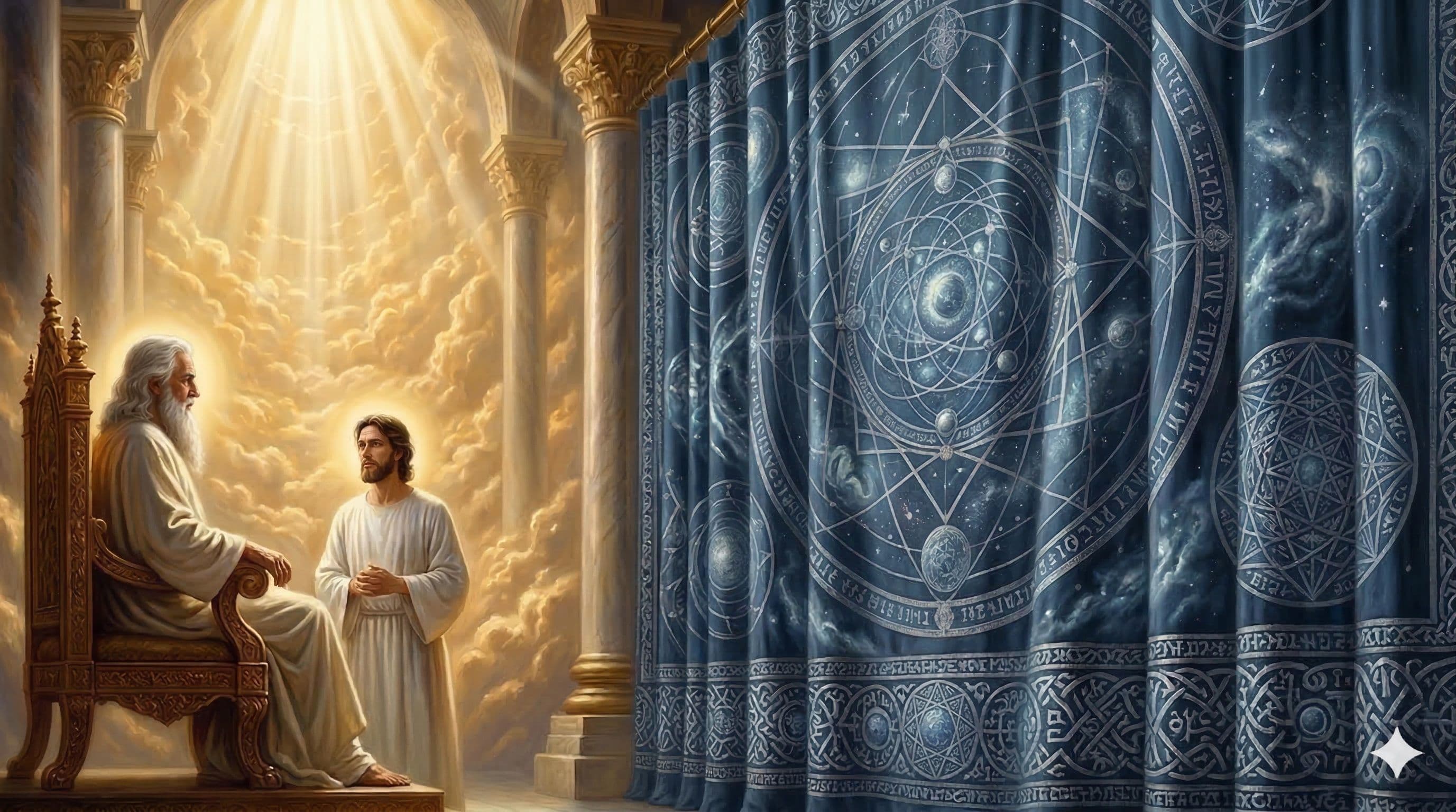
The mention of “curtains” in Moses 7:30 has contextual parallels with extrabiblical Enochic traditions that likely weren’t familiar to Joseph Smith in 1830.A separate evidence article discusses how Moses 7 presents multiple parties—including God, the heavens, Enoch, and the earth—as weeping for the wickedness of the world and the loss of Zion. On a variety of levels, the weeping of these figures parallels extrabiblical Enochic sources.1 In some cases, the details surrounding this weeping motif also resonate well with Enochic traditions. One example of this comes from the “curtain” imagery found in Moses 7:28–31:
And it came to pass that the God of heaven looked upon the residue of the people, and he wept; and Enoch bore record of it, saying: How is it that the heavens weep, and shed forth their tears as the rain upon the mountains? And Enoch said unto the Lord: How is it that thou canst weep, seeing thou art holy, and from all eternity to all eternity? And were it possible that man could number the particles of the earth, yea, millions of earths like this, it would not be a beginning to the number of thy creations; and thy curtains are stretched out still; and yet thou art there, and thy bosom is there; and also thou art just; thou art merciful and kind forever; And thou hast taken Zion to thine own bosom, from all thy creations, from all eternity to all eternity; and naught but peace, justice, and truth is the habitation of thy throne; and mercy shall go before thy face and have no end; how is it thou canst weep?
While this description conceptually aligns with a number of ancient sources,2 it is particularly congruent with details presented in 3 Enoch. This text recounts the experience of a rabbi known as Ishmael, who was given a guided tour of the heavens by an angel named Metatron (Enoch in his glorified angelic state). At one point, after describing the place where the souls of the wicked go after they depart from this life, Metatron dwells on the sorrow and grief of God and the heavens, who lament for the fate of the wicked and the loss of God’s presence on the earth. Much like Enoch, the patriarchs Abraham, Isaac, and Jacob begin to probe God’s emotive response to the sorrow and suffering of his creations:
They were praying before the Holy One, blessed be he, and saying in prayer, “Lord of the Universe, how long will you sit upon your throne, as a mourner sits in the days of his mourning, with your right hand behind you, and not redeem your sons and reveal your kingdom in the world? Do you not pity your sons who are enslaved among the nations of the world? Do you not pity your right hand behind you, by which you stretched out and spread the heavens, the earth, and the heaven of heavens? Have you no pity?” (3 Enoch 44:7)3
In this context, God’s right hand is a symbol of his creative power and divine presence. In essence, the patriarchs wonder why God—whose control over all creations was demonstrated when he “stretched out” the heavens and earth—has withdrawn his protective and intervening presence from mankind. Doesn’t he care? This, of course, echoes Enoch’s probing questions about God’s emotive response to human sorrow and suffering in Moses 7:28–31.
Particularly interesting is the use of the phrase “stretched out” in both texts in connection to the expansive nature of God’s creations. Although the passage in 3 Enoch doesn’t explicitly mention a curtain at this point, the language implies its presence, especially because of its close proximity to the mention of God’s throne (since throne and curtain imagery often go hand in hand).4 Curtain imagery is then explicitly invoked just a few verses later in chapter 45:
R. Ishmael said: Meṭaṭron said to me: Come and I will show you the curtain of the Omnipresent One, which is spread before the Holy One, blessed be he, and on which are printed all the generations of the world and all their deeds, whether done or to be done, till the last generation. I went and he showed them to me with his fingers, like a father teaching his son the letters of the Torah; and I saw: each generation and its potentates; each generation and its potentates; each generation and its heads …. And I saw: Adam and his generation, their deeds and their thoughts; Noah and the generation of the Flood, their deeds and their thoughts; Nimrod and the generation of the division of tongues, their deeds and their thoughts; Abraham and his generation, their deeds and their thoughts; … All the rest of the leaders of every generation and every deed of every generation both of Israel and of the gentiles, whether done or to be done in the time to come, to all generations, till the end of time, were all printed on the curtain of the Omnipresent One. I saw them all with my own eyes, and when I had seen them I opened my mouth and said in praise of the Omnipresent One. (3 Enoch 45:1–6)5
The way this chapter enumerates and elaborates on all categories of people and all epochs of human history (most of which is omitted by the use of ellipses in the quote above) is notable, as it emphasizes the expansive nature and extent of God’s sentient creations. The reader gets the impression that the heavenly curtain is being stretched out before their eyes, as all generations are unfolded before them. According to Philip Alexander, “The idea in 3En 45 appears to be that the whole course of human history is already worked out ‘in blueprint’ in the heavenly realm, and has been totally foreordained by God.”6
The specific wording used to describe what was on the curtain is also pertinent: “on [the curtain] are printed all the generations of the world and all their deeds, whether done or to be done, till the last generation” (3 Enoch 45:1). This aligns very closely with Moses 7:41: “the Lord spake unto Enoch, and told Enoch all the doings of the children of men.”7 Learning of these deeds is, in fact, what caused Enoch himself to weep. What is so interesting is that the description of his weeping in this context uses “stretching” imagery that mirrors the language used in connection to God’s creations and the heavenly curtain in preceding verses. These relationships are demonstrated in the following chart:
Moses 7:30 | Moses 7:36 | Moses 7:41 |
And were it possible that man could number the particles of the earth, yea, millions of earths like this, it would not be a beginning to the number of thy creations; and thy curtains are stretched out still; and yet thou art there, and thy bosom is there; and also thou art just; thou art merciful and kind forever; | Wherefore, I can stretch forth mine hands and hold all the creations which I have made; and mine eye can pierce them also, and among all the workmanship of mine hands there has not been so great wickedness as among thy brethren. | And it came to pass that the Lord spake unto Enoch, and told Enoch all the doings of the children of men; wherefore Enoch knew, and looked upon their wickedness, and their misery, and wept and stretched forth his arms, and his heart swelled wide as eternity; and his bowels yearned; and all eternity shook. |
It seems that the depth and breadth of Enoch’s sorrow—symbolized by his “stretched forth” arms and his heart which “swelled wide as eternity”—are meant to reflect the expansive scope of creation itself, as symbolized by the “stretched out” heavenly curtain. We have good reason, then, to thematically connect “all the doings of the children of men” which caused Enoch’s sorrow in Moses 7:41 with the “curtains” in Moses 7:30. The curtain imagery in Moses 7 thus resonates with 3 Enoch 45 on a level that may not be immediately apparent.
It should also be noted that Enoch, in his role as the angel Metatron, was very closely linked to this divine curtain imagery. In various Jewish texts, Enoch-Metatron was known as the Prince of the Presence, meaning that he had unique access to God’s immediate presence in the heavenly sanctum, which was depicted as a throne room in a celestial temple or court. Enoch-Metatron’s ability to behold God’s face made him uniquely suited for this position.8 Concerning the role of the curtain in this context, Andrei Orlov explains,
It was already observed that the idea of the Prince of the Presence is both mediatorial and liturgical, and therefore is closely linked with the motif of the celestial curtain, Pargod (פרגוד), the entity which separates the divine Presence from the rest of the heavenly world. The function of this Curtain which can be viewed as a celestial counterpart of the veil found in the earthly sanctuary is twofold. First, it protects the angelic hosts from the harmful luminosity of the divine Face. At the same time it shields the Deity by concealing the ultimate mysteries of the Godhead now accessible solely to the prince(s) of the divine Presence whose duty is to serve the Deity behind the Curtain. Several passages found in the Hekhalot literature depict Metatron and other princes of the Face as attendants who serve the divine Presence in the closest proximity to the Throne, and have the right to enter the immediate presence of the Lord.9
This point is corroborated by Metatron being described as one “who serves before the Curtain” on a Mandean incantation bowl.10 Various lines of evidence also portray him as a celestial high priest who performed priestly functions—including navigation of the veil—in the heavenly temple.11 The fact that it is specifically Enoch who mentions God’s curtain in Moses 7:30 is therefore quite fitting. Not only is the weeping context remarkably similar to that of 3 Enoch 44–45, but Enoch (in his role as the angel Metatron) was closely linked with this celestial object in early Jewish lore.
A Parallel with Heavenly Tablets and Adam’s Prophetic Vision
The celestial curtain, with its printed list of categories of all mankind, mirrors a comprehensive record that in various traditions was believed to be inscribed on heavenly tablets. In a note to his translation of the curtain-focused text of 3 Enoch 45, Alexander invites a comparison with a description of heavenly tablets in Hekhalot Rabbati.12 As shown in the following chart, concepts surrounding the heavenly tablets in this text closely mirror the details surrounding the curtain imagery in Moses 7:29–31 (with the curtain/tablets imagery being underlined, while other parallels are color coded).13
Moses 7 | Hekhalot Rabbati 6 |
29 And Enoch said unto the Lord: How is it that thou canst weep, seeing thou art holy, and from all eternity to all eternity? 30 And were it possible that man could number the particles of the earth, yea, millions of earths like this, it would not be a beginning to the number of thy creations; and thy curtains are stretched out still; and yet thou art there, and thy bosom is there; and also thou art just; thou art merciful and kind forever; 31 And thou hast taken Zion to thine own bosom, from all thy creations, from all eternity to all eternity; and naught but peace, justice, and truth is the habitation of thy throne; and mercy shall go before thy face and have no end; how is it thou canst weep? | 3 Said Rabbi Ishmael: Seganzegael, the Prince of the Presence, said to me, “My friend, sit in my bosom and I shall tell thee what is to come upon Israel.” I sat in his bosom and he gazed upon me and did weep, and his tears ran down continually from his eyes and fell upon my face. I said to him, “Why does your Excellency weep?” He said to me, “My friend, come, and I shall take thee in and teach thee what is laid up for Israel, the holy people.” He grasped me by my hand and took me in to the inmost chambers and to the most secret rooms and to the treasuries. He took tablets and opened them and showed me letters written with griefs each different from the other. I said to him, “For whom are these?” He said to me, “For Israel.” |
In Hekhalot Rabbati, the angel then goes on to explain the calamities that the heavenly tablets predicted would befall Israel throughout its generations.14 The setting therefore closely matches both Moses 7 and 3 Enoch 44–45, in which the heavens weep in the context of a comprehensive vision or understanding of mankind’s wickedness and suffering, as well as the loss of the divine presence from the earth.15
Some sources trace the heavenly record all the way back to Adam. Not only do many texts describe Adam as inheriting sacred writings from heaven,16 but they also depict him as envisioning or prophesying of all generations of the world—typically in language that resonates with what is said to be printed on the curtain in 3 Enoch 45.17 For instance, we read the following in Bereshit Rabbah:
Rabbi Yehuda bar Simon said: While Adam the first man was placed unformed before Him who spoke and the world came into being, He showed him each and every generation and its scholars, each and every generation and its wise men, each and every generation and its interpreters of the Torah, each and every generation and its leaders, as it is stated: “Your eyes saw my unformed parts, [and in Your book they were all written]” – the unformed ones whom Your eyes saw, they were already written in the book of Adam the first man. That is, “this is the book of the descendants of Adam.”18
Not only the leaders themselves, but their placement in historical events was also shown, just as upon the heavenly curtain in 3 Enoch 45. This detail is recorded in Midrash Tanchuma Buber:
(Gen. 5:1:) THIS IS THE BOOK…. What did the Holy One do to Adam? He cast a sleep upon him and showed him Noah and all the unblemished, Abraham and all the proselytes, Isaac and all who sacrifice burnt offerings, Jacob and all tent dwellers, Moses and all the humble, Aaron and all the priests, Joshua and all the community leaders, David and all the kings, [Solomon and all the Judges]. Then, when he had seen them all, he awakened from his sleep. The Holy One said to him: Have you seen [these? By your life], all these righteous [are] coming forth from you. When he had told him this, his spirit was at rest.19
These examples from rabbinic sources provide a context to understand a Dead Sea Scrolls text that has language even more similar to the curtain imagery from Moses 7:
With the mystery that is to be [God] spread out its foundation and indeed made it with wisdom and, regarding everything, with cleverness he fashioned it. The dominion of its deeds for all … and all with all … He has laid out for their understanding every deed so that one may walk in the inclination of his intelligence, and he spread out for Adam … for … and with precision of intelligence were made known the secrets of his plan, together with his walking for (he is) perfect in all his deeds. … Engraved is the statute and ordained is all the punishment because engraved is that which is ordained by God against all the iniquities of the sons of Sheth. And the book of remembrance is written before him for the ones who keep his word—that is, the vision of meditation of the book of remembrance. He bequeathed it to Adam (אנוש) together with a spiritual people because according to the likeness of the holy ones he fashioned him.20
Although the text is somewhat fragmentary and therefore difficult to decipher, the repeated use of “spread out” or “laid out” is conceptually aligned with the curtain motif. What is so intriguing about this particular text is its mention of a “book of remembrance,” a unique term that also surfaces in Moses 6:5 and which Enoch specifically mentions in Moses 6:46.
All of this leads to a collection of Islamic traditions, recorded in a work called Bihar Al Anwaar, which provides a very interesting description of Adam’s vision. As seen in the chart below, it uses the peculiar term “particles” to describe the individual members of Adam’s posterity, as shown to him in vision. This nicely mirrors the mention of “particles” that immediately precedes the curtain imagery in Moses 7:30:21
Moses 7 | Bihar Al Anwaar |
30 And were it possible that man could number the particles of the earth, yea, millions of earths like this, it would not be a beginning to the number of thy creations; and thy curtains are stretched out still; and yet thou art there, and thy bosom is there; and also thou art just; thou art merciful and kind forever; | Allah Mighty and Majestic presented to Adam, his offspring to his eyes, in the form of particles, a prophet (after) a prophet, a king (after) a king, a momin (after) a momin, and an infidel (after) an infidel. |
These connections with Adamic sources, while somewhat tangential, suggest that concepts subtly related to the curtain imagery had already been developing throughout Moses 6 in connection to Adam’s prophecy and the book of remembrance.22 The Islamic source further suggests that the term “particles” used in connection to the curtain imagery in Moses 7 is quite appropriate in this context.
The Use of “Curtain” in Other Canonized Scripture
The term “curtain” is used dozens of times in the Old Testament, primarily in connection to the veil of the Israelite tabernacle or temple but also in relation to tent imagery, generally. However, verses that closely mirror Moses 7:30—which involves the stretching out of curtains in the context of God’s creations—are rare. Only two other Old Testament passages in the KJV appear to use “curtain” in this specific manner:23
- “Bless the Lord, O my soul. O Lord my God, thou art very great; thou art clothed with honour and majesty. Who coverest thyself with light as with a garment: who stretchest out the heavens like a curtain” (Psalm 104:1–2)
- “It is he that sitteth upon the circle of the earth, and the inhabitants thereof are as grasshoppers; that stretcheth out the heavens as a curtain, and spreadeth them out as a tent to dwell in” (Isaiah 40:22)
As for Joseph Smith’s own revelations, the term “curtain” is used very rarely. It turns up once in the Book of Mormon in 3 Nephi 22:2, but that is merely a quotation of tent imagery from Isaiah 54:2. A similar use of “curtain” surfaces in D&C 101:21. The only other use of this word, which more closely parallels the instance in Moses 7, can be found in D&C 88:95: “And there shall be silence in heaven for the space of half an hour; and immediately after shall the curtain of heaven be unfolded, as a scroll is unfolded after it is rolled up, and the face of the Lord shall be unveiled.”24
We can therefore observe that “curtain” is not a particularly high-frequency term in scripture, generally speaking, and that usage analogous to Moses 7:30 is quite unusual, especially in Joseph Smith’s own revelations. This increases the likelihood that its use in Moses 7:30 is not random. That such a rare term is used in such a fitting context cannot be easily dismissed.
Conclusion
If one looks at the “curtain” imagery in the Book of Moses in isolation, it could plausibly be explained as deriving from biblical passages such as Psalm 104:1–2 or Isaiah 40:22. However, neither of these passages has anything to do with mourning, much less the specific imagery of heavenly entities mourning for the wickedness of mankind and the loss of God’s presence, as seen in Moses 7:28–31. It is therefore quite remarkable that an extensive discussion of the heavenly curtain appears in that very specific and unusual context in 3 Enoch 44–45, especially since this is the only portion of 3 Enoch that discusses either of these topics. The fact that they show up in such immediate proximity in separate Enoch texts is quite telling.
On a more general level, it is notable that this specific type of curtain imagery, which is rare in the scriptural canon, turns up anywhere at all in Smith’s revelations about Enoch. Although this concept is discernable in 3 Enoch and other Jewish sources, it isn’t clearly present in 1 Enoch, the only major Enoch text potentially available to Smith in 1830.25 It seems unlikely that Smith could have known that Enoch was so intimately connected to the divine curtain in early Jewish traditions.
Once one recognizes that the divine curtain was a conceptual counterpart to other heavenly records, as well as Adam’s visions and prophecies, it becomes possible to connect the curtain imagery in Moses 7 with discussions of these topics in extrabiblical sources. With this backdrop in place, sources like Hekhalot Rabbati and Bihar Al Anwaar help corroborate the development of the curtain motif in Moses 7, as well as some of the language used in connection to it.
All things considered, if Joseph Smith simply fabricated the Book of Moses, he placed this curtain imagery in a very suitable context. When the textual nuances are accounted for, it comes across as an authentic component of an ancient Enochic tradition that Smith likely knew nothing about. It therefore strengthens the credibility of the Book of Moses, generally, as well as Smith’s claim to be a prophet of God.
Further Reading
Jeffrey M. Bradshaw, The First Days and the Last Days (The Interpreter Foundation and Eborn Books, 2021), 174.
Jeffrey M. Bradshaw and David J. Larsen, In God’s Image and Likeness 2: Enoch, Noah, and the Tower of Babel (The Interpreter Foundation and Eborn Books, 2014), 142.
Hugh Nibley, Enoch the Prophet, The Collected Works of Hugh Nibley, Volume 2 (FARMS, 1986), 245–249.
Relevant Scriptures
Moses 1:27–28
Moses 7:28–31
Moses 7:36
Moses 7:41
- 1. Scripture Central, “Book of Moses Evidence: Themes of Weeping,” Evidence 525 (December 23, 2025).
- 2. For ranging examples of the heavenly curtain imagery, see Hugh Nibley, Enoch the Prophet, The Collected Works of Hugh Nibley, Volume 2 (FARMS, 1986), 245–249.
- 3. Translation by Philip Alexander, “3 (Hebrew Apocalypse of) Enoch,” in The Old Testament Pseudepigrapha, 2 vols., ed. James H. Charlesworth (Doubleday, 1983–85), 1:295.
- 4. In ancient and medieval Jewish sources, God is depicted as sitting on a throne in a throne room that was partitioned off from the rest of creation by a heavenly curtain, similar to how the holy of holies and ark of the covenant were separated from the holy place in the Israelite tabernacle and temple. Thus, the throne and curtain were closely linked architectural symbols in the heavenly sanctuary. For more on Enoch’s connection to God’s throne, see Scripture Central, “Book of Moses Evidence: Enoch’s Right to God’s Throne,” Evidence 498 (June 11, 2025).
- 5. Translation by Alexander, “3 (Hebrew Apocalypse of) Enoch,” 296–299.
- 6. Translation by Alexander, “3 (Hebrew Apocalypse of) Enoch,” 296.
- 7. Earlier, the Lord told Enoch, “I will show unto thee the world for the space of many generations” (Moses 7:4). It was also stated that “the Lord showed unto Enoch all the inhabitants of the earth” (Moses 7:21).
- 8. Scripture Central, “Book of Moses Evidence: Enoch Stood Before God’s Face,” Evidence 519 (November 5, 2025).
- 9. Andrei A. Orlov, The Enoch-Metatron Tradition, Texts and Studies in Ancient Judaism 107 (Mohr Siebeck, 2005), 122–123. For further discussion of the purpose of the curtain, see Jeffrey M. Bradshaw, The First Days and the Last Days (The Interpreter Foundation and Eborn Books, 2021), 174; Jeffrey M. Bradshaw and David J. Larsen, In God’s Image and Likeness 2: Enoch, Noah, and the Tower of Babel (The Interpreter Foundation and Eborn Books, 2014), 142.
- 10. Orlov, The Enoch-Metatron Tradition, 114; citing W. S. McCullough, Jewish and Mandean Incantation Texts in the Royal Ontario Museum (University of Toronto Press, 1967) D 5–6.
- 11. See Orlov, The Enoch-Metatron Tradition, 114–117.
- 12. See Alexander, “3 (Hebrew Apocalypse of) Enoch,” 296.
- 13. Heikhalot Rabbati 6:4, online at sefaria.org.
- 14. For more on the heavenly book imagery, see Scripture Central, “Book of Mormon Evidence: Lehi’s Calling (Book),” Evidence 335 (May 2, 2022).
- 15. For a more detailed description of the loss of the divine presence, see Scripture Central, “Book of Moses Evidence: Themes of Weeping,” Evidence 525 (December 23, 2025).
- 16. See, for example, Shamma Friedman, “The Book of Adam,” in Studies in Rabbinic History, Literature, and Culture in Honor of Richard L. Kalmin, ed. Carol Bakhos and Alyssa M. Gray (Brown Judaic Studies, 2024), 33–41.
- 17. See Scripture Central, “Book of Moses Evidence: Adam’s Prophecy,” Evidence 508 (August 20, 2025).
- 18. Bereshit Rabbah 24, online at sefaria.org. This source also aligns nicely with the vision given to Moses: “And it came to pass that Moses looked, and beheld the world upon which he was created; and Moses beheld the world and the ends thereof, and all the children of men which are, and which were created” (Moses 1:8).
- 19. Midrash Tanchuma Buber, Bereshit 32, online at sefaria.org.
- 20. Matthew J. Goff, 4QInstruction, Wisdom Literature from the Ancient World, vol. 2 (Society of Biblical Literature Press, 2013), 139. Note that the original formatting, which helps the reader better discern the ambiguities and content of the original fragmentary manuscripts, has been adjusted for easier reading.
- 21. This text also recalls the vision of Moses, which likewise connects the particles of the earth with the spirits that God had created: “And it came to pass, as the voice was still speaking, Moses cast his eyes and beheld the earth, yea, even all of it; and there was not a particle of it which he did not behold, discerning it by the Spirit of God. And he beheld also the inhabitants thereof, and there was not a soul which he beheld not; and he discerned them by the Spirit of God; and their numbers were great, even numberless as the sand upon the sea shore” (Moses 1:27–28). These texts also recall the promise given to Abraham in Genesis 22:17 (“I will multiply thy seed as the stars of the heaven, and as the sand which is upon the sea shore”) in which posterity is compared to the miniscule components of a physical substance. See also Isaiah 40:12 (in loose connection to the “curtain” imagery in Isaiah 4:22).
- 22. See Scripture Central, “Book of Moses Evidence: Adam’s Prophecy,” Evidence 508 (August 20, 2025).
- 23. For passages that describe the stretching of the heavens without the explicit “curtain” usage, see Job 9:8; Isaiah 42:5; 44:24; 51:13; Jeremiah 10:12; Zechariah 12:1.
- 24. Although the term “curtain” isn’t specifically mentioned, related imagery turns up in D&C 121:4: “O Lord God Almighty, maker of heaven, earth, and seas, and of all things that in them are, and who controllest and subjectest the devil, and the dark and benighted dominion of Sheol—stretch forth thy hand; let thine eye pierce; let thy pavilion be taken up; let thy hiding place no longer be covered; let thine ear be inclined; let thine heart be softened, and thy bowels moved with compassion toward us.”
- 25. Because 1 Enoch 14 implicitly involves a temple setting, it may indirectly imply the presence of a veil or curtain. But that imagery is not explicit. See Orlov, The Enoch-Metatron Tradition, 115–116. On the accessibility of 1 Enoch in 1830, see Jeffrey M. Bradshaw and Ryan Dahle, “Could Joseph Smith Have Drawn on Ancient Manuscripts When He Translated the Story of Enoch?: Recent Updates on a Persistent Question,” Interpreter: A Journal of Latter-day Saint Faith and Scholarship 33 (2019): 308–311; Colby Townsend, “Revisiting Joseph Smith and the Availability of the Book of Enoch,” Dialogue 53, no. 3 (2020): 41–71.