Evidence #561 | October 15, 2026
Book of Moses Evidence: Enoch’s Vision by the Sea East
Post contributed by
Scripture Central
Abstract
When read in context, Enoch’s vision by the “sea east” in Moses 6:42 meaningfully corresponds to his vision at the “waters of Dan” described in 1 Enoch.When Enoch was asked by Mahijah to explain who he was and where he came from, he explained the following:
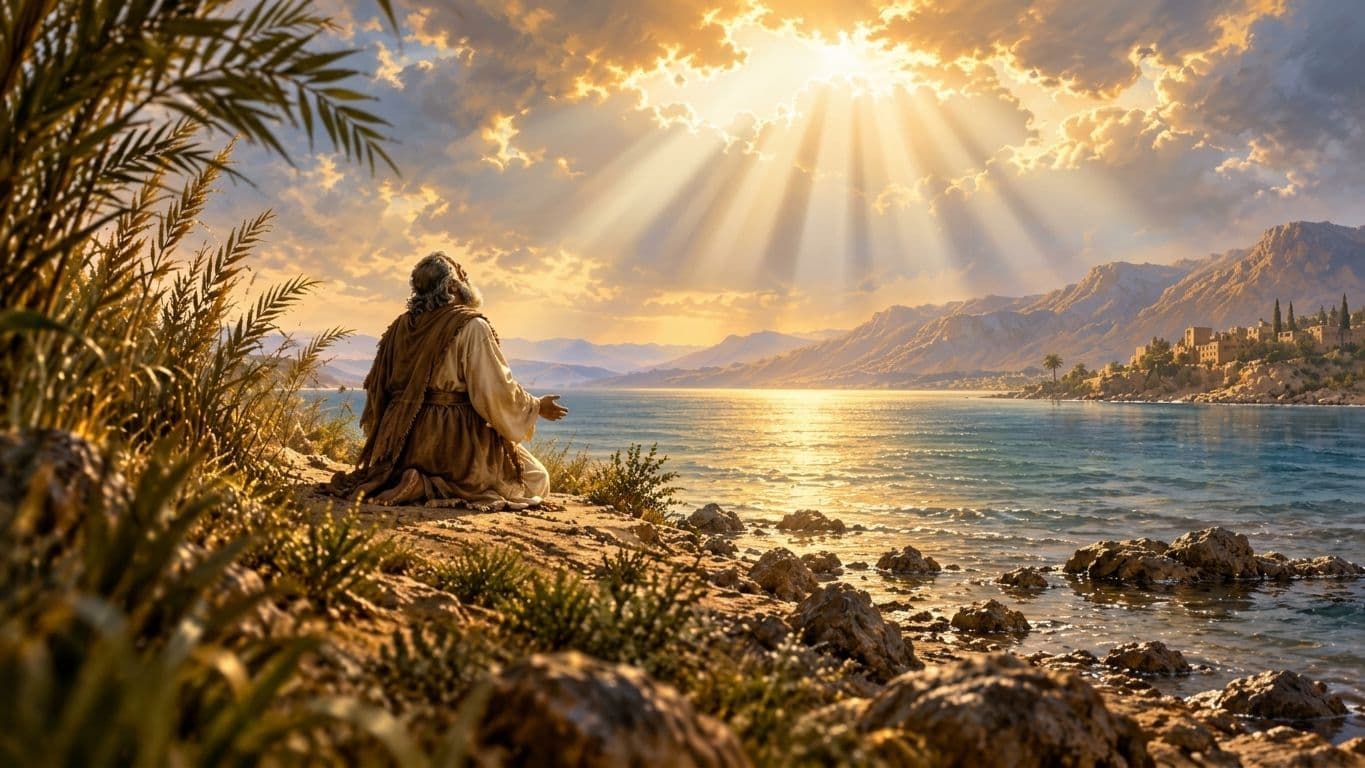
I came out from the land of Cainan, the land of my fathers, a land of righteousness unto this day. And my father taught me in all the ways of God. And it came to pass, as I journeyed from the land of Cainan, by the sea east, I beheld a vision; and lo, the heavens I saw, and the Lord spake with me, and gave me commandment; wherefore, for this cause, to keep the commandment, I speak forth these words. (Moses 6:41–42)1
This establishes that Enoch had a visionary encounter by a body of water in an eastern locale. The account of the fallen Watchers in the book of 1 Enoch likewise describes Enoch as having a vision near a body of water in an eastern region:
And I went and sat down upon the waters of Dan—in Dan which is on the southwest of Hermon—and I read their memorial prayers until I fell asleep. And behold a dream came to me and visions fell upon me, and I saw a vision of plagues (so that) I may speak to the children of heaven and reprimand them. (1 Enoch 13:7–8)2
George Nickelsburg describes the waters of Dan as one of “four major streams” that “converge to form the headwaters of the Jordan. Three of them—the Ḥaṣbani, the Dan, and the Hermon—are fed by the snows of Hermon and gush forth 500 million cubic meters (132 billion gallons) per annum of often white and roaring water.”3 Anciently, the Jordan River fed into Lake Huleh before eventually draining into the Sea of Galilee. These bodies of water are situated in the northeastern boundaries of Israel’s ancestral homeland. Josephus, for instance, described the “Upper Galilee” and the “Fountains of Jordan” as belonging to the “eastern parts” of the land which was allotted to the tribe of Naphtali.4
This general area seems to have held deep religious significance to various ancient societies. According to Nickelsburg, “a stunning mass of literary, epigraphic, and archaeological evidence, stretching from the third millennium B.C.E. to the middle of the first millennium C.E., attests that Canaanites, Israelites, Greek[s], Romans, and Christians treated the area around Hermon as sacred territory.”5 Specifically, the region was associated with “stories of the commissioning” of several biblical figures, in which they received a prophetic calling or divine commission to accomplish a task.6 Enoch’s prophetic commission, recorded in the Book of Watchers (1 Enoch 1–36), thus resonates with the sacred geography of this region.
Enoch’s journey by the “sea east” in the Book of Moses likewise arises in close proximity to his prophetic calling.7 Concerning the directional symbolism in this context, Jeffrey Bradshaw has pointed out that within the corpus of biblical literature, “eastward movement is repeatedly associated with increasing distance from God. This is consistent with the idea that [Enoch] has left ‘the land of righteousness’ as he goes to preach to the wicked.”8
The Waters of Dan and the Sea of Galilee
Bradshaw has further proposed that the waters of Dan may be associated with the Sea of Galilee:
The “waters of Dan” in 1 Enoch arguably may be identified with the Sea of Galilee. Although the “sea east” in the biblical text usually refers to the Dead Sea, the Sea of Galilee (or Kinnereth) is also certainly an “east” sea. See Joshua 12:3; Numbers 34:11–12, where the Sea of Kinnereth is considered the eastern frontier of the Promised Land. In Numbers 13:29, the Canaanites live by this sea.
The Sea of Galilee could probably be called the “waters of Dan,” as it borders on that land. Nearby Mt. Hermon is, of course, where the descent of the Watchers and the ascent of Enoch take place. It was also the site of the Transfiguration, the place marking both Heaven and Sheol. Jewish tradition links Mount Hermon with Jerusalem/Zion (the Jordan was thought to have its source at Mt. Hermon), especially for cultic events like the Yom Kippur liturgy.9
One limitation to this proposal, however, is that the Sea of Galilee, although it is indeed an eastern sea, is not anciently attested as the “waters of Dan.” Nor is it known as the “sea of Dan” or a similar designation. This, of course, does not prove it was never designated as such in ancient times. It simply means the association is conjectural rather than being based on historical precedent. It must also be recognized that the “waters of Dan,” as traditionally understood, are situated approximately two dozen miles north of the Sea of Galilee. Thus, while the two bodies of water are in the same general vicinity according to Israel’s broader geographical profile, they are not immediately adjacent.
Perhaps a better candidate, based purely on geographic proximity, would be Lake Huleh.10 Although the lake was drained in modern times to repurpose the land for agricultural use, it was anciently situated just a dozen miles south of the waters of Dan, thus closing the geographical gap considerably.11 While much smaller and less prominent than the Sea of Galilee, the lake was nevertheless referred to as a “sea” in early Jewish sources.12 However, like the Sea of Galilee, it also is not known to have been designated as the “waters of Dan.”
The Broader Narrative Context
Recognizing these limitations, some observers may assign this parallel limited evidentiary value. And, indeed, the differences must be appropriately accounted for. Nevertheless, when placed in its broader narrative context, the substance of Bradshaw’s proposal becomes much more enticing. This is because the parallel arises amidst a cluster of other intriguing similarities, each of which is discussed in its own subsection below.
Prophetic Commission
Concerning Enoch’s prophetic commission as outlined in 1 Enoch, Nickelsburg views this event as taking place in 1 Enoch 12:2–13:3.13 The reference to the “waters of Dan” then occurs in 1 Enoch 13:7 (only four verses later), and Nickelsburg specifically proposes a connection between this locale and the events of Enoch’s commission.14
As for the Book of Moses, Enoch’s prophetic commission takes place in Moses 6:26–36.15 The reference to the “sea east” is then given in Moses 6:42 (only six verses later). This reference comes just as Enoch begins to fulfill his commission to preach to the people and, importantly, it mentions the commissioning event itself as taking place at that location. Thus, not only do both Enochic sources mention a body of water in close proximity to Enoch’s commission (textually speaking), but each body of water reasonably provides the specific geographic setting for that commission.
Journey, Vision and Commission to Speak
The references to the “waters of Dan” and the “sea east” occur within a broader cluster of three additional narrative parallels. In both accounts, Enoch (1) undertakes a journey, (2) beholds a vision, and (3) receives a specific commission to speak the word of the Lord to the wicked.
1 Enoch 13 | Moses 6 |
7–8 And I went and sat down upon the waters of Dan—in Dan which is on the southwest of Hermon—and I read their memorial prayers until I fell asleep. And behold a dream came to me and visions fell upon me, and I saw a vision of plagues (so that) I may speak to the children of heaven and reprimand them. (1 Enoch 13:7–8) | 42 And it came to pass, as I journeyed from the land of Cainan, by the sea east, I beheld a vision; and lo, the heavens I saw, and the Lord spake with me, and gave me commandment; wherefore, for this cause, to keep the commandment, I speak forth these words. |
Enoch’s Divine Gift of Speech
Enoch, as depicted in 1 Enoch 14:3, explains that God has “given me the word of understanding so that I may reprimand the Watchers.” He contextualizes this by describing how speech itself is a gift from God: “I now speak with my tongue of flesh and the breath of the mouth which the Great One has given to man.”16
These details mirror a theme of divinely empowered speech in the Book of Moses, which begins with Enoch complaining that he was “slow of speech” (Moses 6:31).17 In response, the Lord instructed him, “Open thy mouth, and it shall be filled, and I will give thee utterance” (Moses 6:32). Moreover, the Lord told Enoch, “all thy words will I justify; and the mountains shall flee before you, and the rivers shall turn from their course” (Moses 6:34). This promise is fulfilled in the next chapter, where “all nations feared greatly, so powerful was the word of Enoch, and so great was the power of the language which God had given him” (Moses 7:13).18 Both texts therefore emphasize Enoch’s divine gift of speech in the context of his prophetic calling.
Descriptions of Wickedness and Divine Judgments
Enoch’s prophetic commission in 1 Enoch 12–13 is surrounded by several descriptions of the wickedness of the Watchers and the judgments pronounced upon them. Comparable passages can be found throughout Moses 6–7.19
Topic | 1 Enoch | Moses 6–7 |
Oaths | 6:4 Let us all swear an oath and bind everyone among us by a curse not to abandon this suggestion but to do the deed. Then they all swore together and bound one another by (the curse). | 6:29 Wherefore, they have foresworn themselves, and, by their oaths, they have brought upon themselves death; |
Hell, Darkness, and Prison | 10:4–7 “Bind Azaẓ’el hand and foot (and) throw him into the darkness!” And he made a hole in the desert which was in Duda’el and cast him there; he threw on top of him rugged and sharp rocks. And he covered his face in order that he may not see light; and in order that he may be sent into the fire on the great day of judgment. 10:12 … bind them for seventy generations underneath the rocks of the ground until the day of their judgment … 10:13 In those days they will lead them into the bottom of the fire—and in torment—in the prison (where) they will be locked up forever. 14:6 … you shall remain inside the earth, imprisoned all the days of eternity. | 6:28 And for these many generations, ever since the day that I created them, have they gone astray … and have sought their own counsels in the dark; … 6:29 Wherefore, they have foresworn themselves, and, by their oaths, they have brought upon themselves death; and a hell I have prepared for them, if they repent not; 6:49 Behold Satan hath come among the children of men, and tempteth them to worship him; and men have become carnal, sensual, and devilish, and are shut out from the presence of God. 7:26 And he beheld Satan; and he had a great chain in his hand, and it veiled the whole face of the earth with darkness; and he looked up and laughed, and his angels rejoiced. 7:38 behold, I will shut them up; a prison have I prepared for them. |
Carnal Sin and Expulsion | 10:9 Proceed against the bastards and the reprobates and against the children of adultery; and destroy the children of adultery and expel the children of the Watchers from among the people. 10:11 Make known to Semyaza and the other who are with him, who fornicated with the women, that they will die together with them in all their defilement. 15:4 Surely you, you [used to be] holy, spiritual, the living ones, [possessing] eternal life; but (now) you have defiled yourselves with women, and with the blood of the flesh begotten children, you have lusted with the blood of the people, like them producing blood and flesh, (which) die and perish. | 6:49 Behold Satan hath come among the children of men, and tempteth them to worship him; and men have become carnal, sensual, and devilish, and are shut out from the presence of God. 6:55 And the Lord spake unto Adam, saying: Inasmuch as thy children are conceived in sin, even so when they begin to grow up, sin conceiveth in their hearts, and they taste the bitter, that they may know to prize the good. |
Self-Defilement | 12:4 Enoch, scribe of righteousness, go and make known to the Watchers of heaven who have abandoned the high heaven … and have defiled themselves with women … They have defiled themselves with great defilement upon the earth | 6:29 Wherefore, they have foresworn themselves, and, by their oaths, they have brought upon themselves death; |
Murder | 12:6 For their children delight in seeing the murder of their beloved ones. | 6:28 … and in their own abominations have they devised murder … 7:29 And unto thy brethren have I said, and also given commandment, that they should love one another, … but behold, they are without affection, and they hate their own blood |
Judgment or Decree | 14:4–6 and judgment is passed upon you. From now on you will not be able to ascend into heaven unto all eternity, but you shall remain inside the earth, imprisoned all the days of eternity. | 6:30 And this is a decree, which I have sent forth in the beginning of the world, … I decreed it, even as it shall be sent forth in the world, unto the ends thereof. |
A Memorandum and the Book of Remembrance
According to Nickelsburg, “When Enoch has carried out his commission to announce judgment to the fallen watchers, they in turn commission him to intercede for them and their sons.”20 The specific nature of this reverse commission is quite intriguing: “And they asked that I write a memorandum of petition for them, that they might have forgiveness, and that I recite the memorandum of petition for them in the presence of the Lord of heaven” (1 Enoch 13:4–5).21
In effect, they sought a written petition on their behalf—a favorable memorial or what could possibly be termed a “book of remembrance”—rather than a record emphasizing their wickedness. Lest one view this interpretation as a stretch, non-Latter-day Saint scholar George Nickelsburg, in his commentary on this specific passage, explicitly cites the “book of remembrance” from Malachi 3:16 as being plausibly associated with the Watchers’ “petition of memorandum.”22 This is significant because Enoch mentions a “book of remembrance” in Moses 6:46, just a few verses after the reference to the “sea east” in Moses 6:42. It seems quite plausible that this book included divine decrees or pronouncements of judgment upon the wicked.
Fear and Trembling
Another parallel comes from the response of the wicked in each story. In the midst of describing the Watchers’ petition for Enoch to write their memorandum, it is reported that “they were all frightened, and fear and trembling seized them” (1 Enoch 13:3).23 When Enoch awakens from his dream-vision, he travels to where all the Watchers were assembled, but he finds them “sitting and weeping” and “covering their faces” (1 Enoch 13:9).24 As summarized by Nibley, “What caused them to tremble most of all was that Enoch produced a special book as a witness against them.”25 Likewise, in the Book of Moses, the people who assembled to hear the words of Enoch immediately “trembled, and could not stand in his presence” after he mentioned the “book of remembrance” (Moses 6:46–47).
Conclusion
When viewed in isolation, the correspondence between a “sea east” and the “waters of Dan” may seem rather trivial. While both bodies of water can legitimately be viewed as having eastward significance, they technically belong to different geographical categories: a network of streams versus an actual sea. Moreover, nothing in the Book of Moses explicitly associates Enoch’s activities with the region of Dan. If this surface-level resemblance were the sum and substance of the connection, it would admittedly be underwhelming. But there is much more to the story.
Latter-day Saints naturally assume that the core traditions preserved in the Book of Moses significantly predate Israel’s conquest and settlement of Canaan. So there isn’t a need to assume a one-to-one geographical correspondence in the first place. Nor does the Book of Moses itself provide any clear indication that its events transpired in what would later become known as the land of Israel. One possibility, therefore, is that as earlier Enochic traditions were transmitted and eventually circulated among Jewish authors (such as those who composed 1 Enoch), certain details were adapted to fit more familiar religious and geographical settings.
Such modifications were commonplace in ancient literary traditions, especially when inherited narratives were retold for new audiences. It is therefore not implausible that an early tradition associating Enoch’s vision with a body of water in an eastward setting might eventually have been localized near the waters of Dan, a site of religious and geographical significance in later Jewish tradition. Indeed, variations of this general kind are well attested throughout the surviving corpus of Enochic literature.26
Nevertheless, the mere possibility of such an adaptation does little, by itself, to establish a meaningful textual relationship. For a proposed correspondence of this kind to become persuasive, it generally needs to be supported by a broader network of parallel elements. Fortunately, this is precisely what one encounters when the relevant passages in the Book of Moses and 1 Enoch are compared.
It is not simply that both accounts mention a body of water in an eastward setting. It is that they share a series of additional narrative features in close textual proximity with this detail. These include (1) a journey, (2) a prophetic call formula, (3) a heavenly vision, (4) a commission to preach to the wicked, (5) an emphasis on speech as a divine gift, (6) several parallel descriptions of impending judgments and punishments, (7) records associated with the theme of remembrance, and (8) an audience that responds with fear or distress in response to a revelatory book. Perhaps most important of all, these elements all center upon the very same biblical figure in each text, namely Enoch.
To be sure, differences remain between these accounts, and not every parallel holds the same evidentiary strength. Nevertheless, their cumulative strength is impressive, especially when factors such as specificity, contextual relationships, proximate clustering, and occasional shared sequence are considered.
In light of this analysis, one potential explanation is that Joseph Smith had access to 1 Enoch and subsequently produced his own creative adaptation of the story. While technically possible, given Richard Laurence’s publication of an English translation in 1821, a number of factors cast significant doubt on this hypothesis.27 The notion that Smith encountered some type of brief summary or notice of Laurence’s work seems more plausible, but such limited exposure would hardly suffice to explain this detailed array of parallel elements.28 Ultimately, in the absence of a satisfying naturalistic explanation for the cumulative weight of these correspondences, Enoch’s vision by the “sea east” provides meaningful evidence in support of Joseph Smith’s prophetic claims.
Jeffrey M. Bradshaw and David J. Larsen, In God’s Image and Likeness 2: Enoch, Noah, and the Tower of Babel (The Interpreter Foundation and Eborn Books, 2014), 46, 70, 97.
Bible
Numbers 13:29
Numbers 34:11–12
Joshua 12:3
Malachi 3:16
Pearl of Great Price
Moses 6:26–36
Moses 6:41–49
Moses 6:55
Moses 7:13
Moses 7:26
Moses 7:29
Moses 7:38
- 1. For more on Enoch’s encounters with Mahijah/Mahujah, see Scripture Central, “Book of Moses Evidence: The Name and Role of Mahijah/Mahujah,” Evidence 528 (January 15, 2026).
- 2. E. Isaac, “1 (Ethiopic Apocalypse of) Enoch,” in The Old Testament Pseudepigrapha, 2 vols., ed. James Charlesworth (Doubleday, 1983–1985), 19–20.
- 3. George W. E. Nickelsburg, 1 Enoch 1: A Commentary on the Book of 1 Enoch Chapters 1–36, 81–108, ed. Klaus Baltzer (Fortress Press, 2001), 239–240.
- 4. Josephus, Jewish Antiquities 5.86, trans. William Whiston, in The Genuine Works of Flavius Josephus, the Jewish Historian (London: W. Bowyer, 1737).
- 5. George W. E. Nickelsburg, 1 Enoch 1: A Commentary on the Book of 1 Enoch Chapters 1–36, 81–108, ed. Klaus Baltzer (Fortress Press, 2001), 247.
- 6. Nickelsburg, 1 Enoch 1, 246.
- 7. See Scripture Central, “Book of Moses Evidence: Enoch’s Prophetic Commission,” Evidence 485 (March 12, 2025).
- 8. Jeffrey M. Bradshaw and David J. Larsen, In God’s Image and Likeness 2: Enoch, Noah, and the Tower of Babel (The Interpreter Foundation and Eborn Books, 2014), 70.
- 9. Jeffrey M. Bradshaw and David J. Larsen, In God’s Image and Likeness 2: Enoch, Noah, and the Tower of Babel (The Interpreter Foundation and Eborn Books, 2014), 97.
- 10. See map in Nickelsburg, 1 Enoch 1, 240.
- 11. For a basic overview of the area, see “Hula Valley,” online at wikipedia.org.
- 12. Ancient rabbinic literature explicitly refers to Lake Huleh as a “sea.” See Bava Batra 74b:11: “Jordan issues forth from the cave of Pamyas. That is also taught in a baraita: The Jordan issues forth from the cave of Pamyas, and travels in the Sea of Sivkhi, i.e., the Hula Lake, and in the Sea of Tiberias, the Sea of Galilee, and rolls down to the Great Sea, and rolls down until it reaches the mouth of the leviathan.” See also Kilayim 9:3:16, which references Lake Samkho (the Greek designation for Lake Ḥuleh). The term yammā (Aramaic: “sea”) is what underlies the translation of “lake.”
- 13. See Nickelsburg, 1 Enoch 1, 234.
- 14. See Nickelsburg, 1 Enoch 1, 234–235: “Epiphanies (and commissionings) often take place on holy ground and/or in cultic situations. … If the geographical locations mentioned in 1 Enoch 13:7 and 9 imply that Enoch’s activities took place at a traditional sanctuary … such a setting may be presupposed here.”
- 15. See Scripture Central, “Book of Moses Evidence: Enoch’s Prophetic Commission,” Evidence 485 (March 12, 2025).
- 16. Isaac, “1 (Ethiopic Apocalypse of) Enoch,” 20.
- 17. See Scripture Central, “Book of Moses Evidence: Slow of Speech,” Evidence 496 (May 28, 2025).
- 18. See Scripture Central, “Book of Moses Evidence: Enoch’s Divine Power of Speech,” Evidence 504 (July 23, 2025).
- 19. All translations of 1 Enoch in the following chart derive from Isaac, “1 (Ethiopic Apocalypse of) Enoch,” 17–21. In some instances, additional data from Moses 7 has been added where it seems to overlap with or elucidate the meaning of the content in Moses 6. One significant difference in these accounts is that Enoch is addressing the fallen Watchers in 1 Enoch but wicked mortals in Moses 6. One way to account for this is to recognize that some traditions blurred the distinction between the two groups. See Scripture Central, “Book of Moses Evidence: The Seed of Cain,” Evidence 548 (June 10, 2026); Scripture Central, “Book of Moses Evidence: Forbidden Knowledge and Secret Combinations,” Evidence 532 (February 11, 2026). For further insight into several of the parallels discussed in the chart, see Scripture Central, “Book of Moses Evidence: Hell Was ‘Prepared’,” Evidence 510 (September 3, 2025); Scripture Central, “Book of Moses Evidence: Theme of Darkness,” Evidence 479 (January 31, 2025).
- 20. Nickelsburg, 1 Enoch 1, 237.
- 21. Nickelsburg, 1 Enoch 1, 237.
- 22. Nickelsburg, 1 Enoch 1, 237: “It may refer to … a book (Mal 3:16), set in the presence of God for the purpose of prodding God into action.” Nickelsburg also considers the possibility that it may reflect a chronicle (Ezra 6:2) or a prayer (Tob 12:12). So an association with the “book of remembrance” from Malachi 3 is one of several interpretive possibilities.
- 23. Isaac, “1 (Ethiopic Apocalypse of) Enoch,” 19.
- 24. Nickelsburg, 1 Enoch 1, 248.
- 25. Hugh W. Nibley, Enoch the Prophet, vol. 2 of The Collected Works of Hugh Nibley (FARMS, 1986), 214.
- 26. Numerous comparable examples can be seen in John C. Reeves and Annette Yoshiko Reed, Enoch from Antiquity to the Middle Ages (Oxford University Press, 2018).
- 27. See Jeffrey M. Bradshaw, Matthew L. Bowen, and Ryan Dahle, “Textual Criticism and the Book of Moses: A Response to Colby Townsend’s ‘Returning to the Sources,’ Part 1 of 2,” Interpreter: A Journal of Latter-day Saint Faith and Scholarship 40 (2020): 104–122. The main problem is that Laurence’s translation was published in England and appears to have had a limited initial print run. Although some copies likely made their way to America, it hardly seems like the type of text that would end up in the hands of a poor, uneducated farmer like Joseph Smith in 1830. For more on the details of potential access, see the concluding endnotes in Scripture Central, “Book of Moses Evidence: God Held Noah’s Ark,” Evidence 544 (May 13, 2026).
- 28. See Colby Townsend, “Revisiting Joseph Smith and the Availability of the Book of Enoch,” Dialogue 53, no. 3 (2020): 41–71.