KnoWhy #834 | January 13, 2026
Why Does the Lord Tell Cain That Sin “Lieth at the Door?”
Post contributed by
Scripture Central
“If thou doest not well, sin lieth at the door, and Satan desireth to have thee; and except thou shalt hearken unto my commandments, I will deliver thee up, and it shall be unto thee according to his desire. And thou shalt rule over him.” Moses 5:23
The Know
Genesis 4 contains a verse that has puzzled biblical scholars for many years. In this chapter, Cain gives an offering to God which God refuses (vv. 3-5). God then asks Cain why he is angry (v.6) and tells him “If thou doest well, shalt thou not be accepted? and if thou doest not well, sin lieth at the door. And unto thee shall be his desire, and thou shalt rule over him” (Genesis 4:7). The Hebrew behind the phrase “lieth at the door” is unusual, and it is difficult to know what the phrase might mean. However, the Book of Moses (the opening chapters in the Joseph Smith Translation of Genesis), along with some ancient Near Eastern materials, help to explain that verse.1
The Book of Moses clarifies Genesis 4:7. Moses 5:23 reads, “If thou doest well, thou shalt be accepted. And if thou doest not well, sin lieth at the door, and Satan desireth to have thee; and except thou shalt hearken unto my commandments, I will deliver thee up, and it shall be unto thee according to his [Satan’s] desire. And thou shalt rule over him.” The phrase “and Satan desireth to have thee,” is in the Book of Moses but not in Genesis; it helps to explain who and what the remainder of the verse is referring to, as well as what “his desire” refers to, namely to Satan’s desire is the one who Cain will rule over, and Satan will “desire” Cain. Verse 24 clarifies that this will come about because of the close relationship that had developed between Cain and Satan. This Book of Moses verse brings a level of depth to the way the reader understands Satan that one might not notice at first and it also solves the problem otherwise found here in Genesis.
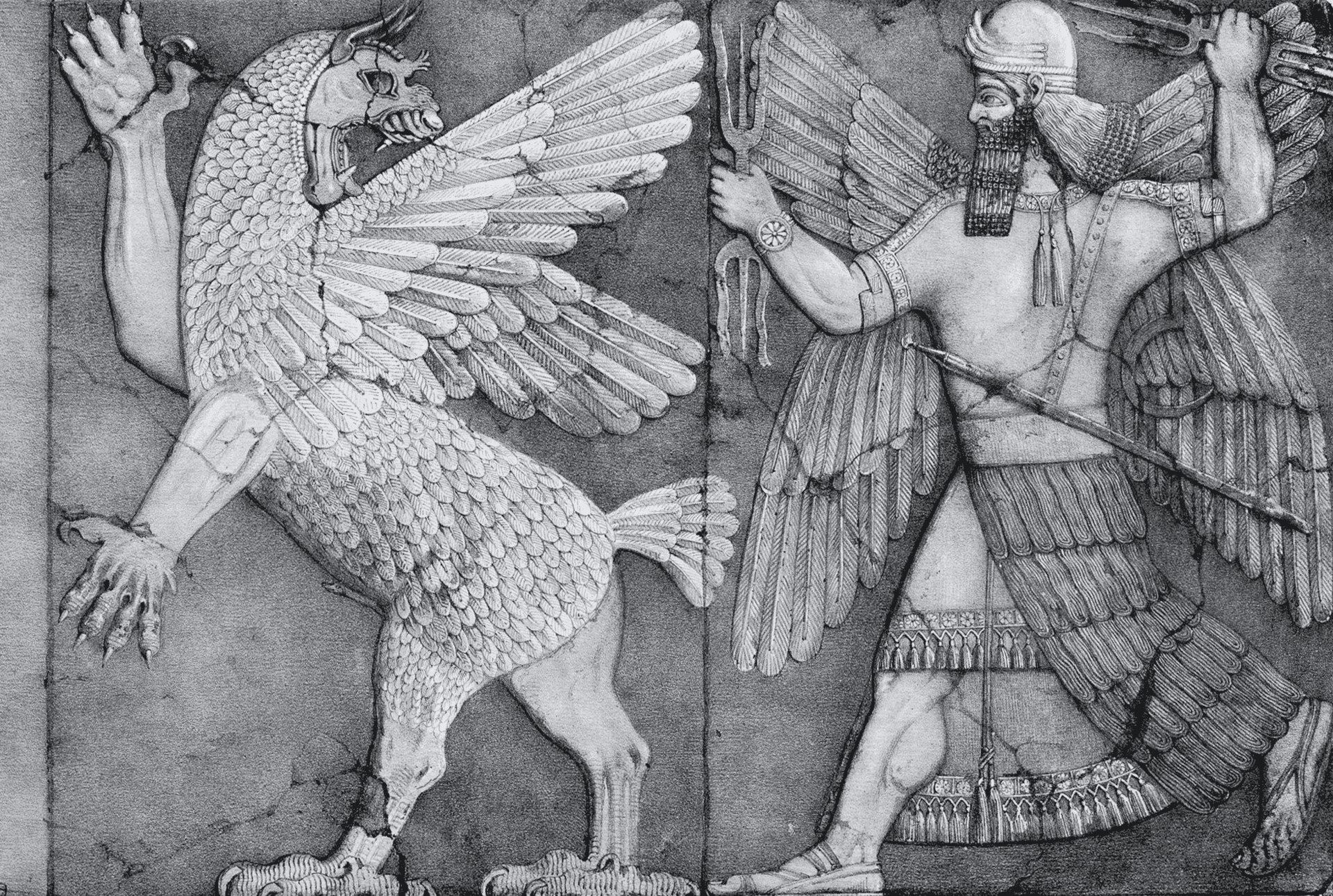
The Hebrew word rabatz, rendered as lieth in Genesis, is similar to word in a language called Akkadian, the language of some of Israel’s neighbors in Mesopotamia. It means “to crouch” or to “lie in wait,” and thus can also be translated as “to lurk.”2 In Genesis, this may mean that sin is “crouching” or “lurking” just outside Cain’s door or someone else’s door. In ancient Mesopotamia, demons called rabisu were thought to lurk outside a person’s door, waiting to attack the person when he or she came out of their house (an interesting insight on how ancient people viewed the sanctity of the home, where they often had images or talismans of deities or ancestors), so the wording in Genesis seems to comport with this background description.3
But Akkadian scholar M. L. Barré has stated that connecting this Mesopotamian idea with Genesis 4:7 “is complicated by the extremely problematic nature of this passage: no satisfactory solution to its difficulties has yet been reached.”4 That verse is often understood to mean that if Cain does not do very his best, then sin will be like a croucher-demon at the door,5 and thus Barré thinks the verse could be referencing a demon who was tempting Cain to kill Abel.6 However, Barré notes that “the Akkadian sources portray the rābişu as a being that attacks its victims, not one that tempts them to commit sin.”7
Here, the Book of Moses helps to resolve some of the difficulty with the text noted by Barré. In Moses 5:23, the demon is not said to be lurking outside the door enticing Cain to sin. Rather, Satan, an embodiment of sin, is waiting outside the door so he can pounce on Cain and thus “have” him unless Cain hearkens unto the Lord’s commandments, as the Book of Moses uniquely clarifies. And since Satan’s waiting outside the door so he can capture Cain is precisely how some ancient Mesopotamians thought demons behaved, the use of the intriguing term in that verse makes perfect sense.8
Never miss a KnoWhy
Get Scripture Central's latest research and resources delivered straight to your inbox.
The Why
The Book of Moses presents the powerful image of Satan as sin lurking outside the door, ready to pounce on Cain and bring him under his control. However, Moses 5 makes it clear that there is a way to escape Satan: “If thou doest well, thou shalt be accepted” (Moses 5:23). God makes clear to Cain that he is not living the way he should, and people would one day say of Cain that “he rejected the greater counsel which was had from God; and this is a cursing which I will put upon thee, except thou repent” (Moses 5:25). Cain could choose to “do well” by repenting and following the counsel of God, and he would thereby escape Satan; but if he did not, Satan was metaphorically crouching outside the door and would attack him and “have” his soul.
The choice presented to Cain is similar to the choice presented to all of God’s children. Anyone who has gone down the wrong path in life can choose to repent and “do well” by obeying God’s counsel, thereby escaping Satan who lies in wait for all of God’s children. As Tamara W. Runia has said, “Satan is the thief of hope. … You are not the voice in your head or the mistakes you have made. …Tell Satan, ‘Not today.’ Put him behind you.”9 Everyone can put Satan behind them through repentance and faithfully following the Lord Jesus Christ. As Tamara Runia also stated, “Repentance is our best news! We don’t stay on the covenant path by never making a mistake. We stay on the path by repenting every day.”10
Jonathon Riley, “Hebraisms in the Book of Moses: Laying Groundwork and Finding a Way Forward” in Tracing Ancient Threads in the Book of Moses: Inspired Origins, Temple Contexts, and Literary Qualities, edited by Jeffrey M. Bradshaw, David R. Seely, John W. Welch and Scott Gordon (Orem, UT: The Interpreter Foundation; Springville, UT: Book of Mormon Central; Redding, CA: FAIR; Tooele, UT: Eborn Books, 2021) 703-732.
Matthew L. Bowen, "Getting Cain and Gain." Interpreter: A Journal of Mormon Scripture 15 (2015): 115-141.
Tamara W. Runia, “Your Repentance Doesn’t Burden Jesus Christ; It Brightens His Joy,” Ensign (May 2025).
- 1. This KnoWhy relies heavily on Jonathon Riley, “Hebraisms in the Book of Moses: Laying Groundwork and Finding a Way Forward” in Tracing Ancient Threads in the Book of Moses: Inspired Origins, Temple Contexts, and Literary Qualities, edited by Jeffrey M. Bradshaw, David R. Seely, John W. Welch and Scott Gordon (Orem, UT: The Interpreter Foundation; Springville, UT: Book of Mormon Central; Redding, CA: FAIR; Tooele, UT: Eborn Books, 2021) 703-732.
- 2. M. L. Barré, “Rabiṣu,” in Dictionary of Deities and Demons in the Bible, ed. Karel van der Toorn, Bob Becking, and Pieter W. van der Horst (Leiden: Brill, 1995. 2nd rev. ed. Grand Rapids: Eerdmans, 1999), 682–3.
- 3. Barré, “Rābişu,” 682–3.
- 4. Barré, “Rābişu,” 682–3.
- 5. Barré, “Rābişu,” 682–3.
- 6. Barré, “Rābişu,” 682–3.
- 7. Barré, “Rābişu,” 682–3.
- 8. Barré, “Rābişu,” 682–3.
- 9. Tamara W. Runia, “Your Repentance Doesn’t Burden Jesus Christ; It Brightens His Joy,” Ensign (May 2025).
- 10. Tamara W. Runia, “Your Repentance Doesn’t Burden Jesus Christ; It Brightens His Joy,” Ensign (May 2025).