KnoWhy #825 | November 18, 2025
Who Killed Joseph and Hyrum Smith?
Post contributed by
Scripture Central
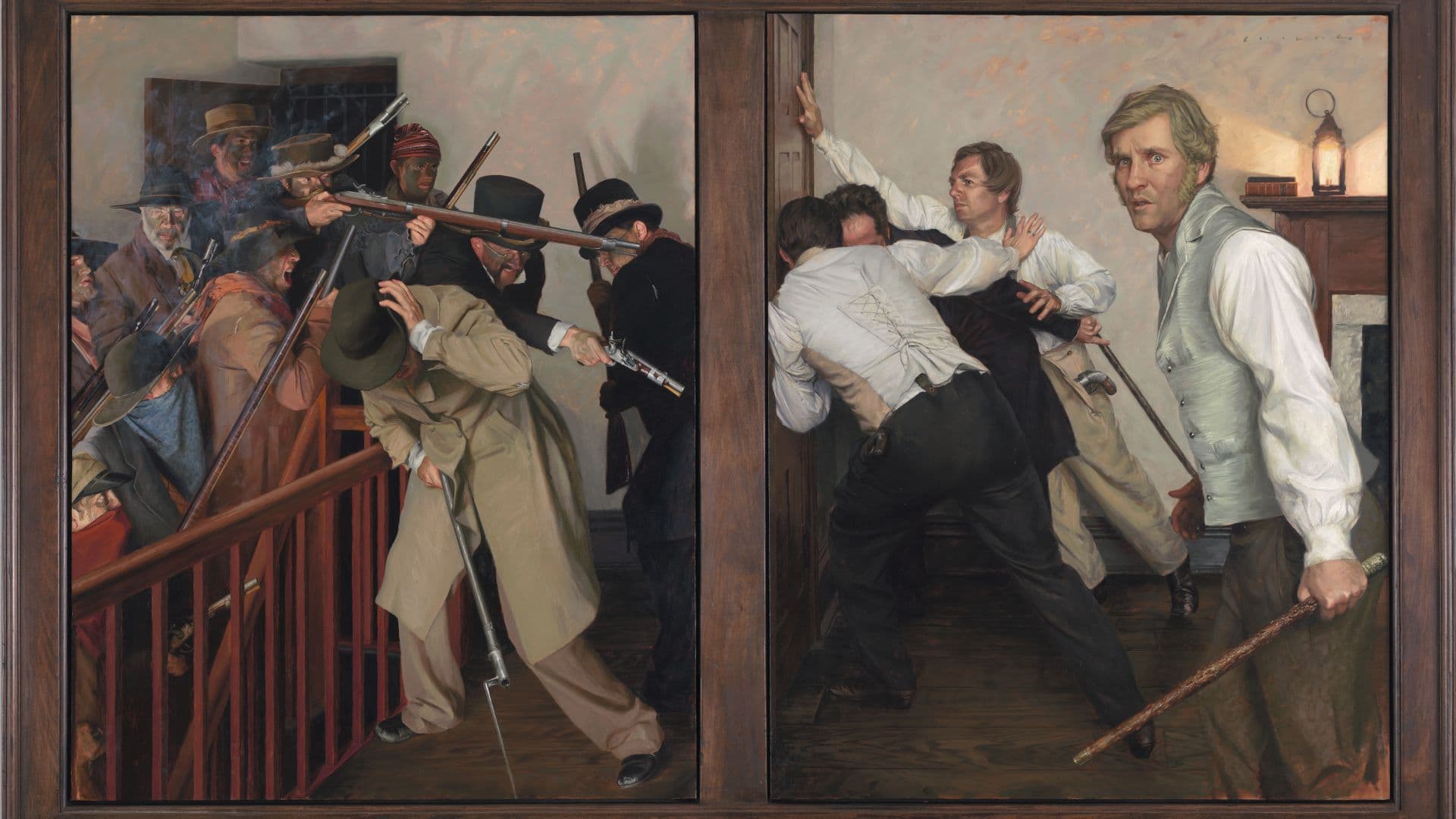
“To seal the testimony of this book and the Book of Mormon, we announce the martyrdom of Joseph Smith the Prophet, and Hyrum Smith the Patriarch. They were shot in Carthage jail, on the 27th of June, 1844, about five o’clock p.m., by an armed mob—painted black—of from 150 to 200 persons. Hyrum was shot first and fell calmly, exclaiming: I am a dead man! Joseph leaped from the window, and was shot dead in the attempt, exclaiming: O Lord my God! They were both shot after they were dead, in a brutal manner, and both received four balls.” Doctrine and Covenants 135:1
At a time when speculative historical reconstructions and fictional narratives about the murders of Joseph and Hyrum Smith are widely circulating,1 we thought it would be helpful to provide all readers with a reliable overview of the general circumstances surrounding Joseph Smith’s final days and the fate of his assassins.
The Know
“I am going like a lamb to the slaughter, but I am calm as a summer’s morning. I have a conscience void of offense toward God and towards all men. I shall die innocent, and it shall yet be said of me—he was murdered in cold blood.”2 Joseph Smith made this famous and chilling pronouncement as he traveled to Carthage in the evening of Monday, June 24, 1844, with friends and many members of the Nauvoo City Council who had been indicted for the crime of “riot” in connection with their destruction of the The Nauvoo Expositor anti-Mormon press two weeks earlier, after the City Council had ruled that that printing office was an illegal nuisance.3
The prisoners arrived at Carthage shortly before midnight, only to find the town in utter chaos due to the influx of the rowdy state militia members and dissident Latter-day Saints. The mob had been drinking and brawling all day in anticipation of Joseph’s arrival, and a riot was in full swing.4 This melee would last much of the time when Joseph and Hyrum were in Carthage.5
The following morning, Tuesday, the brothers were arrested on a second warrant, this time for treason.6 A hearing for the first charge that afternoon was presided over by Robert F. Smith, captain of the Carthage Greys militia and chair of the Central Corresponding Committee for the political party called “The Anti-Mormon Party”—an extraordinary conflict of interest. Smith’s job as chair was to coordinate anti-Mormon political activities.7 Though the hearing should have been held earlier in the day, Robert Smith delayed it until late afternoon, when there was only time to begin a hearing for the riot charges. The hearing for the treason charges would have to wait for another day, necessitating Joseph and Hyrum’s remaining at Carthage.8
The full trial for the riot charges was set for the circuit court’s next session in October, and the bail was set at a $500 per defendant, more than twice the customary amount for a misdemeanor like inciting a riot. Despite the high cost, most of the men posted bail and left, but Joseph and Hyrum were retained in custody, without bail, on the second charge of treason.9 John Taylor and Willard Richards, along with a few others, voluntarily remained behind with them.10
The preliminary hearing on the charge of treason was scheduled for Saturday, June 29, allowing time for witnesses to arrive and for the lawyers to prepare. After learning that the prisoners feared they would not be safe in Carthage, Governor Ford reportedly promised to take Joseph and Hyrum with him when he went to Nauvoo on Thursday, June 27.11 However, when he departed Carthage, he left the prisoners behind, leading John Taylor to say that the Governor leaving them behind was a breach of faith and an insult, thus dashing their last hope for survival.12 A conspiracy to murder the Prophet was in place, with many of the conspirators meeting the night of June 26 and again early in the afternoon of June 27, 1844. At these meetings and various smaller ones, Thomas B. Sharp from Warsaw and other notable figures in the Anti-Mormon movement urged the mobs to assassinate Joseph while the Governor was out of town.13
On that Thursday afternoon, the Carthage Greys, the county militiamen who had been left to protect Joseph and Hyrum from the mob, reportedly only gave a token resistance when the assassins came to town and stormed the jail. The Greys were later said to have purposefully used blanks to fire over the heads of the advancing mob, and a large portion of the militia moved slowly across town toward the jail, allowing the mobbers plenty of time to enact their nefarious plan and flee the scene, scattering most easily to the west. The Greys made no attempt to pursue the assassins.14
During the mob’s attack, the men in the room braced against the door to keep the attackers from entering. Hyrum may have fired at the door a single shot pistol that John S. Fullmer had brought and given to Joseph the day before for self-defense, but Hyrum was struck by a couple of balls and was killed during the attempt. Joseph ran to Hyrum exclaiming “Oh! My poor dear brother Hyrum” and then immediately jumped up, reached his hand through the door, and fired indiscriminately into the stairwell all six rounds of another pistol that had been given to him by Cyrus Wheelock earlier that day, wounding some but to no avail.15 The accounts mention that it misfired two or three times.
After John Taylor was grievously wounded, Joseph attempted to jump from the window, perhaps trying to draw the gunfire away from his friends.16 Joseph was shot a total of four times and fell from the window to the ground below. At the time they died, Joseph was the President of the Church, and Hyrum was serving as Assistant President of the Church and as Church Patriarch. Their enemies thought and hoped that their deaths would decimate The Church of Jesus Christ of Latter-day Saints.
Fortunately, however, most members of the Church remained loyal to the Church, to the Prophet, and to their Patriarch. One longtime friend, Newel Knight, mourned their passing with a touching tribute, calling them “two of the best men that ever lived,” and saying, “They died as they had ever lived––faithful and true to that God who has used them as his servants to build up the Church and Kingdom of the Last Days. … [T]heir names will ever be held in honorable remembrance by all lovers of truth, virtue, integrity, justice and righteousness.”17
In late May 1845, the circuit court came to session at Carthage. Among the cases heard was People v. Levi Williams, in which five defendants were charged with the murder of Joseph Smith: Levi Williams, Thomas C. Sharp, William N. Grover, Jacob C. Davis, and Mark Aldrich. Four others were indicted, but never arrested: John Wills, William Voras, and two men only referred to as Allen and Gallaher.18
Latter-day Saints worried that participating in the trial “would only endanger their lives while accomplishing nothing toward punishing the murderers,” and thus, many refused to testify. Church leaders went so far as to hide from those sent to summond them to appear in court. Their suspicion proved to be warranted.19
On the opening day of jury selection, the defense team submitted two affidavits declaring the county commissioners and sheriff and his deputies were biased against the defendants. They also requested the dismissal of the entire panel of prospective jurors chosen by those officials and asked that substitute officials fill the jury panel instead. This request was granted, and a jury was selected without a single Latter-day Saint in it.20
A heated six-day trial commenced in front of a crowd that was “armed to the teeth.” Evidence established that most of the defendants had been in Carthage shortly before or after the murders, and Sharp was said to have given a speech in which he encouraged the mob attack. However, most witnesses refused to offer any incriminating evidence against the accused. The prosecutor denounced his own star witnesses and withdrew charges against Davis and Grover during his closing statement. In subsequent closing statements, one of the defense attorneys claimed the murders were necessary, desired by most of the citizens of the county, and legally justified. Another witness threatened a civil war if the defendants were not acquitted. As one reporter noted, “The whole [thing] appears more like a farce than a solemn trial.”21
The jury deliberated for only two and a half hours, including a lunch break. In an act that President Dallin H. Oaks and historian Marvin S. Hill long ago labeled as an act of lawless “popular sovereignty,” the jury declared all those who had been accused not guilty of murder.22
There was no trial for the murder of Hyrum Smith, as the prosecutor did not appear.23
Never miss a KnoWhy
Get Scripture Central's latest research and resources delivered straight to your inbox.
The Why
By understanding the events of Carthage and its aftermath as they unfolded, Latter-day Saints can learn important truths about Joseph and Hyrum Smith, their character, their callings as apostles of the Lord Jesus Christ, and the ways in which they were unjustly treated. Joseph and Hyrum Smith died as martyrs. They never rescinded their witness of the miracles and revelations of the Restoration but willingly gave their life “to seal the testimony of” the Doctrine and Covenants “and the Book of Mormon”24
Hyrum was a man said to have “possesse[d] the mildness of a lamb and the integrity of a Job, and in short, the meekness and humility of Christ,” and he and Joseph loved one another “with that love that is stronger than death.”25 Indeed, Hyrum was urged repeatedly to take his family and flee, but refused to let his brother go to his death alone.26 He was also equally as willing as Joseph was to give his life for his testimony.27
After the brutal persecutions a few years earlier in Missouri, Joseph was well aware of the lengths to which the Church’s enemies would go and the imminent danger they posed to his people. In the last few months of his life, he also seemed to realize his appointed time on earth was nearly fulfilled and was coming to an end. He said repeatedly that he was willing to lay down his own life if it meant saving the lives of his people.28
In one such statement, he said:
I do not regard my own life. I am ready to be offered, a sacrifice for this people, for what can they do? Only kill the body, and their power is then at an end. Stand firm, my friends, never flinch. Do not seek to save your lives, for he that is afraid to die for the truth will lose eternal life. Hold out to the end, and we shall be resurrected, and become like Gods, and reign in celestial kingdoms, principalities and eternal dominions. … You have stood by me in the hour of trouble, and I am willing to sacrifice my life for your preservation.29
Ultimately—and tragically—Joseph was right that their enemies’ power ended with his murder. His and Hyrum’s deaths alleviated the mounting pressure from the mobs outside the Church, as well as from dissenters and deserters within the Church. Their deaths bought Church members the time they needed to finish building the temple, leave Nauvoo safely, and to prepare to move west and to roll forward the work of the Kingdom of God. By going to Carthage to face trial, Joseph and Hyrum placed themselves between the mobs and the people of Nauvoo, sealing their testimonies with their blood. In doing so, they exemplified the Savior’s teachings in John 15:13: “Greater love hath no man than this, that a man lay down his life for his friends.”
Dallin H. Oaks and Marvin S. Hill, Carthage Conspiracy: The Trial of the Accused Assassins of Joseph Smith (University of Illinois Press, 1975).
Joseph I. Bentley, “Road to Martyrdom: Joseph Smith’s Last Legal Cases,” in Joseph Smith: A Life Lived in Crescendo, ed. Jeffrey M. Bradshaw, 2 vols. (Interpreter Foundation; Eborn Books, 2024), 2:539–624. Revised and expanded from its original publication in BYU Studies Quarterly 55, no. 2 (2016): 8–73.
John W. Welch, “Joseph Smith’s Short Trip to Iowa, June 23, 1844, to Secure Lawyers to Go with Him to Carthage,” in Joseph Smith: A Life Lived in Crescendo, ed. Jeffrey M. Bradshaw, 2 vols. (Interpreter Foundation; Eborn Books, 2024), 2:625–683.
R. Jean Addams, “True to the End: The Culmination of the Earthly Ministry of the Prophet Joseph Smith in His Martyrdom at Carthage,” in Joseph Smith: A Life Lived in Crescendo, ed. Jeffrey M. Bradshaw, 2 vols. (Interpreter Foundation; Eborn Books, 2024), 2:685–741.
Derek R. Sainsbury, “The Assassination and Aftermath,” in Storming the Nation: The Unknown Contributions of Joseph Smith’s Political Missionaries (Religious Studies Center, Brigham Young University; Deseret Book, 2020), 143‒70.
- 1.Such as the bizarre idea that Brigham Young and John Taylor were behind the murders of Joseph and Hyrum; see https://publicsquaremag.org/faith/leadership/conspiracy-as-history-who-killed-joseph-smith-as-a-case-study/
- 2. “History, 1838–1856, volume F-1 [1 May 1844–8 August 1844], Page 151,” Joseph Smith Papers. For a step by step analysis of these events, see Joseph I. Bentley, “Road to Martyrdom: Joseph Smith’s Last Legal Cases,” in Joseph Smith: A Life Lived in Crescendo, 2 vols., ed. Jeffrey M. Bradshaw (Interpreter Foundation and Eborn Books, 2024), 2:574. This is a revised and expanded version of the original article published in BYU Studies Quarterly 55, no. 2 (2016): 8–73.
- 3. Just the day before, Joseph, Hyrum, and Willard Richards were safely in Iowa Territory, across the Mississippi River from Nauvoo. Though it has long been supposed they were intending to flee West, only to be called home by letters from friends and family, new research by John W. Welch calls that interpretation into question. As Welch documents, Joseph went to Iowa that Sunday morning to secure legal representation to represent him in Carthage. After a brief exchange of letters from his position of safety, Joseph in fact secured the services of three Iowa attorneys Henry Hugins, Hugh Reid, and James Woods to represent him in what would become his final court case. He returned to Nauvoo shortly thereafter to prepare for the journey to Carthage the next day. See John W. Welch, “Joseph Smith’s Short Trip to Iowa, June 23, 1844, to Secure Lawyers to Go with Him to Carthage,” in Joseph Smith: A Life Lived in Crescendo, 2 vols., ed. Jeffrey M. Bradshaw (Interpreter Foundation and Eborn Books, 2024), 2:625–683.
- 4. See “The Martyrdom,” in Church History in the Fulness of Times Student Manual, Second edition (The Church of Jesus Christ of Latter-day Saints, 1989, 1993, 2000, 2003), 277–278.
- 5. At one point on the morning of June 26, for instance, as they marched through the crowd on their way to a court hearing, both Joseph and Hyrum “politely locked arms” with the “worst mobocrat[s they] could see,” using them as human shields against the mob. See Dan Jones, “The Martyrdom of Joseph Smith and His Brother Hyrum,” ed. Ronald D. Dennis, BYU Studies Quarterly 24, no. 1 (1984): 100.
- 6. Joseph and Hyrum had allegedly committed treason by declaring martial law and bringing the Nauvoo Legion out to defend the city against mob violence in the wake of the Nauvoo Expositor incident. Those actions were positioned as rebellion against the state, and the case against Hyrum was especially shaky given that he did not have the authority to do either of those things.
- 7. Because he was not the justice of the peace who issued the arrest warrant, the lawyers for the accused felt that Robert Smith should not have been the one to preside over the hearing, especially given his bias against the Church and its members.
- 8. See Joseph I. Bentley, “Road to Martyrdom: Joseph Smith’s Last Legal Cases,” in Joseph Smith: A Life Lived in Crescendo, 2 vols., ed. Jeffrey M. Bradshaw (Interpreter Foundation and Eborn Books, 2024), 2:574–575; R. Jean Addams, “True to the End: The Culmination of the Earthly Ministry of the Prophet Joseph Smith in His Martyrdom at Carthage,” in Joseph Smith: A Life Lived in Crescendo, 2 vols., ed. Jeffrey M. Bradshaw (Interpreter Foundation and Eborn Books, 2024), 2:708–710.
- 9. See Joseph I. Bentley, “Road to Martyrdom: Joseph Smith’s Last Legal Cases,” in Joseph Smith: A Life Lived in Crescendo, 2 vols., ed. Jeffrey M. Bradshaw (Interpreter Foundation; Eborn Books, 2024), 2:575.
- 10. By the time of the mob’s attack, only John Taylor and Willard Richards were still with the Prophet and Hyrum. The others had been refused reentry after leaving the jail to run errands.
- 11. This promise was reported in numerous places, such as in John Taylor, “John Taylor, Martyrdom Account, p. 42,” and Joseph Smith, “Letter to Emma Smith, 25 June 1844,” Joseph Smith Papers. This promise gave Joseph renewed hope that his life might be spared; he and William Clayton both wrote letters to Judge Jesse B. Thomas, requesting he meet him in Nauvoo to oversee a habeas corpus hearing in a last-ditch effort to overturn the treason charges. This was a tactic Joseph had used with great success in the past. See Joseph Smith, “Letter to Jesse B. Thomas, 26 June 1844–A,” and William Clayton, “Letter to Jesse B. Thomas, 26 June 1844–B,” Joseph Smith Papers; John S. Dinger, “Joseph Smith and the Development of Habeas Corpus in Nauvoo, 1841–44,” Journal of Mormon History 36, no. 3 (Summer 2010): 135–171; Jeffrey N. Walker, “Habeas Corpus in Early Nineteenth-Century Mormonism: Joseph Smith’s Legal Bulwark for Personal Freedom,” BYU Studies Quarterly 52, no. 1 (2013): 5–97, also published in abridged form as “Invoking Habeas Corpus in Missouri and Illinois,” in Sustaining the Law: Joseph Smith’s Legal Encounters, ed. Gordon A. Madsen, Jeffrey N. Walker, and John W. Welch (BYU Studies, 2014), 357–399.
- 12. See John Taylor, “John Taylor, Martyrdom Account, p. 46,” Joseph Smith Papers. After learning there was no further chance at securing a habeas corpus hearing, Joseph wrote to attorney Orville Browning, hoping for representation. See Joseph Smith, “Letter to Orville Browning, 27 June 1844,” Joseph Smith Papers.
- 13. The reports of these meetings contain some conflicting and uncorroborated claims, including over the culpability of Governor Ford and the size and scope of the conspiracy. Ford admitted to being in attendance during the meeting of June 26, though his involvement was likely exaggerated in the aftermath of the martyrdom. He appears to have genuinely thought the prisoners were not in any real danger, as he believed the people “were not that cruel.” See Dan Jones, “The Martyrdom of Joseph Smith and His Brother Hyrum,” ed. Ronald D. Dennis, BYU Studies Quarterly 24, no. 1 (1984): 90, 102–103; Thomas Ford, “To the People of Illinois,” Alton Telegraph 9, no. 27 (July 6, 1844): 2; Derek R. Sainsbury, “The Assassination and Aftermath,” in Storming the Nation: The Unknown Contributions of Joseph Smith’s Political Missionaries (BYU Religious Studies Center and Deseret Book), 149‒150; Robert S. Wicks and Fred R. Foister, Junius and Joseph: Presidential Politics and the Assassination of the First Mormon Prophet (Utah State University Press, 2005), 164–166; “Letter from Stephen Markham, 20 June 1856, Page 3,” Wilford Woodruff Papers; Orrin Porter Rockwell, “Orrin P. Rockwell affidavit, 1856 April 14,” Church History Catalog, CR 100 396; R. Jean Addams, “True to the End: The Culmination of the Earthly Ministry of the Prophet Joseph Smith in His Martyrdom at Carthage,” in Joseph Smith: A Life Lived in Crescendo, 2 vols., ed. Jeffrey M. Bradshaw (Interpreter Foundation; Eborn Books, 2024), 2:715–716; George Turnbull Moore Davis, Autobiography of the Late Col. Geo. T. M. Davis (By His Legal Representatives, 1891), 80–81; Dallin H. Oaks and Marvin S. Hill, Carthage Conspiracy: The Trial of the Accused Assassins of Joseph Smith (University of Illinois Press, 1975), 19–20, 35, 87, 125–126, 130, 136. Research assistance for this note was provided by Joseph Johnstun and Jeffrey Mahas.
- 14. See Dallin H. Oaks and Marvin S. Hill, Carthage Conspiracy: The Trial of the Accused Assassins of Joseph Smith (University of Illinois Press, 1975), 20–21, 124–125, 143, 176.
- 15.John Taylor, Martyrdom Account[a], p. 49[a], The Joseph Smith Papers. See also endnote 18 herein. The History, 1838–1856, volume F-1 [1 May 1844–8 August 1844], p. 176, The Joseph Smith Papers, mentions Wheelock giving a gun to Joseph and then Joseph handing the other gun to Hyrum. See also Appendix 3: Willard Richards, Journal Excerpt, 23–27 June 1844, p. 37, The Joseph Smith Papers, especially note 127.
- 16. See “Historian’s Office, Martyrdom Account, p. 64,” Joseph Smith Papers.
- 17. The full quote reads, “I have taken up considerable space in telling you the circumstances under which two of the best men who that ever lived, lost their lives for the truth’s sake. I have known them from boyhood,––have been associated with Joseph from the time before he received the first revelation until the present, and Hyrum has been his constant companion since the Church has been organized. I have shared in the blessings of the Gospel which they have enjoyed, and been a partaker of the sorrows and troubles, and fierce persecutions which they have endured. I have seen them at home and abroad,––in the discharge of their religious duties; and I have known them as founders of a great City, and seen their administration of its government. In every circumstance of life they have ever been true men of God,––humane, upright and just in all their dealings; they loved righteousness and taught it to their followers; their friends loved them for the good they did, and their enemies hated them, because they reproved their sins and wickedness. They died as they had ever lived––faithful and true to that God who has used them as his servants to build up the Church and Kingdom of the Last Days. In the hour of prosperity they taught the people humility and meekness; in the hour of persecution, they practiced these virtues and no men have done a greater work on the earth since the days of the Savior than they have; and their names will ever be held in honorable remembrance by all lovers of truth, virtue, integrity, justice and righteousness; whilst their persecutors will sink in shame, confusion and infamy until they will go down to the place prepared for all doers of wickedness. O, how I loved those men, and rejoiced under their teachings!” Newel Knight, The Rise of the Latter-Day Saints: The Journals and Histories of Newel Knight, ed. Michael Hubbard MacKay and William G. Hartley (BYU Religious Studies Center and Deseret Book, 2019), 146–147.
- 18. Davis was an Illinois state senator at the time. Voras, Wills, and Gallaher were allegedly wounded by Joseph’s gun during the mob attack at Carthage Jail, proving their involvement. Robert Smith, whose legal shenanigans kept Joseph and Hyrum imprisoned at Carthage, was not indicted but “was heavily implicated since he had commanded the Carthage Greys guarding the jail.” Arrest warrants were also issued but never served for Joseph H. Jackson, William Law, Robert D. Foster, Charles A. Foster, and “the whole guard that was placed over the Smiths.” Though no arrest warrants were issued for them, Francis and Chauncey Higbee and Sylvester Emmons also played prominent roles leading to the assassination. Chief counsel for the defense was Orville Browning, a man who had defended Joseph Smith just the year before, and to whom Joseph had written for help from Carthage the day he died. Dallin H. Oaks and Marvin S. Hill, Carthage Conspiracy: The Trial of the Accused Assassins of Joseph Smith (University of Illinois Press, 1975), 4, 36, 38, 51–52, 55–56, 79–84.
- 19. Dallin H. Oaks and Marvin S. Hill, Carthage Conspiracy: The Trial of the Accused Assassins of Joseph Smith (University of Illinois Press, 1975), 70–72, 102–109.
- 20. See Dallin H. Oaks and Marvin S. Hill, Carthage Conspiracy: The Trial of the Accused Assassins of Joseph Smith (University of Illinois Press, 1975), 97–109.
- 21. Dallin H. Oaks and Marvin S. Hill, Carthage Conspiracy: The Trial of the Accused Assassins of Joseph Smith (University of Illinois Press, 1975), 113–184.
- 22. Dallin H. Oaks and Marvin S. Hill, Carthage Conspiracy: The Trial of the Accused Assassins of Joseph Smith (University of Illinois Press, 1975), 184–186, 210–214. Commentator John Hay explained, “There was not a man on the jury, in the court, in the county, that did not know the defendants had done the murder. But it was not proven, and the verdict of not guilty was right in law. And you cannot find in this generation an original inhabitant of Hancock County who will not stoutly sustain that verdict.” John Hay, “The Mormon Prophet’s Tragedy,” as cited in Orson F. Whitney, “‘The Mormon Prophet’s Tragedy’: A Review of an Article by the late John Hay, published originally in The Atlantic Monthly for December, 1869, and republished in The Saints‘ Herald of June 21, 1905,” (The Deseret News, 1905), 89.
- 23. See Dallin H. Oaks and Marvin S. Hill, Carthage Conspiracy: The Trial of the Accused Assassins of Joseph Smith (University of Illinois Press, 1975), 191–192.
- 24. See Scripture Central, “What Does It Mean to be a Martyr?” KnoWhy 1 (January 1, 2016).
- 25. Joseph Smith, entry for Friday, 18 December 1835, “Journal, 1835–1836, p. 76,” Joseph Smith Papers. John Taylor also wrote, “If ever there was an exemplary, honest, good and virtuous man, an embodiment of all that is noble in the human form, Hyrum Smith was its representative.” John Taylor, “John Taylor, Martyrdom Account, p. 53,” Joseph Smith Papers.
- 26. For one such example, see “History of Joseph Smith,” Latter-Day Saints’ Millennial Star 24, no. 16 (April 19, 1862): 248.
- 27. Of his imprisonment in Liberty Jail, Hyrum wrote, “I had been abused and thrust into a dungeon, and confined for months on account of my faith, and the ‘testimony of Jesus Christ.’ However, I thank God that I felt a determination to die, rather than deny the things which my eyes had seen, which my hands had handled, and which I had borne testimony to. … I can assure my beloved brethren that I was enabled to bear as strong a testimony, when nothing but death presented itself, as ever I did in my life.” Hyrum Smith, “To the Saints Scattered Abroad,” Times and Seasons 1, no. 2 (December 1839): 23.
- 28. To read about Joseph’s belief he would soon die, see “The Martyrdom,” in Church History in the Fulness of Times Student Manual, Second edition (The Church of Jesus Christ of Latter-day Saints, 1989, 1993, 2000, 2003), 273–274. For a sampling of statements about giving his life for the citizens of Nauvoo, see “History, 1838–1856, volume F–1 [1 May 1844–8 August 1844], Page 80,” Joseph Smith Papers; Dan Jones, “The Martyrdom of Joseph Smith and His Brother Hyrum,” ed. Ronald D. Dennis, BYU Studies Quarterly 24, no. 1 (1984): 85–86; Joseph I. Bentley, “Road to Martyrdom: Joseph Smith’s Last Legal Cases,” in Joseph Smith: A Life Lived in Crescendo, 2 vols., ed. Jeffrey M. Bradshaw (Interpreter Foundation and Eborn Books, 2024), 2:560; R. Jean Addams, “True to the End: The Culmination of the Earthly Ministry of the Prophet Joseph Smith in His Martyrdom at Carthage,” in Joseph Smith: A Life Lived in Crescendo, 2 vols., ed. Jeffrey M. Bradshaw (Interpreter Foundation and Eborn Books, 2024), 2:703.
- 29. Joseph Smith, entry for 18 June 1844, “History Draft [1 January–21 June 1844], p. 65a,” Joseph Smith Papers.