Evidence #542 | April 29, 2026
Doctrine and Covenants Evidence: Enoch’s Wisdom
Post contributed by
Scripture Central
Abstract
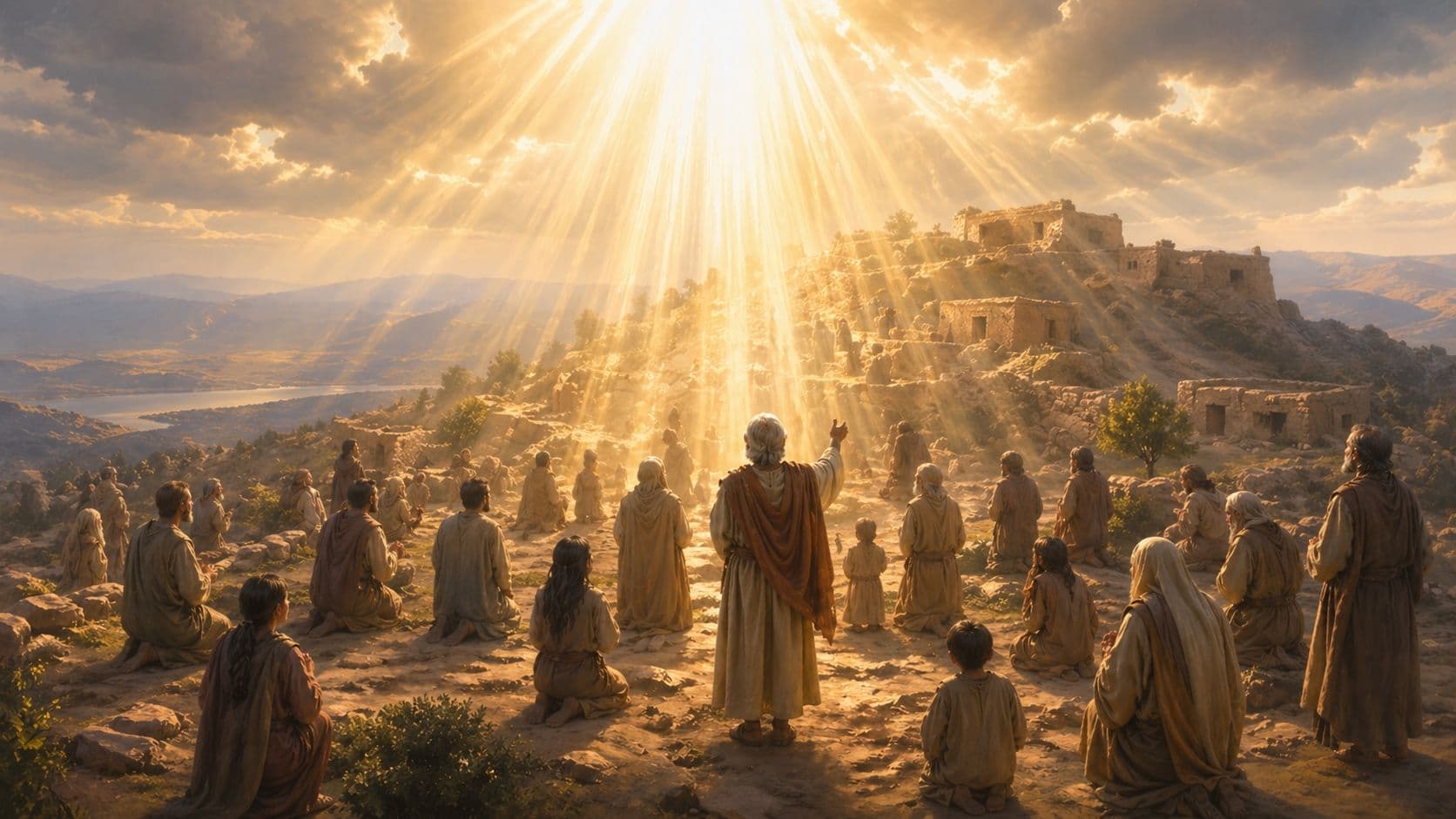
In D&C 45:10–12 the Lord’s wisdom is closely associated with Enoch and his people, a detail that is amply corroborated by ancient and medieval sources.Although wisdom is regularly referenced throughout scripture, this attribute is rarely associated with a specific individual. One significant exception is King Solomon, who was renowned for his wisdom (1 Kings 4:29–34). Joseph and Daniel were also described as being wise (Genesis 41:39; Daniel 1:17). But, generally speaking, most other prophets, apostles, and notable scriptural figures are not associated with wisdom in any prominent way, at least not in the scriptural canon itself.1 For this reason, it is rather interesting that Enoch and his people seem to have a pronounced association with God’s wisdom in D&C 45:10–12:
I will reason as with men in days of old, and I will show unto you my strong reasoning. Wherefore, hearken ye together and let me show unto you even my wisdom—the wisdom of him whom ye say is the God of Enoch, and his brethren, Who were separated from the earth, and were received unto myself—a city reserved until a day of righteousness shall come—a day which was sought for by all holy men.
This statement suggests that Enoch and his people may have been known in ancient times as archetypal recipients of divine wisdom. While nothing in the Bible itself directly hints at this association, the unique wisdom of Enoch is abundantly attested in ancient and medieval traditions.2
Enoch’s Wisdom in Extrabiblical Sources
The Book of Similitudes, a booklet within 1 Enoch, opens with the following description:
The vision which Enoch saw the second time—the vision of wisdom which Enoch, son of Jared, son of Mahalalel, son of Kenan, son of Enosh, son of Seth, son of Adam, saw: This is the beginning of the words of wisdom which I commenced to propound. … It is good to declare these words to those of former times, but one should not withhold the beginning of wisdom from those of latter days. Until now such wisdom, which I have received as I recited (it) in accordance with the will of the Lord of the Spirits, had not been bestowed upon me before the face of the Lord of the Spirits. (1 Enoch 37:1–4)3
Enoch is also described as passing on his wisdom in 1 Enoch 82:1–2: “Now, Methuselah, my son … I have given wisdom to you, to your children, and to those who shall become your children in order that they may pass it (in turn) to their own children and to the generations that are discerning. All the wise ones shall give praise, and wisdom shall dwell upon your consciousness.”4
In the opening to The Epistle of Enoch, yet another booklet within 1 Enoch, we read, “(Book) five, which is written by Enoch, the writer of all the signs of wisdom among all the people” (1 Enoch 92:1).5 A manuscript variant for this passage states, “Enoch, skilled scribe and wisest of men, and the chosen of the sons of men and judge of all the earth.”6
Remarkably, 2 Enoch also opens with a description of Enoch’s wisdom: “There was a wise man and a great artisan whom the LORD took away. And he loved him so that he might see the highest realms and of the most wise and great and inconceivable and unchanging kingdom of God almighty.”7 Later in the same text, the Lord makes the following statement: “And now, Enoch, whatever I have told you, and whatever you have understood, and whatever you have seen in the heavens, and whatever you have seen on the earth, and whatever I have written in the books—by my supreme wisdom all these things I planned to accomplish.”8
Wisdom is also associated with the angel Metatron (Enoch in his glorified form) in 3 Enoch. In one passage he declares, “Then the Holy One, blessed be he, bestowed upon me wisdom heaped upon wisdom” (3 Enoch 8:2).9 Another passage states, “The Holy One, blessed be he, revealed to me from that time onward all the mysteries of wisdom, all the depths of the perfect Torah and all the thoughts of men’s hearts” (3 Enoch 11:1).10
According to Jubilees 4:16–17, Enoch’s father “called him Enoch. This one was the first who learned writing and knowledge and wisdom, from (among) the sons of men, from (among) those who were born upon earth.”11 Another Jewish text, known as Midrash ’Aggadah, relates that Enoch “walked with the angels for three hundred years. He was with them in the Garden of Eden, and he learned about intercalation, the seasons, the constellations, and many types of wisdom from them.”12 The Zohar declares,
It is taught in the Book of Enoch that at the time they revealed to him the wisdom of the supernal mysteries he saw the Tree which is in the Garden of Eden. They showed to him the celestial secret wisdom, and he discerned that all the worlds were bound to each other. He asked them how they (the worlds) were sustained. They responded: each one of them stands upon the letter yod, and from it they were built and knotted together, as scripture affirms: “all of them You formed with wisdom” (Ps 104:24).13
Enoch’s wisdom is also emphasized in Islamic sources, which identify him as Idris. Other texts associate Enoch with the Egyptian figure known as Hermes. Over time, these associations underwent various degrees of syncretic merging. One Islamic source declares “‘Idris’ was the grandfather of the father of Noah (upon whom be peace). His name in the Torah is Enoch (Akhnukh), and he was called ‘Idris’ due to his constant study (dars) of books, meaning books and wisdom of God.”14 Another source mentions the “Wisdom of the great Hermes, whose deeds are most praiseworthy, whose words and exploits are most gratifying, who is counted as one of the greatest prophets, and who is said to be the prophet Idris, upon whom be peace!”15 Yet another source explains,
The ancient ones among the Greeks claim that Enoch is Hermes, and he bears the surname Trismegistus, meaning a teaching about “three,” because he depicted the Most Exalted Creator with these three attributes: existence, wisdom, and vitality. The Arabs call him Idris. … The third Hermes was Egyptian. He was the one who was called Trismegistus, meaning three times in wisdom, because he appeared as the third of the Hermes sages.16
Conclusion
In addition to the sources cited above, other texts from Jewish, Christian, and Islamic traditions similarly emphasize Enoch’s profound wisdom, which is often portrayed as being dispensed to him and his people by God or other heavenly beings (see the Appendix). Summarizing this body of research, Andrei Orlov writes:
Scholars have observed that it is possible that “the oldest feature connected to Enoch is that of the primeval sage.” This role of the patriarch as a sage preoccupied with primeval knowledge and wisdom often has been considered by students of Enochic traditions to be principally responsible for shaping the patriarch’s legendary profile.17
Could Joseph Smith have known of this association in 1830? It is possible, as this detail is present in 1 Enoch, which had been published in English in 1821.18 And it could have been transmitted to him through some other intermediary source, such as Freemasonry.19 Nevertheless, the way that D&C 45:10–12 associates Enoch and his people with divine wisdom is consistent with a host of ancient and medieval sources. At the same time, this element isn’t clearly present in the Bible. It therefore constitutes a consistent detail of Enochic lore that Joseph Smith would have needed to either correctly guess or derive from arcane sources in his day. While it may not be a profound parallel on its own, the proliferation of these types of consistencies within Joseph Smith’s revelations is quite notable.
Samuel Zinner, “‘Zion’ and ‘Jerusalem’ as Lady Wisdom in Moses 7 and Nephi’s Tree of Life Vision,” Interpreter: A Journal of Latter-day Saint Faith and Scholarship 12 (2014): 281–323.
1 Enoch 37:1–2
Book two: The vision which Enoch saw the second time—the vision of wisdom which Enoch, son of Jared, son of Mahalalel, son of Kenan, son of Enosh, son of Seth, son of Adam, saw: This is the beginning of the words of wisdom which I commenced to propound.20
1 Enoch 37:3–4
It is good to declare these words to those of former times, but one should not withhold the beginning of wisdom from those of latter days. Until now such wisdom, which I have received as I recited (it) in accordance with the will of the Lord of the Spirits, had not been bestowed upon me before the face of the Lord of the Spirits. From him, the lot of eternal life has been given to me. Three things were imparted to me”; and I began to recount them to those who dwell upon the earth.21
1 Enoch 82:1–2
Now, Methuselah, my son … I have given wisdom to you, to your children, and to those who shall become your children in order that they may pass it (in turn) to their own children and to the generations that are discerning. All the wise ones shall give praise, and wisdom shall dwell upon your consciousness.22
1 Enoch 92:1
“(Book) five, which is written by Enoch, the writer of all the signs of wisdom among all the people.”23
“Enoch, skilled scribe and wisest of men, and the chosen of the sons of men and judge of all the earth.”24
2 Enoch 1a:1–2
There was a wise man and a great artisan whom the LORD took away. And he loved him so that he might see the highest realms and of the most wise and great and inconceivable and unchanging kingdom11 of God almighty.25
2 Enoch 33:3 (cf. 2 Enoch 48:4, p. 174)
And now, Enoch, whatever I have told you, and whatever you have understood, and whatever you have seen in the heavens, and whatever you have seen on the earth, and whatever I have written in the books—by my supreme wisdom all these things I planned to accomplish. And I created them from the highest foundation to the lowest, and to the end.26
3 Enoch 8:2
Then the Holy One, blessed be he, bestowed upon me wisdom heaped upon wisdom.27
3 Enoch 10:3–5
“I have appointed Meṭaṭron my servant as a prince and a ruler over all the denizens of the heights …. Whatever he says to you in my name you must observe and do, because I have committed to him the Prince of Wisdom and the Prince of Understanding, to teach him the wisdom of those above and of those below, the wisdom of this world and of the world to come.”28
3 Enoch 11:1
The Holy One, blessed be he, revealed to me from that time onward all the mysteries of wisdom, all the depths of the perfect Torah and all the thoughts of men’s hearts. All the mysteries of the world and all the orders of nature stand revealed before me as they stand revealed before the Creator.29
3 Enoch 48C:4
I committed to him wisdom and understanding, so that he should behold the secrets of heaven above and earth beneath.30
3 Enoch 48C:9
I gave seventy princes into his hand, to issue to them my commandments in every language …. to exalt rulers over their dominions, as it is written, “He controls the procession of times and seasons; he makes and unmakes kings”; to give wisdom to all the wise of the world, and understanding and knowledge to those who understand, as it is written, “He confers wisdom on the wise, and knowledge on those with wit to discern.”31
Jubilees 4:16–17
And he called him Enoch. This one was the first who learned writing and knowledge and wisdom, from (among) the sons of men, from (among) those who were born upon earth.32
Pseudo-Sabas, On the Mysteries of Letters (ed. Bandt)
Moreover in the same way the transposition of Enoch happened after seven generations in order to indicate the immortal character of the Resurrection .... Now behold the ineffable wisdom of God: In the beginning, from the very foundation of the universe, since the time of Enoch, the one who was the seventh person (born) after Adam, He has taught the mystery of Christ.33
Ben Sira 44:16
Enoch [was foun]d to be perfect, and he walked with the Lord And was removed, (thereby becoming) an emblem of knowledge for all generations.34
Rasā’il Ikhwān al-Ṣafā’ (ed. Ragep-Mimura)
And so it is related about Hermes the thrice-endowed with wisdom—and who is the prophet Idris, may peace be upon him—that he ascended to the sphere of Saturn and revolved with it for thirty years until he witnessed all the states of the celestial sphere. Then he descended back to earth and instructed people about star-lore. God Most High said (of him): “and We raised him up to a lofty place” (Q 19:57).35
Sefer Noah (ed. Jellinek)
Now by using this book, he grew wise and astute with regard to the cycles and the constellations and all the (heavenly) luminaries which officiate in each and every month and the names which are invoked for every cycle and for the ministering angels during the four seasons of the year. He learned (from it) the names for the earth and the names for the heavens and even the names for the sun and the moon. He continued to venerate it with all his energy, and he gained insight into every type of wisdom, more so even than Adam the Protoplast.36
Midrash ’Aggadah (ed. Buber)
“And Enoch walked with God ...” (Gen 5:22, 24). He walked with the angels for three hundred years. He was with them in the Garden of Eden, and he learned about intercalation, the seasons, the constellations, and many types of wisdom from them.37
Shahrastānī, Kitāb al-milal wa’l-niḥal (ed. Kaylānī)
Wisdom of the great Hermes, whose deeds are most praiseworthy, whose words and exploits are most gratifying, who is counted as one of the greatest prophets, and who is said to be the prophet Idris, upon whom be peace!38
4Q534 (4QNoah ar) 1 I, 4–8
3 .... and knowledge [wi]ll be in his heart.
4. During his youth he will be ... [and like on]e who knows nothin[g until] the time when
5. [he] understands three books.
6. Then he will gain wisdom and will know ... a vision to come to him on his knees
7. and with his father and [with] his ancestors(?) .... Counsel and wisdom will be with him
8. and he will know the secrets of humanity, and his wisdom will go forth to all peoples, and he will know the secrets of all living things.39
Zohar Ḥadash, Terumah fol. 42d (ed. Margaliot)
He entered the Garden of Eden and found there the Tree of Life, the branches and the fruits of the Tree. He breathed their aroma, and that spirit of the Light of Life took up residence within him. Messengers—supernal angels—came and taught him supernal wisdom. They gave him a book that had been hidden within the Tree of Life, and he studied it and discerned the ways of the Holy One.40
Zohar 1.37b (ed. Vilna)
R. Abba said: They brought down to Adam the protoplast (from heaven) an actual book, and using it he became knowledgeable about supernal wisdom. That book later reached the “sons of God” (Gen 6:1?)—the wise of their generation—and whoever gained the privilege to peruse it learned from it supernal wisdom. They devoted attention to it and became learned in it. That book was brought down to Adam by the “lord of mysteries,” preceded by three messengers. At the time when Adam was expelled from the Garden of Eden, he clutched this book, but when he exited from the Garden, it flew away from him. He prayed and wept before his Lord, and they returned to him as before so that wisdom might not be forgotten by humanity, and that they might strive to obtain knowledge of their Lord. We are thus taught that Enoch also had a book, and that book was from the (same) place as the “book of the generations of Adam” (Gen 5:1). Truly this is a secret of wisdom.41
Zohar 2.277a-b (ed. Vilna)
... (the light189 was lost) until Enoch b. Yared was born. When he was born, he found himself near the Garden. That light began to shine within him. He was anointed with a holy anointment and a sparkling light settled upon him. He entered the Garden of Eden and found there Trees (sic!) of Life, with the branches and fruit of the Tree. He breathed its aroma and <and that spirit of the Light of Life took up residence within him>. Emissaries—celestial angels—came (and) instructed him in supernal wisdom.42
Zohar 3.10b (ed. Vilna)
It is taught in the Book of Enoch that at the time they revealed to him the wisdom of the supernal mysteries he saw the Tree which is in the Garden of Eden. They showed to him the celestial secret wisdom, and he discerned that all the worlds were bound to each other. He asked them how they (the worlds) were sustained. They responded: each one of them stands upon the letter yod, and from it they were built and knotted together, as scripture affirms: “all of them You formed with wisdom” (Ps 104:24).43
Ṭabarsī, Tafsīr to Q 19:56–7
“Idris” was the grandfather of the father of Noah (upon whom be peace). His name in the Torah is Enoch (Akhnukh), and he was called “Idris” due to his constant study (dars) of books, meaning books and wisdom of God. He was the first one who wrote with a pen.44
IQapGen 19.25 (ed. Machiela)
... and they (i.e., the Egyptian nobles) sought booklore, wisdom, and truth for themselves, and so I read in their presence the book of the words of Enoch.45
Mubashshir b. Fātik, Mukhtār al-ḥikam wa-maḥāsin al-kalim (ed. Badawī)
Hermes (i.e., the antediluvian Hermes who was identified in the previous paragraph as Enoch) departed from Egypt and traveled around the whole earth. He then went back to Egypt, and God raised him up to Himself there. … God gave him wisdom so that he spoke to them in their different languages, taught them, and educated them.46
Sefer ha-Yashar (ed. Dan)
Divine inspiration would fill Enoch, and he would teach all present the wisdom of the Lord and His ways. Humanity thus served the Lord during the lifetime of Enoch, and they came to listen to his wisdom. Moreover, all the former and current kings of humanity along with their officers and judicial officials came to visit Enoch once they heard of his wisdom, prostrating themselves before him with their faces on the ground. … So they all assembled together––about one hundred and thirty kings and princes—and installed Enoch as their ruler, and they all submitted themselves to his power and his commands. Enoch instructed them in wisdom, knowledge, and the way of the Lord. … Enoch spoke to them regarding all their concerns, and he taught them wisdom and knowledge, and he instructed them in the fear of the Lord. Everyone was very intimidated, and they were astounded at his wisdom …. At that time when Enoch heard this utterance, he commanded that all the inhabitants of the earth should gather to him so that he might teach them wisdom, knowledge, and the instruction(s) of the Lord. He said to them, “I have been summoned to ascend to heaven, (but) I do not know the day of my departure. I will therefore teach you wisdom and morality to practice on the earth whereon you live before I depart from you.” And he did so. He taught them wisdom, knowledge, and morality, and he admonished them. … That day Enoch taught everyone wisdom, knowledge, and proper behavior expected by the Lord, and he strictly commanded them to serve the Lord and to walk in His paths all the days of their lives. He reestablished peace once more among all of them.47
Ibn al-Qifṭī, Ta’rīkh al-ḥukamā (ed. Lippert)
Erudite ones among the nations differed over the first one who spoke about wisdom and its basic principles, mathematics, logic, natural science, and theology, for each group thought that the first one belonged to it, but that one was not truly the first. When investigators thoroughly scrutinized (this state of affairs), they saw that these (things) were prophetic information revealed to Idris. All of those Erfinderen who are mentioned by the world somehow are dependant upon the teaching of his (i.e., Idris’s) pupils or the pupils of his pupils.48
Bar Hebraeus, Chronicon Syriacum (ed. Bedjan)
When God removed Enoch to Himself, Asclepius became distressed (with) a great sadness because the earth and its inhabitants had been deprived of his (Enoch’s) blessings and wisdom.49
Bar Hebraeus, Ta’rīkh (ed. Ṣāleḥānī)
The ancient ones among the Greeks claim that Enoch is Hermes, and he bears the surname Trismegistus, meaning a teaching about “three,” because he depicted the Most Exalted Creator with these three attributes: existence, wisdom, and vitality. The Arabs call him Idris. … The third Hermes was Egyptian. He was the one who was called Trismegistus, meaning three times in wisdom, because he appeared as the third of the Hermes sages.50
Bereshit Rabbati (ed. Albeck)
The Holy One, blessed be He, gave him seventy angels corresponding to the seventy nations, and He charged him with the supervision of the celestial retinue and the lower retinue. He endowed him with wisdom and understanding superior to that of all (the other) angels, and He made him to be greater than all the ministering angels.51
R. Moses de León, Sefer Mishkan ha-‘Edut (ed. Bar-Asher)
And I looked in esoteric books of wisdom (authored) by the ancient exalted sages which recount what they said about this, for they looked in the Book of Enoch.52
R. Moses de León, Sefer Mishkan ha-‘Edut (ed. Bar-Asher)
Now with regard to this heaven I have seen marvelous and profoundly esoteric things in what they (i.e., the Sages of blessed memory) have said as well as from what is in the Book of Enoch, where I found the secret of the esoteric wisdom, but I have not written them down here because they are not suitable for disclosure completely in this way—using these hints will have to suffice.53
D&C 45:10–12
- 1. The wisdom of Bezaleel is mentioned in Exodus 31:1–2. But this seems to be mostly in connection to his skill as a craftsman. Ammon is mentioned as being “wise, yet harmless” in Alma 18:22, but this seems to be more of a comment on his ability to persuade King Lamoni of the truth using wise (i.e., cunning) rhetoric that was ultimately for a righteous purpose (cf. Genesis 3:1; Matthew 10:16; D&C 111:11). This seems to be a fundamentally different type of wisdom than was given to Solomon, Joseph, and Daniel.
- 2. It should be noted that some aspects of the Enoch account in the Book of Moses also have wisdom connotations. See, for example, Samuel Zinner, “‘Zion’ and ‘Jerusalem’ as Lady Wisdom in Moses 7 and Nephi’s Tree of Life Vision,” Interpreter: A Journal of Latter-day Saint Faith and Scholarship 12 (2014): 281–323.
- 3. Translation by E. Isaac, “1 (Ethiopic Apocalypse of) Enoch,” in The Old Testament Pseudepigrapha, 2 vols., ed. James Charlesworth (Doubleday, 1983–1985), 1:29. See also 1 Enoch 48–49.
- 4. Translation by Isaac, “1 (Ethiopic Apocalypse of) Enoch,” 60.
- 5. Translation by Isaac, “1 (Ethiopic Apocalypse of) Enoch,” 73.
- 6. Andrei A. Orlov, The Enoch-Metatron Tradition, Texts and Studies in Ancient Judaism 107 (Mohr Siebeck, 2005), 47.
- 7. Translation by Frances I. Anderson, “2 (Slavonic Apocalypse of) Enoch,” in The Old Testament Pseudepigrapha, 1:102; formatting slightly adjusted.
- 8. Translation by Anderson, “2 (Slavonic Apocalypse of) Enoch,” 156.
- 9. Translation by Philip Alexander, “3 (Hebrew Apocalypse of) Enoch,” in The Old Testament Pseudepigrapha, 1:263.
- 10. Translation by Alexander, “3 (Hebrew Apocalypse of) Enoch,” 264. See also 3 Enoch 48C:4–9: “I committed to him wisdom and understanding, so that he should behold the secrets of heaven above and earth beneath. … I gave seventy princes into his hand, to issue to them my commandments in every language …. to exalt rulers over their dominions, as it is written, ‘He controls the procession of times and seasons; he makes and unmakes kings’; to give wisdom to all the wise of the world, and understanding and knowledge to those who understand, as it is written, ‘He confers wisdom on the wise, and knowledge on those with wit to discern’” (p. 312).
- 11. Translation by O. S. Wintermute, “Jubilees,” in The Old Testament Pseudepigrapha, 2:62.
- 12. Midrash ’Aggadah (ed. Buber); as cited in Reeves and Reed, Enoch from Antiquity to the Middle Ages, 73.
- 13. Zohar 3.10b (ed. Vilna); as cited in Reeves and Reed, Enoch from Antiquity to the Middle Ages, 91.
- 14. Ṭabarsī, Tafsīr to Q 19:56–7; as cited in Reeves and Reed, Enoch from Antiquity to the Middle Ages, 100.
- 15. Shahrastānī, Kitāb al-milal wa’l-niḥal (ed. Kaylānī); as cited in Reeves and Reed, Enoch from Antiquity to the Middle Ages, 74.
- 16. Bar Hebraeus, Ta’rīkh (ed. Ṣāleḥānī); as cited in Reeves and Reed, Enoch from Antiquity to the Middle Ages, 152.
- 17. Orlov, The Enoch-Metatron Tradition, 48.
- 18. For discussions of the availability of 1 Enoch to Joseph Smith, see Jeffrey M. Bradshaw and Ryan Dahle, “Could Joseph Smith Have Drawn on Ancient Manuscripts When He Translated the Story of Enoch?: Recent Updates on a Persistent Question,” Interpreter: A Journal of Latter-day Saint Faith and Scholarship 33 (2019): 308–311; Colby Townsend, “Revisiting Joseph Smith and the Availability of the Book of Enoch,” Dialogue 53, no. 3 (2020): 41–71.
- 19. See, for example, Jeffrey M. Bradshaw, Freemasonry and the Origins of Latter-day Saint Temple Ordinances (Interpreter Foundation and Eborn Books, 2022), 211–213.
- 20. Translation by Isaac, “1 (Ethiopic Apocalypse of) Enoch,” 29.
- 21. Translation by Isaac, “1 (Ethiopic Apocalypse of) Enoch,” 30.
- 22. Translation by Isaac, “1 (Ethiopic Apocalypse of) Enoch,” 60.
- 23. Translation by Isaac, “1 (Ethiopic Apocalypse of) Enoch,” 73.
- 24. Andrei A. Orlov, The Enoch-Metatron Tradition, Texts and Studies in Ancient Judaism 107 (Mohr Siebeck, 2005), 47.
- 25. Translation by Anderson, “2 (Slavonic Apocalypse of) Enoch,” 102; formatting slightly adjusted.
- 26. Translation by Anderson, “2 (Slavonic Apocalypse of) Enoch,” 156.
- 27. Translation by Alexander, “3 (Hebrew Apocalypse of) Enoch,” 263.
- 28. Translation by Alexander, “3 (Hebrew Apocalypse of) Enoch,” 264.
- 29. Translation by Alexander, “3 (Hebrew Apocalypse of) Enoch,” 264.
- 30. Translation by Alexander, “3 (Hebrew Apocalypse of) Enoch,” 312.
- 31. Translation by Alexander, “3 (Hebrew Apocalypse of) Enoch,” 312.
- 32. Translation by Wintermute, “Jubilees,” 62.
- 33. Cited in Reeves and Reed, Enoch from Antiquity to the Middle Ages, 24.
- 34. Ben Sira 44:16; as cited in Reeves and Reed, Enoch from Antiquity to the Middle Ages, 31. The editors further comment: “The precise significance of the final clause in the Hebrew text is frustratingly cryptic. Enoch serves as ‘an emblem of knowledge’ (אות דעת), but knowledge of or about what exactly? Does the curious phrase ‘sign of wisdom’ (te'merta ṭebab) applied to the booklet known as the ‘Epistle of Enoch’ in Ethiopic versions of 1En. 92:1 play on or echo this Hebrew epithet?”
- 35. Cited in Reeves and Reed, Enoch from Antiquity to the Middle Ages, 69.
- 36. Cited in Reeves and Reed, Enoch from Antiquity to the Middle Ages, 71.
- 37. Cited in Reeves and Reed, Enoch from Antiquity to the Middle Ages, 73.
- 38. Cited in Reeves and Reed, Enoch from Antiquity to the Middle Ages, 74.
- 39. Cited in Reeves and Reed, Enoch from Antiquity to the Middle Ages, 81. Note that the figure in this passage is often assumed to be Noah, although some scholars have suspected it to be Enoch or that it may relate to him in some way (see pp. 82–83).
- 40. Cited in Reeves and Reed, Enoch from Antiquity to the Middle Ages, 86.
- 41. Cited in Reeves and Reed, Enoch from Antiquity to the Middle Ages, 87.
- 42. Cited in Reeves and Reed, Enoch from Antiquity to the Middle Ages, 90.
- 43. Cited in Reeves and Reed, Enoch from Antiquity to the Middle Ages, 91.
- 44. Cited in Reeves and Reed, Enoch from Antiquity to the Middle Ages, 100.
- 45. Cited in Reeves and Reed, Enoch from Antiquity to the Middle Ages, 111.
- 46. Cited in Reeves and Reed, Enoch from Antiquity to the Middle Ages, 112.
- 47. Cited in Reeves and Reed, Enoch from Antiquity to the Middle Ages, 117–119.
- 48. Cited in Reeves and Reed, Enoch from Antiquity to the Middle Ages, 139.
- 49. Cited in Reeves and Reed, Enoch from Antiquity to the Middle Ages, 150.
- 50. Cited in Reeves and Reed, Enoch from Antiquity to the Middle Ages, 152.
- 51. Cited in Reeves and Reed, Enoch from Antiquity to the Middle Ages, 252.
- 52. Cited in Reeves and Reed, Enoch from Antiquity to the Middle Ages, 318.
- 53. Cited in Reeves and Reed, Enoch from Antiquity to the Middle Ages, 319.