Evidence #527 | January 7, 2026
Book of Mormon Evidence: Elephants, Cureloms, and Cumoms
Post contributed by
Scripture Central
Abstract
The book of Ether describes elephants, cureloms, and cumoms as being present in the New World. Ongoing research suggests that several viable candidates for these animals—including those with elephant-like features—could indeed have existed in the Americas during Jaredite times.Elephants, along with unknown animals called “cureloms” and “cumoms,” are mentioned in Ether 9:19 as being among the fauna the ancient Jaredites found useful. For many readers, the mention of elephants is surprising because the term elephant typically invokes images of Asian and African elephants, which do not appear in the New World today. Some readers have even criticized the Book of Mormon on this point. According to one commentator writing in 1857, “The elephant is not a native of America and never was its inhabitant.”1 However, Latter-day Saint researchers have identified probable candidates for the Jaredite elephant as well as for the potentially related creatures designated as cureloms and cumoms.
Elephants in the Biblical World
The flora and fauna in the Book of Mormon are sometimes compared to similar items in the Bible, but elephants are unfortunately not mentioned in the Bible.2 When the Book of Mormon was first published, three species of elephant were extant: (1) the Asian elephant (Elephas maximus), which was the easiest to tame and has been used for combat and logging since ancient times, (2) the African bush elephant (Loxodonta africana), and (3) the African forest elephant (Loxodonta cyclotis).3 Each of these species, however, live outside of the lands of either the Bible or Book of Mormon.
Interestingly, a few species of elephant that are now extinct inhabited the Old World in Jaredite times.4 Of particular note is the Syrian elephant, which did not die out in Mesopotamia and Syria until over a millennium after the Jaredites left. As a subspecies of the Asian elephant, it was likely a useful animal in some regards. While there is nothing in the text that suggests the Jaredites brought such large animals with them to the Americas, they could have potentially carried some knowledge of these beasts.5
Elephants in the Americas
At the time of the Book of Mormon’s publication, evidence for elephant-like animals in the Americas was limited.6 However, since 1829, extensive evidence for large elephant-like animals has been discovered in the New World.7 All these animals are now extinct, but the exact date of their extinction is uncertain and based on approximations that use the latest extant fossils. It is therefore possible that some of these animals could have lived during Jaredite times.8
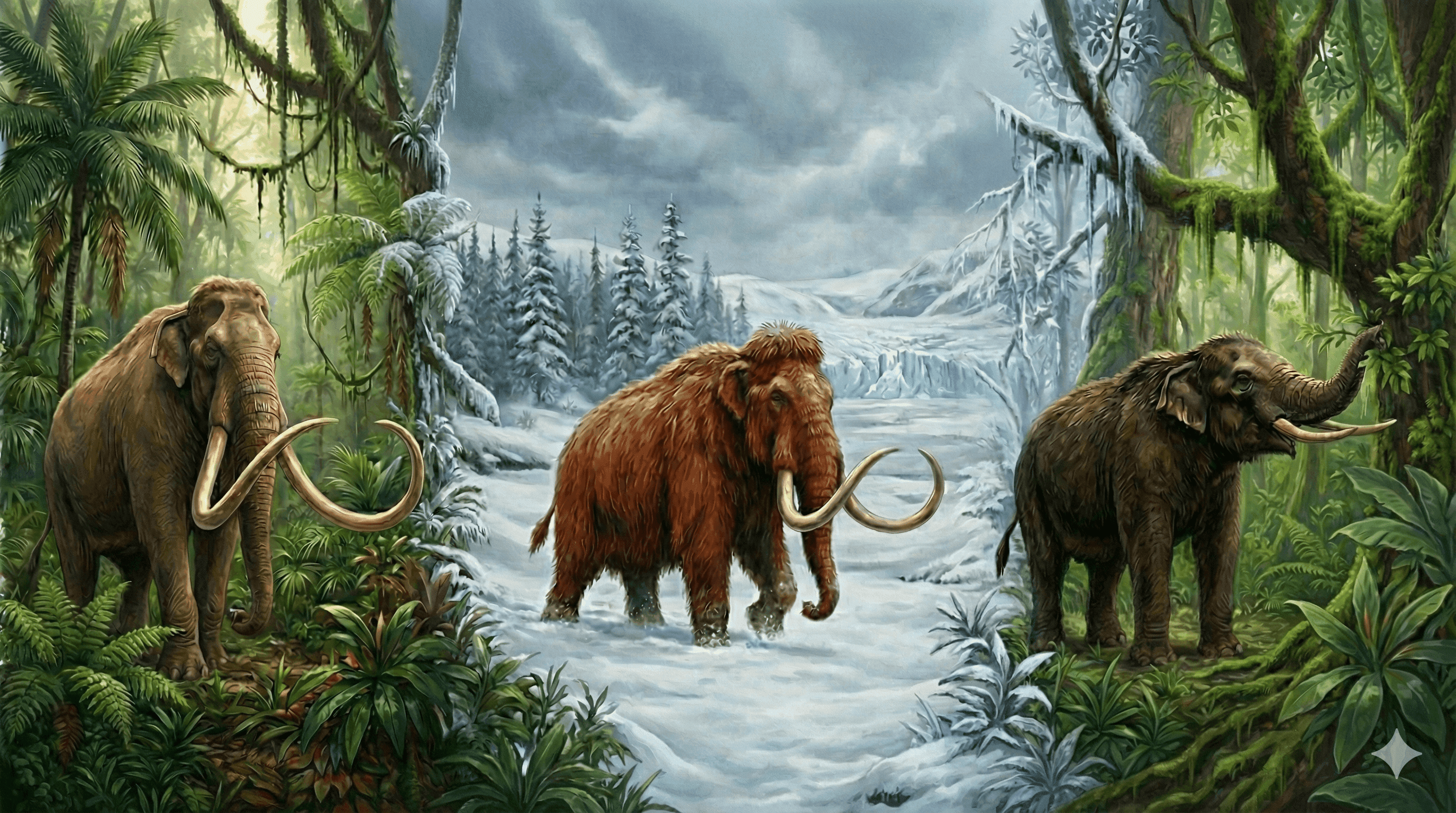
The most likely candidate for the elephant in Ether 9:19 is the Columbian mammoth (Mammuthus columbi), which ranged across North and Central America. Wade Miller explains, “For many years paleontologists called mammoths elephants as they wrote about them. Some still do. The Columbian mammoth of North America, based on studies of its fossils, is more closely related to the Indian (or Asian) elephant than the Indian elephant is to the African one!”9 It is taxonomically referred to as an elephantid. “With the realization that the Columbian mammoth is very closely related to the Indian elephant,” notes Miller, “it should not be a surprise that Jaredites could use this animal to do work.”10
While most fossils date to no more recently than 10,000 BC (when many other large American animals appear to have gone extinct), some populations of mammoths appear to have lived long past that point. For example, Matthew Roper notes that “a collagen sample from a mammoth bone found in Sandy, Utah yielded a date of 5985 BP (3985 BC).”11
The Columbian mammoth ranged much farther south than the better-known woolly mammoth and probably did not have that mammoth’s shaggy hair, looking much like surviving elephants today. The woolly mammoth is a weaker candidate for a Book of Mormon elephant because of its exclusively northern range. However, woolly mammoth fossils have been well preserved in northern climes, showing that this species “survived in the Arctic, including parts of Alaska and Canada, thousands of years longer than had been previously accepted.”12 In fact, a team of researchers working on Wrangel Island in the Siberian arctic announced in 1993 that “numerous teeth of dwarf mammoth dated 7,000–4,000 yr BP [ca. 5000–2000 BC] have been found.”13
The American mastodon (Mammut americanum), though less closely related to elephants than the Columbian mammoth, is another animal that could have been considered an elephant. Mastodon remains from Mexico have been dated to 7150 BC, and other remains from Huntington, Utah, were dated to 5080 and 5590 BC, both postdating the end of the Pleistocene Ice Age by several thousand years.14 After the mammoth and the mastodon, another potential option for the Book of Mormon elephant is the gomphothere (genus Cuvieronius), a smaller and more distant relation to the elephant than the others. Roper notes, “This species also survived past the Pleistocene and into the Holocene period in Guatemala. Remains from La Estanzuela have been dated to around 7500 BC.”15 Though the final extinction dates of all American mammoths, mastodons, and gomphotheres are uncertain, any of them could have qualified as a Jaredite elephant (assuming any populations of these species lived during Jaredite times).16
Cureloms and Cumoms
The book of Ether lists two unknown animals alongside elephants—cureloms and cumoms—which are also said to have been “useful unto man” (Ether 9:19). These animals are mentioned nowhere else in scripture, and besides their generic usefulness, no other description is given. The origin of the names curelom and cumom is also uncertain, causing Latter-day Saint linguists to assert that “no etymology may be proposed” for these indigenous American creatures not known in the day of Joseph Smith.17
While it may initially seem odd that these animal names are not translated into an English equivalent, Spencer Kraus has observed that this follows the trends of transliterated terms in other ancient translations. Specifically, words that only occur once in a given text (called hapax legomena by scholars) are often difficult to translate. This difficulty is further compounded when the word in question refers to “animals and plants that have no clear textual clues to determine their identities.”18 Indeed, biblical translators in antiquity faced similar problems when translating the Old Testament and likewise left certain words untranslated, including names of unknown animals.19 If these animals were unknown to Mosiah or Moroni, who translated and abridged the Jaredite record, their inclusion as untranslated animal names would make sense.20
Based on these and other instances of words left untranslated in the English text of the Book of Mormon, Kraus concluded, “The Book of Mormon consistently provides the same types of transliterations expected of a translation of an ancient text. … It would appear that the untranslated words in the Book of Mormon provide better clues into its nature as an ancient book.”21
Because elephants, cureloms, and cumoms are not mentioned as animals “useful for the food of man,” John L. Sorenson reasoned that these creatures were instead probably used as beasts of burden like the horses and asses or perhaps for hides and ivory.22 It may even be that cureloms or cumoms (or both) were related to the three elephant-like animals mentioned above. Miller has also proposed that some camelids (extinct relatives of the llama) could qualify as cureloms or cumoms. These animals could be quite large and ranged across the Americas, potentially serving as beasts of burden, much like llamas are used today.23
Conclusion
Many questions remain about the elephants, cureloms, and cumoms mentioned in the Book of Mormon, but ongoing research over the last two centuries has provided some intriguing candidates for these creatures. It is true that most populations of New World megafauna appear to have died out about 10,000 BC. While this may seem distant on an archaeological timescale, it is actually quite recent on a geological and biological timescale. Moreover, estimated extinction dates for elephant-like animals have had to be adjusted several times now already (sometimes by several thousand years!), due to ongoing discoveries. Some of these now range very close to when the Jaredites likely lived.
While this certainly doesn’t prove the Book of Mormon is an accurate historical record, it demonstrates that mere absences of evidence in this type of context pose a minimal threat to its authenticity. The notion that elephant-like animals lived during Book of Mormon times is becoming increasingly plausible over time, and because of the highly fragmentary fossil record, it is impossible to prove that pockets of such creatures didn’t survive to that period. Like many other textual features that were once viewed as obviously anachronistic, ongoing research and data are tending towards confirmation in this area.24
Matthew Roper, “Anachronisms: Accidental Evidence in Book of Mormon Criticisms,” Interpreter: A Journal of Latter-day Saint Faith and Scholarship 65 (2025).
Spencer Kraus, “A Closer Look at Transliterations in Divine Translations,” Interpreter: A Journal of Latter-day Saint Faith and Scholarship 63 (2025): 121–134.
Wade Miller, Science and the Book of Mormon: Cureloms, Cumoms, Horses and More (KCT & Associates, 2009), 47–70.
Wade E. Miller and Matthew Roper, “Animals in the Book of Mormon: Challenges and Perspectives,” BYU Studies Quarterly 56 (2017): 133–175.
Ether 9:19
- 1. John Hyde Jr., Mormonism: It’s Leaders and Designs (New York: W. P. Fetridge, 1857), 226. Another writing in 1873 claimed, “Scientific men are unanimously agreed that elephants never existed on this continent.” T. B. H. Stenhouse, The Rocky Mountain Saints (New York: D. Appleton Company, 1873), 532.
- 2. Only ivory is mentioned; see Ludwig Koehler, Walter Baumgartner, and Johann J. Stamm, The Hebrew and Aramaic Lexicon of the Old Testament [HALOT], ed. Mervyn E. J. Richardson, 2 vols. (Brill, 2001), s.vv. “שֵׁן,” “שֶׁנְהַבִּים.”
- 3. Webster’s 1828 Dictionary defines elephant as an African and Asian animal and gives somewhat rigid encyclopedic information rather than a simple definition. The Indian elephant was used from very ancient times as a beast of burden (trained by “mahouts”), while the Indian and North African elephants were used as war animals by ancient India, China, Persia, Alexander the Great, the Romans, and the Carthaginians. See Thomas R. Trautmann, Elephants and Kings: An Environmental History (University of Chicago Press, 2015), 50–297.
- 4. The Syrian elephant (subspecies of Indian) was present in Mesopotamia in the early first millennia BCE, and the North African elephant in Nubia was used in Egypt (and later Carthage) up into Roman times. Trautmann, Elephants and Kings, 50–297.
- 5. Wade Miller also suggests that if the Jaredite exodus to the Americas meandered along coastal India, the group could have encountered elephant taming in this region as well. Wade Miller, Science and the Book of Mormon: Cureloms, Cumoms, Horses and More (KCT & Associates, 2009), 51.
- 6. See Matthew Roper, “Anachronisms: Accidental Evidence in Book of Mormon Criticisms,” Interpreter: A Journal of Latter-day Saint Faith and Scholarship 65 (2025), 27–31.
- 7. The three extant species of elephant (Loxodonta africana, Loxodonta cyclotis, Elephas maximus) and the extinct North African elephant (Loxodonta africana pharaohensis) all fall within the taxonomic order of Proboscidea. This grouping includes several elephant-like proboscideans that were discovered in the New World since the Book of Mormon’s publication. See Roper, “Anachronisms,” 27–31.
- 8. The American species within the clade Eliphantimorpha seems to have largely died out as part of the mass extinction of megafauna around 10,000 BC at the end of the Pleistocene, but residual populations may have continued on for several more millennia and lived during Jaredite times.
- 9. Miller, Science and the Book of Mormon, 48.
- 10. Miller, Science and the Book of Mormon, 51.
- 11. Roper, “Anachronisms,” 30; citing Jim I. Mead and David J. Meltzer, “North American Late Quaternary Extinctions and the Radiocarbon Record,” in Quaternary Extinctions: A Prehistoric Revolution, ed. Paul S. Martin and Richard G. Klein (University of Arizona Press, 1984), 443–446; see also Wade E. Miller and Matthew Roper, “Animals in the Book of Mormon: Challenges and Perspectives,” BYU Studies Quarterly 56 (2017): 165–167.
- 12. Roper, “Anachronisms,” 28–29.
- 13. S. L. Vartanyan, V. E. Garutt, and A. V. Sher, “Holocene Dwarf Mammoths from Wrangle Island in the Siberian Arctic,” Nature 362 (1993): 337.
- 14. O. J. Polaco, J. Arroyo-Cabrales, E. Corona-M., and J. G. Lopez-Oliva, “The American Mastodon Mammut americanum in Mexico,” in The World of Elephants: International Congress, ed. G. Cavarretta, P. Giola, and M. R. Palombo (Comune di Roma Consiglio, Nazionale delle Ricerche, 2001), 240; Wade E. Miller, “Mammut americanum, Utah’s First Record of the American Mastodon,” Journal of Paleontology 61 (1987): 168–183.
- 15. Roper, “Animals,” citing S. Lorena Davila et al., “Guatemala’s Late Pleistocene (Rancholabrean) Fauna: Revision and Interpretation,” Quaternary Science Reviews 219 (2019): 280, 289.
- 16. Roper, “Animals,” also notes that “during the Late Pleistocene in Mexico, Cuvieronius, mammoth, and mastodon may have been contemporaneous, and at some Mexican sites Cuvieronius and mammoth have been found together.”
- 17. Stephen D. Ricks, Paul Y. Hoskisson, Robert F. Smith, and John Gee, Dictionary of Proper Names and Foreign Words in the Book of Mormon (Interpreter Foundation; Eborn Books, 2022), s.vv. “cumoms,” “cureloms.” They continue: “Whatever fauna cureloms [and cumoms] were, three criteria affect their identification: (1) they were especially useful to the Jaredites; (2) they were indigenous to Jaredite America; and (3) it must be assumed that Joseph Smith did not have an English translation for them or he would have rendered it in English. Therefore, whatever etymology is proposed must meet these three criteria.”
- 18. Spencer Kraus, “A Closer Look at Transliterations in Divine Translations,” Interpreter: A Journal of Latter-day Saint Faith and Scholarship 63 (2025): 128.
- 19. See Kraus, “Transliterations in Divine Translations,” 128–129; Sagit Butbul, “The Rendering of Bird Names in Early Judeo-Arabic Biblical Translations,” Aleph 10 no. 1 (2010): 14–37.
- 20. Kraus, “Transliterations in Divine Translations,” 131–132 also notes a similar phenomenon occurred when Joseph Smith rendered Isaiah 34:7 as “And the re-em shall come down with them, and the bullocks with the bulls” in his new translation of the Bible. The King James Version of this verse rendered the Hebrew term re-em as “unicorns,” a word which “typically now refers to a Celtic mythological creature rather than the wild cattle the Hebrew originally implied.” Based on this, Kraus concluded, “In both cases, Joseph Smith came across an animal name that was unfamiliar to him and he did not have an English word to adequately capture the intended meanings of either. Instead of attempting to guess what the animal may have been, Joseph instead opted to transliterate the word, which is what one would expect regarding translated texts. Even if Moroni2 or Mosiah2 were the first to transliterate these unfamiliar Jaredite words, the principle is still the same, as he likewise dealt with a text originally written in a foreign language and would have potentially met the same challenges that Joseph Smith would face centuries later.”
- 21. Kraus, “Transliterations in Divine Translations,” 133.
- 22. Ether 9:18; John L. Sorenson also argues that elephants, cureloms, and cumoms were less tamed or domesticated than other animals because it simply notes “there were” these creatures, while the other animals listed were “had” by the Jaredites. John L. Sorenson, Animals in the Book of Mormon: An Annotated Bibliography (Foundation for Ancient Research and Mormon Studies, 1992), 41. Sorenson also proposes that because cureloms and cumoms were mentioned alongside elephants, they may have been relatively bulky and of comparable size.
- 23. Miller notes the likely genera of Camelops and Hemiauchenia, though other Pleistocene American camelids include the less likely genera Palaeolama, Pleiolama, and the enormous Titanotylopus. Miller, Science and the Book of Mormon, 62. George Reynolds and Janne M. Sjodahl, Commentary on the Book of Mormon, 7 vols. (Deseret Book, 1973), 6:145, suggest a camel as a curelom based on a doubtful etymological connection (see Ricks et al., Dictionary of Proper Names, s.v. “curelom”); however, llamas are taxonomically referred to as camelids and are fairly close relatives of the camel. Other animals have been put forward as cureloms and cumoms but are unlikely because they often refer to animals (such as the extinct ground sloth) that would not be useful beasts of burden as the Book of Mormon implies. See Miller, Science and the Book of Mormon, 56–59, for a brief overview of some of these unlikely candidates.
- 24. For an in-depth treatment of this trend, see Roper, “Anachronisms.”