Evidence 524 | December 17, 2025
Book of Mormon Evidence: Concern for Unburied Bodies
Post contributed by
Scripture Central
Abstract
The concern for the proper burial of bodies in the Book of Mormon—as well as the attention given to circumstances in which corpses weren’t properly buried—is consistent with ancient Near Eastern cultural values.Burial Themes in the Ancient Near East
Within Old Testament texts, people were sometimes warned that if they did not repent, they would die and their bodies—instead of being properly buried—would be left to rot or be devoured by wild animals.1 Such a fate was seen by ancient peoples not only as a tragedy, as it would be today, but a disgrace and an indication of divine judgment.2 Among ancient Near Eastern cultures, judgment was believed to carry over into the afterlife, where a person’s role and identity was thought to be determined and facilitated by where and how their body was buried. As Matthew Suriano explains, “The ideal afterlife in the Hebrew Bible was bound to the tomb …. Death was relational, and the tomb was a critical component in defining relationships and establishing the identity of the dead.”3
Lack of burial, in an ancient Near Eastern worldview, could thus result in being dislodged and displaced in the afterlife, leaving one to wander aimlessly without a role or identity, and without any connection to the world of the living. According to John Walton, “In Mesopotamia the importance of the burial of the body was connected with a belief that, without burial, the etemmu (ghost) of the deceased would not find its natural place among the community of the dead and would therefore have no rest.”4
Unburied corpses also held connotations of uncleanliness and impurity and therefore were sometimes associated with a curse upon the land (Deuteronomy 21:22–23). Some evidence suggests that Israelite concerns with unburied corpses may even have stemmed from worries over restless spirits haunting the living.5 On a practical sensory level, those who encountered a corpse would experience the unpleasant smell of decomposing flesh. However, rather than simply viewing this as a result of natural biological processes, premodern cultures likely associated the smell with the unseen spiritual world. As explained by Yitzhaq Feder,
Ethnographic parallels … suggest that the spread of corpse pollution was modeled after the experience of the disseminating odor of a decomposing corpse. Accordingly, one may suggest that the smell of the decaying corpse was associated with the nepeš [Hebrew: soul or spirit] separating from the body. It was contact with the nepeš in this transitional phase that was considered defiling and, based on these ethnographic parallels, perhaps even dangerous.6
This may partly explain the purity laws involving rotting corpses in Numbers 19:14–16: “This is the law, when a man dieth in a tent: all that come into the tent, and all that is in the tent, shall be unclean seven days. And every open vessel, which hath no covering bound upon it, is unclean. And whosoever toucheth one that is slain with a sword in the open fields, or a dead body, or a bone of a man, or a grave, shall be unclean seven days.”
It is also instructive that the living were expected to care for their dead through ongoing mortuary rites and communal meals.7 Lack of proper burial prevented these things from happening and thus “dissolved community between the living and the dead.”8 If a body were to be devoured by animals, it could further worsen the fate of the dead. “In such a case, some Mesopotamian texts suggest, the dead person was consigned to a formless and chaotic reality and perhaps even to the world of demons.”9 It is difficult to determine precisely to what extent ancient Israelites shared beliefs regarding death and burial with their surrounding neighbors at different stages of their history, but various lines of evidence suggest a significant degree of overlap.10
Burial Themes in the Book of Mormon
This cultural backdrop may help explain the special concern for burying the dead that often arises in the Book of Mormon. As demonstrated in the following survey of passages, this is a recurring talking point, especially in connection to the death of prominent leaders or in the aftermath of battles:
- “And it came to pass that Ishmael died, and was buried in the place which was called Nahom” (1 Nephi 16:34)
- “And it came to pass after my father, Lehi, had spoken unto all his household, according to the feelings of his heart and the Spirit of the Lord which was in him, he waxed old. And it came to pass that he died, and was buried.
- “And I, myself, with mine own hands, did help to bury their dead” (Mosiah 9:19)
- “And it came to pass that the Nephites who were not slain by the weapons of war, after having buried those who had been slain—now the number of the slain were not numbered, because of the greatness of their number—after they had finished burying their dead they all returned to their lands” (Alma 3:1)
- “And it came to pass that after two days and two nights they were about to take his body and lay it in a sepulchre, which they had made for the purpose of burying their dead” (Alma 19:1)
- “He is not dead, but he sleepeth in God, and on the morrow he shall rise again; therefore bury him not” (Alma 19:8)
- “and also after the Lamanites were driven out of the land, and their dead were buried by the people of the land” (Alma 30:1)
- “Now their dead were not numbered because of the greatness of their numbers; neither were the dead of the Nephites numbered—but it came to pass after they had buried their dead … there began to be continual peace throughout all the land” (Alma 30:2)
- “And it came to pass that they did set guards over the prisoners of the Lamanites, and did compel them to go forth and bury their dead, yea, and also the dead of the Nephites who were slain” (Alma 53:1)
- “And it came to pass that after the Lamanites had finished burying their dead and also the dead of the Nephites, they were marched back into the land Bountiful” (Alma 53:3)
- “And now it came to pass that after we had thus taken care of our wounded men, and had buried our dead and also the dead of the Lamanites …” (Alma 57:28)
- “And it came to pass that on the morrow the people did assemble themselves together to mourn and to fast, at the burial of the great chief judge who had been slain. And thus also those judges who were at the garden of Nephi, and heard his words, were also gathered together at the burial” (Helaman 9:10–11)
- “And it came to pass that the five were liberated on the day of the burial” (Helaman 9:18)
- “Coriantumr should receive a burial by them” (Ether 13:21)
Such passages also help accentuate the significance of occasions in which the dead were not buried. One prominent example involves the destruction of the Jaredites. According to Ether 11:6, prophets of the Lord had predicted that the people would experience a great destruction, “and their bones should become as heaps of earth upon the face of the land except they should repent of their wickedness.” Several chapters later, this prophecy was fulfilled:
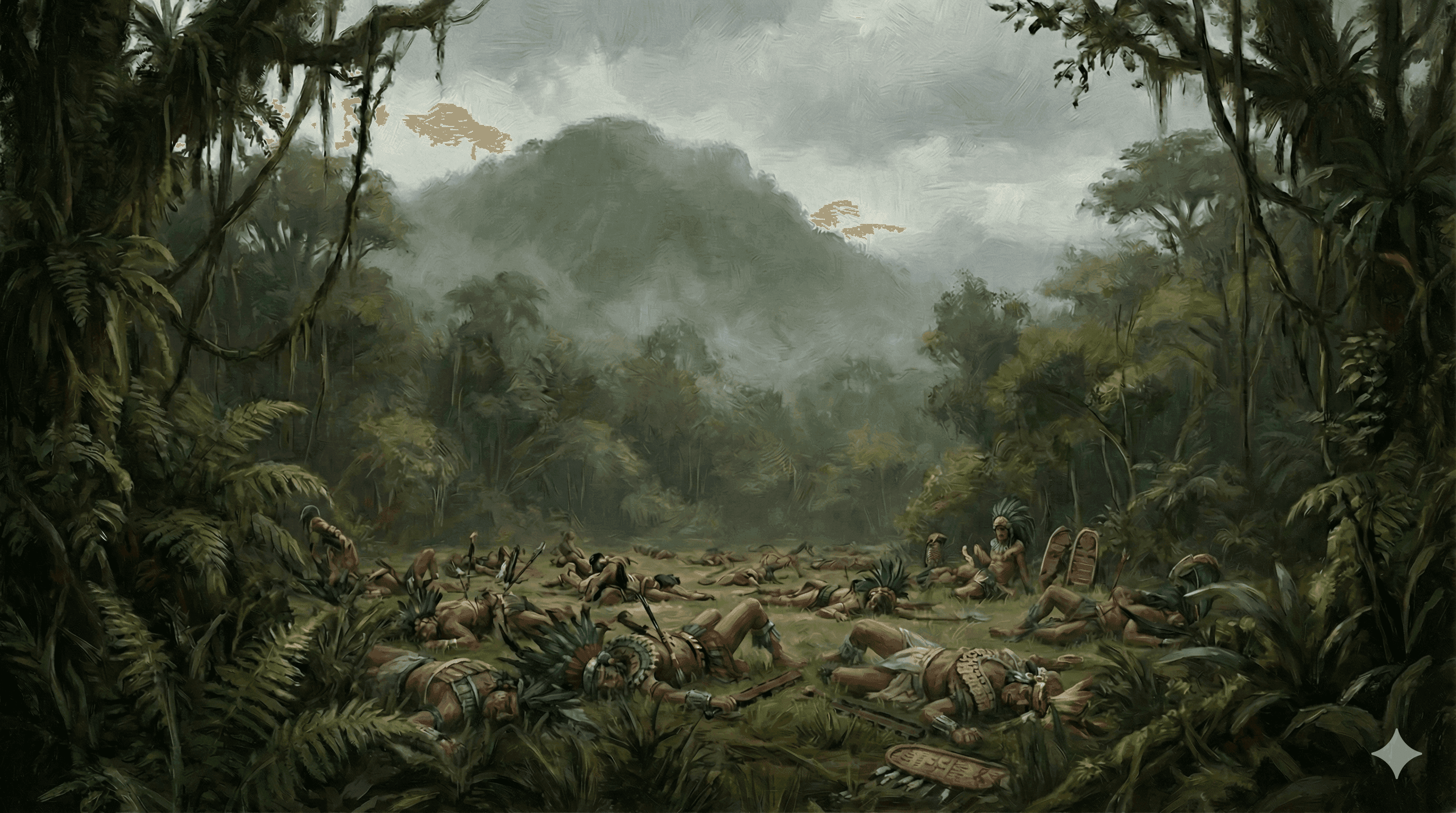
And so great and lasting had been the war, and so long had been the scene of bloodshed and carnage, that the whole face of the land was covered with the bodies of the dead. And so swift and speedy was the war that there was none left to bury the dead, but they did march forth from the shedding of blood to the shedding of blood, leaving the bodies of both men, women, and children strewed upon the face of the land, to become a prey to the worms of the flesh. And the scent thereof went forth upon the face of the land, even upon all the face of the land; wherefore the people became troubled by day and by night, because of the scent thereof. (Ether 14:21–23)
This unsettling aspect of the Jaredite demise became a recurring talking point within Mormon’s abridgment of Nephite history. On multiple occasions, he drew attention to the bones and unburied bodies of those who previously occupied the land northward:
- “It also spake a few words concerning his fathers. And his first parents came out from the tower, at the time the Lord confounded the language of the people; and the severity of the Lord fell upon them according to his judgments, which are just; and their bones lay scattered in the land northward” (Omni 1:22)
- “And they were lost in the wilderness for the space of many days, … having discovered a land which was covered with bones of men, and of beasts” (Mosiah 8:8)
- “Nevertheless, they did find a land which had been peopled; yea, a land which was covered with dry bones; … And they brought a record with them, even a record of the people whose bones they had found” (Mosiah 21:26–27)
- “And it bordered upon the land which they called Desolation, it being so far northward that it came into the land which had been peopled and been destroyed, of whose bones we have spoken” (Alma 22:30)
Within an ancient Near Eastern mindset, the repeated emphasis on the unburied remains of the Jaredite civilization would have had a foreboding connotation. Not only was their civilization destroyed, but the manner of destruction (with no one to bury the dead) would have been especially tragic. The scattered bones may have suggested that the departed spirits would find no peace or rest in the afterlife.
The bodily remains may also have signaled that the land itself had been cursed or polluted, due to the wickedness of its inhabitants. As mentioned in the original prophecy of destruction recorded in Ether 11:6, “a great curse should come upon the land, and also upon the people, … and their bones should become as heaps of earth upon the face of the land” (Ether 11:6). This curse would have been even more viscerally felt in the immediate aftermath of the destruction, as “the people became troubled by day and by night, because of the scent thereof” (Ether 14:23).
These accounts of Jaredite destruction served as a horrifying prelude and precedent for later Nephite calamities. One particularly striking example can be seen in a prophecy given by the prophet Abinadi, who declared that the people of King Noah would be slain and devoured by wild animals (Mosiah 12:2). As demonstrated by the parallels in the chart below, Mormon appears to have recorded the fulfillment of this prediction when the Amlicites were destroyed in Alma 2. A subsequent fulfillment likely took place when the people of Ammonihah were destroyed, as recorded in Alma 16, as well as the destruction of their Lamanite-Amulonite aggressors in Alma 25.11
Mosiah 12 (Prophecy) | Alma 2 (Fulfillment) | Alma 16 (Fulfillment) | Alma 25 (Fulfillment) |
2 Thus saith the Lord, it shall come to pass that this generation, because of their iniquities, shall be brought into bondage, and shall be smitten on the cheek; yea, and shall be driven by men, and shall be slain; and the vultures of the air, and the dogs, yea, and the wild beasts, shall devour their flesh. | 37 Yea, they were met on every hand, and slain and driven, until they were scattered on the west, and on the north, until they had reached the wilderness, which was called Hermounts; and it was that part of the wilderness which was infested by wild and ravenous beasts. 38 And it came to pass that many died in the wilderness of their wounds, and were devoured by those beasts and also the vultures of the air; and their bones have been found, and have been heaped up on the earth. | 10 But behold, in one day it was left desolate; and the carcasses were mangled by dogs and wild beasts of the wilderness. 11 Nevertheless, after many days their dead bodies were heaped up upon the face of the earth, and they were covered with a shallow covering. | 3 And after that, they had many battles with the Nephites, in the which they were driven and slain. 12 And [Abinadi] said unto the priests of Noah that their seed should cause many to be put to death, in the like manner as he was, and that they should be scattered abroad and slain, even as a sheep having no shepherd is driven and slain by wild beasts; and now behold, these words were verified, for they were driven by the Lamanites, and they were hunted, and they were smitten. |
It should be pointed out that two of the fulfillments (Alma 2:38; Alma 16:10–11) include an element of human remains being heaped upon the earth that isn’t present in Abinadi’s original prophecy (Mosiah 12:2). This specific language seems intended to parallel the prophesied destruction of the Jaredites, whose “bones should become as heaps of earth upon the face of the land” (Ether 11:6). Another parallel along these lines comes from the mention of an unpleasant “scent” of rotting corpses, as well as the use of the term “Desolation of Nehors” in Alma 16:11. This resonates with the terrible “scent” that resulted from the destruction of the Jaredites (Ether 14:23), as well as the term “Desolation” that the Nephites used for Jaredite lands (Ether 7:6). Solidifying the significance and intentionality of these parallels, Mormon later brought up unburied corpses again when he gave an overview of what took place during the 1st and 15th years of the reign of the judges: “And the bodies of many thousands are laid low in the earth, while the bodies of many thousands are moldering in heaps upon the face of the earth” (Alma 28:11).
Clearly, this concern was important to Mormon. He apparently saw unburied corpses as an abject tragedy, in contrast to those that were properly buried. And unlike Abinadi, who wouldn’t have known of the Jaredite civilization before his death, Mormon was intimately aware of the fate of the previous inhabitants of the land.12 This may help explain why the parallel language (involving heaps of bones or bodies) only shows up in Mormon’s accounts of the fulfillment of Abinadi’s prophecy, rather than in the original prophecy itself.
Later, during Mormon’s own day, he again brought attention to unburied bodies: “for I saw thousands of them hewn down in open rebellion against their God, and heaped up as dung upon the face of the land” (Mormon 2:15). The imagery crops up again in Mormon’s account of the final Nephite battle at Cumorah: “their flesh, and bones, and blood lay upon the face of the earth, being left by the hands of those who slew them to molder upon the land, and to crumble and to return to their mother earth” (Mormon 6:15). Mormon thus drives home the point that his own people suffered essentially the same disturbing fate as the Jaredites.
As a final point of interest, these descriptions of unburied bodies may thematically relate to the imagery of spirits whispering from the dust, especially as described by Nephi: “those who shall be destroyed shall speak unto them out of the ground, and their speech shall be low out of the dust, and their voice shall be as one that hath a familiar spirit” (2 Nephi 26:16).13 In an ancient Near Eastern context, the unburied remains of both the Nephites and Jaredites play well into this theme. It is almost as if the restless spirits of the dead—whose bodies were tragically left to rot untended upon the earth—are collectively calling out to future generations to not bring upon themselves and the land the same awful curse of destruction.14
Conclusion
The modern reader might easily miss the attention that the Book of Mormon places on the bodies of the deceased. In numerous instances, the text goes out of its way to comment on the proper burial of the dead.
At the same time, the Nephite record also shows impressive consistency and attention to cases where the dead were left unburied. This can be seen in the prophecy that “bones should become as heaps of earth upon the face of the land” in Ether 11:6, which was clearly fulfilled in Ether 14:21–23 and which also was referenced repeatedly by Mormon throughout his abridgment. It is also illustrated by Abinadi’s prophecy in Mosiah 12:2, the fulfillment of which Mormon recorded in Alma 2:38 and in Alma 16:10–11 (using language that evoked the previous Jaredite destruction). Mormon then brought attention to similar types of destruction that faced his people in his own day.
Overall, the way this theme is developed throughout the Book of Mormon is both remarkably consistent and textually complex, while resonating very well with conceptions of death and burial throughout the ancient Near East. This textual feature thus comes across as believably authentic on multiple levels.
See John L. Sorenson, Mormon’s Codex: An Ancient American Book (Neal A. Maxwell Institute for Religious Scholarship and Deseret Book, 2013), 381–425.
Relevant Scriptures
Deuteronomy 21:22–23
Numbers 19:14–16
1 Nephi 16:34
2 Nephi 26:16
Mosiah 8:8
Mosiah 9:19
Mosiah 12:2
Mosiah 21:26–27
Alma 2:38
Alma 3:1
Alma 16:10–11
Alma 19:1
Alma 19:8
Alma 22:30
Alma 28:11
Alma 30:1
Alma 30:2
Alma 53:1
Alma 53:3
Alma 57:28
Helaman 9:10–11
Helaman 9:18
Omni 1:22
Ether 11:6
Ether 13:21
Ether 14:21–23
Mormon 2:15
Mormon 6:15
- 1. See Deuteronomy 28:26; 1 Kings 16:3–4; 21:24; 2 Kings 9:10, 30–37; Jeremiah 8:1–3; 14:16; 16:4–6; 22:19; 25:33; Ecclesiastes 6:3–5.
- 2. Philip J. King and Lawrence E. Stager, Life in Biblical Israel (Westminster John Knox, 2001), 363: “For a corpse to remain unburied was a disgrace and a sign of divine judgment.” The Greeks also considered it a duty of military commanders to see that their fallen soldiers or sailors were given a proper burial, and the Romans built family shrines and monuments to their dead that needed to be maintained by generations to come.
- 3. Rachel S. Hallote, Death, Burial, and Afterlife in the Biblical World (Ivan R. Doe, 2001), 29–45; Matthew J. Suriano, A History of Death in the Hebrew Bible (Oxford University Press, 2018), 177–216. A biblical passage that discusses ideas along these lines is Isaiah 14:18–20, which suggests that the king of Babylon would not rest in a tomb like kings of other nations.
- 4. John H. Walton and Craig S. Keener, eds., NIV Cultural Backgrounds Study Bible (Zondervon, 2016), 632–633; capitalization silently altered. Hallote, Death, Burial, and Afterlife, 102–112 discusses the considerable overlap between Israelite and Mesopotamian beliefs about the dead.
- 5. See Yitzhaq Feder, “Death, Afterlife and Corpse Pollution: The Meaning of the Expression ṭāmēˀ la-nepeš,” Vetus Testamentum 69 (2019) 422–426.
- 6. Feder, “Death, Afterlife and Corpse Pollution,” 420–421.
- 7. See Hallote, Death, Burial, and Afterlife, 54–68.
- 8. Walton and Keener, Cultural Backgrounds, 633.
- 9. Walton and Keener, Cultural Backgrounds, 633–634.
- 10. See, for example, Kerry M. Sonia, Caring for the Dead in Ancient Israel (SBL Press, 2020).
- 11. Although the textual parallels between these passages are fairly obvious, the social connections are not as immediately apparent. In Alma 2:1 we learn that Amlici was “after the order of the man that slew Gideon by the sword.” In other words, he belonged to the infamous Order of the Nehors. Many of the people of Ammonihah who were slain in Alma 16:10–11 also apparently belonged to this same group (see Alma 14:16–18). Only later, however, does it become clear that many of the Amulonites were also “after the order of the Nehors” (Alma 21:4). Ultimately, it appears that Amulon’s seed spread out not only into several dissenting groups among the Nephites, but that they also joined with the Lamanites. See Alma 21:2; 24:1; 25:4; 43:13. This helps explain why Mormon could have seen several different destruction events as all being related to Abinadi’s earlier prophecy. For more on these apostate connections, see A. Keith Thompson, “Apostate Religion in the Book of Mormon,” Interpreter: A Journal of Latter-day Saint Faith and Scholarship 25 (2017) : 191–226, esp. 203–206; Scripture Central, “How Were the Amlicites and Amalekites Related? (Alma 2:11),” KnoWhy 109 (May 15, 2017). The intricate relationships behind this fulfilled prophecy also showcase one aspect of the Book of Mormon’s complexity. For more in fulfilled prophecies in the Book of Mormon, see Scripture Central, “Book of Mormon Evidence: Internally Fulfilled Prophecies,” Evidence 85 (September 19, 2020).
- 12. As demonstrated previously, Mormon commented repeatedly on the Jaredite bones that were discovered by the people of Limhi. Moreover, Mormon clearly planned to include an account of the Jaredites in his own abridgment (see Mosiah 28:17–19). When he died before including that record, Moroni finished it for him.
- 13. Other versions of this idea more clearly involve righteous prophets (rather than a destroyed nation) speaking from the dust. See 2 Nephi 3:19–20; 26:15–16; 27:9; 33:13; Mormon 8:23; Ether 8:24; Moron 10:27.
- 14. See Scripture Central, “How Are the Words of the Book of Mormon Like ‘One That Hath a Familiar Spirit’? (2 Nephi 26:16),” KnoWhy 491 (August 21, 2019).