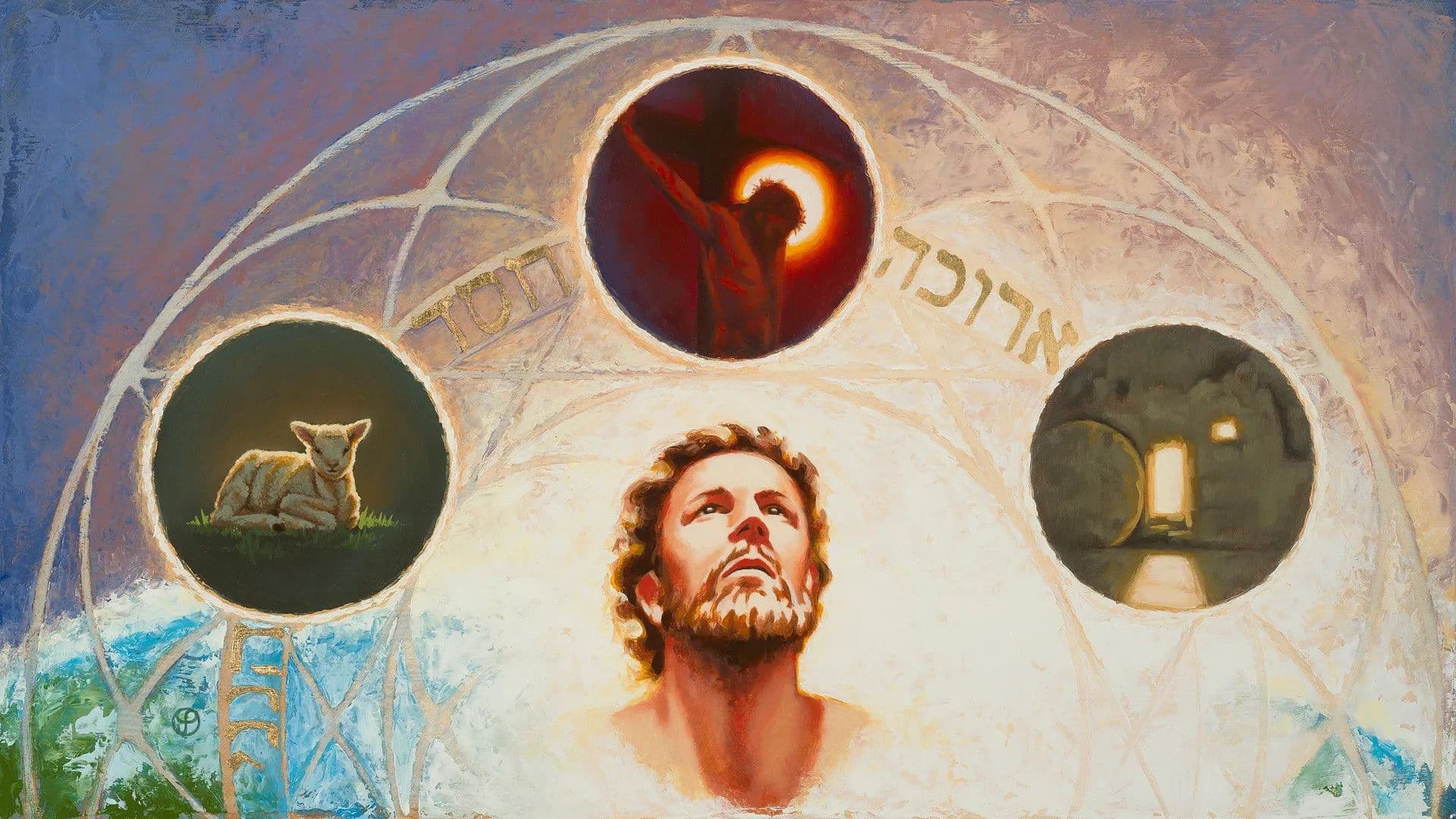
Moses 7
“The Lord Called His People Zion”
February 2 - February 8
scripture
quotes
God Weeps At Human Suffering
<p>"God’s plan of moral and mortal agency allows us to learn by our own experience. Some of our greatest life lessons come from things we would never choose. In love, Jesus Christ descended below and ascended above all things. He rejoices in our divine capacities for creativity and delight, kindness without hope for reward, faith unto repentance and forgiveness. And He weeps in sorrow at the enormity of our human suffering, cruelty, unfairness—often brought by human choice—as do the heavens and the God of heaven with them.</p>
Gerrit W. Gong, “Eternity's Great Gifts: Jesus Christ's Atonement, Resurrection, Restoration,” April 2025 General Conference"
Agency and Why We Are Here
<p>Why are you here on planet earth?</p> <p>One of the most important reasons is to receive a mortal body. Another is to be tested—to experience mortality—to determine what you will do with life’s challenging opportunities. Those opportunities require you to make choices, and choices depend on agency. A major reason for your mortal existence, therefore, is to test how you will exercise your agency.</p> <p>Agency is a divine gift to you. You are free to choose what you will be and what you will do. ... That precious privilege of choice—man’s agency—was decreed before the world was created. It is a moral agency. Thus, it was opposed by Satan but affirmed by the Lord and reaffirmed through prophets in ancient and in modern times.</p>
Russell M. Nelson, “Choices,” October 1990 General Conference
commentary
Enoch’s Grand Vision: God and the Heavens Weep for the Wicked
<p><strong>7:28–40.</strong> Within the book of Moses, Noah’s and Enoch’s stories of rescue and exaltation share a common motif: water. On one hand, Noah’s waters are the waters of destruction, the floods of an all-consuming deluge that cleanses the earth—a prelude to a new creation. On the other hand, Enoch’s waters are the waters of sorrow, the bitter tears that precede a terrible, annihilating storm. Indeed, in <a class="ref_link">Moses 7</a> three distinct parties weep for the wickedness of humankind: God (verse 28), the heavens (verses 28, 37), and Enoch (verses 41, 49). In addition, a fourth party, the earth, complains and mourns—though does not specifically weep—for humankind (verses 48–49).</p> <p>While Charles Harrell argued that “Moses 7 accentuates only [God’s] wrath rather than his tender-heartedness,”<a href="#_ftn1" name="_ftnref1">[1]</a> a useful corrective to this perspective may be found through comparing this chapter to suitable Old Testament analogues. While the fusion of justice and mercy in the character of God may seem like an irreconcilable contradiction in modern thinking, ancient scripture writers had no problem in putting these seemingly opposite characteristics together—often in proximity within a single chapter of scripture. This general Old Testament model is best exemplified in two classic chapters of the Old Testament: <a class="ref_link">Isaiah 1</a> and <a class="ref_link">Deuteronomy 32</a>.<a href="#_ftn2" name="_ftnref2">[2]</a> For example, Moses 7:28–41 resonates with selected themes mentioned by John Hobbins in his outline of Isaiah 1, including</p> <ul> <li>God’s call for heaven and earth to witness His grievance,</li> <li>the relationship of privilege and obligation entailed by a Father and His children,</li> <li>the actions God will take in response to the wayward and defiant state of His children, and</li> <li>God’s proposal for a merciful resolution of His children’s troubles.</li> </ul> <p><strong>The weeping voice of the heavens.</strong> Jewish tradition links the weeping of the heavens with the separation of the “waters above” and the “waters beneath” via the firmament during the second day of Creation.<a href="#_ftn3" name="_ftnref3">[3]</a> Given the Creation setting of this motif, it is not surprising that the book of Moses associates the weeping of the heavens with the story of the Flood, which in essence recounts the alienation of the earth from the heavens and the reunion of the two in the re-creation of a new earth and a new covenant with the righteous Noah as its new Adam.<a href="#_ftn4" name="_ftnref4">[4]</a></p> <p><strong>The weeping voices of God and Enoch. </strong>The tradition of weeping prophets is perhaps best exemplified by Jeremiah, who cried out, “Oh that my head were waters, and mine eyes a fountain of tears, that I might weep day and night for the slain of the daughter of my people!” (<a class="ref_link">Jeremiah 9:1</a>). Less well known as a weeping prophet is Enoch. For example, in <em>Midrash Rabbah</em> on Lamentations, Enoch is portrayed as weeping in the likeness of God because of the destruction of the Israelite temple. No similar scene has been found in the ancient literature relating to any other prophet. But here in <em>Midrash Rabbah</em> and in the book of Moses, it is specifically connected with Enoch. Having seen God weep, Metatron (Enoch in his glorified state) said, “‘Sovereign of the Universe, let me weep, but do Thou not weep.’ He replied to him: ‘If thou lettest Me not weep now, I will repair to a place which thou hast not permission to enter, and will weep there.’”<a href="#_ftn5" name="_ftnref5">[5]</a></p> <p><strong>7:38. “a prison have I prepared.”</strong> Both the book of Moses and the <em>Book of Giants</em> contain a “prediction of utter destruction and the confining in prison that is to follow” for the unrepentant wicked.<a href="#_ftn6" name="_ftnref6">[6]</a> From the book of Moses we read, “But behold, these . . . shall perish in the floods; and behold, I will shut them up; a prison have I prepared for them” (<a class="ref_link">Moses 7:38</a>). Likewise, in the <em>Book of Giants</em> we read the lament of one of the <em>gibborim</em>: “he has imprisoned us and overpowered yo[u].”<a href="#_ftn7" name="_ftnref7">[7]</a><sup> </sup><a class="ref_link">Moses 7:39</a> follows the general pattern of <a class="ref_link">Isaiah 1</a>, where “Yahweh’s decision not to blot the people out entirely, despite the defection, is . . . recounted.”<a href="#_ftn8" name="_ftnref8">[8]</a> Here, the way is open not only for the living but also for the dead—those who refused to hear the gospel while yet on earth. Similarly, in verse 39, God explains that His Chosen will suffer for the sins of the penitent and will release them from prison “inasmuch as they will repent.”</p> <p> </p> <p><a href="#_ftnref1" name="_ftn1">[1]</a> Charles Harrell, personal communication to the author, cited in Jeffrey M. Bradshaw and Ryan Dahle, “Textual Criticism and the Book of Moses: A Response to Colby Townsend’s ‘Returning to the Sources,’” <em>Interpreter: A Journal of Latter-day Saint Faith and Scholarship</em> 40 (2020): 115.</p> <p><a href="#_ftnref2" name="_ftn2">[2]</a> On this model, see John F. Hobbins, “The Rhetoric of Isaiah 1:2–20: An Exploration,” <em>Ancient Hebrew Poetry</em>, updated February 2, 2007, https://ancienthebrewpoetry.typepad.com/ancient_hebrew_poetry/files/isa_1_220_rhetoric.pdf. The structure of Moses 7:28–41 seems to follow themes generally similar to some of those mentioned by John F. Hobbins above in his outline of Isaiah 1. For an extended discussion of resemblances, see Bradshaw and Dahle, “Textual Criticism,” 115–22.</p> <p><a href="#_ftnref3" name="_ftn3">[3]</a> David L. Lieber and Jules Harlow, eds., <em>Etz Hayim: Torah and Commentary</em> (Philadelphia, PA: Jewish Publication Society, 2001), 5. See also Avram R. Shannon, “Firmament,” in <em>Old Testament Cultural Insights</em>, ed. Taylor Halverson (Springville, UT: Book of Mormon Central, 2022).</p> <p><a href="#_ftnref4" name="_ftn4">[4]</a> See Jeffrey M. Bradshaw and David J. Larsen, <em>In God’s Image and Likeness</em> <em>2: Enoch, Noah, and the Tower of Babel</em>, 2 vols. (Orem, UT: Interpreter Foundation; Salt Lake City, UT: Eborn Books, 2014), 256–259, 277–285.</p> <p><a href="#_ftnref5" name="_ftn5">[5]</a> H. Freedman and Maurice Simon, eds., <em>Midrash Rabbah</em>, 3rd ed., 10 vols. (London, England: Soncino Press, 1983), 7:41, Lamentations 24.</p> <p><a href="#_ftnref6" name="_ftn6">[6]</a> Hugh W. Nibley, “Churches in the Wilderness,” in<em> Nibley on the Timely and the Timeless</em>, ed. Truman G. Madsen (Salt Lake City, Utah: Bookcraft, 1978), 161.</p> <p><a href="#_ftnref7" name="_ftn7">[7]</a> Donald W. Parry, <em>The Dead Sea Scrolls Reader</em>, ed. Emanuel Tov, vol. 1 of 2, <em>Texts Concerned with Religious Law, Exegetical Texts, and Parabiblical Texts</em>, 2nd ed. (Leiden, Netherlands: Brill, 2013), 945, 4Q203, frg. 7b, col. i, l. 5.</p> <p><a href="#_ftnref8" name="_ftn8">[8]</a> Hobbins, “Rhetoric of Isaiah 1:2–20,” 11.</p> <p> </p> <p><strong>Author</strong>: Jeffrey M. Bradshaw<br /><strong>General Editor:</strong> Taylor Halverson<br /><strong>Associate Editor:</strong> Morgan Tanner<br /><strong>Senior Editor:</strong> Sarah Whitney Johnson<br /><strong>Assistant Editor:</strong> Verlanne Johnson</p>
Old Testament Minute: Genesis by BMC
video
God Weeps! (Moses 7)
<p>Taylor Halverson, “God Weeps! (Come Follow Me: Moses 7) Week 4, Part 4/7,” Book of Mormon Central Video, 2022.</p>
Taylor Halverson