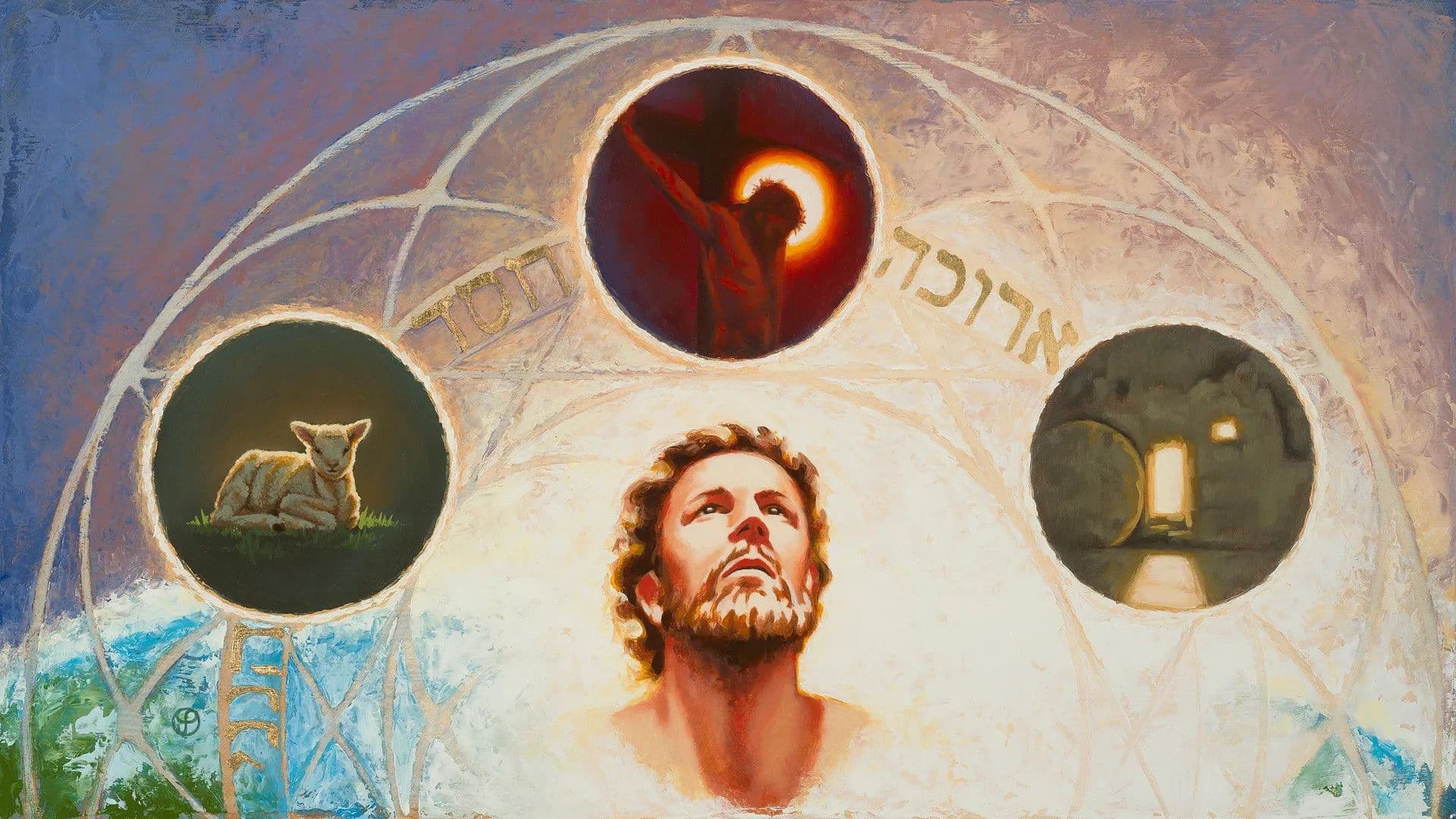
Moses 7
“The Lord Called His People Zion”
February 2 - February 8
scripture
quotes
Becoming of One Heart
<p>While we hold ourselves to the Lord’s high standards, let’s also be patient with one another. We are each a work in progress, and we all rely on the Savior for any progress we make. That’s true for us as individuals, and it’s true for the kingdom of God on earth.</p> <p>The Lord invites us not just to join His kingdom but also to be anxiously engaged in building it. God envisions a people who are “of one heart and one mind.” And to be of one heart, we must seek pure hearts, and that requires a mighty change of heart.</p> <p>But that doesn’t mean changing my heart to align with yours. Nor does it mean changing your heart to align with mine. It means that we all change our hearts to align with the Savior.</p> <p>If we are not there yet, remember: with the Lord’s help, nothing is impossible.</p>
Dieter F. Uchtdorf, “‘By This All Will Know That You Are My Disciples,” April 2025 General Conference
How Can We Become One?
<p>Becoming one is a recurring theme in the gospel of Jesus Christ and in God’s dealings with His children. ...</p> <p>In our own dispensation, the Lord admonished, “I say unto you, be one; and if ye are not one ye are not mine.” Among the reasons the Lord gave as to why the early Saints in Missouri had failed to establish a place of Zion was that they “are not united according to the union required by the law of the celestial kingdom.”</p> <p>Where God prevails in all hearts and minds, the people are described as “in one, the children of Christ.”</p> <p>When the resurrected Savior appeared to the ancient Book of Mormon peoples, He noted with disapproval that in the past there had been disputations among the people about baptism and other matters. He commanded:</p> <p>“There shall be no disputations among you, as there have hitherto been; neither shall there be disputations among you concerning the points of my doctrine, as there have hitherto been.</p> <p>“For verily, verily I say unto you, he that hath the spirit of contention is not of me, but is of the devil, who is the father of contention.”</p> <p>In our extremely contentious world, how can unity be achieved, especially in the Church, where we are to have “one Lord, one faith, one baptism”? Paul gives us the key:</p> <p>“For as many of you as have been baptized into Christ have put on Christ.</p> <p>“There is neither Jew nor Greek, there is neither bond nor free, there is neither male nor female: for ye are all one in Christ.”</p> <p>We are too diverse and at times too discordant to be able to come together as one on any other basis or under any other name. Only in Jesus Christ can we truly become one.</p>
D. Todd Christofferson, “One in Christ,” April 2023 General Conference
commentaries
Enoch’s People Gather to Zion and Keep the Law of Consecration
<p><strong>7:17. “the glory of the Lord, which was upon his people.”</strong> Previously, it was Enoch who was “clothed upon with glory” (Moses 7:3). Now all his people have become glorified.</p> <p><strong>7:17. “blessed upon the mountains, and upon the high places.”</strong> Mountains and high places are the favored locations for sanctuaries.<a href="#_ftn1" name="_ftnref1">[1]</a> Similarly, the <em>Book of Giants</em> describes those who repented in response to Enoch’s preaching and gathered to divinely prepared cities as dwelling “on the skirts of four huge mountains.”<a href="#_ftn2" name="_ftnref2">[2]</a></p> <p><strong>7:18. “the Lord called his people Zion.” </strong>The word <em>Zion</em>, which probably predates the arrival of the Israelites to the Jerusalem area, may be related to the root <em>ṣwn</em> (also Arabic <em>ṣâna</em>), which means “to protect, preserve, defend,” consistent with its description as a fortified hill in <a class="ref_link">2 Samuel 5:7</a>. This is also consistent with Zion’s depiction in <a class="ref_link">Doctrine and Covenants 45:66</a> as “a land of peace, a city of refuge, a place of safety for the saints of the Most High God.”</p> <p>In contrast to typical biblical usage that associates Zion with a <em>place</em> in the environs of Jerusalem, the Lord applies the name to a <em>group of people</em> in <a class="ref_link">Doctrine and Covenants 97:21</a>: “For this is Zion—the pure in heart.”<a href="#_ftn3" name="_ftnref3">[3]</a> BYU professor Richard D. Draper and his coauthors observed that in <a class="ref_link">Moses 7:18</a> it was likewise the Lord “who conferred the name on His people, itself a sacred act.”<a href="#_ftn4" name="_ftnref4">[4]</a> The Lord called His people Zion because they kept the crowning covenant of consecration: “the law of the celestial kingdom” (<a class="ref_link">Doctrine and Covenants 88:22</a>). In respecting this and all the Lord’s covenants, “they were of one heart and one mind, and dwelt in righteousness; and there was no poor among them” (<a class="ref_link">Moses 7:18</a>).</p> <p>President George Q. Cannon taught, “As a people we are expecting the day to come when Jesus will descend in the clouds of Heaven; but before this day comes . . . the organization of society that exists in the heavens must exist on the earth.”<a href="#_ftn5" name="_ftnref5">[5]</a> The conditions for such a society have been achieved only rarely with long, sustained effort. Terryl and Fiona Givens observed, “All who have attempted to reenact Enoch’s enterprise have found the transition from worldly ways to celestial society a more taxing challenge than anticipated. The hard lesson has been, that ‘Zion cannot be built up unless it is by the principles of the law of the celestial kingdom’ (<a class="ref_link">Doctrine and Covenants 105:5</a>). Rome is not the only city that cannot be built in a day.”<a href="#_ftn6" name="_ftnref6">[6]</a></p> <p><strong>7:18. “one heart and one mind.” </strong>At a conference of the Church held soon after Moses 7 was dictated, the Lord emphasized one of this chapter’s most important lessons: “I say unto you, be one; and if ye are not one ye are not mine” (<a class="ref_link">Doctrine and Covenants 38:27</a>).</p> <p><strong>7:18. “no poor among them.”</strong> Enoch and his people were, in the words of William W. Phelps, “above the pow’r of mammon.”<a href="#_ftn7" name="_ftnref7">[7]</a> Latter-day Saint pioneer and author George W. Crocheron asked, “What was the primal cause which brought about this happy condition of society, socially, religiously and industrially? It was due to the people having consecrated their time, talents, and all their earthly possessions, to one common end—the good of the whole community.”<a href="#_ftn8" name="_ftnref8">[8]</a> Compare <a class="ref_link">4 Nephi 1:3</a>.</p> <p> </p> <p><a href="#_ftnref1" name="_ftn1">[1]</a> Richard D. Draper, S. Kent Brown, and Michael D. Rhodes, <em>The Pearl of Great Price: A Verse-by-Verse Commentary</em> (Salt Lake City, UT: Deseret Book, 2005), 120.</p> <p><a href="#_ftnref2" name="_ftn2">[2]</a> W. B. Henning, “The Book of the Giants,” <em>Bulletin of the School of Oriental and African Studies</em> 11, no. 1 (1943): 69.</p> <p><a href="#_ftnref3" name="_ftn3">[3]</a> Compare <a class="ref_link">Isaiah 49:2</a>; <a class="ref_link">Hosea 1:8–11</a>; 2:23.</p> <p><a href="#_ftnref4" name="_ftn4">[4]</a> Draper, Brown, and Rhodes, <em>Pearl of Great Price</em>, 120.</p> <p><a href="#_ftnref5" name="_ftn5">[5]</a> George Q. Cannon, in<em> Journal of Discourses</em>, 26 vols. (London, England: Latter-day Saints’ Book Depot, 1854–1886), 13:99.</p> <p><a href="#_ftnref6" name="_ftn6">[6]</a> Terryl L. Givens and Fiona Givens, <em>The God Who Weeps: How Mormonism Makes Sense of Life</em> (Salt Lake City, UT: Ensign Peak, 2012), 114.</p> <p><a href="#_ftnref7" name="_ftn7">[7]</a> William W. Phelps, “Adam-ondi-Ahman,” in <em>Hymns</em> (Salt Lake City: The Church of Jesus Christ</p> <p>of Latter-day Saints, 1985), no. 49.</p> <p><a href="#_ftnref8" name="_ftn8">[8]</a> George W. Crocheron, “The City of Enoch,” <em>Improvement Era</em> 8, no. 7 (1905): 537.</p> <p> </p> <p><strong>Author</strong>: Jeffrey M. Bradshaw<br /><strong>General Editor:</strong> Taylor Halverson<br /><strong>Associate Editor:</strong> Morgan Tanner<br /><strong>Senior Editor:</strong> Sarah Whitney Johnson<br /><strong>Assistant Editor:</strong> Verlanne Johnson</p>
Old Testament Minute: Genesis by BMC
Enoch’s Grand Vision: Enoch Sees All Nations
<p><strong>7:22. “the residue of the people which were the sons of Adam.”</strong> “The residue of the people” refers to all those who had not been taken up to heaven with the city of Enoch. Might this phrasing, which specifically distinguishes the people who were “the sons of Adam,” allow for the possibility of the presence of non-Adamic lineages on the earth at that time?</p> <p><strong>7:22. “the seed of Cain were black.” </strong>Other than a possible allusion in a Joseph Smith Translation addition to <a class="ref_link">Genesis 9:26</a>, no explicit connection is made in scripture between the seed of Cain (“who were black” [<a class="ref_link">Moses 7:22</a>]) and the people of Canaan mentioned in <a class="ref_link">Moses 7:8</a> (“there was a blackness came upon all the children of Canaan”). The two groups are mentioned in different visions, and their tribal names are of different origin.<a href="#_ftn1" name="_ftnref1">[1]</a> This verse might be understood in connection with the “mark” of Cain (see <a class="ref_link">Moses 5:40</a>). Decoding the nature of that mark is not a straightforward matter (see the commentary on <a class="ref_link">Moses 5:40</a>). Early Church leaders and most other Americans in the nineteenth century believed that Cain’s descendants were Black. Modern Church leaders have specifically disavowed previous racial theories.</p> <p>[From the editors: The most likely explanation that fits both the ancient context and what we know from the gospel, is that the color term “black” was not a designation of skin color but rather a covenantal designation of being outside God’s covenant. That is “the seed of Cain were black” would more appropriately mean “the seed of Cain were outside of God’s covenant.” Why did they not have “place among [God’s covenant people]?” Because those who were of the seed of Cain had rejected God’s covenant; they had rejected being part of God’s covenant people. And the color term to designate that they weren’t in the covenant was “black”. Again, there was no racial designation for that term, only covenantal designation. Similarly in Moses 7:8 we see that the people of Canaan had rejected God’s covenant. A “blackness” had come upon them and “they were despised among all people.” Meaning, the consequences of being outside of God’s covenant had come upon them and therefore they were considered a separate people (i.e., despised) by those who were within God’s covenant.]</p> <p><strong>7:23. “Enoch beheld.”</strong> The prologue ended and its poignant message underscored with eloquent restraint, the grand vision opened. What did Enoch behold? With “all the nations of the earth . . . before him,” he saw “the power of Satan . . . upon all the face of the earth” (7:23–24).</p> <p><strong>7:24. “Enoch was high and lifted up.” </strong>Because of his continued faith and righteousness, Enoch was “lifted up . . . in the bosom of the Father, and of the Son of Man” (verses 13, 19, 24). This is the first mention of the Son of Man in this chapter. Note the parallel between Enoch being lifted up in this verse and the Son of Man being “lifted up on the cross, after the manner of men” in verse 55. In addition, the idea of being lifted up may be connected to initiation into heavenly mysteries. For example, Enoch recounts in the <em>Book of Parables</em> 71:3, “And the angel Michael, one of the archangels, took me by my right hand, and raised me up, and brought me out to all the secrets; and he showed me all the secrets of mercy.”<a href="#_ftn2" name="_ftnref2">[2]</a> Later in that account, Enoch was proclaimed a “Son of Man,”<a href="#_ftn3" name="_ftnref3">[3]</a> meaning in this instance that he became as God is—a concept that is disconcerting to some readers but which poses no problem for Latter-day Saint theology.<a href="#_ftn4" name="_ftnref4">[4]</a></p> <p><strong>7:24. “the power of Satan was upon all the face of the earth.”</strong> Once Zion was taken up, Satan’s power was unrestrained.</p> <p><strong>7:25. “angels descending out of heaven.”<a href="#_ftn5" name="_ftnref5">[5]</a></strong> The Lord’s response to Satan’s derision is a merciful rescue mission for the residue of the people who had not been caught up to Zion. Note that this identical phrase is repeated in verse 27.</p> <p><strong>7:25. “so, wo be unto the inhabitants of the earth.”</strong> The first message the angels are required to proclaim is faith and repentance, thus preparing the world to receive the ordinances of the gospel.</p> <p><strong>7:26. “a great chain.”</strong> Satan’s chain is for imprisoning those who will perish in the Flood. Compare verse 57; <a class="ref_link">Alma 12:10–11</a>; <a class="ref_link">Doctrine and Covenants 123:7–8</a>.</p> <p><strong>7:26. “it veiled the whole face of the earth with darkness.” </strong>Satan’s chains are designed to block light. God’s curtains are designed to let in as much light as possible, to whatever degree the world is ready to receive it (see <a class="ref_link">Moses 7:30</a>).</p> <p><strong>7:26. “he looked up and laughed, and his angels rejoiced.” </strong>See <a class="ref_link">3 Nephi 9:2</a> and contrast <a class="ref_link">3 Nephi 27:30</a>.</p> <p><strong>7:27. “bearing testimony of the Father and Son.” </strong>The second message of the angels, after faith and repentance (see <a class="ref_link">Moses 7:25</a>), is the ordinances of the gospel, which they proclaimed through bearing testimony of the Father and Son.</p> <p><strong>7:27. “many . . . were caught up by the powers of heaven into Zion.”</strong> The mission of the angels was successful. Many were converted by the Holy Ghost and were translated to join those in Zion.</p> <p> </p> <p><a href="#_ftnref1" name="_ftn1">[1]</a> Richard D. Draper, S. Kent Brown, and Michael D. Rhodes, <em>The Pearl of Great Price: A Verse-by-Verse Commentary</em> (Salt Lake City, UT: Deseret Book, 2005), 115, 126n10.</p> <p><a href="#_ftnref2" name="_ftn2">[2]</a> George W. E. Nickelsburg and James C. VanderKam, <em>1 Enoch 2: A Commentary on the Book of 1 Enoch, Chapters 37–82</em>, ed. Klaus Baltzer (Minneapolis, MN: Fortress Press, 2012), 320.</p> <p><a href="#_ftnref3" name="_ftn3">[3]</a> Nickelsburg and VanderKam, <em>1 Enoch 2</em>, 321.</p> <p><a href="#_ftnref4" name="_ftn4">[4]</a> See S. Kent Brown and Jeffrey M. Bradshaw, “Man and Son of Man: Probing Theology and Christology in the Book of Moses and in Jewish and Christian Tradition,” in<em> Tracing Ancient Threads in the Book of Moses: Inspired Origins, Temple Contexts, and Literary Qualities</em>, ed. Jeffrey M. Bradshaw, David R. Seely, John W. Welch, and Scott Gordon (Orem, UT: Interpreter Foundation; Springville, UT: Book of Mormon Central; Redding, CA: FAIR; Salt Lake City, UT: Eborn Books, 2021), 1285–1286.</p> <p><a href="#_ftnref5" name="_ftn5">[5]</a> Compare Alma 10:19–22; 12:29; 13:22; 32:23; <a class="ref_link">Revelation 8:13</a>.</p> <p> </p> <p><strong>Author</strong>: Jeffrey M. Bradshaw<br /><strong>General Editor:</strong> Taylor Halverson<br /><strong>Associate Editor:</strong> Morgan Tanner<br /><strong>Senior Editor:</strong> Sarah Whitney Johnson<br /><strong>Assistant Editor:</strong> Verlanne Johnson</p>
Old Testament Minute: Genesis by BMC
video
Enoch and the People of Zion (Moses 7:18-27)
<p>Casey Paul Griffiths, “Enoch and the People of Zion (Come Follow Me Genesis: Moses 7) Week 4, Part 3/7,” Book of Mormon Central Video, 2022.</p>
Casey Paul Griffiths