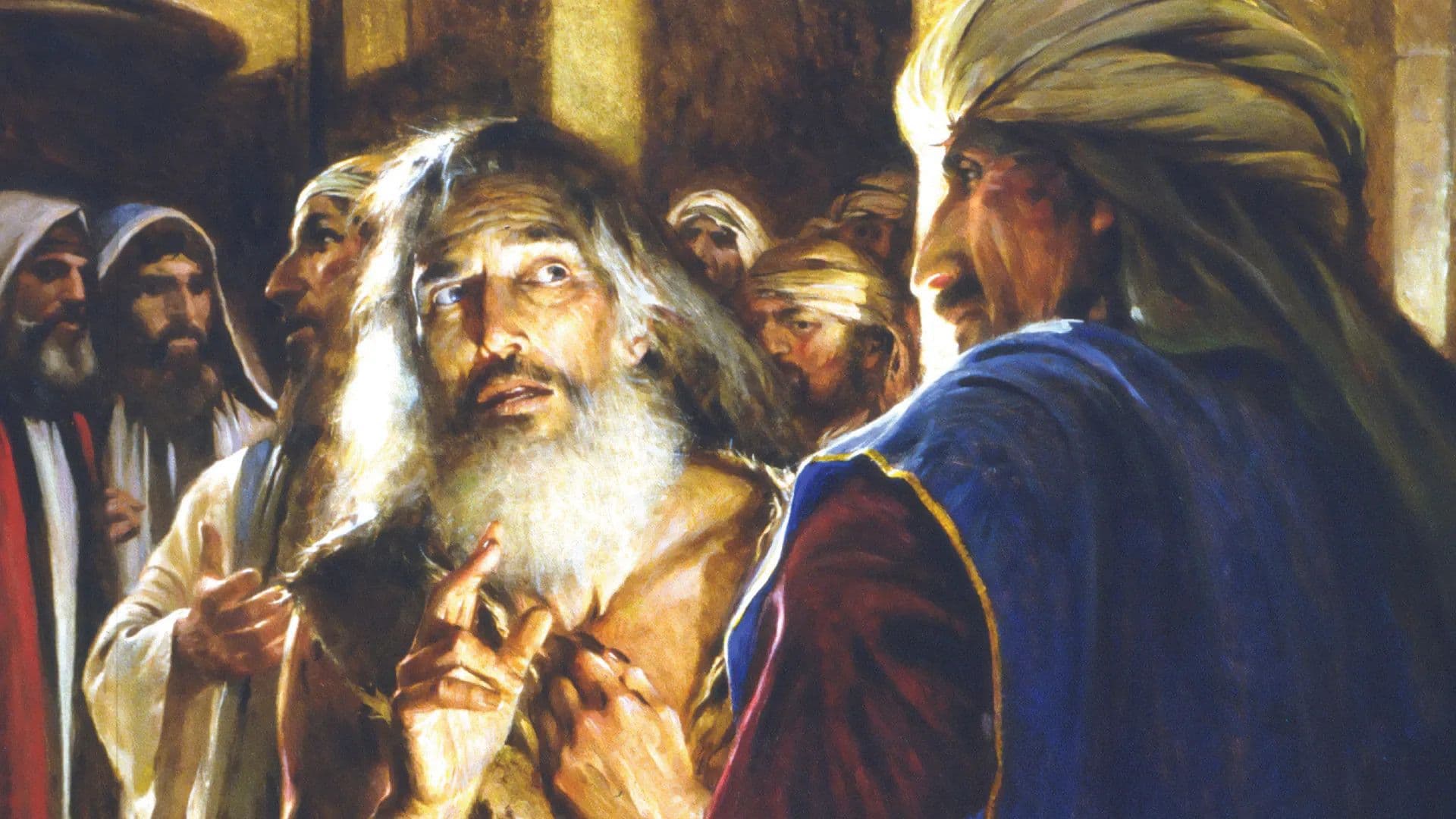
Jeremiah 1-3, 7, 16-18, 20
“Before I Formed Thee in the Belly I Knew Thee”
October 19 - October 25
scriptures
quotes
Your Foreordination
<p>Why does it matter to seek to know and understand your foreordination? In a day when questions abound, when so many seek to know their true identity, the fact that God knows and has blessed each one of us individually before we were ever born on this earth with “essential characteristic[s] of … premortal, mortal, and eternal identity and purpose” brings sweet peace and assurance to our mind and heart. Knowing who you are begins with understanding God’s foreordained blessings bestowed upon you before you were ever born on this earth. Our Heavenly Father desires to reveal to you your personal foreordination, and He will do so as you seek to learn and follow His will (Jeremiah 1:5).</p>
Steven R. Bangerter, “Foreordained to Serve,” April 2024 General Conference
The Calling of a Prophet
<p>Do you think it is difficult to be a prophet? As you read the scriptures, you cannot help but be impressed with the fact that the calling of a prophet is a most difficult assignment. In fact, you will be astonished to find that when some of the prophets first received their callings they pleaded with the Lord not to send them forth. This was the case with Moses, who said, ". . . they will not believe me . . . I am not eloquent" (Ex. 4:1,10). This was the case with Moses, who said, ". . . all the people hate me; for I am slow of speech; wherefore am I thy servant?" (Moses 6:31). And this was also the case with Jeremiah, who said, ". . . behold, I cannot speak: for I am a child" (Jer. 1:6).</p> <p>These men felt incapable. They felt there were others who would be more readily accepted. But in spite of their own feelings to the contrary, they went forth and delivered their messages because God had called them.</p> <p>The same principle applied when Jesus selected his twelve apostles. He said to them, "Ye have not chosen me, but I have chosen you, and ordained you" (John 15:16).</p> <p>And here's the clue to the way prophets are raised up!</p> <p>In the holy writ you will not find a single instance where God ever selected a professional holy man to be one of his prophets. In every case, the came like a bolt out of the blue, often to men who considered themselves weak and incapable, and were amazed that God should honor them with revelation and a prophetic calling.</p>
Paul H. Dunn, “Living Prophets for Our Generation”, October 1969 General Conference
commentaries
Introduction to Jeremiah
<h1>Historical Context</h1> <p>Jeremiah was a prophet during the end of the seventh century and the beginning of the sixth century BC. He served in Jerusalem during the reigns of five Judahite kings: Josiah, Jehoahaz, Jehoiakim, Jehoiachin, and Zedekiah (approximately from 627 to 580 BC). He was a contemporary of Lehi (see 1 Nephi 5:13); therefore, he was ministering when King Josiah was killed by Pharaoh Necho in 609 BC (2 Kings 23:29) when Babylon defeated the Egyptians, who were helping the defeated Assyrians, thereby taking control of the land in 605 BC (Jeremiah 46:2). Nebuchadnezzar had become king of Babylon in 604 BC, meaning he was king when Jerusalem was besieged in 597 BC (2 Kings 24:10) and eventually destroyed in 586 BC.<a href="#_ftn1" name="_ftnref1">[1]</a></p> <p> </p> <p><a href="#_ftnref1" name="_ftn1">[1]</a> Some commentaries say 587 BC.</p> <p> </p> <p><strong>Author:</strong> Noé Correa<br /><strong>General Editor:</strong> Taylor Halverson<br /><strong>Associate Editor:</strong> Morgan Tanner<br /><strong>Senior Editor:</strong> Sarah Whitney Johnson<br /><strong>Assistant Editor:</strong> Sam Lofgran<br /><strong>Assistant Editor:</strong> Verlanne Johnson</p>
Old Testament Minute: Jeremiah by BMC
Jeremiah 1:7–10
<p>The Lord gently reproved Jeremiah for his lack of confidence. The call to preach to all and to speak whatsoever he is commanded was an invitation to take courage and trust in the Lord. Church callings can be challenging at times and may appear to be beyond our talents. Just as the Lord blessed Jeremiah’s mouth to give him words, so too the Lord can bless us with the necessary tools and talents to serve with all of our heart, mind, might, and soul. Jeremiah was then told that he had been placed “over the nations and over the kingdoms,” which could have been overwhelming. The Lord’s next words offer a plan for the prophet; the Lord not only gave Jeremiah a calling but also provided him with general instructions. Jeremiah was to begin with the difficult, and perhaps harsh, tasks: he was told to “root out,” “pull down,” “destroy,” and “throw down.” After the bringing down of sin would come the lifting up of righteousness. Jeremiah was then “to build, and to plant.” In all our callings, we too are to build and plant unto the Lord. Building implies strengthening those we serve, and planting may imply sowing the seeds of faith and testimony.</p> <p> </p> <p><strong>Author:</strong> Noé Correa<br /><strong>General Editor:</strong> Taylor Halverson<br /><strong>Associate Editor:</strong> Morgan Tanner<br /><strong>Senior Editor:</strong> Sarah Whitney Johnson<br /><strong>Assistant Editor:</strong> Sam Lofgran<br /><strong>Assistant Editor:</strong> Verlanne Johnson</p>
Old Testament Minute: Jeremiah by BMC
Jeremiah 1:11–16
<p>The prophet sees two visions. The first consists of a wordplay; a better English translation for “I will hasten” in verse 12 is “I am watching.” In the original Hebrew, the word for “almond” (<em>shaqed</em>) sounds very similar to the word for “watching” (<em>shoqed</em>;<a href="#_ftn1" name="_ftnref1">[1]</a> “hasten” in the King James Version). The message here is that the Lord is watching, awaiting fulfillment of His divine mandates.<a href="#_ftn2" name="_ftnref2">[2]</a> The second vision consisted of a boiling pot that faced north. Babylon was in the north (northeast, specifically) and would be coming to execute judgment (Jeremiah 52). Ancient Israelites held a true fear of having “all the families of the kingdoms of the north” inhabit their land. Anciently, everyone had their own land (and their own god, for that matter; see 2 Kings 5:17). When the Northern Kingdom of Israel was overcome by Assyria in 721 BC, their land was inhabited by non-Israelites (2 Kings 17:30–31). It would spell disaster were Jerusalem to suffer the same fate.<a href="#_ftn3" name="_ftnref3">[3]</a> </p> <p> </p> <p><a href="#_ftnref1" name="_ftn1">[1]</a> See John Bright, trans., <em>Jeremiah</em>, 2nd ed. (Garden City, NY: Doubleday, 1981), 5, 7.</p> <p><a href="#_ftnref2" name="_ftn2">[2]</a> Compare Genesis 1:4, 10, 12, 18, 21, 25, 31.</p> <p><a href="#_ftnref3" name="_ftn3">[3]</a> This may be comparable to the Saints’ fear of the “gentiles” who would reach Utah after the completion of the railroad system in 1869. The principal reason why President Brigham Young had the Zion’s Cooperative Mercantile Institution organized on October 24, 1868, was to mitigate the merchandise brought by train that might be tempting to the Saints. See Thomas G. Alexander, <em>Things in Heaven and Earth: The Life and Times of Wilford Woodruff, a Mormon Prophet</em> (Salt Lake City, UT: Signature Books, 1993), 207; Devery S. Anderson, <em>Salt Lake School of the Prophets, 1867–1883</em> (Salt Lake City, UT: Signature Books, 2018), loc. 1491 of 16087, Kindle.</p> <p> </p> <p><strong>Author:</strong> Noé Correa<br /><strong>General Editor:</strong> Taylor Halverson<br /><strong>Associate Editor:</strong> Morgan Tanner<br /><strong>Senior Editor:</strong> Sarah Whitney Johnson<br /><strong>Assistant Editor:</strong> Sam Lofgran<br /><strong>Assistant Editor:</strong> Verlanne Johnson</p>
Old Testament Minute: Jeremiah by BMC
Jeremiah 1:17–19
<p>The focus of the text then returns to the prophet’s call, written as a chiasm. The section begins with Jeremiah’s call, moving on to the two visions, then returning to the prophet’s mission. The invitation was for Jeremiah to arise and boldly speak the words of the Lord. Jeremiah may represent the city of Jerusalem: just as Babylon would attack the city, Jeremiah would be attacked by the people of Judah, including their kings, princes, and priests. The prophet received the promise that the Lord would abide with him. Such is the case for those who serve faithfully (see Matthew 28:19–20).</p> <p> </p> <p><strong>Author:</strong> Noé Correa<br /><strong>General Editor:</strong> Taylor Halverson<br /><strong>Associate Editor:</strong> Morgan Tanner<br /><strong>Senior Editor:</strong> Sarah Whitney Johnson<br /><strong>Assistant Editor:</strong> Sam Lofgran<br /><strong>Assistant Editor:</strong> Verlanne Johnson</p>
Old Testament Minute: Jeremiah by BMC