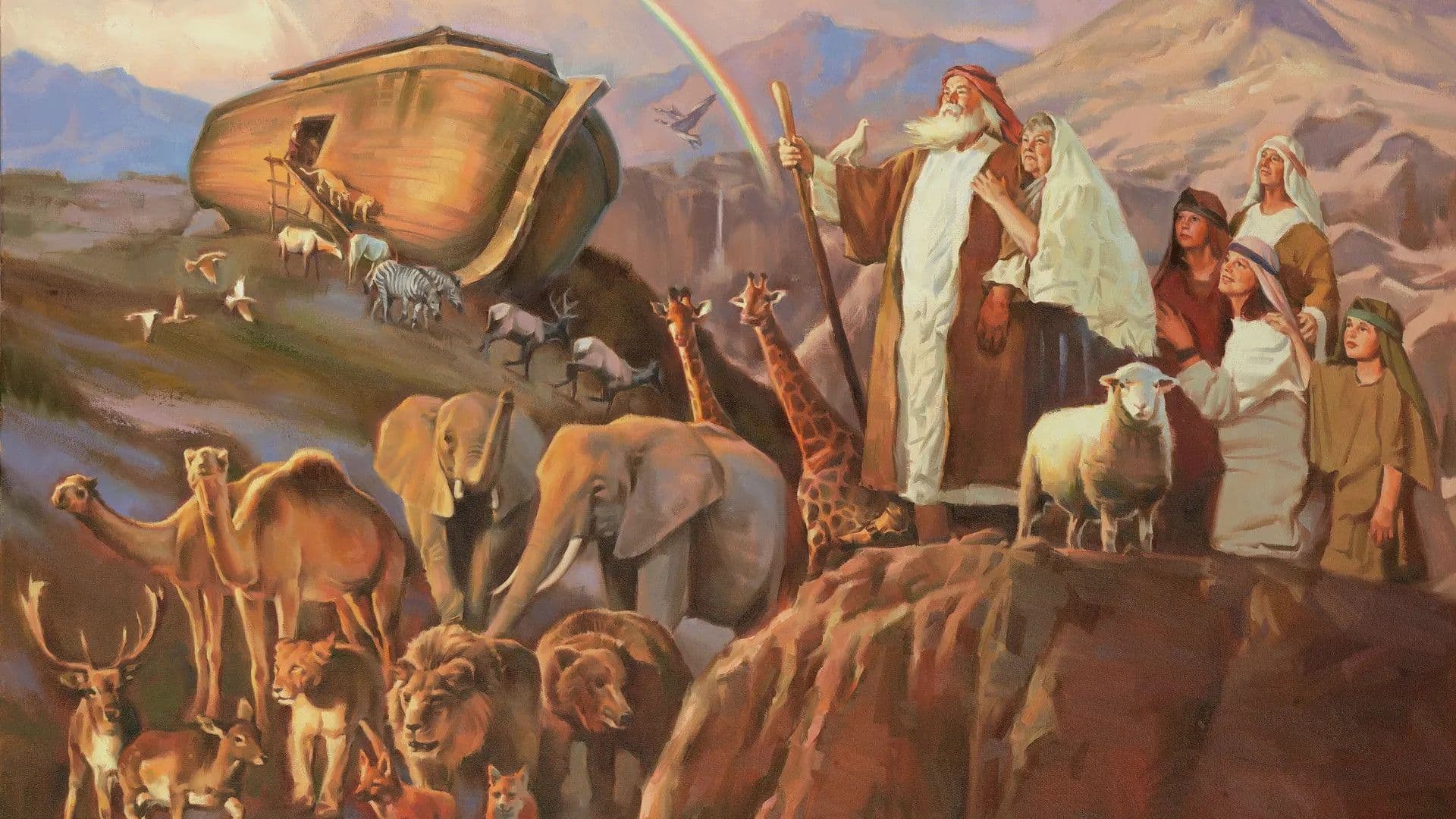
Genesis 6-11; Moses 8
“Noah Found Grace in the Eyes of the Lord”
February 9 - February 15
scripture
commentaries
Moses 8:25–26
<p>This revision of the King James Version of Genesis 6:6 (“it repented the Lord”) most likely reflects the Prophet Joseph Smith’s desire to avoid confusion over the connotation of the English word <em>repent</em> and any attending misapprehension about some supposed need on God’s part to repent for any wrongdoing. An archaic, obsolete meaning of <em>repent</em> captured in the King James Version is “to feel regret,” and this is indeed reflected in the underlying Hebrew (<em>nḥm</em>) of this verse (that is, God regretted or sorrowed at His creating humanity because of their abject sinfulness). As revised here, it is Noah who grieves over the depraved condition of humanity, which God acknowledges. The added detail that these wicked people sought Noah’s life heightens the tension of the story and provides additional justification for God’s decision to terminate humanity.</p>
Pearl of Great Price Study Edition by Stephen O. Smoot
Moses 8:27
<p>Noah is both “just” and “perfect” in his generation. These two terms in Hebrew (<em>ṣadiq</em> and <em>timam</em>) denote a sense of moral uprightness and personal integrity (but not necessarily a sense of absolute sinlessness or being free from any mortal flaw or shortcoming). Here, however, these terms take on new Christological and soteriological significance in light of the text depicting Noah as having accepted and taught the gospel of Jesus Christ as revealed to Adam and Enoch. By virtue of his righteousness and responsiveness to God’s calling, Noah finds grace or favor (<em>ḥēn</em>) in the eyes of the Lord.</p>
Pearl of Great Price Study Edition by Stephen O. Smoot
The Sons of Men Mock Noah and Refuse His Teaching
<p><strong>8:20. “Noah called upon the children of men that they should repent.”</strong> Calling people to repentance was required by ancient biblical law “in order to establish intentionality and the degree of criminal responsibility. Their refusal to heed the call defines the degree of the criminal responsibility of the antediluvian sinners, and, consequently, the justice of their punishment.”<a href="#_ftn1" name="_ftnref1">[1]</a></p> <p><strong>8:21. “we are the sons of God; have we not taken unto ourselves the daughters of men?”</strong> In sarcastically designating their wives “daughters of men,” these puffed-up sons of men are deliberately deprecating the former status of these women as “daughters of thy sons” (verse 15)—meaning daughters of the sons of Noah, who were in reality sons of God (see verse 13). In brief, the light-minded jesting of these men turns the real situation upside down. They, the sons of men, make themselves out to be the sons of God while dishonoring their wives—the daughters of the sons of God—by characterizing them as the daughters of men.</p> <p><strong>8:21. “eating and drinking, and marrying and giving in marriage.”</strong> This phrase “conveys a sense of both normalcy and prosperity”<a href="#_ftn2" name="_ftnref2">[2]</a>—both conditions of the mindset of the worldly in the time of Noah and in the last days (Matthew 24:37–39). Frederick Dale Bruner perceptively observed, “One of the most surprising facts in Jesus’ end-time teaching now is that the last times will be normal. According to this passage, there will be parties, gourmet meals, courtships, and weddings right into the cataclysmic coming of the Son of Man. . . . That is instructive. The Great Tribulation occurs while superficially all seems well. To the unobservant, it’s party time.”<a href="#_ftn3" name="_ftnref3">[3]</a></p> <p><strong>8:21. “our wives bear unto us children.” </strong>Having been told that all mankind would be destroyed if they did not repent, these “sons of men” who styled themselves “sons of God” are said in rabbinic sources to have defiantly replied, “If this is the case, we will stop human reproduction and multiplying, and thus put an end to the lineage of the sons of men ourselves.”<a href="#_ftn4" name="_ftnref4">[4]</a></p> <p><strong>8:21; 6:4. “mighty men, which are like unto men of old, men of great renown.”</strong> Parallel phrases in Genesis 6:4 read more literally in Hebrew: “the <em>gibborim</em> that are of old, the men of the name (<em>ha-shem</em>).” Perhaps the mention of the “mighty men . . . of old” refers to the <em>gibborim</em> of Enoch’s day. It also anticipates the person of Nimrod and the group who will build the Tower of Babel in Genesis 11.</p> <p> </p> <p><a href="#_ftnref1" name="_ftn1">[1]</a> Devorah Dimant, “Noah in Early Jewish Literature,” in<em> Biblical Figures Outside the Bible</em>, ed. Michael E. Stone and Theodore A. Bergren (Harrisburg, PA: Trinity Press International, 1998), 132.</p> <p><a href="#_ftnref2" name="_ftn2">[2]</a> Richard D. Draper, S. Kent Brown, and Michael D. Rhodes, <em>The Pearl of Great Price: A Verse-by-Verse Commentary</em> (Salt Lake City, UT: Deseret Book, 2005), 168.</p> <p><a href="#_ftnref3" name="_ftn3">[3]</a> Frederick Dale Bruner, <em>Matthew: A Commentary</em>, vol. 2 of 2, <em>The Churchbook, Matthew 13–28</em>, rev. ed. (Grand Rapids, MI: Eerdmans, 2004), 524.</p> <p><a href="#_ftnref4" name="_ftn4">[4]</a> Jeffrey M. Bradshaw and David J. Larsen, <em>In God's Image and Likeness 2: Enoch, Noah, and the Tower of Babel</em>, 2 vols. (Orem, UT: Interpreter Foundation; Salt Lake City, UT: Eborn Books, 2014), 230.</p> <p> </p> <p><strong>Author:</strong> Jeffrey M. Bradshaw<br /><strong>General Editor:</strong> Taylor Halverson<br /><strong>Associate Editor:</strong> Morgan Tanner<br /><strong>Senior Editor:</strong> Sarah Whitney Johnson<br /><strong>Assistant Editor:</strong> Verlanne Johnson</p>
Old Testament Minute: Genesis by BMC
The Earth Is Corrupt and Will Be Destroyed
<p><strong>8:28; 6:11. “corrupt.”</strong> “The key Hebrew stem <em>sh-h-t</em> occurs seven times in the [Noah] narrative.”<a href="#_ftn1" name="_ftnref1">[1]</a> “In order to grasp the full significance of the verb <em>sahath</em> here, we must bear in mind the words of Jeremiah 18:3–4 concerning the potter: ‘So I went down to the potter’s house, and there he was working at his wheel. And the vessel he was making of clay was spoiled.’ The material did not receive the form that the potter wished to give it; it assumed another shape and the vessel was spoiled in his hand. Then the potter changed the material back into a shapeless mass, and made of it another vessel in accordance with his desire.”<a href="#_ftn2" name="_ftnref2">[2]</a></p> <p><strong>8:28; 6:11. “violence.”</strong> The Hebrew term <em>hamas</em> corresponds to synonyms such as “‘falsehood,’ ‘deceit,’ or ‘bloodshed.’ It means, in general, the flagrant subversion of the ordered processes of law.”<a href="#_ftn3" name="_ftnref3">[3]</a> This description starkly contrasts the just conduct of Noah (see Moses 7:27; Genesis 6:9). Leon Kass described the deplorable state of Noah’s world, which is (according to the Gospels—Matthew 24:37) the same state we are in today:</p> <blockquote> <p>Self-conscious men . . . betake themselves to war and to beautiful (but not good) women, seeking recognition for their superhuman prowess. Whether from rage over mortality, from jealousy and resentment, or from a desire to gain favor from beautiful women, or to avenge the stealing of their wives and daughters, proud men are moved to the love of glory, won in bloody battle with one another. The world erupts into violence, the war of each against all. What ensues is what [English philosopher Thomas] Hobbes would later call ‘the state of nature,’ that is, the state characterized by absence of clear juridical power and authority, in which the life of man is nasty, brutish, and—through violence—short. Bloody destruction covers the earth.<a href="#_ftn4" name="_ftnref4">[4]</a></p> </blockquote> <p><strong>8:30; 6:13. “God said unto Noah.”</strong> In Mesopotamian accounts of the Flood, the supreme god consults only with his divine assembly about the Flood, and the hero learns about the impending destruction only when one of the lesser gods covertly conveys the secret to him. Here, however, the most high God decides to make Noah aware of His intentions and speaks directly to him. Because the order to board the ark seems to have occurred forty days after the New Year, it is reasonable to suppose that this first communication occurred on the first day of the New Year.<a href="#_ftn5" name="_ftnref5">[5]</a></p> <p><strong>8:30; 6:13. “destroy all flesh from off the earth.”</strong> The Hebrew verb for “destroy” (<em>mashitam</em>) is “identical with the one used three times above in the sense of ‘corrupt’ and so inscribes a pattern of measure for measure.”<a href="#_ftn6" name="_ftnref6">[6]</a> What humankind has ruined, God will obliterate. <em>Mashitam</em> is sometimes translated “wipe out” or “blot out” because, according to Gordon J. Wenham, “it is used of erasing names from records (e.g., Exodus 17:14; 32-32-33) and wiping plates (2 Kings 21:13). Since water was sometimes used for achieving this result (Numbers 5:23), the very word chosen perhaps hints at how the complete annihilation of [humankind] will be secured.”<a href="#_ftn7" name="_ftnref7">[7]</a></p> <p> </p> <p><a href="#_ftnref1" name="_ftn1">[1]</a> Nahum M. Sarna, <em>Genesis</em>: <em>The Traditional Hebrew Text with the New JPS Translation Commentary</em>, The JPS Torah Commentary, ed. Nahum M. Sarna and Chaim Potok (Philadelphia, PA: Jewish Publication Society, 1989), 51.</p> <p><a href="#_ftnref2" name="_ftn2">[2]</a> Umberto Cassuto, <em>A Commentary on the Book of Genesis</em>, vol. 2, <em>From Noah to Abraham</em>, trans. Israel Abrahams (Jerusalem, Israel: Magnes Press, 1997), 53.</p> <p><a href="#_ftnref3" name="_ftn3">[3]</a> Sarna, <em>Genesis</em>, 51.</p> <p><a href="#_ftnref4" name="_ftn4">[4]</a> Leon R. Kass, <em>The Beginning of Wisdom: Reading Genesis</em> (New York, NY: Free Press, 2003), 162.</p> <p><a href="#_ftnref5" name="_ftn5">[5]</a> Cassuto, <em>Commentary on the Book of Genesis</em>, 2:71. Cassuto wrote: “Possibly the ancient poetic tradition related that the first Divine communication came to Noah on the first day of the first month, and that his work on the construction and equipment of the ark lasted forty days, corresponding to the periods mentioned later in our section ([Genesis] 7:4, 12, 17; 8:6). This would be in keeping with what becomes evident a little later, namely, that also according to the Bible the date of the second communication, which came to Noah at the end of his work, was the tenth day of the second month, that is, forty days after the commencement of the year.” This agrees with the conclusion of Sarna, <em>Genesis</em>, 51.</p> <p><a href="#_ftnref6" name="_ftn6">[6]</a> Robert Alter, <em>The Five Books of Moses: A Translation with Commentary</em> (New York, NY: W. W. Norton, 2004), 41n13.</p> <p><a href="#_ftnref7" name="_ftn7">[7]</a> Gordon J. Wenham, <em>Genesis 1–15</em>, Word Biblical Commentary 1 (Waco, TX: Word Books, 1987), 145.</p> <p> </p> <p><strong>Author:</strong> Jeffrey M. Bradshaw<br /><strong>General Editor:</strong> Taylor Halverson<br /><strong>Associate Editor:</strong> Morgan Tanner<br /><strong>Senior Editor:</strong> Sarah Whitney Johnson<br /><strong>Assistant Editor:</strong> Verlanne Johnson</p>
Old Testament Minute: Genesis by BMC