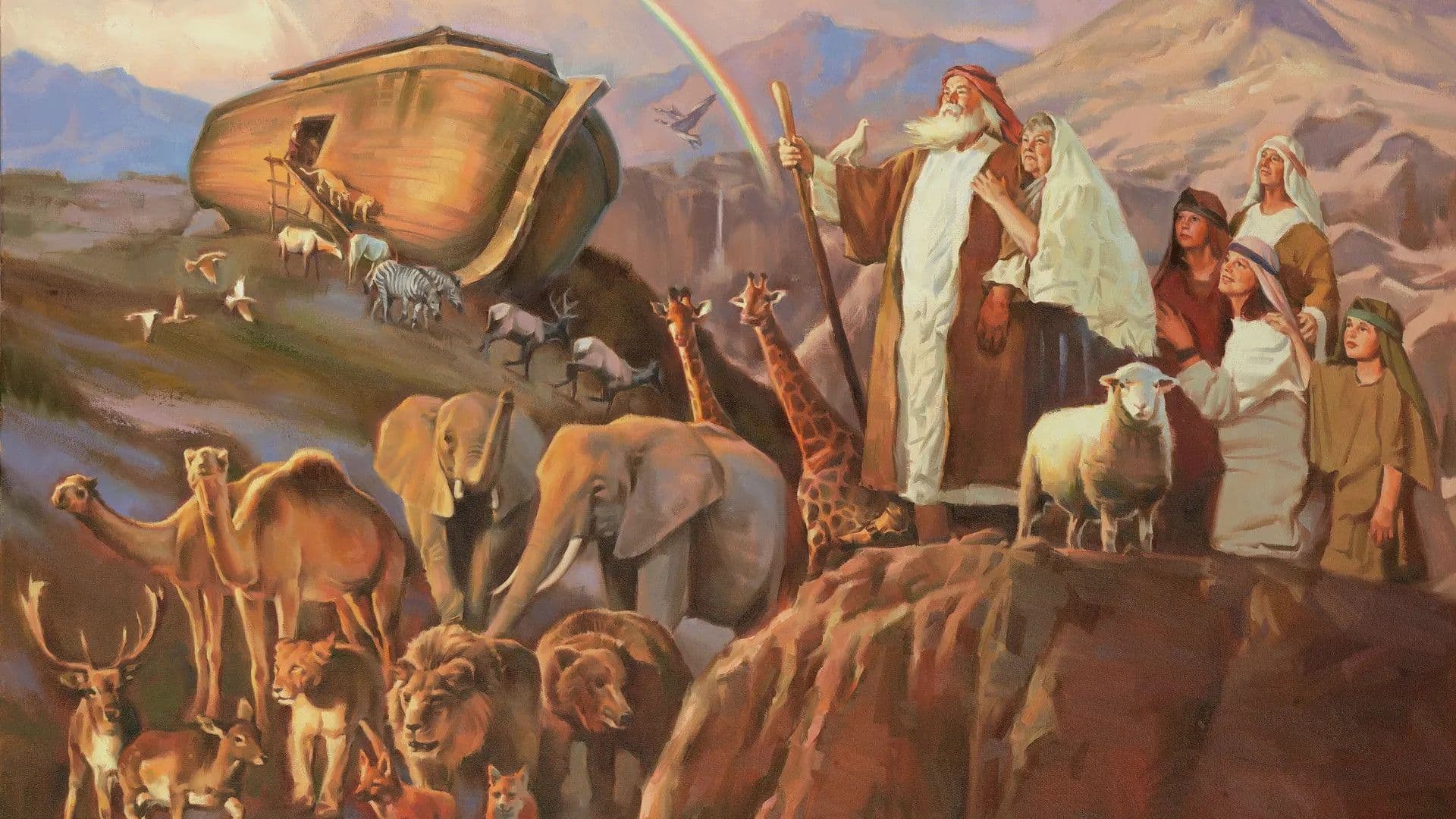
Genesis 6-11; Moses 8
“Noah Found Grace in the Eyes of the Lord”
February 9 - February 15
scripture
commentaries
The Waters Decrease and the Ark Rests
<p><strong>8:1. “God remembered Noah.”</strong> The phrase “God remembered Noah” does not imply that Noah had ever been forgotten. In fact, it might be better to translate the phrase as “God had <em>not</em> forgotten Noah.” Genesis scholar Nahum Sarna explained, “In the Bible, ‘remembering,’ particularly on the part of God, is not the retention or recollection of a mental image, but a focusing upon the object of memory that results in action.”<a href="#_ftn1" name="_ftnref1"><sup>[1]</sup></a> Often it occurs in the context of a covenant-related action. Having “remembered” Noah, God sent a wind that dried the waters so his family could come out on dry ground, just as in having “remembered” Israel, God sent a wind so the children of Israel could cross the Red Sea on dry ground (see Exodus 14:21).<a href="#_ftn2" name="_ftnref2"><sup>[2]</sup></a></p> <p><strong>8:1. “a wind to pass over the earth, and the waters assuaged.”</strong> In ancient Hebrew, the movement of air and the movement of the divine spirit are described by the same word: <em>ruach</em>. Here as in the story of Creation, the <em>ruach</em> “indicates the beginning of new life.”<a href="#_ftn3" name="_ftnref3"><sup>[3]</sup></a> “As the waters are the symbol of chaos, the undoing of Creation, so the movement of the wind . . . heralds the reimposition of order.”<a href="#_ftn4" name="_ftnref4"><sup>[4]</sup></a></p> <p><strong>8:4. “the ark rested.”</strong> The Hebrew text (<em>va-tanach</em>, “and she rested”) describes the ark’s final landing in terms of rest, reminding us of the verb that underlies Noah’s name.<a href="#_ftn5" name="_ftnref5"><sup>[5]</sup></a> According to the calendar in <em>Jubilees</em>,<a href="#_ftn6" name="_ftnref6"><sup>[6]</sup></a> this was a Friday—thus, the ark came to its rest just in time for the Sabbath.<a href="#_ftn7" name="_ftnref7"><sup>[7]</sup></a></p> <p><strong>8:4. “mountains of Ararat.”</strong> A prominent mountain in Turkey is identified in Christian tradition as Mount Ararat.<a href="#_ftn8" name="_ftnref8"><sup>[8]</sup></a> This identification, however, is incorrect. The Bible does not refer to a summit called Ararat but to “the mountains of Ararat,” and this proper name refers to the kingdom of Urartu.<a href="#_ftn9" name="_ftnref9">[9]</a> Ancient Jewish authors and early Bible translators understood there was no mountain called Ararat. There are many conflicting traditions, and none seem highly reliable.</p> <p>Looking for the answer in a different direction, Elizabeth Harper suspected the name may be a wordplay. “Ararat” evokes the Hebrew term <em>arar</em>, which means “to curse.” Does the ark—which contains Noah (the one to relieve the world of the curse) and whose name evokes temple and atonement—now bring rest upon Mount Cursed? The observant Israelite might even note that the landing of the ark takes place seven days after the Day of Atonement.<a href="#_ftn10" name="_ftnref10">[10]</a></p> <p>Going further, ancient Israelites thought the holiest spot on earth was the foundation stone in front of the ark of the covenant at the Jerusalem temple because they believed “it was the first solid material to emerge from the waters of Creation, and it was upon this stone that the Deity effected Creation.”<a href="#_ftn11" name="_ftnref11">[11]</a> The depiction of the ark/temple of Noah perched upon Mount Ararat would have evoked similar temple imagery for ancient readers of the Bible.</p> <p><strong>8:6. “at the end of forty days.” </strong>“If this is not a round number, it makes Noah start work on a Sunday, the day after the Sabbath.”<a href="#_ftn12" name="_ftnref12"><sup>[12]</sup></a></p> <p><strong>8:6. “Noah opened the window of the ark.” </strong>God expected Noah to act for himself in finding out whether the earth was ready for him and his family to leave the boat.</p> <p> </p> <p><a href="#_ftnref1" name="_ftn1">[1]</a> Nahum M. Sarna, <em>Genesis: The Traditional Hebrew Text with the New JPS Translation Commentary</em>, The JPS Torah Commentary, ed. Nahum M. Sarna and Chaim Potok (Philadelphia, PA: Jewish Publication Society, 1989), 56. Compare Genesis 19:29, 30:22; Exodus 2:24, 6:5.</p> <p><a href="#_ftnref2" name="_ftn2">[2]</a> John H. Sailhamer, “Genesis,” in <em>The Expositor's Bible Commentary</em>, ed. Frank E. Gaebelein (Grand Rapids, MI: Zondervan, 1990), 89.</p> <p><a href="#_ftnref3" name="_ftn3">[3]</a> Umberto Cassuto, <em>A Commentary on the Book of Genesis</em>, vol. 2, <em>From Noah to Abraham</em>, trans. Israel Abrahams (Jerusalem, Israel: Magnes Press, 1998), 101.</p> <p><a href="#_ftnref4" name="_ftn4">[4]</a> Sarna, <em>Genesis</em>, 56.</p> <p><a href="#_ftnref5" name="_ftn5">[5]</a> Richard S. Hess, <em>Studies in the Personal Names of Genesis 1–11</em> (Winona Lake, IN: Eisenbrauns, 2009), 28. See Jeffrey M. Bradshaw, <em>In God's Image and Likeness 1: Creation, Fall, and the Story of Adam and Eve</em>, rev. ed., 2 vols. (Salt Lake City, UT: Eborn Books, 2014), 246nM8–16.</p> <p><a href="#_ftnref6" name="_ftn6">[6]</a> James C. VanderKam, ed. and trans., <em>The Book of Jubilees: A Critical Text </em>(Leuven, Belgium: Peeters, 1989), 36, Jubilees 5:27–28.</p> <p><a href="#_ftnref7" name="_ftn7">[7]</a> Gordon J. Wenham, <em>Genesis 1–15</em>, <em>Word Biblical Commentary 1</em> (Waco, TX: Word Books, 1987), 184.</p> <p><a href="#_ftnref8" name="_ftn8">[8]</a> See Richard Neitzel Holzapfel, Dana M. Pike, and David Rolph Seely, <em>Jehovah and the World of the Old Testament</em> (Salt Lake City, UT: Deseret Book, 2009), 27.</p> <p><a href="#_ftnref9" name="_ftn9">[9]</a> Compare Jeremiah 51:27. See also 2 Kings 19:37; Isaiah 37:38.</p> <p><a href="#_ftnref10" name="_ftn10">[10]</a> See Elizabeth A. Harper, “It's All in the Name: Reading the Noah Cycle in the Light of Its Plot Markers,” in <em>Opening Heaven’s Floodgates: The Genesis Flood Narrative, its Context, and Reception</em>, ed. Jason M. Silverman (Piscataway, NJ: Gorgias Press, 2013), 49–74.</p> <p><a href="#_ftnref11" name="_ftn11">[11]</a> John M. Lundquist, <em>The Temple: Meeting Place of Heaven and Earth</em> (London, England: Thames and Hudson, 1993), 7.</p> <p><a href="#_ftnref12" name="_ftn12">[12]</a> Wenham, <em>Genesis 1–15</em>, 186.</p> <p> </p> <p><strong>Author:</strong> Jeffrey M. Bradshaw<br /><strong>General Editor:</strong> Taylor Halverson<br /><strong>Associate Editor:</strong> Morgan Tanner<br /><strong>Senior Editor:</strong> Sarah Whitney Johnson<br /><strong>Assistant Editor:</strong> Verlanne Johnson</p>
Old Testament Minute: Genesis by BMC
The Dove Is Sent Forth
<p><strong>8:8. “he sent forth a dove.” “</strong>The dove . . . is a symbol of beauty and gentleness, integrity and friendship. Time and again the maiden in the Song of Songs is called ‘my dove’ or ‘my dove, my perfect one’ (Song of Solomon 2:14; 5:2; 6:9); and her eyes and the eyes of the youth are compared to doves (Song of Solomon 1:15; 4:1; 5:12).”<a href="#_ftn1" name="_ftnref1"><sup>[1]</sup></a> A “phonetic affinity”<a href="#_ftn2" name="_ftnref2"><sup>[2]</sup></a> can be found between the name Noah (<em>noach</em>) and the word for <em>dove</em> (<em>hayyonah</em>). On her first trip from the ark, the dove found “no rest [<em>manoah</em>] for the sole of her foot” (Moses 8:9). When the dove brought the olive leaf back after her second journey, however, the leaf “rested” in her beak.<a href="#_ftn3" name="_ftnref3"><sup>[3]</sup></a> In contrast to the black, unclean raven, the dove “is white, a clean animal often used in sacrifice (e.g., Leviticus 1:14, 12:6). Like other sacrificial animals, it is sometimes seen as a symbol of Israel (Hosea 7:11, 11:11) and therefore within this story it is an ideal representative of Noah himself.”<a href="#_ftn4" name="_ftnref4"><sup>[4]</sup></a></p> <p><strong>8:9. “no rest for the sole of her foot.” </strong>Claus Westermann takes this phrase to mean that “not even the tiniest resting place”<a href="#_ftn5" name="_ftnref5"><sup>[5]</sup></a> was available for the bird—another instance of the theme of rest in Noah’s story.</p> <p><strong>8:9. “the waters were on the face of the whole earth.”</strong> Hugh Nibley explains, “From where [Noah] was, ‘the whole earth’ was covered with water as far as he could see; after things had quieted down for 150 days and the Ark ground to a halt, it was still three months before he could see any mountain tops. But what were conditions in other parts of the world? If Noah knew that, he would not have sent forth messenger birds to explore. The flood as he described it is what he saw of it.”<sup> <a href="#_ftn6" name="_ftnref6">[6]</a></sup></p> <p><strong>8:9. “he put forth his hand.”</strong> “This is the second reference in Genesis to putting forth one’s hand to take hold of something. Noah’s hand is stretched forth to offer refuge to one of God’s creatures. Earlier God had seen the possibility that [Adam and Eve] would ‘put forth [their] hand and take also of the tree of life’ (Moses 4:28 [see also Genesis 3:22]).”<a href="#_ftn7" name="_ftnref7"><sup>[7]</sup></a></p> <p><strong>8:11. “in the evening.”</strong> “That is, when birds customarily return to their nests. The note implies that the dove had been out all day, signifying the availability of resting places.”<a href="#_ftn8" name="_ftnref8"><sup>[8]</sup></a></p> <p><strong>8:11. “an olive leaf.”</strong> Genesis scholar Umberto Cassuto explained that the dove brought Noah “good tidings, in the form possible to a creature that cannot speak.”<a href="#_ftn9" name="_ftnref9"><sup>[9]</sup></a> Nahum Sarna discussed the symbolism of the olive tree:</p> <blockquote> <p>The olive tree, one of the earliest to be cultivated in the Near East, is an evergreen. It is extraordinarily sturdy and may thrive up to a thousand years. Thus it became symbolic of God’s blessings of regeneration, abundance, and strength, which is most likely the function it serves here. In the present context the olive branch is invested with the idea of peace and reconciliation, and for this reason it was incorporated into the official emblem of the State of Israel.<sup> <a href="#_ftn10" name="_ftnref10">[10]</a></sup></p> </blockquote> <p>The scenes following the Flood conjure up memories of the story of Adam and Eve. Though analogs to the tree of life and the tree of knowledge are not explicitly mentioned in the description ark’s landing, an olive tree (a possible analog) is implied in the story when the dove returns with an olive branch. Multiple texts associate the olive tree with the Garden of Eden. For example, ancient traditions recount that on his sickbed, Adam requested that Eve and Seth return to the garden to retrieve oil—presumably olive oil—from the “tree of his mercy.”<a href="#_ftn11" name="_ftnref11"><sup>[11]</sup></a> In reference to the dove that brought Noah the olive branch, one rabbinical opinion states that the “gates of the garden of Eden opened for the dove, and from there she brought it.”<a href="#_ftn12" name="_ftnref12"><sup>[12]</sup></a></p> <p><strong>8:11. “plucked off.”</strong> “The rare noun <em>taraf</em> connotes that [the branch] was freshly removed from the tree and was not flotsam, a sure sign that plant life had begun to renew itself.”<a href="#_ftn13" name="_ftnref13"><sup>[13]</sup></a></p> <p> </p> <p><a href="#_ftnref1" name="_ftn1">[1]</a> Umberto Cassuto, <em>A Commentary on the Book of Genesis</em>, vol. 2, <em>From Noah to Abraham</em>, trans. Israel Abrahams (Jerusalem: Israel: Magnes Press, 1997), 108.</p> <p><a href="#_ftnref2" name="_ftn2">[2]</a> Gordon J. Wenham, <em>Genesis 1–15</em>, Word Biblical Commentary 1 (Waco, TX: Word Books, 1987), 186.</p> <p><a href="#_ftnref3" name="_ftn3">[3]</a> See Michael Maher, trans., <em>Targum Pseudo-Jonathan, Genesis</em>, The Aramaic Bible 1B (Collegeville, MN: Liturgical Press, 1992), 43; see also 43n11.</p> <p><a href="#_ftnref4" name="_ftn4">[4]</a> Wenham, <em>Genesis 1–15</em>, 186.</p> <p><a href="#_ftnref5" name="_ftn5">[5]</a> Claus Westermann, <em>Genesis 1–11: A Continental Commentary</em>, trans. John J. Scullion (Minneapolis, MN: Fortress Press, 1994), 448.</p> <p><a href="#_ftnref6" name="_ftn6">[6]</a> Hugh W. Nibley, “Before Adam,” in<em> Old Testament and Related Studies</em>, ed. John W. Welch, Gary P. Gillum and Don E. Norton, The Collected Works of Hugh Nibley 1 (Salt Lake City, UT: Deseret Book, 1986), 65–66.</p> <p><a href="#_ftnref7" name="_ftn7">[7]</a> Victor P. Hamilton, <em>The Book of Genesis: Chapters 1–17</em> (Grand Rapids, MI: Eerdmans, 1990), 305.</p> <p><a href="#_ftnref8" name="_ftn8">[8]</a> Nahum M. Sarna, <em>Genesis</em>: <em>The Traditional Hebrew Text with the New JPS Translation Commentary,</em> The JPS Torah Commentary, ed. Nahum M. Sarna and Chaim Potok (Philadelphia, PA: Jewish Publication Society, 1989), 58.</p> <p><a href="#_ftnref9" name="_ftn9">[9]</a> Cassuto, <em>From Noah to Abraham</em>, 111.</p> <p><a href="#_ftnref10" name="_ftn10">[10]</a> Sarna, <em>Genesis</em>, 58.</p> <p><a href="#_ftnref11" name="_ftn11">[11]</a> Gary A. Anderson and Michael Stone, eds., <em>A Synopsis of the Books of Adam and Eve</em>, 2nd ed. (Atlanta, GA: Scholars Press, 1999), 40, Latin 36:2.</p> <p><a href="#_ftnref12" name="_ftn12">[12]</a> Jacob Neusner, <em>Parashiyyot One through Thirty-Three on Genesis 1:1 to 8:14</em>, vol. 1 of <em>Genesis Rabbah: The Judaic Commentary to the Book of Genesis, A New American Translation</em> (Atlanta, GA: Scholars Press, 1985), 351. Others said the branch came from the Mount of Olives (see, for example, Maher, <em>Targum Pseudo-Jonathan</em>, 43).</p> <p><a href="#_ftnref13" name="_ftn13">[13]</a> Sarna, <em>Genesis</em>, 58.</p> <p> </p> <p><strong>Author:</strong> Jeffrey M. Bradshaw<br /><strong>General Editor:</strong> Taylor Halverson<br /><strong>Associate Editor:</strong> Morgan Tanner<br /><strong>Senior Editor:</strong> Sarah Whitney Johnson<br /><strong>Assistant Editor:</strong> Verlanne Johnson</p>
Old Testament Minute: Genesis by BMC
Noah Offers Sacrifice
<p><strong>8:20. “Noah builded an altar unto the Lord.”</strong> Noah’s first action on the renewed earth was building an altar for burnt offerings. In contrast to every major action Noah had performed previously,<a href="#_ftn1" name="_ftnref1"><sup>[1]</sup></a> he made the sacrifice without divine instruction. In scripture, this type of sacrifice is called a freewill offering.<a href="#_ftn2" name="_ftnref2"><sup>[2]</sup></a> It is foremost a means of rendering thanksgiving.</p> <blockquote> <p>When a person has been saved from a terrible danger, or has escaped from a general catastrophe, his first reaction is to give thanks to him who saved him or helped him to escape. And there could be no greater thanksgiving than these sacrifices. Of the few domestic animals and birds that constituted his sole, meagre possessions for the new period of his life in a world that is completely waste, Noah gave up several animals and birds in honor of his Divine Savior.<sup> <a href="#_ftn3" name="_ftnref3">[3]</a></sup></p> </blockquote> <p>In addition to describing Noah’s natural expression of thanks, the account portrays Noah as a new Adam, “reversing the estrangement” between God and man by means of this atoning sacrifice.<a href="#_ftn4" name="_ftnref4"><sup>[4]</sup></a></p> <p>Claus Westermann noted, “The sacrifice of Noah is one of those elements which occurs very often in the flood narratives, e.g., in the Babylonian, Greek, Phoenician, Indian stories. Ziusudra, Utnapishtim, Deucalion, Demarius, Manu, all offer sacrifice after they have been saved.”<sup> <a href="#_ftn5" name="_ftnref5">[5]</a></sup></p> <p> </p> <p><a href="#_ftnref1" name="_ftn1">[1]</a> That is, if we classify the sending forth of the birds as a minor action.</p> <p><a href="#_ftnref2" name="_ftn2">[2]</a> Leviticus 22:17–25; Numbers 15:1–11. See Victor P. Hamilton, <em>The Book of Genesis: Chapters 1–17</em> (Grand Rapids, MI: Eerdmans, 1990), 308.</p> <p><a href="#_ftnref3" name="_ftn3">[3]</a> Umberto Cassuto, <em>A Commentary on the Book of Genesis</em>, vol. 2, <em>From Noah to Abraham</em>, trans. Israel Abrahams (Jerusalem, Israel: Magnes Press, 1997), 117.</p> <p><a href="#_ftnref4" name="_ftn4">[4]</a> L. Michael Morales, <em>The Tabernacle Pre-Figured: Cosmic Mountain Ideology in Genesis and Exodus</em> (Leuven, Belgium: Peeters, 2012), 197; compare Florentino Garcia Martinez, ed., “Genesis Apocryphon (1QapGen ar),” in<em> The Dead Sea Scrolls Translated: The Qumran Texts in English, </em>trans. Wilfred G. E. Watson, 2nd ed. (Leiden, Netherlands; Brill; Grand Rapids, MI: Eerdmans, 1996), 231; James C. VanderKam, ed. and trans., <em>The Book of Jubilees: A Critical Text</em> (Leuven, Belgium: Peeters, 1989), 36, <em>Jubilees </em>6:2.</p> <p><a href="#_ftnref5" name="_ftn5">[5]</a> Claus Westermann, <em>Genesis 1–11: A Continental Commentary</em>, trans. John J. Scullion (Minneapolis, MN: Fortress Press, 1994), 452.</p> <p> </p> <p><strong>Author:</strong> Jeffrey M. Bradshaw<br /><strong>General Editor:</strong> Taylor Halverson<br /><strong>Associate Editor:</strong> Morgan Tanner<br /><strong>Senior Editor:</strong> Sarah Whitney Johnson<br /><strong>Assistant Editor:</strong> Verlanne Johnson</p>
Old Testament Minute: Genesis by BMC