Genesis 6-11; Moses 8
“Noah Found Grace in the Eyes of the Lord”
February 9 - February 15
scripture
commentaries
Overview. The Flood
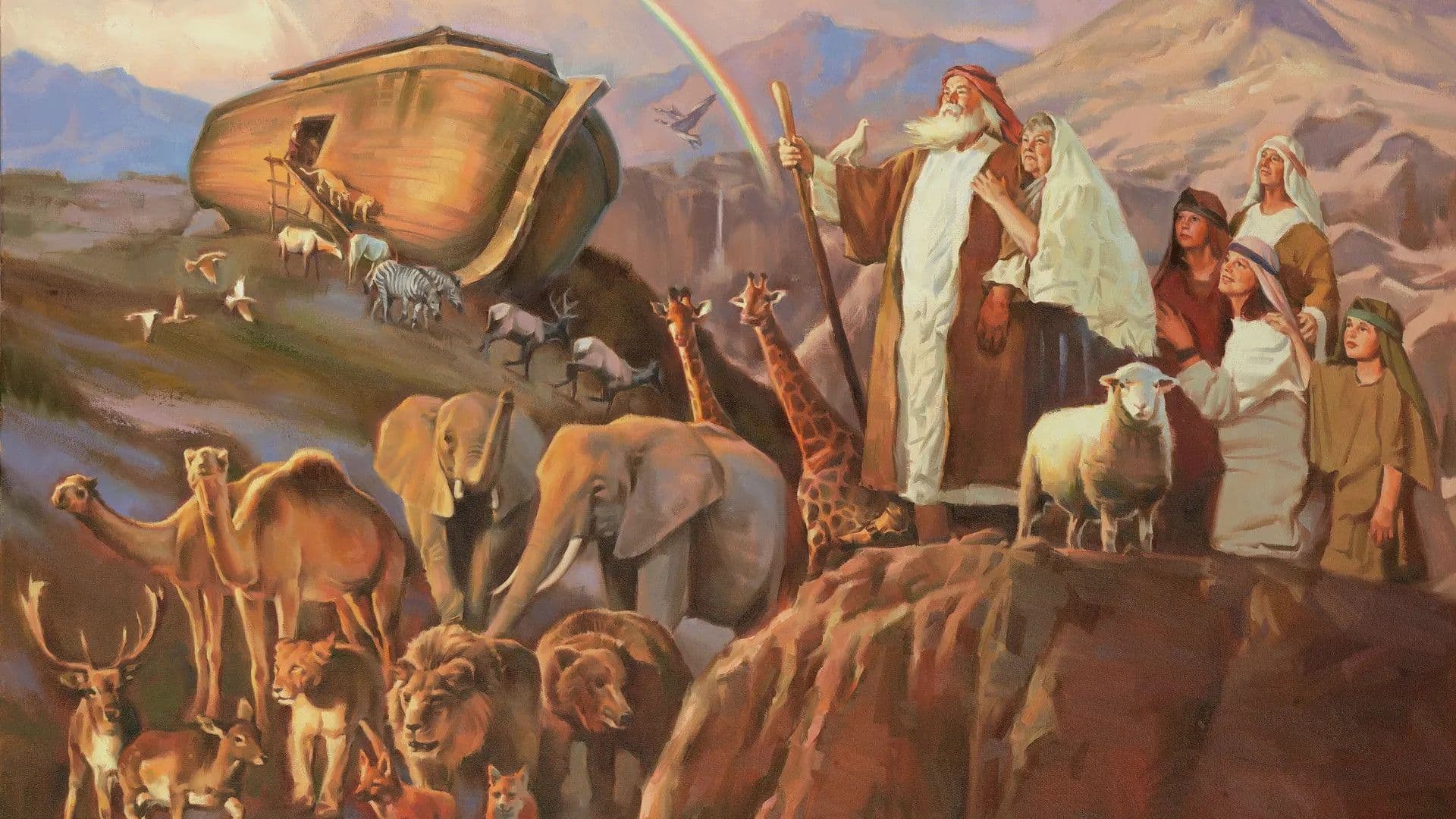
<p>Despite its ungainly shape as a buoyant temple, the ark is portrayed as floating confidently above the chaos of the great deep. Significantly, the movement of the ark “upon the face of the waters” (Genesis 7:18) paralleled the movement of the Spirit of God “upon the face of the waters” at the original creation of heaven and earth (1:2). These are the only two verses in the Bible that contain the phrase “the face of the waters,” making the deliberate nature of the parallel clear. In short, we are made to understand that in the presence of the ark, the same Spirit of God that hovered over the waters at Creation (Genesis 1:2)—and whose previous withdrawal was predicted in Genesis 6:3—has returned.</p> <p>Just as “darkness was upon the face of the deep” (Genesis 1:2) when God descended immediately preceding the Creation, so darkness surrounded the glorious ark as Noah moved over the waters before the remaking of the world. Hugh Nibley noted that in accounts where torrential waters and thick darkness above and beneath occlude the horizon, “the distinction between earth-travel and sky-travel often disappears.”<a href="#_ftn1" name="_ftnref1"><sup>[1]</sup></a></p> <p>In the story of the ark’s motions upon the waters, however, we are witnessing something graver than a blurring of the distinction between earth-travel and sky-travel. Rather, we can understand that, figuratively speaking, the very sky has fallen. Consequently, the “habitable and culture-orientated world lying between the heavens above and the underworld below, and separating them” has vanished.<a href="#_ftn2" name="_ftnref2"><sup>[2]</sup></a> In the words of 1 Enoch, “heaven . . . fell down upon the earth. And when it fell upon the earth, . . . the earth was swallowed up in the great abyss.”<a href="#_ftn3" name="_ftnref3"><sup>[3]</sup></a> After that violent crash, what remained was a jumbled, watery confusion—with one exception: the motion of the ark “upon the face of the waters,” like the Spirit of God at Creation, was a portent of the appearance of light and life. Within the ark, itself a “mini replica of Creation,” were the last vestiges of the <em>original</em> Creation, “an alternative earth for all living creatures,”<a href="#_ftn4" name="_ftnref4"><sup>[4]</sup></a> “a colony of heaven” containing seedlings for a second “Garden of Eden”<a href="#_ftn5" name="_ftnref5"><sup>[5]</sup></a>—that is, the nucleus of animal and plant life for a “new world.” All this was hidden within a rescue vessel described in scripture as a likeness of God’s own traveling pavilion, like the tabernacle (see Psalm 18; Doctrine and Covenants 121:1).</p> <p>The mission of Noah and his family aboard the ark was one that few of us would envy. As Nibley put it,</p> <blockquote> <p>If we fancy Noah riding the sunny seas high, dry, and snug in the Ark, we have not read the record—the long, hopeless struggle against entrenched mass resistance to his preaching, the deepening gloom and desperation of the years leading up to the final debacle, then the unleashed forces of nature, with the family absolutely terrified, weeping and praying “because they were at the gates of death” as the Ark was thrown about with the greatest violence by terrible winds and titanic seas. Albright’s suggestion that the flood story goes back to “the tremendous floods which must have accompanied the successive retreats of the glaciers” is supported by the tradition that the family suffered terribly because of the cold and that Noah on the waters “coughed blood on account of the cold.” The Jaredites had only to pass through the tail end of the vast storm cycle of Noah’s day, yet for 344 days they had to cope with “mountain waves” and a wind that “did never cease to blow” (Ether 6:6, 8). Finally, Noah went forth into a world of utter desolation, as Adam did, to build his altar, call upon God, and try to make a go of it all over again, only to see some of his progeny on short order prefer Satan to God and lose all the rewards that his toil and sufferings had put in their reach.<a href="#_ftn6" name="_ftnref6">[6]</a></p> </blockquote> <p> </p> <p><a href="#_ftnref1" name="_ftn1">[1]</a> Hugh W. Nibley, “Tenting, Tolling, and Taxing,” in<em> The Ancient State</em>, ed. Donald W. Perry and Stephen D. Ricks, The Collected Works of Hugh Nibley 10 (Salt Lake City, UT: Deseret Book, 1991), 41. Compare William Shakespeare, <em>The Winter’s Tale</em>, in<em> The Riverside Shakespeare</em>, ed. G. Blakemore Evans (Boston, MA: Houghton-Mifflin Company, 1974), 1585, act 3, scene 3, lines 84–86: “I am not to say it is a sea, for it is now the sky, betwixt the firmament and it you cannot thrust a bodkin’s point.”</p> <p><a href="#_ftnref2" name="_ftn2">[2]</a> Nicolas Wyatt, “The Darkness of Genesis 1:2,” in<em> The Mythic Mind: Essays on Cosmology and Religion in Ugaritic and Old Testament Literature</em>, ed. Nicholas Wyatt (London, England: Equinox, 2005), 93. Compare 2 Peter 3:6.</p> <p><a href="#_ftnref3" name="_ftn3">[3]</a> George W. E., Nickelsburg and James C. VanderKam, <em>1 Enoch 1: A Commentary on the Book of 1 Enoch, Chapters 1–36; 81–108</em>, ed. Klaus Baltzer (Minneapolis, MN: Fortress Press, 2001), 345, 1 Enoch 83:3–4.</p> <p><a href="#_ftnref4" name="_ftn4">[4]</a> Elizabeth A. Harper, “You Shall Make a Tebah. First Draft Paper Prepared as Part of Initial Research into a Doctorate on the Flood Narrative,” 54, https://academia.edu/61068844/You_Shall_Make.</p> <p><a href="#_ftnref5" name="_ftn5">[5]</a> L. Michael Morales, <em>The Tabernacle Pre-Figured: Cosmic Mountain Ideology in Genesis and Exodus</em> (Leuven, Belgium: Peeters, 2012), 163. Compare Hugh W. Nibley, “Treasures in the Heavens,” in<em> Old Testament and Related Studies</em>, ed. John W. Welch, Gary P. Gillum, and Don E. Norton, The Collected Works of Hugh Nibley 1 (Salt Lake City, UT: Deseret Book, 1986), 185, where he uses Mandaean and Gnostic sources describing the process of creating new worlds through a “colonizing process called ‘planting.’”</p> <p><a href="#_ftnref6" name="_ftn6">[6]</a> Hugh W. Nibley, <em>Abraham in Egypt</em>, ed. Gary P. Gillum, The Collected Works of Hugh Nibley 14 (Salt Lake City, UT: Deseret Book, 2000), 164–165.</p> <p> </p> <p><strong>Author:</strong> Jeffrey M. Bradshaw<br /><strong>General Editor:</strong> Taylor Halverson<br /><strong>Associate Editor:</strong> Morgan Tanner<br /><strong>Senior Editor:</strong> Sarah Whitney Johnson<br /><strong>Assistant Editor:</strong> Verlanne Johnson</p>
Old Testament Minute: Genesis by BMC
The Waters Prevail and All Life Perishes
<p><strong>7:17. “the flood was forty days upon the earth.”</strong> This phrase describes the first heavy phase of the deluge. “The absence of any personal names [in the verses that follow] apart from a parenthetic mention of Noah in v. 23, enhances the atmosphere of desolation.”<a href="#_ftn1" name="_ftnref1"><sup>[1]</sup></a></p> <p><strong>7:17. “the waters increased.”</strong> Literally translated, this is “the waters multiplied.” Old Testament scholar Gordon Wenham called this phrase “a baleful echo of the injunction given to the first creatures to be fruitful and multiply [Moses 2:22, 28]. As if to reinforce this echo, the word appears again in v. 18.”<a href="#_ftn2" name="_ftnref2">[2]</a></p> <p><strong>7:18. “the waters prevailed.”</strong> This is a notice that the flood has increased one” stage further. The waters do not merely multiply greatly; they triumph.”<a href="#_ftn3" name="_ftnref3"><sup>[3]</sup></a></p> <p><strong>7:18. “went upon the face of the waters.”</strong> Nahum Sarna translated this as “drifted upon the waters.”<a href="#_ftn4" name="_ftnref4"><sup>[4]</sup></a> The biblical account makes it clear that the ark “was not shaped like a ship and it had no oars,” “accentuating the fact that Noah’s deliverance was not dependent on navigating skills, [but rather happened] entirely by God’s will”<a href="#_ftn5" name="_ftnref5"><sup>[5]</sup></a> since its movement was solely determined by “the thrust of the water and wind.”<a href="#_ftn6" name="_ftnref6"><sup>[6]</sup></a></p> <p><strong>7:19. “all the high hills, that were under the whole heaven, were covered.” </strong>Christian scholar Walter Bradley explained:</p> <blockquote> <p>The fundamental question is whether the Noachian flood was global or local. The terminology used in Genesis 6–9 seems to favor a global flood. . . . [However,] the use of such biblical language in other stories may help us to understand the intention here. In Genesis 41:56, we are told, “The famine was spread over all the face of the earth.” We normally interpret this famine as devastating the lands of the ancient Near East around Egypt and do not assume that American Indians and Australian Aborigines came to buy grain from Joseph. 1 Kings 10:24 states that “the whole world sought audience with Solomon to hear the wisdom God had put in his heart.” Surely Inca Indians from South America or Maoris from New Zealand had not heard of Solomon and sought his audience.</p> <p>The Hebrew word <em>eretz</em> used in Genesis 7:19 is usually translated “earth” or “world” but does not generally refer to the entire planet. Depending on the context, it is often translated “country” or “land” to make this clear. References to the entire planet are found in Genesis 1:1; 2:1; and 14:22, for example. However, more typical references might be Genesis 1:10; 2:11; or 2:13, where <em>eretz</em> is translated “land.” In Genesis 12:1, Abram was told to leave his <em>eretz</em>. He was obviously not told to leave the planet but rather to leave his country. . . . A final helpful comparison to obtain a proper interpretation of Genesis 7:19 involves Deuteronomy 2:25, which talks about all the nations “under the heavens” being fearful of the Israelites. Obviously, all nations “under the heavens” was not intended to mean all on planet Earth.<a href="#_ftn7" name="_ftnref7">[7]</a></p> </blockquote> <p>Thus the verse does not oblige us to accept that the Flood was global.</p> <p><strong>7:23. “they were destroyed from the earth: and Noah only remained alive.”</strong> “Life did not simply die. It was wiped out. The threats of 6:7 and 7:15 were fulfilled. Only Noah and those with him in the Ark survived. The contrast between those wiped out <em>mhh</em> and Noah <em>nh</em> is deliberately highlighted by using the similar verb with the proper name.”<a href="#_ftn8" name="_ftnref8"><sup>[8]</sup></a> “The survivors do indeed represent a ray of hope for the future, but for the moment they are but a meager and woeful remnant.”<a href="#_ftn9" name="_ftnref9"><sup>[9]</sup></a></p> <p><strong>7:24. “the waters prevailed upon the earth.”</strong> The chapter ends “with an awe-inspiring picture of the mighty waters covering the entire earth. We see water everywhere, as though the world had reverted to its primeval state at the dawn of Creation, when the waters of the deep submerged everything. Nothing remained of the teeming life that had burst forth upon the earth. Only a tiny point appears on the face of the terrible waters: the Ark that preserves between its planks the seeds of life for the future. But it is a mere atom and is almost lost in the endless expanse of water that was spread over the face of the whole earth. A melancholy scene that is liable to fill the reader with despair. What will happen to this atom of life?”<a href="#_ftn10" name="_ftnref10"><sup>[10]</sup></a></p> <p> </p> <p><a href="#_ftnref1" name="_ftn1">[1]</a> Gordon J. Wenham, <em>Genesis 1–15</em>, Word Biblical Commentary 1 (Waco, TX: Word Books,1987), 182.</p> <p><a href="#_ftnref2" name="_ftn2">[2]</a> Wenham, <em>Genesis 1–15</em>, 182.</p> <p><a href="#_ftnref3" name="_ftn3">[3]</a> Wenham, <em>Genesis 1–15</em>, 182.</p> <p><a href="#_ftnref4" name="_ftn4">[4]</a> Nahum M. Sarna, <em>Genesis: The Traditional Hebrew Text with the New JPS Translation Commentary</em>, The JPS Torah Commentary, ed. Nahum M. Sarna and Chaim Potok (Philadelphia, PA: Jewish Publication Society, 1989), 55.</p> <p><a href="#_ftnref5" name="_ftn5">[5]</a> Meir Zlotowitz, <em>Bereishis/Genesis: A New Translation with a Commentary Anthologized from Talmudic, Midrashic, and Rabbinic Sources</em>, 2nd ed., 2 vols. (New York, NY: Mesorah Publications, 1986), 230.</p> <p><a href="#_ftnref6" name="_ftn6">[6]</a> Umberto Cassuto,<em> A Commentary on the Book of Genesis, </em>vol. 2,<em> From Noah to Abraham</em>, trans. Israel Abrahams (Jerusalem, Israel: Magnes Press, 1998), 60.</p> <p><a href="#_ftnref7" name="_ftn7">[7]</a> Walter Bradley, “Why I Believe the Bible Is Scientifically Reliable,” in<em> Why I Am a Christian: Leading Thinkers Explain Why They Believe</em>, ed. Norman L. Geisler and Paul K. Hoffman (Grand Rapids, MI: Baker Books, 2001), 177–178.</p> <p><a href="#_ftnref8" name="_ftn8">[8]</a> Wenham, <em>Genesis 1–15</em>, 183.</p> <p><a href="#_ftnref9" name="_ftn9">[9]</a> Cassuto, <em>Noah to Abraham</em>, 97.</p> <p><a href="#_ftnref10" name="_ftn10">[10]</a> Cassuto, <em>Noah to Abraham</em>, 97<em>.</em></p> <p> </p> <p><strong>Author:</strong> Jeffrey M. Bradshaw<br /><strong>General Editor:</strong> Taylor Halverson<br /><strong>Associate Editor:</strong> Morgan Tanner<br /><strong>Senior Editor:</strong> Sarah Whitney Johnson<br /><strong>Assistant Editor:</strong> Verlanne Johnson</p>
Old Testament Minute: Genesis by BMC