Genesis 37-41
“The Lord Was with Joseph”
March 9 - March 15
scripture
quotes
Ancient Temptations and Temptations Today
<p>For some unknown reason there is constantly appearing the false rationalization that at one time in the long-ago, virtue was easy and that now it is difficult. I would like to remind you that there has never been a time since the creation when the same forces were not at work which are at work today. The proposal made by Potiphar’s wife to Joseph in Egypt (Gen. 39:7) is not essentially different from that faced by many a young man and woman in our day.</p> <p>The influences today may be more apparent and more seductive, but they are no more compelling. You cannot be shielded entirely from these influences. They are all about us. Our culture is saturated with them. But the same kind of self-discipline exercised by Joseph will yield the same beneficial result. Notwithstanding the so-called “new morality,” notwithstanding the much-discussed changes in our moral standard, there is no adequate substitute for virtue. The old standard is challenged on every campus in America as it is in Europe. But God has not abrogated his commandments.</p>
Gordon B. Hinckley, “The Dimension of the Spirit”, October 1964 General Conference
Trust Is Important
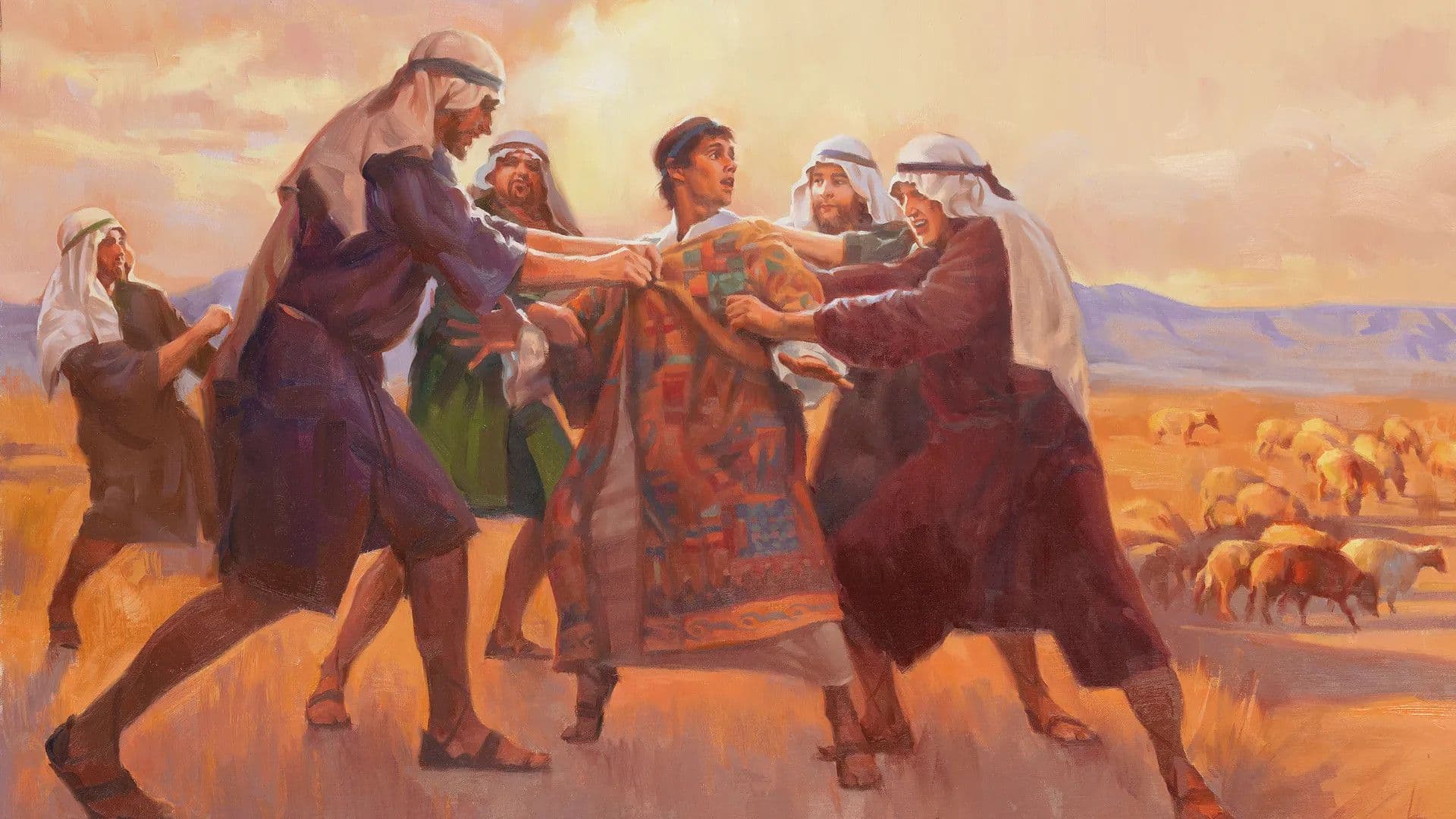
<p>Joseph, the son of Jacob and Rachel, was sold into slavery in Egypt. Because of treachery in the house of Potiphar, Joseph went to prison. Pharaoh had two troubling dreams. Hearing of Joseph’s discernment from the captain of the prison guard, he sent for him to interpret the dreams. Joseph told him, through inspiration, that seven years of plenty would be followed by seven years of famine. Pharaoh not only recognized this true interpretation, but he trusted Joseph and appointed him to be second only to Pharaoh in power. The years passed and the famine came. In time Joseph rescued all of his brothers and his father from starvation (Gen. 37; Gen. 39; Gen. 40; Gen. 41; Gen. 42). Because he earned the implicit trust of those who were over him, Joseph enjoyed a great amount of freedom. Like Joseph, you too can be trusted by others, but trust must be earned.</p>
James E. Faust, “Obedience: The Path to Freedom”, April 1999 General Conference
commentaries
Genesis 39:7–18. The Seduction of Potiphar’s Wife
<p>The story of Potiphar’s wife attempting to seduce Joseph appears to be based on an Egyptian type scene, as illustrated in the similar story found in the “Tale of Two Brothers,” which dates to around the thirteenth century BC.<a href="#_ftn1" name="_ftnref1">[1]</a> In both stories, a servant finds himself alone in the house with his master’s wife, who then bluntly invites the servant to lie with her; the servant declines the proposition with an extended speech, after which the woman defames him to her husband and claims the servant attempted to force himself on her.<a href="#_ftn2" name="_ftnref2">[2]</a></p> <p>As expected, when comparing various versions of a type scene, differences are as important as similarities. In the “Tale of Two Brothers,” details are exaggerated and fanciful, illustrating the fictional nature of the story, while the Joseph story reflects a more sober and realistic account befitting of historical narrative.<a href="#_ftn3" name="_ftnref3">[3]</a> Both stories also involve a garment, though in the Egyptian tale, the master’s wife offers to make the servant a garment if he gives in to her demand. In contrast, in the biblical story Joseph’s garment is seized from him and used as evidence against him (Genesis 39:12–18).</p> <p>The most important difference, however, is reflected in Joseph’s response to Potiphar’s wife. In the “Tale of Two Brothers,” the servant “becomes angry and fierce, like a wild animal,” in refusing the proposition of his master’s wife.<a href="#_ftn4" name="_ftnref4">[4]</a> In contrast, Joseph remains calm and concludes with an appeal to divine morality: “How then can I do this great wickedness, and sin against God?” (verse 9). As John Gee noted, “While the Egyptian account features ferocity, the biblical account promotes piety.”<a href="#_ftn5" name="_ftnref5">[5]</a> Jewish scholar Nahum Sarna further explained:</p> <blockquote> <p>Probably nothing is more indicative of the wide chasm separating Israel from its neighbors than the line of argument used by Joseph in rejecting the repeated entreaties of the would-be adultress. . . . This plea of Joseph expresses [a] distinctive biblical concept of morality. Adultery is a sin against God. It is not a matter of social impropriety or breach of convention, not just an indignity to the husband or an outrage upon society. It is a religious offense in which God is vitally involved. In other words, the sanction of morality is divine, not social, and for this reason morality is absolute and not relative.<a href="#_ftn6" name="_ftnref6">[6]</a></p> </blockquote> <p> </p> <p><a href="#_ftnref1" name="_ftn1">[1]</a> John Gee, “Clothes and Cups: The Tangible World of Joseph,” in <em>From Creation to Sinai: The Old Testament through the Lens of the Restoration</em>, ed. Daniel L. Belnap and Aaron P. Schade (Salt Lake City, UT: Deseret Book; Provo, UT: Religious Studies Center, Brigham Young University, 2021), 431–432; Victor H. Matthews and Don C. Benjamin, eds. and trans., <em>Old Testament Parallels: Laws and Stories from the Ancient Near East</em>, 3rd ed. (Mahwah, NJ: Paulist Press, 2006), 65–69.</p> <p><a href="#_ftnref2" name="_ftn2">[2]</a> Gee, “Clothes and Cups,” 432–437; Nahum M. Sarna, <em>Understanding Genesis through Rabbinic Tradition and Modern Scholarship </em>(New York, NY: Melton Research Center, Jewish Theological Seminary of America, 1966), 215–217.</p> <p><a href="#_ftnref3" name="_ftn3">[3]</a> Gee, “Clothes and Cups,” 432–433.</p> <p><a href="#_ftnref4" name="_ftn4">[4]</a> Gee, “Clothes and Cups,” 436.</p> <p><a href="#_ftnref5" name="_ftn5">[5]</a> Gee, “Clothes and Cups,” 436.</p> <p><a href="#_ftnref6" name="_ftn6">[6]</a> Sarna, <em>Understanding Genesis</em>, 217.</p> <p> </p> <p><strong>Author:</strong> Neal Rappleye<br /><strong>General Editor:</strong> Taylor Halverson<br /><strong>Associate Editor:</strong> Morgan Tanner<br /><strong>Senior Editor:</strong> Sarah Whitney Johnson<br /><strong>Assistant Editor:</strong> Sam Lofgran<br /><strong>Assistant Editor:</strong> Verlanne Johnson</p>
Old Testament Minute: Genesis by BMC
Genesis 39:19–23. Joseph’s Punishment
<p>Adultery had a wide range of possible punishments in ancient Egypt: “Adultery . . . could be punished by throwing the adulterer or adulteress to the crocodiles, setting them on fire, killing them, beating them up, or fining them,” among other possibilities. All things considered, “Joseph’s punishment for a crime he did not commit was comparatively mild,” especially when his social status as a slave is taken into account.<a href="#_ftn1" name="_ftnref1">[1]</a> One scholar has suggested that this relatively lenient punishment may indicate that Potiphar did not fully believe his wife’s account.<a href="#_ftn2" name="_ftnref2">[2]</a></p> <p>Going from slave to prisoner seems like a “further degradation for Joseph, a step worse than slavery.”<a href="#_ftn3" name="_ftnref3">[3]</a> But once again, the Lord was with Joseph and blessed him to prosper despite these undesirable circumstances (Genesis 39:21–23). Joseph’s imprisonment “actually moves him closer to triumph and the fulfillment of his childhood dreams.”<a href="#_ftn4" name="_ftnref4">[4]</a></p> <p> </p> <p><a href="#_ftnref1" name="_ftn1">[1]</a> John Gee, “Clothes and Cups: The Tangible World of Joseph,” in <em>From Creation to Sinai: The Old Testament through the Lens of the Restoration</em>, ed. Daniel L. Belnap and Aaron P. Schade (Salt Lake City, UT: Deseret Book; Provo, UT: Religious Studies Center, Brigham Young University, 2021), 437.</p> <p><a href="#_ftnref2" name="_ftn2">[2]</a> Gordon J. Wenham, “Genesis,” in <em>Eerdmans Commentary on the Bible</em>, ed. James D. G. Dunn and John W. Rogerson (Grand Rapids, MI: Eerdmans, 2003), 66.</p> <p><a href="#_ftnref3" name="_ftn3">[3]</a> Wenham, “Genesis,” 66.</p> <p><a href="#_ftnref4" name="_ftn4">[4]</a> Wenham, “Genesis,” 66.</p> <p> </p> <p><strong>Author:</strong> Neal Rappleye<br /><strong>General Editor:</strong> Taylor Halverson<br /><strong>Associate Editor:</strong> Morgan Tanner<br /><strong>Senior Editor:</strong> Sarah Whitney Johnson<br /><strong>Assistant Editor:</strong> Sam Lofgran<br /><strong>Assistant Editor:</strong> Verlanne Johnson</p>
Old Testament Minute: Genesis by BMC
video
Joseph is Cast into Prison (Genesis 40)
<p>John Hilton III, “Joseph is Cast into Prison (Week 11, Part 5/7) Genesis 37–41 | Mar 7 - Mar 13,” Book of Mormon Central Video, 2022.</p>
John Hilton III