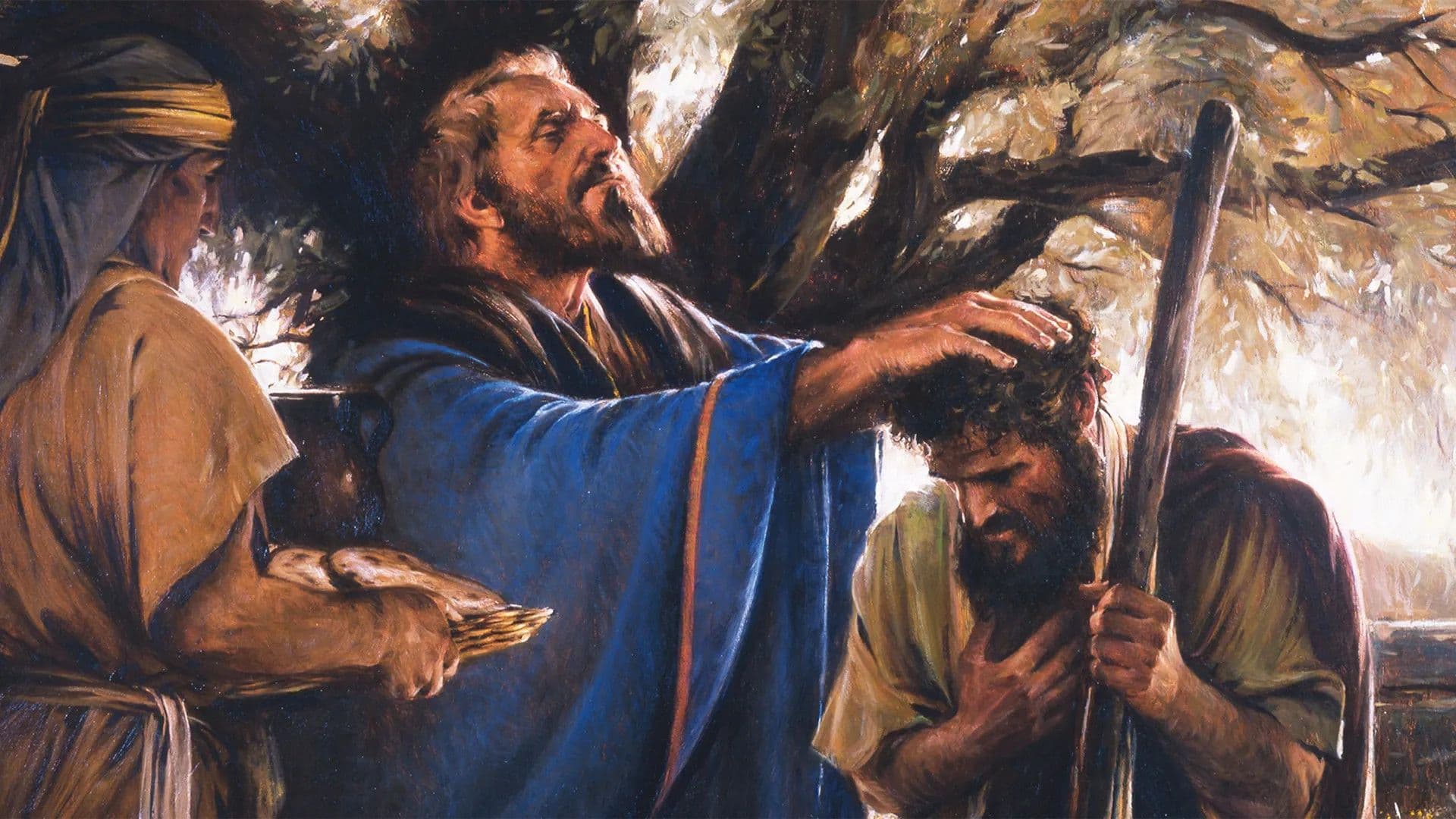
Genesis 12-17; Abraham 1-2
“To Be a Greater Follower of Righteousness”
February 16 - February 22
scriptures
commentaries
Abraham 2:22–25
<p>Unlike in the parallel account in Genesis 12:11–13, here the Lord instructs Abraham to call Sarai his sister instead of his wife. The concern behind this subterfuge is clear from the text. Given that ancient Egyptian texts depict pharaohs as taking any women they wanted, and given the capacity for callousness in ancient royalty, this fear was not unrealistic. The text is taking advantage of an ambiguity in ancient Egyptian language and culture. In ancient Egyptian, the word for <em>wife</em> (<em>ḥmt</em>) meant “wife,” but the word for <em>sister</em> (<em>snt</em>) could mean either “sister” or “wife.” In any case, Genesis 20:12 identifies Sarai as Abraham’s half-sister. The Lord was thus not instructing Abraham to lie but rather to be evasive or purposefully ambiguous. Interestingly, a text recovered among the Dead Sea Scrolls depicts Abraham as being warned of this impending danger in a dream.</p>
Pearl of Great Price Study Edition by Stephen O. Smoot
Genesis 12:10–20. The Abrahamic Test of Sarah
<p>It is one thing to choose the right when the right seems reasonable and blessings for obedience seem obvious. It is another thing to bow in humble submission when “the thought makes reason stare” and the rewards of faith are not forthcoming.<a href="#_ftn1" name="_ftnref1">[1]</a> In the well-known story of Abraham’s willingness to offer up Isaac in sacrifice (Genesis 22), Abraham made an unthinkable choice—a choice that opposed reason, went contrary to the commandments, seemed to nullify God’s prior promises, and must have made his whole soul recoil in moral repugnance.<a href="#_ftn2" name="_ftnref2">[2]</a> Does the Lord require other disciples to make similar choices?</p> <p>When scripture, Jewish tradition, and modern revelation are brought into consideration, the answer becomes a most definite yes. Not only Abraham but also Sarah, Isaac, and Hagar each experienced “Abrahamic tests”—as have many disciples in other dispensations, including ours. The connection between these tests and temple covenants is significant (as explained in more detail in the paragraph below), as is the need for the rescuing power of the Atonement of Jesus Christ. Elder Neal A. Maxwell taught, “If we are serious about our discipleship, Jesus will eventually request each of us to do those very things which are the most difficult for us to do.”<a href="#_ftn3" name="_ftnref3">[3]</a> Thus, “sometimes the best people have the worst experiences because they are the most ready to learn.”<a href="#_ftn4" name="_ftnref4">[4]</a></p> <p>Although Sarah’s role is backgrounded in the story of Isaac’s near-sacrifice, she is front and center in Genesis 12 and 20, where she was twice taken as a prospective wife by foreign rulers Pharaoh and Abimelech. Hugh Nibley suggested a hypothesis to explain the two close variants of Sarah’s story: that something akin to the two accounts of her trials might have been used in former times as a means to explain and illustrate ritual.<a href="#_ftn5" name="_ftnref5">[5]</a> Following the logic of Nibley, one might see the themes of Sarah’s story as a natural fit for a discussion of something like the laws of obedience, sacrifice, and chastity just as the story of Enoch’s city provided a perfect context for lecture on the law of consecration. Nibley briefly summarized the story:</p> <blockquote> <p>It was . . . a pharaoh who sought the hand of Sarah, the true princess, in order to raise up a royal progeny by her. Upon a royal bed identical in form with the altar of Abraham [Abraham 1:11–13], she too prayed for deliverance and was rescued by an angel while the king was constrained to recognize Sarah’s true marriage and heritage, bestowing upon her regal insignia and a royal escort.<a href="#_ftn6" name="_ftnref6">[6]</a></p> </blockquote> <p>Highlighting the independence of Sarah’s exercise of moral agency, Nibley wrote:</p> <blockquote> <p>It is she and she alone who is being tested . . . this time. It is incorrect to say with Robert Graves that “Abraham gave Sarah to Pharaoh,” for he was in no position to do so: he was completely in Pharaoh’s power—he had already taken Sarah by force—and Pharaoh was listening only to Sarah! . . . [T]hroughout the story every crucial decision rests with Sarah and Sarah alone. . . .</p> <p>There was nothing in the world to keep her from exchanging her hard life with Abraham for a life of unlimited ease and influence as Pharaoh’s favorite except her loyalty to her husband. By a special order from heaven Abraham had stepped out of the picture and Pharaoh had been placed in a legally and ethically flawless position, and Sarah knew it: “I Abraham, told Sarai, my wife, all that the Lord had said to me.”</p> <p>Why is the brilliant prospect of being Queen of Egypt never mentioned as an inducement or even a lightening of Sarah’s burden? Sarah apparently never thinks of that, for she was as upset as Abraham: “Sarai wept at my words that night.” Still, the proposition was never put to her as a command, but only as a personal request from Abraham: “Please say you are my sister for the sake of my well-being, so that through your ministration I shall be saved, and owe my life to you!” (Genesis 12:13); and so with Abimelech: “This will be a special favor which I am asking of you in my behalf” (Genesis 20:13). . . .</p> <p>[T]he stories of Isaac and Sarah teach us that salvation is a family affair, in which, however, each member acts as an individual and makes his own choice, for each must decide for himself when it is a matter of giving up all things, including life itself, if necessary. . . . If Abraham knew that “God would provide a sacrifice,” Isaac did not; if he was perfectly sure of his wife, she was not and prayed desperately for help—husband, wife, and son each had to undergo the terrible test alone.<a href="#_ftn7" name="_ftnref7">[7]</a></p> </blockquote> <h3>Source</h3> <p>Book of Genesis Minute by Jeffrey M. Bradshaw, adapted from Nahum M. Sarna, <em>Genesis: The Traditional Hebrew Text with the New JPS Translation Commentary</em>, The JPS Torah Commentary, ed. Nahum M. Sarna and Chaim Potok (Philadelphia, PA: Jewish Publication Society, 1989), 93–97.</p> <h3>Related verses</h3> <p>Genesis 12:10–20</p> <p> </p> <p><a href="#_ftnref1" name="_ftn1">[1]</a> Eliza R. Snow, “O My Father,” in <em>Hymns </em>(Salt Lake City, UT: The Church of Jesus Christ of Latter-day Saints, 1985), no. 292.</p> <p><a href="#_ftnref2" name="_ftn2">[2]</a> No explanation was given for the divine injunction given to Abraham to sacrifice his son; the idea of child sacrifice was condemned in ancient Israel (see Leviticus 20:2–5; 1 Kings 11:4–11; 2 Kings 21:6; 2 Chronicles 28:1–4; Jeremiah 32:35–36); and the greatest promise Abraham received was posterity through Sarah and his son Isaac. Additionally, Abraham’s soul likely recoiled because human sacrifice was part of the culture Abraham had experienced personally and had despised (see Abraham 1:7–15).</p> <p><a href="#_ftnref3" name="_ftn3">[3]</a> Neal A. Maxwell, <em>A Time to Choose</em> (Salt Lake City, UT: Deseret Book, 1972), 46.</p> <p><a href="#_ftnref4" name="_ftn4">[4]</a> Neal A. Maxwell, quoted in Bruce C. Hafen, <em>A Disciple’s Life: The Biography of Neal A. Maxwell</em> (Salt Lake City, UT: Deseret Book, 2002), 20.</p> <p><a href="#_ftnref5" name="_ftn5">[5]</a> See Hugh W. Nibley, <em>Abraham in Egypt</em>, ed. Gary P. Gillum, The Collected Works of Hugh Nibley 14 (Salt Lake City, UT: Deseret Book, 2000), 343–381.</p> <p><a href="#_ftnref6" name="_ftn6">[6]</a> Hugh W. Nibley, “Patriarchy and Matriarchy,” in<em> Old Testament and Related Studies</em>, ed. John W. Welch, Gary P. Gillum, and Don E. Norton, The Collected Works of Hugh Nibley 1 (Salt Lake City, UT: Deseret Book, 1986), 98–99.</p> <p><a href="#_ftnref7" name="_ftn7">[7]</a> Nibley, <em>Abraham in Egypt</em>, 363–364, 366–367, 374.</p> <p> </p> <p><strong>Author:</strong> Jeffrey M. Bradshaw<br /><strong>General Editor:</strong> Taylor Halverson<br /><strong>Associate Editor:</strong> Morgan Tanner<br /><strong>Senior Editor:</strong> Sarah Whitney Johnson<br /><strong>Assistant Editor:</strong> Sam Lofgran<br /><strong>Assistant Editor:</strong> Verlanne Johnson</p>
Old Testament Minute: Genesis by BMC