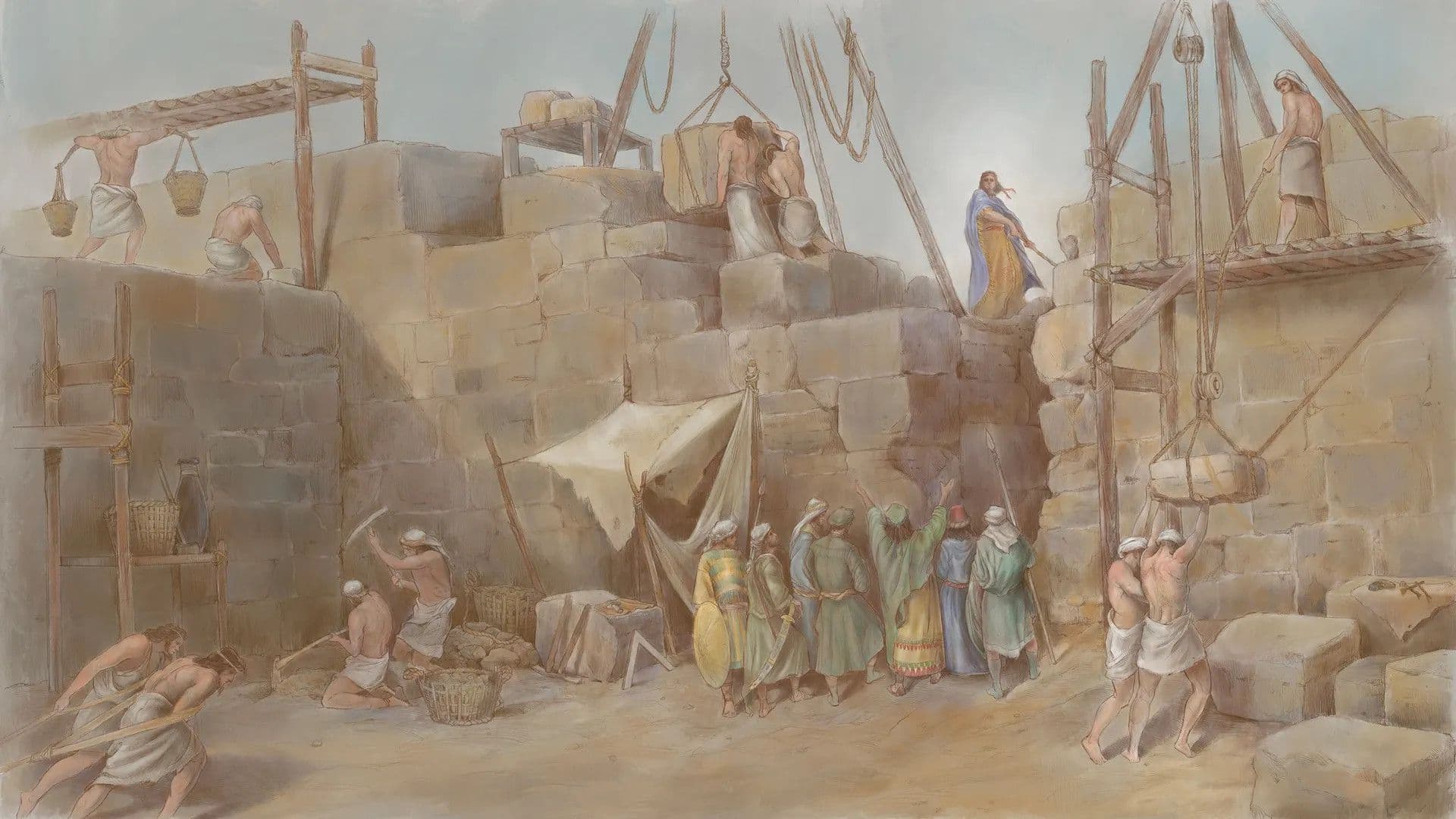
Ezra 1, 3-7; Nehemiah 2, 4-6, 8
“I Am Doing a Great Work”
July 27 - August 2
scriptures
quote
God Can Bless Nations
<p>Trust in God can bless nations. I have come to know that we can trust God to fulfill the promise of Alma that “behold, the Lord doth grant unto all nations, of their own nation and tongue, to teach his word, yea, in wisdom, all that he seeth fit that they should have” (Alma 29:8).</p> <p>God does not rule in nations, but He is mindful of them. He can and does place people in positions of influence who want what is best for the people and who trust in the Lord.</p> <p>I have seen it in my travels across the world.</p>
Henry B. Eyring, “Trust in God, Then Go and Do,” October 2010 General Conference
commentaries
Ezra 1:1–4. The Lord stirs up the spirit of Cyrus
<p>Chapter 1 opens during the first year of Cyrus’s reign. (Cyrus started ruling Persia in 559 BC and conquered Babylon in 539 or 538 BC.) This passage alludes to a prophecy of Jeremiah concerning the seventy-year exile when Babylon was destroyed (see Jeremiah 25:12).</p> <p>In this proclamation, Cyrus claimed God had given him all the kingdoms of the earth and had told him to build a house at Jerusalem. He invited people of Judah to return to rebuild the temple. Those who remained behind should send resources to support the temple construction.</p> <p>The Cyrus Cylinder expanded this decree to other nations, giving them permission to worship their own gods and build their own temples.<a href="#_ftn1" name="_ftnref1">[1]</a></p> <p>The first two and a half verses are also found in 2 Chronicles 36:22–23, and the close relationship between the Lord and Cyrus is also described in Isaiah 44:28 and 45:1.</p> <p>As He did with Cyrus, God potentially can work through world leaders today to accomplish His broader purposes for His children on the earth.</p> <p> </p> <p><a href="#_ftnref1" name="_ftn1">[1]</a> See an image of the Cyrus Cylinder at <a href="https://commons.wikimedia.org/wiki/File:Cyrus_Cylinder_front.jpg">https://commons.wikimedia.org/wiki/File:Cyrus_Cylinder_front.jpg</a>.</p> <p> </p> <p><strong>Author:</strong> Jared Ludlow<br /><strong>General Editor:</strong> Taylor Halverson<br /><strong>Associate Editor:</strong> Morgan Tanner<br /><strong>Senior Editor:</strong> Sarah Whitney Johnson<br /><strong>Assistant Editor:</strong> Sam Lofgran<br /><strong>Assistant Editor:</strong> Verlanne Johnson</p>
Old Testament Minute: Ezra by BMC
Ezra 1:5–6. Offerings to build the temple
<p>Some of the clan leaders of Judah and Benjamin, along with priests and Levites and those “whose spirit God had raised,” went to Jerusalem to rebuild the temple (Ezra 1:5). Those who stayed behind sent silver, gold, animals, precious things, and other offerings to support the temple construction. Joseph Smith used language that echoes that of these verses when he invited the Saints of his day to contribute precious things and whatever could be given to the construction of the temple (see Doctrine and Covenants 109:5).</p> <p> </p> <p><strong>Author:</strong> Jared Ludlow<br /><strong>General Editor:</strong> Taylor Halverson<br /><strong>Associate Editor:</strong> Morgan Tanner<br /><strong>Senior Editor:</strong> Sarah Whitney Johnson<br /><strong>Assistant Editor:</strong> Sam Lofgran<br /><strong>Assistant Editor:</strong> Verlanne Johnson</p>
Old Testament Minute: Ezra by BMC
Ezra 3 Overview
<p>Chapter 3 depicts the initial rebuilding of the temple altar so that sacrifices could be offered for the Feast of Tabernacles. The foundation of the temple for its rebuilding was laid later. The organization of the temple priesthood, including the priests and Levites, went along with the rebuilding of the temple. People rejoiced to see the rebuilding of the temple, but others who were older and knew the previous temple wept that it could not be rebuilt to the same splendor as the original.</p> <p> </p> <p><strong>Author:</strong> Jared Ludlow<br /><strong>General Editor:</strong> Taylor Halverson<br /><strong>Associate Editor:</strong> Morgan Tanner<br /><strong>Senior Editor:</strong> Sarah Whitney Johnson<br /><strong>Assistant Editor:</strong> Sam Lofgran<br /><strong>Assistant Editor:</strong> Verlanne Johnson</p>
Old Testament Minute: Ezra by BMC
Ezra 3:1–7. Altar of the temple rebuilt
<p>One of the first actions of the returnees to Jerusalem was to rebuild the altar of the temple. We see throughout scripture one of the first things that religious people do in a new location is build an altar to offer sacrifices of gratitude.<a href="#_ftn1" name="_ftnref1">[1]</a></p> <p>The people in Ezra’s day especially wanted to complete their altar in the seventh month of the agricultural calendar year (the first month of the religious year) so that they could celebrate the Feast of Tabernacles. When Solomon completed the first temple, its dedication was connected to the Feast of Tabernacles. In this regard, Ezra seemed to be connecting this temple with the earlier one. On the newly re-erected altar, they offered the prescribed sacrifices and offerings even though the temple foundations had still not yet been laid. Today’s temples do not include sacrifices on altars, but they do feature altars as a place for making covenants. The sacrifice that the Lord requires alongside these covenants today is a broken heart and a contrite spirit to remind us of Jesus Christ’s atoning sacrifice.</p> <p>Verse 2 mentions Jeshua, the priest, and Zerubbabel, a governor of Davidic descent. These officials are connected with the authority from before the exile. Verse 3 mentions their “fear of the peoples of the land.” A recurring theme in Ezra and Nehemiah is the conflict between the returnees and the locals. Part of their sacrifices here in this verse seem to be a petition to God to protect them from the locals. These “locals” will later become the Samaritans during the time of Jesus. Some historians refer to them in this time period as Samarians because they came from the region of Samaria. Verse 7 details some of the arrangements made for supplies and labor to rebuild the temple, particularly cedarwood and craftsmen from Lebanon (Phoenicia).</p> <p> </p> <p><a href="#_ftnref1" name="_ftn1">[1]</a> For example, Abraham (Genesis 13:4; 18), Jacob (Genesis 35:1, 3, 7), and Lehi (1 Nephi 2:7).</p> <p> </p> <p><strong>Author:</strong> Jared Ludlow<br /><strong>General Editor:</strong> Taylor Halverson<br /><strong>Associate Editor:</strong> Morgan Tanner<br /><strong>Senior Editor:</strong> Sarah Whitney Johnson<br /><strong>Assistant Editor:</strong> Sam Lofgran<br /><strong>Assistant Editor:</strong> Verlanne Johnson</p>
Old Testament Minute: Ezra by BMC
Ezra 3:8–13. Temple construction resumes
<p>This section recounts the reappointing of priests and Levites to serve in the temple. The Levites had to be at least twenty years old to serve. With great celebration, which included trumpets and cymbals, the people laid the foundation of the Lord’s temple. They sang songs and praised God’s steadfast love. The Hebrew word for this covenantal love is <em>hesed</em>. The concept of <em>hesed</em> is found throughout the Old Testament, and this particular phrase in verse 11 is found in several psalms and second temple liturgy. In Church teachings today, there is continued acknowledgment of God’s constant love through His covenantal relationships with His children. Despite praising God, those who knew the earlier temple of Solomon and its superior grandeur also expressed sadness. The shouting for joy and weeping for sadness blended together and created a noise heard at a great distance.</p> <p> </p> <p><strong>Author:</strong> Jared Ludlow<br /><strong>General Editor:</strong> Taylor Halverson<br /><strong>Associate Editor:</strong> Morgan Tanner<br /><strong>Senior Editor:</strong> Sarah Whitney Johnson<br /><strong>Assistant Editor:</strong> Sam Lofgran<br /><strong>Assistant Editor:</strong> Verlanne Johnson</p>
Old Testament Minute: Ezra by BMC