Deuteronomy 6-8, 15, 18, 29-30, 34
“Beware Lest Thou Forget the Lord”
May 11 - May 17
scriptures
quote
Love and Obedience
<p>Above all, God’s children should learn to listen, then listen to learn from the Lord. On several sacred occasions in the world’s history, our Heavenly Father has personally appeared to introduce His divine Son with a specific charge to “hear him.”</p> <p>Jesus taught this first and great commandment: “Thou shalt love the Lord thy God with all thy heart, and with all thy soul, and with all thy mind” (Matt. 22:37).</p> <p>Scriptures recorded in all dispensations teach that we show our love of God as we hearken to His commandments and obey them. These actions are closely connected. In fact, the Hebrew language of the Old Testament in most instances uses the same term for both hearkening (to the Lord) and obedience (to His word).</p>
Russell M. Nelson, “Listen to Learn,” April 1991 General Conference
commentaries
Deuteronomy 30:1–10. Promised Blessings
<p>If the Israelites <em>remember</em> the Lord’s covenant promises even after they’ve been “cast into another land” as a consequence of disobedience (Deuteronomy 29:28), they will be able to return from captivity and once again enjoy the land and all the blessings attached to it (30:2–10). According to Mark Biddle, throughout this section is wordplay “on the Hebrew word that can be translated ‘to repent,’ ‘to return’ or ‘to restore.’” This wordplay is theologically significant and reinforces the message of the covenant: “When Israel <em>repents</em>, Israel can <em>return</em> because Yahweh will <em>restore</em>.”<a href="#_ftn1" name="_ftnref1">[1]</a></p> <p> </p> <p><a href="#_ftnref1" name="_ftn1">[1]</a> Mark Biddle, “Deuteronomy,” in <em>The New Interpreter’s Bible: One Volume Commentary</em>, ed. Beverly Roberts Gaventa and David Peterson (Nashville, TN: Abingdon Press, 2010), 137–138.</p> <p> </p> <p><strong>Author:</strong> Neal Rappleye<br /><strong>General Editor:</strong> Taylor Halverson<br /><strong>Associate Editor:</strong> Morgan Tanner<br /><strong>Senior Editor:</strong> Sarah Whitney Johnson<br /><strong>Assistant Editor:</strong> Sam Lofgran<br /><strong>Assistant Editor:</strong> Verlanne Johnson</p>
Old Testament Minute: Deuteronomy by BMC
Deuteronomy 30:11–20. Final Call to Obey
<p>Moses concluded this formalizing of the covenant with a call to action, a call to make a choice between the two paths provided by the covenant: “life and good” and “death and evil” (Deuteronomy 30:15). Moses urged the people to “choose life, that both thou and thy seed may live” (verse 19). This framing of the two choices between obedience and disobedience as ultimately being the choice between good and evil and life and death is a common framework from antiquity known as the “two ways.” It is found throughout the ancient world and other parts of the Bible and is also attested in various prophetic speeches given in the Book of Mormon.<a href="#_ftn1" name="_ftnref1">[1]</a></p> <p> </p> <p><a href="#_ftnref1" name="_ftn1">[1]</a> Mack C. Stirling, “The Way of Life and the Way of Death in the Book of Mormon,” <em>Journal of Book of Mormon Studies</em> 6, no. 2 (1997): 152–204; Book of Mormon Central, “Are There Really Only Two Churches? (1 Nephi 14:10),” <em>KnoWhy</em> 16 (January 21, 2016), available online at <a href="https://knowhy.bookofmormoncentral.org/knowhy/are-there-really-only-two-churches">https://knowhy.bookofmormoncentral.org/knowhy/are-there-really-only-two-churches</a>.</p> <p> </p> <p><strong>Author:</strong> Neal Rappleye<br /><strong>General Editor:</strong> Taylor Halverson<br /><strong>Associate Editor:</strong> Morgan Tanner<br /><strong>Senior Editor:</strong> Sarah Whitney Johnson<br /><strong>Assistant Editor:</strong> Sam Lofgran<br /><strong>Assistant Editor:</strong> Verlanne Johnson</p>
Old Testament Minute: Deuteronomy by BMC
Deuteronomy 34:1–6. The Death of Moses
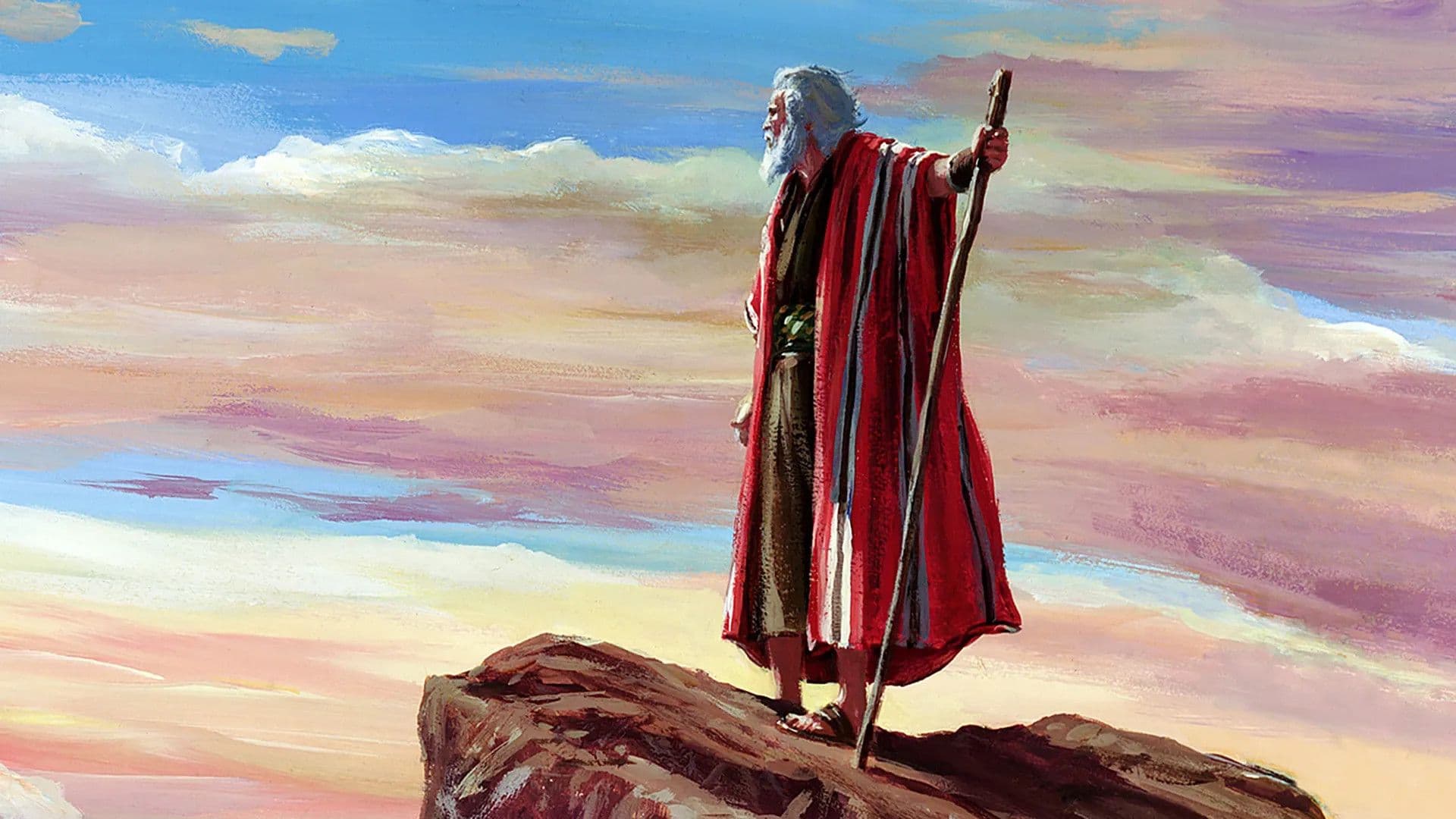
<p>Deuteronomy concludes with a short note on Moses’s death and the passing of authority to Joshua. The description of Moses’s death is somewhat enigmatic. Moses ascended Mount Nebo to get a panoramic view of the land the people were about to enter (Deuteronomy 34:1–4). The text then says that he “died in the land of Moab,” but where he was buried is unknown (verses 5–6). Some ancient writers implied that Moses was actually translated. Josephus, for example, “described Moses’ entrance into a cloud and his disappearance, clearly hinting at his translation.”<a href="#_ftn1" name="_ftnref1">[1]</a> The Joseph Smith Translation says, “For the Lord took him unto his fathers”—also suggesting translation instead of death (Joseph Smith Translation, Deuteronomy 34:6).</p> <p>In the Book of Mormon, Alma the Younger simply left the land of Zarahemla and was never heard of again (see Alma 45:18). As with Moses, this led to later speculation about what really happened to Alma, and it was rumored that “he was taken up by the Spirit, or buried by the hand of the Lord, even as Moses” (Alma 45:19).</p> <p> </p> <p><a href="#_ftnref1" name="_ftn1">[1]</a> D. Kelly Ogden and Andrew C. Skinner, <em>Verse by Verse: The Old Testament</em>, vol. 1 of 2 (Salt Lake City, UT: Deseret Book, 2013), 324–325.</p> <p> </p> <p><strong>Author:</strong> Neal Rappleye<br /><strong>General Editor:</strong> Taylor Halverson<br /><strong>Associate Editor:</strong> Morgan Tanner<br /><strong>Senior Editor:</strong> Sarah Whitney Johnson<br /><strong>Assistant Editor:</strong> Sam Lofgran<br /><strong>Assistant Editor:</strong> Verlanne Johnson</p>
Old Testament Minute: Deuteronomy by BMC
Deuteronomy 34:7–8. Moses’s 120-Year Life Span
<p>Moses was 120 years old when he died, which was a symbolic number that represented three times forty. Moses’s life can be divided neatly into three forty-year periods, as D. Kelly Ogden and Andrew C. Skinner explained:</p> <ol> <li>Forty years as <em>prince</em>, when he received education and leadership training and discovered his life’s mission</li> <li>Forty years as <em>pastor</em> or shepherd, when he learned the work of shepherding, received the priesthood, began raising a family, and met with God</li> <li>Forty years as <em>prophet</em>, when he experienced many trials, overcame personal weaknesses, and performed a noble ministry of preparing himself and his people to return to God<a href="#_ftn1" name="_ftnref1">[1]</a></li> </ol> <p> </p> <p><a href="#_ftnref1" name="_ftn1">[1]</a> D. Kelly Ogden and Andrew C. Skinner, <em>Verse by Verse: The Old Testament</em>, vol. 1 of 2 (Salt Lake City, UT: Deseret Book, 2013), 325.</p> <p> </p> <p><strong>Author:</strong> Neal Rappleye<br /><strong>General Editor:</strong> Taylor Halverson<br /><strong>Associate Editor:</strong> Morgan Tanner<br /><strong>Senior Editor:</strong> Sarah Whitney Johnson<br /><strong>Assistant Editor:</strong> Sam Lofgran<br /><strong>Assistant Editor:</strong> Verlanne Johnson</p>
Old Testament Minute: Deuteronomy by BMC
Deuteronomy 34:9–12. No Other Prophet like Moses
<p>The authority to lead is passed on to Joshua—Moses had previously “laid his hands upon him” (Deuteronomy 34:9). However, “there arose not a prophet since in Israel like unto Moses, whom the Lord knew face to face” (verse 10). This may seem like a contradiction, especially since earlier, Moses was promised that the Lord would raise up a prophet like him (Deuteronomy 18:15–18). As noted earlier in my commentary, Moses became the prophetic archetype in the Old Testament, and later prophets—including Joshua—were presented as being like him in various ways (see commentary on Deuteronomy 18:9–22). According to Richard Elliott Friedman, “this need not be a contradiction. . . . The passage at the end of the Torah visibly means that no other prophet was as great as Moses. It is simply a linguistic matter: the range of expression ‘to be like someone’ is wide enough to have two meanings (and several more).”<a href="#_ftn1" name="_ftnref1">[1]</a></p> <p>As the New Testament and Latter-day Saint scripture make clear, eventually Jesus rose up as <em>the</em> prophet like Moses in the full and complete sense.<a href="#_ftn2" name="_ftnref2">[2]</a></p> <p> </p> <p><a href="#_ftnref1" name="_ftn1">[1]</a> Richard Elliott Friedman, <em>Commentary on the Torah, with a New English Translation and the Hebrew Text</em> (New York, NY: HarperOne, 2001), 623–624.</p> <p><a href="#_ftnref2" name="_ftn2">[2]</a> See Acts 3:22–23; 1 Nephi 22:20–21; 3 Nephi 20:23.</p> <p> </p> <p><strong>Author:</strong> Neal Rappleye<br /><strong>General Editor:</strong> Taylor Halverson<br /><strong>Associate Editor:</strong> Morgan Tanner<br /><strong>Senior Editor:</strong> Sarah Whitney Johnson<br /><strong>Assistant Editor:</strong> Sam Lofgran<br /><strong>Assistant Editor:</strong> Verlanne Johnson</p>
Old Testament Minute: Deuteronomy by BMC