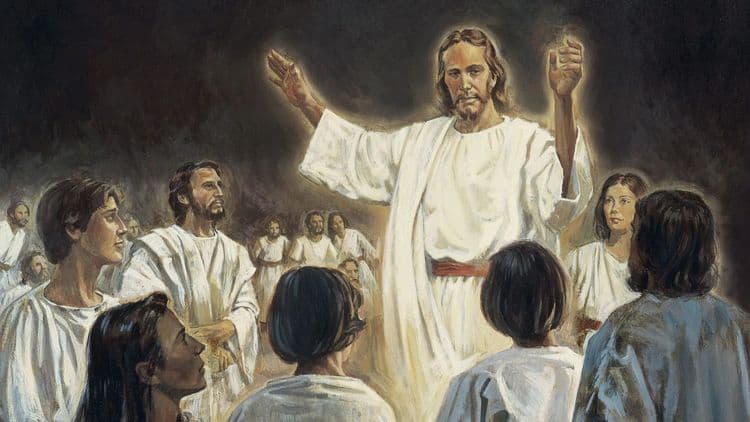
Doctrine and Covenants 137-138
“The Vision of the Redemption of the Dead”
December 1 - December 7
scripture
quotes
Opportunities to Repent
<p>“Each living person can repent. But what about those who have died? They also have opportunities to repent. Scripture declares that ‘the faithful elders of this dispensation, when they depart from mortal life, continue their labors in the preaching of the gospel of repentance … among those who are … under the bondage of sin in the great world of the spirits of the dead.</p> <p>‘The dead who repent will be redeemed, through obedience to the ordinances of the house of God,</p> <p>‘And after they have paid the penalty of their transgressions, and are washed clean, [they] shall receive a reward according to their works.’</p> <p>The Prophet Joseph Smith further revealed that ‘the earth will be smitten with a curse unless there is a welding link of some kind or other between the fathers and the children. … We without [our dead] cannot be made perfect; neither can they without us be made perfect. … [This] dispensation is now beginning to usher in, that a whole and complete and perfect union, and welding together of dispensations, and keys, and powers, and glories should take place.’”</p>
Russell M. Nelson, “Repentance and Conversion,” April 2007 General Conference
Our Responsibilities Towards the Dead
<p>“The Lord went into the spirit world, himself, turned the key for the salvation of the dead and our elders when they pass to the next world, go into that world to continue their labors of preaching the gospel, bringing to repentance all who are willing to repent and receive the truth, that they might come into the kingdom of God (D&C 138:30-35), or as Paul calls it, ‘the family of God in heaven and on earth’ (Eph. 3:15). For it is the family of God. The kingdom of God will be one great family. We call ourselves brothers and sisters. In very deed we become joint heirs with Jesus Christ through the gospel of Jesus Christ, sons and daughters of God, and entitled to the fullness of the blessings of his kingdom if we will repent and keep these commandments.</p> <p>In conclusion I want to read to you one or two statements dealing with our responsibilities towards the dead. First from the Prophet Joseph Smith:</p> <p>‘The greatest responsibility in this world that God has laid upon us, is to seek after our dead’ (Teachings of the Prophet Joseph Smith, p. 356).</p> <p>‘This doctrine was the burden of the scriptures. Those Saints who neglect it, in behalf of their deceased relatives, do it at the peril of their own salvation’ (Ibid., p. 193).</p> <p>‘It is one of the greatest and most important subjects that God has revealed. He should send Elijah to seal the children to the fathers, and the fathers to the children . . . without us, they could not be made perfect, nor we without them; the fathers without the children, nor the children without the fathers . . . I wish you to understand this subject, for it is important’ (Ibid., p. 337).</p> <p>‘We have a work to do just as important in its sphere as the Savior's work was in its sphere. Our fathers cannot be made perfect without us; we cannot be made perfect without them (D&C 128:15). They have done their work and now sleep. We are now called upon to do ours; which is to be the greatest work man ever performed on the earth’ (Brigham Young, Discourses, p. 406).”</p>
Joseph Fielding Smith, “Temple Work,” April 1959 General Conference
commentary
Commentary on D&C 138:32–37
<p>The ordinances and principles of the gospel are the same for the living and the dead. The primary difference in the way the gospel is taught in mortality and in the spirit world is the way the ordinances of the gospel are carried out. For those who have laid down their mortal bodies, a living person acts as proxy in making covenants. The covenants themselves may be accepted or rejected by the deceased, just as they are here on earth. The act of performing a proxy baptism only opens the door to salvation for a departed soul; that soul must choose to enter through the door themselves. </p> <p>On a separate occasion, President Joseph F. Smith taught, “The same principles that apply to the living apply also to the dead. . . . And so we are baptized for those that are dead. The living cannot be made perfect without the dead, nor the dead be made perfect without the living. There has got to be a welding together and a joining together of parents and children and children and parents until the whole chain of God’s family shall be welded together into one chain, and they shall all become the family of God and His Christ.”<a href="#_ftn1" id="_ftnref1" title="" class="see-footnote">[1]</a> Baptism for the remission of sins was instituted in the time of Adam (Moses 6:64–66); however Joseph Fielding Smith explains that vicarious baptism for the dead was only available after the Savior completed His visit to the spirit world, </p> <blockquote> <p>There was no baptism for the dead before the days of the Son of God and until after he had risen from the dead, because he was the first who declared the gospel unto the dead. No one else preached unto the dead until Christ went to them and opened the doors, and from that time for the elders of Israel, who have passed away, have had the privilege of going to the spirit world and declaring the message of salvation.<a href="#_ftn2" id="_ftnref2" title="" class="see-footnote">[2]</a></p> </blockquote> <div class="footnotes"> <p class="footnote"><a href="#_ftnref1" id="_ftn1" title="" class="footnote-label">[1]</a> <em>Teachings of Presidents of the Church: Joseph F. Smith, </em>1998,407–15. </p> <p class="footnote"><a href="#_ftnref2" id="_ftn2" title="" class="footnote-label">[2]</a> Joseph Fielding Smith, <em>Doctrines of Salvation, </em>2:116.</p> </div>
Doctrine and Covenants Minute by Casey Paul Griffiths