Doctrine and Covenants 125-128
“A Voice of Gladness for the Living and the Dead”
November 3 - November 9
scripture
quote
Our Obligation to Our Ancestors
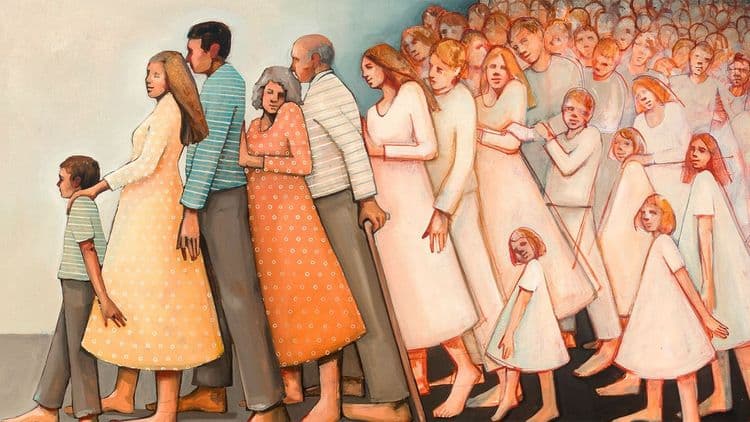
<p>The doctrine of the family in relation to family history and temple work is clear. The Lord in initial revelatory instructions referred to “baptism for your dead” (D&C 127:5). Our doctrinal obligation is to our own ancestors. This is because the celestial organization of heaven is based on families. The First Presidency has encouraged members, especially youth and young single adults, to emphasize family history work and ordinances for their own family names or the names of ancestors of their ward and stake members. We need to be connected to both our roots and branches. The thought of being associated in the eternal realm is indeed glorious.</p>
Quentin L. Cook, “Roots and Branches”, April 2014 General Conference
commentaries
Baptism for the Dead
<p>Years before the Prophet Joseph Smith announced the doctrine of baptism for the dead, glimpses of the glorious principle were revealed to him. In 1836 in an upper room of the Kirtland Temple, the Prophet exclaimed, “I [see] Fathers Adam and Abraham, and my father and mother, [and] my brother, Alvin, that has long since slept.” In reference to Alvin, he “marveled how it was that he had obtained an inheritance in that kingdom, seeing that he had departed this life before the Lord had set His hand to gather Israel the second time, and had not been baptized for the remission of sins.” When Joseph sought clarification as to how his beloved brother could have inherited celestial glory, the voice of the Lord declared, “All who have died without a knowledge of this Gospel, who would have received it if they had been permitted to tarry, shall be heirs of the celestial kingdom of God, ... for I, the Lord, will judge all men according to their works, according to the desires of their hearts” (D&C 137:7, 9).<a id="_ftnref1" class="see-footnote" title="" href="#_ftn1">[1]</a></p> <p>In July 1838, in reply to the query “What has become of all those who have died since the days of the apostles?” Joseph answered, “All these who have not had an opportunity of hearing the gospel, and being administered unto by an inspired man in the flesh, must have it hereafter, before they can be finally judged.”<a id="_ftnref2" class="see-footnote" title="" href="#_ftn2">[2]</a></p> <p>Two years passed before Joseph again spoke of the deceased hearing the gospel of Jesus Christ. The occasion was the funeral for Seymour Brunson, a high councilor and bodyguard of the Prophet. Forty-year-old Brunson died on August 10, 1840, in Joseph Smith’s home. “For awhile he desired to live and help put over the work of the Lord but gave up and did not want to live,” stated his descendants. “After calling his family together, blessing them and bidding them farewell,” he succumbed.<a id="_ftnref3" class="see-footnote" title="" href="#_ftn3">[3]</a></p> <p>On August 15, 1840, his funeral was held at the burial ground overlooking Nauvoo. According to Heber C. Kimball, the procession to the burial ground was “judged to be one mile long.”<a id="_ftnref4" class="see-footnote" title="" href="#_ftn4">[4]</a> Once the processional reached the site, mourners listened as the Prophet Joseph eulogized Seymour Brunson. It is reported that Joseph read 1 Corinthians, chapter 15, where the Apostle Paul was “talking to a people who understood baptism for the dead, for it was practiced among them” (see John 3:5). Then, seeing a widow whose son had died without baptism, the Prophet added, “This widow [had read] the sayings of Jesus ‘except a man be born of water and of the spirit he cannot enter the kingdom of heaven,’ and that ‘not one jot nor tittle of the Savior’s words should pass away, but all should be fulfilled.’”</p> <p>The Prophet Joseph announced that the Saints could now “act for their friends who had departed this life, and that the plan of salvation was calculated to save all who were willing to obey the requirements of the law of God.”<a id="_ftnref5" class="see-footnote" title="" href="#_ftn5">[5]</a> Jane Nyman, whom historians suggest was the widow Joseph saw at the funeral, went down to the Mississippi and was baptized in behalf of her deceased son, Cyrus Livingston Nyman, by Harvey Olmstead.</p> <p>From that time forward, other Saints waded knee-deep into the Mississippi River to be baptized as proxy for their deceased kindred and friends. As for the Prophet Joseph, he continued to receive revelations that clarified the new doctrine. “If the dead rise not at all, why are they then baptized for the dead?” Joseph asked his followers. “If we can, by the authority of the Priesthood of the Son of God, baptize a man in the name of the Father, of the Son, and of the Holy Ghost, for the remission of sins, it is just as much our privilege to act as an agent, and be baptized for the remission of sins for and in behalf of our dead kindred, who have not heard the Gospel, or the fullness of it.”<a id="_ftnref6" class="see-footnote" title="" href="#_ftn6">[6]</a></p> <p>Of the prophet’s teachings on baptism for the dead, Wilford Woodruff penned, “I remember well the first time I read the revelation given through the Prophet Joseph concerning the redemption of the dead—one of the most glorious principles I had ever become acquainted with on earth. ... Never did I read a revelation with greater joy than I did that revelation.”<a id="_ftnref7" class="see-footnote" title="" href="#_ftn7">[7]</a></p> <div class="footnotes"> <p class="footnote"><a id="_ftn1" class="footnote-label" title="" href="#_ftnref1">[1]</a> Smith, <em>History of the Church</em>, 2:380</p> <p class="footnote"><a id="_ftn2" class="footnote-label" title="" href="#_ftnref2">[2]</a> Elders’ <em>Journal</em> 1 (July 1838), 43.</p> <p class="footnote"><a id="_ftn3" class="footnote-label" title="" href="#_ftnref3">[3]</a> Arlene Bishop Hecker, “History of Seymour Brunson,” 4. Church History Library.</p> <p class="footnote"><a id="_ftn4" class="footnote-label" title="" href="#_ftnref4">[4]</a> Andrew F. Ehat and Lyndon W. Cook, <em>The Words of Joseph Smith </em>(Provo, UT: Religious Studies Center, Brigham Young University, 1980), 49.</p> <p class="footnote"><a id="_ftn5" class="footnote-label" title="" href="#_ftnref5">[5]</a> Simon Baker, reporting a discourse given by Joseph Smith on August 15, 1840, in Nauvoo, Illinois; in Journal History of The Church of Jesus Christ of Latter-day Saints, August 15, 1840; see Smith, History of the Church, 4:231.</p> <p class="footnote"><a id="_ftn6" class="footnote-label" title="" href="#_ftnref6">[6]</a> Smith, History of the Church, 4:569.</p> <p class="footnote"><a id="_ftn7" class="footnote-label" title="" href="#_ftnref7">[7]</a> Wilford Woodruff, Journal, April 6, 1891. Church History Library.</p> </div>
Insights and Stories of the Doctrine and Covenants by Susan Easton Black
Commentary on D&C 127:5–12
<p>The Saints enthusiastically embraced the doctrine of baptisms for the dead when it was introduced on August 10, 1840. A few weeks after Joseph Smith introduced the ordinance, he wrote to the Twelve Apostles in England to explain the new practice: “The saints have the privilege of being baptized for those of their relatives who are dead, who they feel to believe would have embraced the gospel if they had been privileged with hearing it, and who have received the gospel in the spirit through the instrumentality of those who may have been commissioned to preach to them while in the prison. Without enlarging on the subject you will undoubtedly see its consistency, and reasonableness, and [it] presents the gospel of Christ in probably a more enlarged scale than some have received it.”<a href="#_ftn1" id="_ftnref1" title="" class="see-footnote">[1]</a></p> <p>We do not know precisely when the first proxy baptisms took place in Nauvoo, but the first documented baptism for the dead was performed on September 12, 1840. Jane Neyman requested that Harvey Olmstead baptize her in behalf of her son Cyrus Livingston Neyman, who was deceased. Vienna Jacques served as a witness for the baptism by riding her horse into the water so she could hear and watch the ordinance. Shortly after the baptism was performed, Joseph Smith gave his approval to the ordinance.<a href="#_ftn2" id="_ftnref2" title="" class="see-footnote">[2]</a></p> <p>As with any new practice, the Saints soon encountered questions that required refinements to the way baptisms for the dead were performed. In a revelation received in January 1841, the Lord instructed that baptisms for the dead needed to be performed inside the temple (D&C 124:30–39). However, while the temple was under construction, the Saints were allowed to perform baptisms in the nearby Mississippi River. These first baptisms were carried out in a haphazard and unsystematic manner. Wilford Woodruff later recalled going to the river along with Joseph Smith and other Church members to perform baptisms for the dead. They baptized hundreds of people, but no one was assigned to record the names of the deceased who were baptized. President Woodruff later remembered, “The Lord told Joseph that he must have recorders present at these baptisms—men who could see with their eyes and hear with their ears, and record these things. Of course, we had to do the work over again. Nevertheless, that does not say that work was not of God.”<a href="#_ftn3" id="_ftnref3" title="" class="see-footnote">[3]</a></p> <p>In a discourse to the Nauvoo Relief Society recorded on August 21, 1842, “Pres[ident]. S[mith] said he had one remark to make respecting the baptism for the dead—to suffice for the time being, until he has opportunity to discuss the subject to greater length—that is, all persons baptized for the dead must have a Recorder present, that he may be an eyewitness to testify of it. It will be necessary in the grand Council, that these things be testified—let it be attended to from this time, but if there is any lack[,] it may be at the expense of our friends—they may not come forth.”<a href="#_ftn4" id="_ftnref4" title="" class="see-footnote">[4]</a> From this small beginning in Nauvoo, Church members have labored to create a record of all the proxy ordinances performed in this dispensation. In section 127 Joseph also recorded the words of the Lord: “I am about to restore many things to the earth, pertaining to the priesthood, saith the Lord of Hosts” (D&C 127:8). Baptisms for the deceased represented only the beginning of the great work of redeeming the dead. </p> <div class="footnotes"> <p class="footnote"><a href="#_ftnref1" id="_ftn1" title="" class="footnote-label">[1]</a> Letter to Quorum of the Twelve, 15 December 1840, p. 6, JSP. </p> <p class="footnote"><a href="#_ftnref2" id="_ftn2" title="" class="footnote-label">[2]</a> See Alexander L. Baugh, “‘For This Ordinance Belongeth to My House’: The Practice of Baptism for the Dead outside the Nauvoo Temple,” <em>Mormon Historical Studies, </em>vol. 3, no. 1 (2002), 48. </p> <p class="footnote"><a href="#_ftnref3" id="_ftn3" title="" class="footnote-label">[3]</a> <em>Millennial Star, </em>June 29, 1891, 405. </p> <p class="footnote"><a href="#_ftnref4" id="_ftn4" title="" class="footnote-label">[4]</a> Minutes and Discourse, 31 August 1842, p. 83, JSP. </p> </div>
Doctrine and Covenants Minute by Casey Paul Griffiths