Doctrine and Covenants 124
“A House unto My Name”
October 27 - November 2
scripture
quote
The Gospel and Rulers
<p>“Let us note that the kings and rulers and potentates and VIPs are not exempt from listening to this gospel, and we take the gospel to them and make special efforts for them.”</p>
Spencer W. Kimball, “Living the Gospel in the Home,” April 1978 General Conference
commentaries
D&C 124: Historical Context
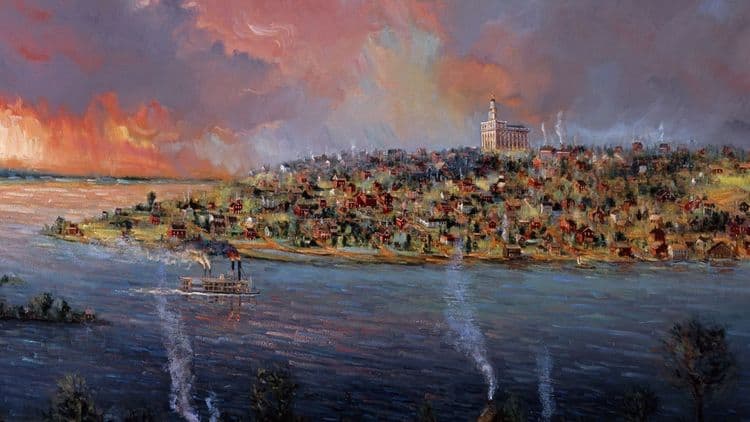
<p>Following their forced exodus from Missouri, the Latter-day Saints regrouped in Illinois as refugees on the banks of the Mississippi River. Joseph Smith and his companions were freed from their captivity in Liberty Jail on April 16, 1839, and joined the Saints a few days later. Dimick Huntington, who was at the docks when Joseph Smith arrived, later vividly described Joseph’s appearance after months of confinement in Liberty Jail. The Prophet “was dressed in an old pair of boots, full of holes, pants torn [and] tucked inside of boots.” He “had not been shaved for some time” and wore a “blue cloak with collar turned up, wide brim black hat, rim sopped down.” Huntington finished his description by adding that Joseph “looked pale and haggard.”<a href="#_ftn1" id="_ftnref1" title="" class="see-footnote">[1]</a> In many ways, the Prophet’s gaunt appearance was a metaphor for the state of the Church after the trials of Missouri. Most Church members lost nearly everything, and the future was uncertain.</p> <p>Joseph Smith and other Church leaders moved quickly to find a new gathering place for the Saints. The citizens of Quincy, Illinois, offered temporary refuge and relief from the persecutions of Missouri while Church leaders began looking at available land nearby for a new home. After viewing properties in Lee County, Iowa, and Hancock County, Illinois, Church agents purchased thousands of acres of land in both counties for a new headquarters for the Church<a href="#_ftn2" id="_ftnref2" title="" class="see-footnote">[2]</a> and laid out a new city on a peninsula that jutted into the Mississippi River. Commerce, as it was then known, was mostly malarial swampland. Willard Richards later wrote that “there were 1 stone house[,] 3 frame hou[s]es & two block hou[s]es which constitu[t]ed the whole city of Commerce . . . the place was literally a wilderness.”<a href="#_ftn3" id="_ftnref3" title="" class="see-footnote">[3]</a> However, the Saints saw the location with an eye of faith. In April 1840 the name was officially changed to <em>Nauvoo</em>, a Hebrew word meaning “beautiful.” Nauvoo served as Church headquarters from 1839–46.<a href="#_ftn4" id="_ftnref4" title="" class="see-footnote">[4]</a></p> <p>Doctrine and Covenants 124 was received nearly two years after Joseph Smith and his companions escaped from Liberty Jail. We know little about the specific context of the revelation, but it was received only a few days after the state of Illinois passed an act to officially incorporate the city of Nauvoo.<a href="#_ftn5" id="_ftnref5" title="" class="see-footnote">[5]</a> Thus, Doctrine and Covenants 124 acts in many ways as a spiritual charter for the city of Nauvoo. The revelation also served as a set of instructions for reconstructing the Church after the heavy toll exacted by the Kirtland apostasy and the Missouri persecutions. The revelation affirms the importance of the gathering (verse 2) and the centrality of the temple in the spiritual life of the Saints (verses 45–55). It includes directions for reorganizing many of the leading quorums of the Church and for calling new leaders to replace those lost to death or apostasy (verses 84–145). It also contains the first reference in the Doctrine and Covenants to the practice of proxy baptisms for the deceased (verses 37–44). Joseph Smith worked to fulfill the commandments given in this revelation for nearly every waking moment of his life until his death in June 1844.<a href="#_ftn6" id="_ftnref6" title="" class="see-footnote">[6]</a> </p> <p>Doctrine and Covenants 124 also marks the beginning of the Nauvoo period in the history of the Church, a time ripe with change and controversy. Many of the crowning doctrines and practices of the Church came through revelation during this time. The Nauvoo era is filled with some of the most exciting and most tragic moments in the history of the Church. Doctrine and Covenants 124 was read in the April 1844 general conference of the Church. It was also published in the Church’s Nauvoo newspaper, <em>Times and Seasons, </em>as well as in the September 1841 issue of the <em>Latter-day Saints’ Millennial Star, </em>the Church’s newspaper in England.<a href="#_ftn7" id="_ftnref7" title="" class="see-footnote">[7]</a> It was first included in the 1844 edition of the Doctrine and Covenants.<a href="#_ftn8" id="_ftnref8" title="" class="see-footnote">[8]</a> </p> <p>See “Historical Introduction,” Revelation, 19 January 1841 [D&C 124].</p> <div class="footnotes"> <p class="footnote"><a href="#_ftnref1" id="_ftn1" title="" class="footnote-label">[1]</a> Quoted in Anthony Sweat, <em>Repicturing the Restoration, </em>2020, 134–35. </p> <p class="footnote"><a href="#_ftnref2" id="_ftn2" title="" class="footnote-label">[2]</a> Lyndon W. Cook, <em>The Revelations of the Prophet Joseph Smith, </em>1985, 242. </p> <p class="footnote"><a href="#_ftnref3" id="_ftn3" title="" class="footnote-label">[3]</a> “Historical Introduction,” Revelation, 19 January 1841 [D&C 124], fn. 2, JSP. </p> <p class="footnote"><a href="#_ftnref4" id="_ftn4" title="" class="footnote-label">[4]</a> “Nauvoo, Illinois,” reference material, JSP. See also Letterbook 2, p. 135, JSP. </p> <p class="footnote"><a href="#_ftnref5" id="_ftn5" title="" class="footnote-label">[5]</a> Act to Incorporate the City of Nauvoo, 16 Dec. 1840, p. 286, JSP. </p> <p class="footnote"><a href="#_ftnref6" id="_ftn6" title="" class="footnote-label">[6]</a> Cook, <em>Revelations of the Prophet Joseph Smith, </em>243. </p> <p class="footnote"><a href="#_ftnref7" id="_ftn7" title="" class="footnote-label">[7]</a> “Minutes of the General Conference,” <em>Times and Seasons,</em> Apr. 15, 1841, 2:386; “Revelation to J. Smith,” <em>LDS Millennial Star,</em> Sept. 1841, 2:67–69. </p> <p class="footnote"><a href="#_ftnref8" id="_ftn8" title="" class="footnote-label">[8]</a> Robert J. Woodford, <em>Historical Development of the Doctrine and Covenants, </em>1974, 3:1626.</p> </div>
Doctrine and Covenants Minute by Casey Paul Griffiths
Commentary on D&C 124:1–14
<p>The first commandment given in section 124 is to make a solemn proclamation</p> <blockquote> <p>to all the kings of the world, to the four corners thereof, to the honorable president-elect, and the high-minded governors of the nation in which you live, and to all the nations of the earth scattered abroad” (D&C 124:3). The proclamation was not completed in Joseph Smith’s lifetime, though he did make several attempts to complete it. His efforts were hindered by the death of Joseph’s assistant, Robert B. Thompson, who was commanded to assist in writing the proclamation (D&C 124:12). The proclamation was also delayed by the apostasy of John C. Bennett and William Law, who were also commanded to assist with it (D&C 124:16, 107).</p> </blockquote> <p>Joseph Smith began work on the proclamation on December 22, 1841, in accordance with the instructions given in Doctrine and Covenants 124.<a id="_ftnref1" class="see-footnote" title="" href="#_ftn1">[1]</a> However, by November 21, 1844, the proclamation was still not complete, and Joseph “instructed Elders [Willard] Richards, [Orson] Hyde, [John] Taylor and [William W.] Phelps to write a proclamation to the Kings of the earth.”<a id="_ftnref2" class="see-footnote" title="" href="#_ftn2">[2]</a> In 1863 William W. Phelps reported that he was commissioned in May 1844 to write the proclamation under the direction of Joseph Smith. He produced twenty-two pages, but the project was dropped in the aftermath of Joseph Smith’s martyrdom in June 1844.<a id="_ftnref3" class="see-footnote" title="" href="#_ftn3">[3]</a> The proclamation was finally completed by the Quorum of the Twelve Apostles in 1845 and published to the world.</p> <p>The finished proclamation was written by Parley P. Pratt on behalf of the Quorum of the Twelve. It was published in Liverpool, England, under the title “Proclamation of the Twelve Apostles of the Church of Jesus Christ of Latter-day Saints.” It began by announcing: “That the kingdom of God has come: as has been predicted by ancient prophets, and prayed for in all ages; even that kingdom which shall fill the whole earth, and shall stand for ever . . . Being established in these last days for the restoration of all things spoken by the prophets since the world began; and in order to prepare the way for the coming of the Son of Man.”<a id="_ftnref4" class="see-footnote" title="" href="#_ftn4">[4]</a></p> <div class="footnotes"> <p class="footnote"><a id="_ftn1" class="footnote-label" title="" href="#_ftnref1">[1]</a> JS Journal, December 1841–December 1842, p. 36, JSP.</p> <p class="footnote"><a id="_ftn2" class="footnote-label" title="" href="#_ftnref2">[2]</a> JS History, vol. E-1, p. 1779, JSP.</p> <p class="footnote"><a id="_ftn3" class="footnote-label" title="" href="#_ftnref3">[3]</a> Lyndon W. Cook, <em>The Revelations of the Prophet Joseph Smith, </em>1985, 243.</p> <p class="footnote"><a id="_ftn4" class="footnote-label" title="" href="#_ftnref4">[4]</a> “Proclamation of the Twelve Apostles of the Church of Jesus Christ of Latter-day Saints,” 1845, accessed June 14, 2021, <a href="https://archive.bookofmormoncentral.org/content/proclamation-twelve-apostles-church-jesus-christ-latter-day-saints">https://archive.bookofmormoncentral.org/content/proclamation-twelve-apostles-church-jesus-christ-latter-day-saints</a>.</p> </div>
Doctrine and Covenants Minute by Casey Paul Griffiths