Doctrine and Covenants 121-123
“O God Where Art Thou”
October 20 - October 26
scripture
quote
I Will Not Forsake Thee
<p>“Many of you are now passing through physical, mental, and emotional trials that could cause you to cry out as did one great and faithful servant of God I knew well. His nurse heard him exclaim from his bed of pain, ‘When I have tried all my life to be good, why has this happened to me?’ ... There seems to me no better answer to the question of why trials come and what we are to do than the words of the Lord Himself, who passed through trials for us more terrible than we can imagine. ... You and I have faith that the way to rise through and above trials is to believe that there is a ‘balm in Gilead’ and that the Lord has promised, ‘I will not … forsake thee.’”</p>
Henry B. Eyring, “Mountains to Climb,” April 2012 General Conference
commentaries
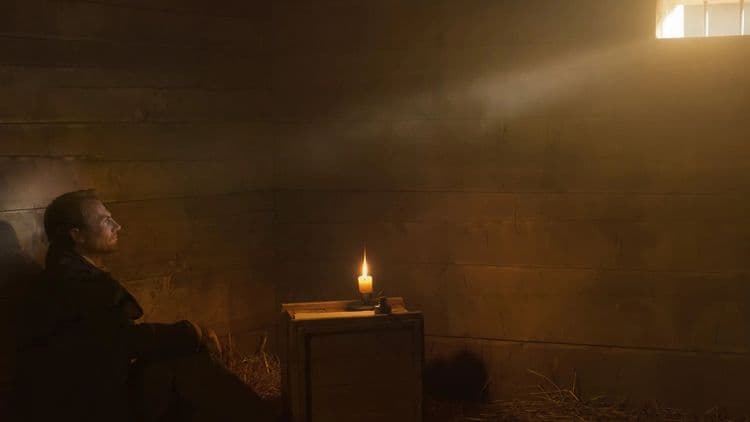
Section 122 Context
<p>Section 122 immediately follows the last part of section 121 in Joseph’s March 20, 1839, letter from Liberty Jail.<a href="#_ftn1" id="_ftnref1" title="" class="see-footnote">[1]</a> Several of the statements in it refer to his personal experiences. Verses 6–7, for example, evoke the awful events in Far West, Missouri, the preceding fall as Joseph was wrenched from his family, sentenced to execution, <em>later</em> charged with treason, and confined in the “pit”—the underground cell in Liberty, Missouri. </p> <p>The revelation compounds Joseph’s suffering in heavy <em>if </em>statements that build to an unbearable crescendo, as if they were rocks piling on his body or lashes across his bare back. The Lord does all that to make two profound points, communicated in what must have been, especially juxtaposed with what proceeded it, a reassuring voice of a loving Father: “Know thou, my son, that all these things shall give thee experience, and shall be for thy good.” </p> <p>The revelation made the second point to Joseph by posing the profound question of verse 8: “The Son of Man hath descended below them all. Art thou greater than he?” The “therefore what?” follows as Joseph is encouraged to hold on and fear not and is promised the priesthood forever and life until his work on earth is finished.</p> <p>Joseph wanted Emma to be first to read his long letter, and he pled with her in a letter the following day to have it copied immediately and circulated to the leaders of the Church and his parents. Though the letter from which sections 121–23 derives exhibited the limits of Joseph’s schooling, he regarded it as the vessel of some of the most profound revelation he received and some of the best counsel he ever gave. The parts that became sections 121 and 122 reoriented and motivated Joseph, have had a similar effect on many others, and continue to be a primary source of Latter-day Saint resolve to this day to keep the faith in the face of adversity.</p> <p>In a dark, confined space he was powerless to escape, Joseph pled “how long” with an implied “why?” From his timeless and infinite vantage, the Lord answered “a small moment” and because “all these things shall give thee experience” (D&C 121:7; 122:7). These words “turned the raw Missouri experience into a theology of suffering” that made sense from God’s perspective. Liberty Jail, in effect, served Joseph as a microcosm of life in a telestial world, a dog-eat-dog sphere of power-seeking, aspiration, materialism, and unrighteous dominion. There, in that hell, Joseph was powerless. Or was he? </p> <p>B. H. Roberts called the jail </p> <blockquote> <p>more temple than prison, so long as the Prophet was there. It was a place of meditation and prayer. A temple, first of all, is a place of prayer; and prayer is communion with God. It is the “infinite in man seeking the infinite in God.” Where they find each other, there is holy sanctuary—a temple. Joseph Smith sought God in this rude prison, and found him.<a href="#_ftn2" id="_ftnref2" title="" class="see-footnote">[2]</a></p> </blockquote> <p>As a result, sections 121–122 endowed Joseph with power. While the bounds of his enemies were set, Joseph would always have the priesthood (D&C 122:9). His oppressors, those who used their supposed power and influence to hurt, take, abuse, insult, misrepresent, and compel would be cursed, lose their posterity, and be severed from the temple and, thus, confidence in the presence of God. It was they who were powerless to “hinder the Almighty from pouring down knowledge from heaven upon the heads of the Latter-day Saints” (D&C 121:33). The powerful on earth would, in a small moment, be impotent while Joseph and the faithful would reign with gentleness, meekness, and by love unfeigned forever and ever (vv. 41, 46). </p> <p>These divine explanations helped Joseph see as if from God’s eyes that things were not as they seemed. Section 122 made sense of suffering. Mankind was on earth to gain “experience.” “The word ‘experience’ suggested that life was a passage. The enduring human personality was being tested. Experience instructed. Life was not just a place to shed one’s sins but a place to deepen comprehension by descending below them all.” In sum, sections 121–22 taught Joseph that “the Missouri tribulations were a training ground” for godhood.<a href="#_ftn3" id="_ftnref3" title="" class="see-footnote">[3]</a> Hell, it turned out, could serve as a temple, a place to be endowed with God’s heart and mind in anticipation of assuming His “everlasting dominion” (D&C 121:46). </p> <p>Joseph came to understand this because of his “experience” in Liberty. He wrote from that stinking but sacred space, “It seems to me that my heart will always be more tender after this than ever it was before.” He recognized that trials “give us that knowledge to understand the minds of the Ancients,” like Abraham, who typified the Savior’s unequaled unjust suffering. “For my part,” Joseph wrote, “I think I never could have felt as I now do if I had not suffered the wrongs that I have suffered.”<a href="#_ftn4" id="_ftnref4" title="" class="see-footnote">[4]</a></p> <p>Renewed certainty resulted from these revelations. The day after he dictated them, Joseph still did not know how long he would be in jail, but he wrote to Emma that since he knew “for a certainty of eternal things, if the heavens linger it is nothing to me.”<a href="#_ftn5" id="_ftnref5" title="" class="see-footnote">[5]</a> After he finally escaped from Missouri a few weeks later, Joseph seemed the most determined soul on earth. He knew what he had to do and nothing could stop him. His days were not only known but numbered, and with them he pursued a course to mentor the apostles and give them the priesthood keys he had received from ministering angels, build a temple, and begin offering the ordinances of exaltation to the faithful. </p> <p>As a result of these revelations, Joseph emerged from his darkest unbroken, undaunted, and with his eyes fixed on eternity. So long as he saw the world through section 122, he could press forward, coping with any experience, come what may. </p> <div class="footnotes"> <p class="footnote"><a href="#_ftnref1" id="_ftn1" title="" class="footnote-label">[1]</a> “<a href="https://www.josephsmithpapers.org/paper-summary/letter-to-the-church-and-edward-partridge-20-march-1839/1" target="_blank">Letter to the Church and Edward Partridge, 20 March 1839</a>,” The Joseph Smith Papers, accessed December 5, 2020. </p> <p class="footnote"><a href="#_ftnref2" id="_ftn2" title="" class="footnote-label">[2]</a> B. H. Roberts, <em>A Comprehensive History of The Church of Jesus Christ of Latter-day Saints </em>(Salt Lake City: Deseret News Press, 1930), 1:526.</p> <p class="footnote"><a href="#_ftnref3" id="_ftn3" title="" class="footnote-label">[3]</a> Richard Lyman Bushman, <em>Joseph Smith: Rough Stone Rolling</em> (New York: Knopf, 2005), 380.</p> <p class="footnote"><a href="#_ftnref4" id="_ftn4" title="" class="footnote-label">[4]</a> “<a href="https://www.josephsmithpapers.org/paper-summary/letter-to-presendia-huntington-buell-15-march-1839/1" target="_blank">Letter to Presendia Huntington Buell, 15 March 1839</a>,” p. [1], The Joseph Smith Papers, accessed December 5, 2020. </p> <p class="footnote"><a href="#_ftnref5" id="_ftn5" title="" class="footnote-label">[5]</a> Joseph Smith to Emma Smith, March 21, 1839, Liberty, Missouri, in Dean C. Jessee, editor, <em>Personal Writings of Joseph Smith</em>, 408–409.</p> </div>
D&C Contexts by Steven C. Harper
Commentary on D&C 122:1–4
<p>In a time filled with discouragement, the Lord takes a moment to share His own testimony of the importance of the mission of the Prophet Joseph Smith. While the Church of Jesus Christ is Christ’s Church, Joseph Smith was the Prophet chosen to open the last dispensation. Even though Joseph had flaws and imperfections, we have an obligation to testify, as the Lord did, of the divine mission of the Prophet Joseph Smith. The Lord declares that He will stand by Joseph (D&C 122:4), and so must the Latter-day Saints. </p> <p>President David O. McKay said, “Since childhood it has been very easy for me to believe in the reality of the visions of the Prophet Joseph Smith.”<a href="#_ftn1" id="_ftnref1" title="" class="see-footnote">[1]</a> President McKay’s testimony of Joseph Smith was built on the foundation of the witness of the Prophet shared by his father, Thomas McKay. As a young missionary in Scotland, Thomas McKay experienced severe opposition whenever he shared his testimony of Joseph Smith. “One day he concluded that the best way to reach these people would be to preach just the simple principles, the atonement of the Lord Jesus Christ, the first principles of the gospel, and not bear testimony of the restoration,” President McKay later shared.<a href="#_ftn2" id="_ftnref2" title="" class="see-footnote">[2]</a></p> <p>As the weeks stretched on, Thomas continued to become more and more discouraged. He eventually reached a point when he determined that if he could not rid himself of his feelings of gloominess, it might be better if he returned home. Seeking guidance from God, he went to a cave near the seashore to plead with God to remove the feelings of depression he was struggling with. He pleaded, “Oh, Father, what can I do to have this feeling removed? I must have it lifted or I cannot continue in this work.” President McKay said his father “heard a voice, as distinct as the tone I am now uttering, say, ‘Testify that Joseph Smith is a prophet of God.’ Remembering then what he tacitly had decided six weeks or more before, and becoming overwhelmed with the thought, the whole thing came to him in a realization that he was there for a special mission, and he had not given that special mission the attention it deserved. Then he cried in his heart, ‘Lord, it is enough,’ and went out from the cave.”<a href="#_ftn3" id="_ftnref3" title="" class="see-footnote">[3]</a></p> <p>President McKay later wrote, “As a boy, I sat and heard that testimony from one whom I treasured and honored as you know I treasured no other man in the world, and that assurance was instilled in my youthful soul.”<a href="#_ftn4" id="_ftnref4" title="" class="see-footnote">[4]</a> Just as Thomas McKay learned, the Lord emphasizes the importance of Latter-day Saints sharing their testimony of the divine mission of the Prophet Joseph Smith. </p> <div class="footnotes"> <p class="footnote"><a href="#_ftnref1" id="_ftn1" title="" class="footnote-label">[1]</a> David O. McKay, <em>Gospel Ideals, </em>1953, 524. </p> <p class="footnote"><a href="#_ftnref2" id="_ftn2" title="" class="footnote-label">[2]</a> <em>Teachings of Presidents of the Church: David O. McKay, </em>2003, 91. </p> <p class="footnote"><a href="#_ftnref3" id="_ftn3" title="" class="footnote-label">[3]</a> <em>Teachings: David O. McKay, </em>91. </p> <p class="footnote"><a href="#_ftnref4" id="_ftn4" title="" class="footnote-label">[4]</a> <em>Teachings: David O. McKay,</em> 91. </p> </div>
Doctrine and Covenants Minute by Casey Paul Griffiths