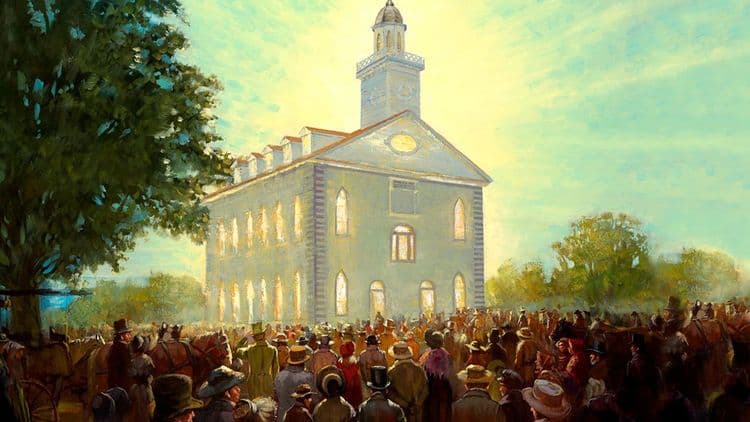
Doctrine and Covenants 109-110
“It Is Thy House, A Place of Thy Holiness”
September 29 - October 5
scripture
quotes
“I Will Manifest Myself”
<p>“During this visitation, the Lord affirmed His identity. He said, ‘I am the first and the last; I am he who liveth, I am he who was slain; I am your advocate with the Father.’ Jesus Christ then declared that He had accepted the temple as His house and made this stunning promise: ‘I will manifest myself to my people in mercy in this house.’ This significant promise applies to every dedicated temple today. I invite you to ponder what the Lord’s promise means for you personally.”</p>
Russell M. Nelson, “Rejoice in the Gift of Priesthood Keys,” April 2024 General Conference
A Real Witness
<p>“Now, as servants of the Lord, we announce and testify that these three visions were as real and true as any ever received by any prophet in any age. There is no room for contention or debate. We are not quoting the Bible to prove what happened any more than Peter turned to the writings of Isaiah to prove he had felt the nail marks in the hands and feet of the risen Lord. We are saying with words of soberness that men in our day have heard the voice of God and seen the visions of eternity, and that the power of God whereby salvation comes is once more held by living apostles and prophets. And all men everywhere have exactly the same obligation to heed and believe our testimony as men had in former days to accept the witness of the prophets of old.”</p>
Bruce R. McConkie, “Our Belief in Christ,” October 1970 General Conference
The Wonderful Blessing of the Sacrament
<p>The section heading to Doctrine and Covenants 110 (D&C 110 Headnote) gives the context for one of our most relevant verses about enjoying arms of safety. On a Sabbath day during the dedication of the Kirtland Temple, the Prophet Joseph Smith explained that he and other priesthood holders had administered the sacrament to the Church.</p> <p>Following this sacred ordinance, Joseph Smith and Oliver Cowdery retired to pray in private. Following the prayer, the Savior appeared to these two men and said, “Behold, your sins are forgiven you; you are clean before me; therefore, lift up your heads and rejoice” (D&C 110:5).</p> <p>The sequence of events in the Kirtland Temple in 1836 parallels our day and is likened to us. Sabbath after Sabbath, you young priesthood holders administer the sacrament to the Saints, who come to sacrament meeting prayerfully, hungering for spiritual healing, hoping, pleading to hear in their minds and hearts these words: “Behold, your sins are forgiven you; you are clean before me; therefore, lift up your heads and rejoice” (D&C 110:5).</p> <p>Elder Dallin H. Oaks has testified that there is a spiritual cleansing or healing associated with the sacrament: “The sacrament of the Lord’s Supper is a renewal of the covenants and blessings of baptism. We are commanded to repent of our sins and come to the Lord with a broken heart and a contrite spirit and partake of the sacrament. In the partaking of the bread, we witness that we are willing to take upon us the name of Jesus Christ and always remember Him and keep His commandments. When we comply with this covenant, the Lord renews the cleansing effect of our baptism. We are made clean and can always have His Spirit to be with us” (“Special Witnesses of Christ,” Liahona, Apr. 2001, 14; Ensign, Apr. 2001, 13).</p>
Jay E. Jensen, “Arms of Safety”, October 2008 General Conference
commentary
Section 110 Context
<p>April 3, 1836, was the second-greatest Easter Sunday in history. Joseph attended an afternoon sacrament meeting in the temple at Kirtland. When it ended, he and Oliver Cowdery retreated behind the heavy curtains used to divide the room. They bowed in what Joseph’s journal describes as “solemn, but silent prayer to the Most High.” Then they beheld a series of visions.<a id="_ftnref1" class="see-footnote" title="" href="#_ftn1">[1]</a></p> <p>First, they saw and heard the Lord standing before them. Four times, in a voice like rushing water, he declared, “I am,” evoking Old Testament revelations in which he repeatedly identified himself by saying, “I am the Lord your God” (see Exodus 20 and Leviticus 19). It seems like he meant to evoke the related words of the Hebrew verb for <em>to be</em> and the name transliterated into English as “Jehovah.” In other words, the Lord Jesus Christ was declaring that he is the God who told Moses to tell the Israelites that "I AM hath sent me unto you" (Exodus 3:14). Jesus Christ was affirming that he is the God of Israel, the promised Messiah.</p> <p>In a powerful but understated juxtaposition of present and past verb tenses, Christ declares himself the crucified Christ who conquered death. "I am he who liveth. I am he who <em>was</em> slain; I am your advocate with the Father” (D&C 110:4, emphasis added). Who else can say<em> “They killed me, but here </em>I am<em>, in Kirtland, Ohio, forgiving your sins, accepting my temple and promising to visit my people here and pour out an endowment of power from here</em>?”</p> <p>Section 110 fulfills the Lord’s conditional promise to the Saints that if they would move to Ohio and build him a holy house, he would endow them with power in it (see sections 38, 88, and 95). It fulfills section 88’s great and last promise that the sanctified would come into the presence of the Lord. Indeed, Joseph promised the Saints that “on conditions of our obedience,” the Savior had promised “a visit from the heavens to honor us with his own presence.”<a id="_ftnref2" class="see-footnote" title="" href="#_ftn2">[2]</a></p> <p>After the vision of the Savior ended, Moses appeared to Joseph and Oliver and gave them the priesthood keys needed to gather Israel. Next Elias appeared and dispensed keys for the gospel of Abraham, “saying that in us and our seed all generations after us should be blessed” (D&C 110:12). Then Elijah appeared and said that it was time to fulfill a multi-layered prophecy.</p> <p>Through Malachi, the Lord prophesied, “I will send you Elijah the prophet before the coming of the great and dreadful day of the Lord” (Malachi 4:5). Moroni paraphrased and personalized that prophecy for Joseph Smith in 1823 (see section 2). Elijah fulfilled it nearly thirteen years later, as recorded in section 110. Jews had long awaited Elijah’s prophesied return and welcomed him during the Passover <em>Seder</em>. On the very day Elijah appeared in the temple, some Jews were celebrating the sacred meal with the hope that Elijah would return.</p> <p>Moses showing up was pretty impressive too. “His appearance in company with Elijah offers another striking parallel between Mormon teachings and Jewish tradition, according to which Moses and Elijah would arrive together at the ‘end of time.’”<a id="_ftnref3" class="see-footnote" title="" href="#_ftn3">[3]</a></p> <p>Section 110 reenacts the endowment received in the Biblical account of the Mount of Transfiguration (Matthew 17:1–9). Joseph received priesthood keys from the heavenly messengers. He had received all the priesthood when he was ordained by Peter, James, and John years earlier (see D&C 27:12), but he did not have all the keys they had, and which he needed, until after section 110. In other words, Joseph had power but not permission to send missionaries globally or to perform temple ordinances until Moses, Elias, and Elijah brought him the keys—the permission to exercise the priesthood in those ways.</p> <p>Section 110 welds dispensations together. Given on Easter and during the Passover season, the revelation links Israel’s Old Testament deliverance with Christ’s New Testament resurrection and affirms that Joseph Smith and the temple-building Latter-day Saints are the heirs of God’s promises to the Israelite patriarchs. Christ is the Passover lamb who “was slain” and then resurrected and now appears to Joseph in Kirtland, Ohio, to approve of the Latter-day work and to commission Joseph to fulfill the work of Moses (the gathering of Israel), Elias (the gospel of Abraham), and Elijah (the sealing of families).</p> <p>Joseph went to work putting the keys to use, against great opposition. Not long after receiving the keys to gather Israel from Moses, Joseph whispered in Heber Kimball’s ear a mission call to Great Britain. Joseph had previously sent missionaries on short local or regional missions. Heber and his companions began the ongoing process of gathering Israel from the ends of the earth. Though oppressed by what seems like a concerted opposition that included financial collapse, widespread apostasy, an executive order driving the Saints from Missouri, and then unjust imprisonment in Liberty, Missouri, Joseph began to teach and administer the ordinances of the temple. In sum, the endowment of priesthood keys he received on the second-greatest Easter in history authorized him to begin performing temple ordinances.</p> <p>Section 110 communicated temple knowledge and power. It came in the temple, behind a veil, was recorded but not preached, and acted on but not publicly explained.<a class="see-footnote" title="" href="#_ftn4" name="_ftnref4">[4]</a> After the revelation, Joseph used the keys to gather, endow, and seal in anticipation of the Savior’s second coming. Section 110 marks the restoration of temple-related power and knowledge that Moses possessed and “plainly taught” but which had been forfeited by the children of Israel (D&C 84:19–25).</p> <div class="footnotes"> <p class="footnote"><a id="_ftn1" class="footnote-label" title="" href="#_ftnref1">[1]</a> “<a href="https://www.josephsmithpapers.org/paper-summary/journal-1835-1836/195" target="_blank" rel="noopener">Journal, 1835–1836</a>,” 192, The Joseph Smith Papers, accessed November 24, 2020.</p> <p class="footnote"><a id="_ftn2" class="footnote-label" title="" href="#_ftnref2">[2]</a> “<a href="https://www.josephsmithpapers.org/paper-summary/letter-to-william-w-phelps-11-january-1833/1" target="_blank" rel="noopener">Letter to William W. Phelps, 11 January 1833</a>,” The Joseph Smith Papers, accessed November 24, 2020.</p> <p class="footnote"><a id="_ftn3" class="footnote-label" title="" href="#_ftnref3">[3]</a> Stephen D. Ricks, “The Appearance of Elijah and Moses in The Kirtland Temple and the Jewish Passover,” <em>BYU Studies</em> 23:4 (1903): 484.</p> <p class="footnote"><a id="_ftn4" class="footnote-label" title="" href="#_ftnref4">[4]</a> Richard L. Bushman, <em>Joseph Smith: Rough Stone Rolling</em> (New York: Knopf, 2005), 320–321.</p> </div>
D&C Contexts by Steven C. Harper