April 27, 2026
A 1967 Letter Lost and Found: The Discovery of Chiasmus in The Book of Mormon
Post contributed by
Scripture Central
The Book of Leviticus contains one of the most famous instances of chiasmus in the Bible, in Leviticus 24:13-23 (see https://scripturecentral.
Chiasmus is an ancient Hebrew poetry form in which concepts are presented in one order and then in reverse order are presented again. This form served in ancient biblical writing to emphasize a particular idea, which can be found at the passage’s conceptual center. For instance, a short ABBA chiasm can be found in Matthew 23:12: “Whosoever [A] exalts himself [B] shall be abased; and he that [B] shall humble himself [A] shall be exalted.”
While serving a mission in southeastern Germany in 1967, John W. (Jack) Welch began finding chiasms in The Book of Mormon. He had been reading a book on the subject of chiasmus in the Gospel of Matthew, recently published by a Jesuit priest, and then verified those patterns against the text in his German copy of the New Testament. Then, on August 16, as he puts it, “Early that morning—it was still dark outside—I was awakened by the words, ‘If it is evidence of Hebrew style in Matthew, it must be evidence of Hebrew style in the Book of Mormon.’” He got up and began reading where he and his missionary companion had left off reading in the German Book of Mormon the night before, turned one page, and immediately noticed the chiastic word order in Mosiah 5:10-12, as follows:
A And now it shall come to pass, that whosoever shall not take upon him the name of Christ
B must be called by some other name;
C therefore, he findeth himself on the left hand of God
D And I would that ye should remember also, that this is the name that I said I should give unto you
E that never should be blotted out,
F except it be through transgression;
F' therefore, take heed that ye do not transgress,
E' that the name be not blotted out of your hearts.
D' I say unto you, I would that ye should remember to retain the name written always in your hearts,
C' that ye are not found on the left hand of God,
B' but that ye hear and know the voice by which ye shall be called, and also,
A' the name by which he shall call you.
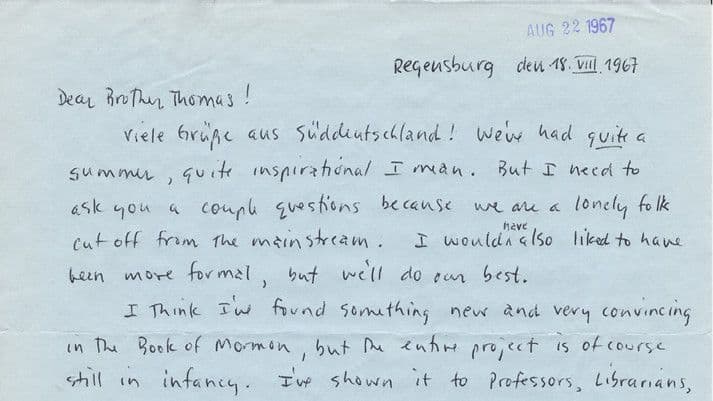
Two days later, on P-day, he wrote two letters. He sent one to his family, which his mother kept and gave to him when he returned home.
The other letter he sent to BYU English Professor Robert K. Thomas, who had been his Book of Mormon teacher his freshman year before his mission. As Jack explains, “I wanted to share my discovery of chiasmus in the Book of Mormon with him immediately and ask if he knew of anyone else coming across something like this.” He received a return letter from Brother Thomas, but until recently did not know what had become of the lengthy letter that he had sent.
While processing Brother Thomas’s administrative papers after his passing, a team at BYU discovered several items that did not look like they belonged in BYU records, but may be of some interest to Brother Thomas’s family. Among those personal items, a member of the family who knew Brother Welch recognized his name on the back of the airmail envelope in which this letter had been mailed over 50 years earlier. The letter was returned to him and has now been published in BYU Studies 64:4, as a remarkable artifact of the discovery of chiasmus in the Book of Mormon. It is an exciting piece of history and an interesting view into the young mind of Brother Welch.
Scans of this 5-page letter, together with helpfully facing transcripts, together with copies of the pages in the German Book of Mormon that were marked up that morning, are also included in this article, entitled “The Newly Found Letter from John W. Welch to Robert K. Thomas Two Days after the Discovery of Chiasmus in the Book of Mormon.” (available free on the BYU Studies website, https://byustudies.byu.edu/