KnoWhy #848 | April 14, 2026
Why Would Anyone Care about Loanwords in the Law of Moses?
Post contributed by
Scripture Central
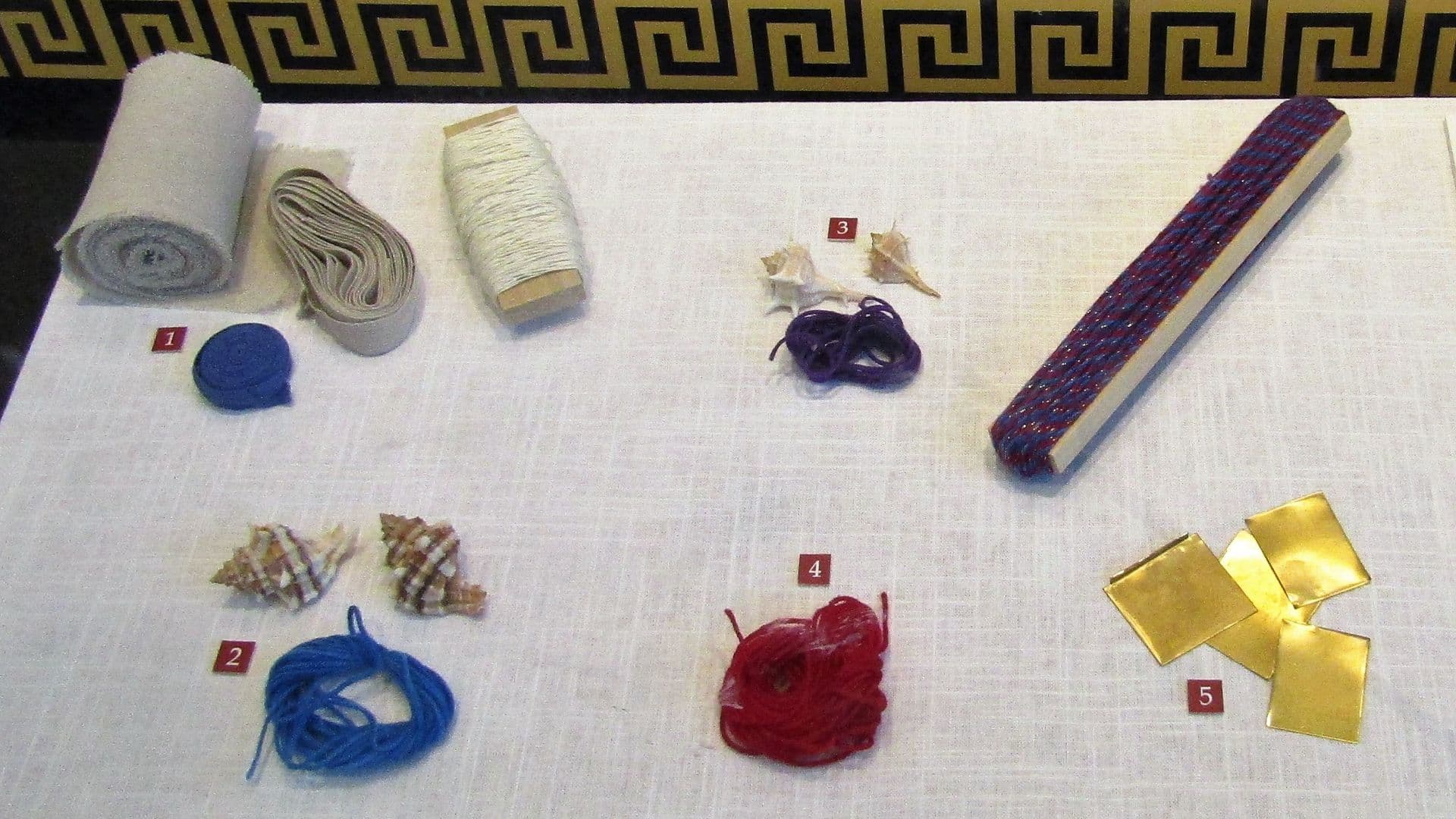
"And they made coats of fine linen of woven work for Aaron, and for his sons, And a mitre of fine linen, and goodly bonnets of fine linen, and linen breeches of fine twined linen.” Exodus 39:27–28
The Know
The exodus of the Hebrews from Egypt likely dates to sometime in the 13th century BC, but much of the language of books like Exodus, Leviticus, and Numbers dates from a later time.1 Some people have used this evidence to argue that much of the material in the Torah was fabricated centuries after the events they describe.2 However, there are some elements of the language of these books that point to an earlier date, just not in the way one might expect at first.
Most languages contain words known as “loanwords,” words that are taken from one language into another. Words like memoir and analogue, for example, are French loanwords that are now part of the English language, reflecting the significant contact between English and French speakers after the French conquest of England in 1066.3 Juggernaut is a Hindi word that made its way into English, showing the significant contact between India and the British Empire.4 Likewise, Biblical Hebrew contains a number of loanwords from languages it came into contact with throughout its history.
Intriguingly, Egyptian is a language from which many loanwords in Hebrew derives. Of course, Hebrew may well have incorporated loanwords from Egyptian at many points throughout its history, as there were many periods of significant contact between these two nations.5 However, specialists who study the Hebrew lexicon have argued that Exodus–Numbers contains an unusually high concentration of Egyptian loanwords compared with the rest of the Hebrew Bible. In one detailed study, Benjamin Noonan counts 27 different Egyptian loanwords in the exodus/wilderness material and says this density is significantly higher than elsewhere in the Hebrew Bible, except in texts that also reflect unusually intense Egyptian contact.
What is also notable is what kind of words they are. They are not mostly abstract theological terms. They are largely concrete material-culture and setting words. For example. Hebrew has two different terms for reeds which are Egyptian loanwords: soof and gomea.6 In a place like ancient Egypt, which revolved around its river system, two different words for reeds makes sense, and the Hebrews may have taken these terms with them when they left. Soof is the term used to describe the reeds by the side of the river where Moses was placed as a baby, as well as the ancient Hebrew term for the area roughly equivalent to our Red Sea, known to them as the Reed Sea.7 Gomea is the term used for the reeds, perhaps papyrus, used to make the ark that the infant Moses floated in by the banks of the river.8 Even the term “ark” tevah in which Moses was placed is likely an Egyptian loanword, as is the pitch the ark is sealed with.9 Later in Exodus, the Hebrew term for the magicians Moses encounters is also an Egyptian loanword.10 The word for Pharaoh is also a loanword and likely comes from the Egyptian term for “great house.”11
The description of the clothes worn by the priests as well as the materials used in the tabernacle contain several Egyptian loanwords. The sash worn by Aaron is described using an Egyptian loanword.12 It also describes the linen used to make the priest’s undergarments using an Egyptian loanword as well.13 Exodus 39:28 similarly describes the turban worn by the high priest as well as his leather vest using an Egyptian term.14 The leather and linen used in the creation of the tabernacle are described using Egyptian loanwords, as is the acacia wood used in its construction.15 The metal plating used to cover the ephod of the priest as well as the altar is also described with an Egyptian loanword.16 The poles used for carrying things like the Ark of the Covenant (Exod 25:13—15), altar (27:6—7), and the table for the Bread of the Presence (Exod 25:27—28) are also described with an Egyptian loanword.17 The vessel—shaped portion of the Tabernacle’s lampstand seen in Exod 25:31,33,34; 37:17. 19—20 is yet another Egyptian loanword.18 A term used for the metal rings used in the Tabernacle (in Exod 25:12, for example) which can also be used more generically for jewelry rings as well (as in Exod 35:22) is of Egyptian origin.19 The bowl for holding the blood which was sprinkled on the altar in Exodus 24:6 is an Egyptian word.20 Even the oven used to make the unleavened bread for the Tabernacle is an Egyptian loanword.21
The precious stones used in the outfit of the high priest in Exodus 28:17-20 are often Egyptian loanwords. Words for red jasper, feldspar, turquoise, an unidentified gemstone thought by some to be peridot, and another completely unknown precious stone are all Egyptian loanwords.22 Units of measurement also reveal Egyptian origins. The ephah, a Hebrew dry measurement similar to a bushel, a cor, which was ten ephah measurements, a length measurement which was the Hebrew equivalent of a span, as well as the hin, yet another liquid volume measurement, all take their names from Egyptian words.23 Even the terms for a produce-basket and a riverboat are Egyptian.24 All these examples are the sort of vocabulary one expects from close contact with Egyptian life and institutions, not from some later writer merely sprinkling in a few exotic names.
Although it is hypothetically possible that these Egyptian terms all came into the Hebrew language later and just happened to be used in the Hebrew Bible in a high concentration in Exodus-Deuteronomy (Egyptian loanwords are by far the most common non-Semitic loanwords in these books) it makes more sense to see these terms as being brought out of Egypt by the Israelites when they left.25
These terms would then have been attached to items which they knew from Egypt or brought with them from Egypt. The high concentration of Egyptian loanwords in these books fits the Egyptian context of the Exodus and wilderness wandering, strongly suggesting that these portions of the Law of Moses were not fabricated out of whole cloth years after the events they proport to describe, but can be traced to memories of items and events close to the time and place they report.
The Why
Perhaps even more significant is what the presence of these loanwords teaches about how the ancient Hebrews approached their Egyptian neighbors. During some periods of Israelite history, authors made a point of never using loanwords.26 However, for the ancient Hebrews who had suffered under Egyptian slavery for so many years, this does not appear to have been a concern.
This is particularly significant when one considers that even important religious terms associated with the high priest were sometimes Egyptian loanwords. This suggests a surprising lack of contempt for the ancient Egyptians on the part of the Hebrews. In a world which is often polarized, examples like this remind modern readers of the importance of not hating outsiders or even one’s enemies, even when such hatred would have been understandable by the standards of the time. This evidence suggests that the ancient Hebrews took the sentiment in Deuteronomy 23:7 to heart, “thou shalt not abhor an Egyptian; because thou wast a stranger in his land.”
Wally Breitenstein, “Exodus 24, 28, 31-34,” in Old Testament Minute: Exodus, edited by Taylor Halverson, Vol. 2 (Book of Mormon Central, 2022).
John Gee, "Edfu and Exodus," Interpreter: A Journal of Latter-day Saint Faith and Scholarship 44 (2021): 271-286.
Donald W. Parry, "Ancient Sacred Vestments: Scriptural Symbols and Meanings," Interpreter: A Journal of Latter-day Saint Faith and Scholarship 48 (2021): 11-32.
- 1. For more on how Hebrew closer to the time of Moses looks, see Brian D. Russell, The Song of the Sea: The Date of Composition and Influence of Exodus 15:1–21 (Peter Lang, 2007), 59.
- 2.For an overview of these issues, see Lester L. Grabbe, Did Moses Speak Attic?: Jewish Historiography and Scripture in the Hellenistic Period (Sheffield Academic Press, 2001).
- 3. Merriam-Webster.com Dictionary, s.v. “memoir,” accessed March 19, 2025, https://www.merriam-webster.com/dictionary/memoir.
- 4. Merriam-Webster.com Dictionary, s.v. “juggernaut,” accessed March 19, 2025, https://www.merriam-webster.com/dictionary/juggernaut.
- 5. Benjamin J. Noonan, Non-Semitic Loanwords in the Hebrew Bible: A Lexicon of Language Contact, 1st ed. (Pennsylvania State University Press, 2019), 21-22.
- 6. Noonan, Non-Semitic Loanwords, 160.
- 7. Noonan, Non-Semitic Loanwords, 160.
- 8. Noonan, Non-Semitic Loanwords, 83.
- 9. For the ark, see Noonan, Non-Semitic Loanwords, 217. For the pitch see Noonan, Non-Semitic Loanwords, 98.
- 10. Noonan, Non-Semitic Loanwords, 102.
- 11. Noonan, Non-Semitic Loanwords, 160.
- 12. See, for example, Exodus 28:4. Noonan, Non-Semitic Loanwords, 35.
- 13. See Exodus 28:42, Lev 6:3; 16:4, 23, 32. Noonan, Non-Semitic Loanwords, 72.
- 14. See Exod 28:32; 39:23. For the turban, see Noonan, Non-Semitic Loanwords, 169. For the leather vest, see Noonan, Non-Semitic Loanwords, 218.
- 15. For Egyptian leather see Exodus 25:5, among others. N Noonan, Non-Semitic Loanwords, 218. For Egyptian linen see, for example, Exodus 25:4. See Noonan, Non-Semitic Loanwords, 215. For acacia see, for example, Exod 25:5, 10, 13, 23, 38. The term is used 26 times. See Noonan, Non-Semitic Loanwords, 208.
- 16. See Exod 39:3; Num 17:3. Noonan, Non-Semitic Loanwords, 173.
- 17. Noonan, Non-Semitic Loanwords, 71-72.
- 18. Noonan, Non-Semitic Loanwords, 79.
- 19. Noonan, Non-Semitic Loanwords, 109.
- 20. Noonan, Non-Semitic Loanwords, 39.
- 21. See, for example, Exod 7:28 (8:3 in the English version); Lev 2:4; 7:9; 11:35; 26:26. Noonan, Non-Semitic Loanwords, 222.
- 22. For red jasper, see Noonan, Non-Semitic Loanwords, 48. For feldspar, see Noonan, Non-Semitic Loanwords, 143. For turquoise, see Noonan, Non-Semitic Loanwords, 153. For the gemstone, see Noonan, Non-Semitic Loanwords, 174. For the unknown precious stone, see Noonan, Non-Semitic Loanwords, 206.
- 23. For the Ephah, see Noonan, Non-Semitic Loanwords, 60. For the hin, see Noonan, Non-Semitic Loanwords, 95. For the span, see Noonan, Non-Semitic Loanwords, 99. For the cor, see Noonan, Non-Semitic Loanwords, 190.
- 24. See, Deut 26:2, 4; 28:5, 17 for the basket. For more on this, see Noonan, Non-Semitic Loanwords, 110. For the riverboat, see Numbers 24:24; see also Noonan, Non-Semitic Loanwords, 189.
- 25. Noonan, Non-Semitic Loanwords, 241.
- 26. The authors of all but one of the Dead Sea Scrolls appear to have scrupulously avoided Greek loanwords, for example. See Florentino Garcia Martinez, ”Greek Loanwords in the Copper Scroll,“ in F. Garcia Martinez and G. P. Luttikhuizen, eds, Jerusalem, Alexandria, Rome: Studies in Ancient Cultural Interaction in Honour of A. Hilhorst (Brill, 2003), 119–45.