KnoWhy #844 | March 17, 2026
Why Were the Hebrews Allowed to Settle in Egypt?
Post contributed by
Scripture Central
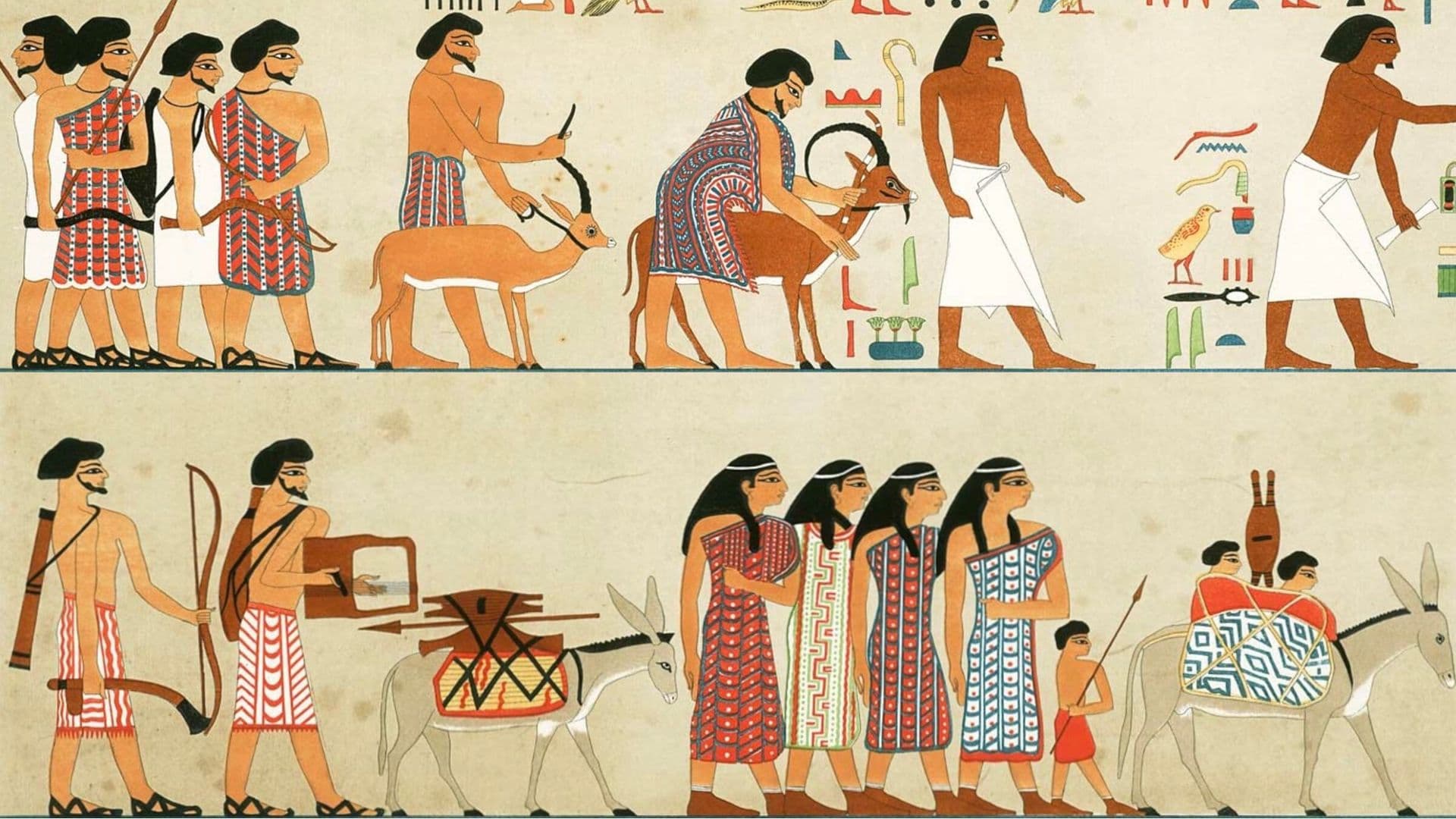
"Now there arose up a new king over Egypt, which knew not Joseph." Exodus 1:8
The Know
Genesis 46:6 states that Jacob and his family went down to Egypt to live there, and 47:27–28 states that they lived in Egypt for many years.1 How were people from Canaan able to move to Egypt and live there for centuries, as the Jacob and his descendants did. An examination of ancient Egyptian evidence makes it clear that many people from Canaan (the western coast of today’s Israel and Lebanon) lived in Egypt during a variety of historical periods, clarifying parts of the biblical story.
One example of Canaanites living in Egypt comes from a group known as the Hyksos. They settled in Egypt over the course of centuries.2 By 1650 B.C., there were so many of these Canaanites living in Egypt that they took over the northern part of that land, inaugurating a period known as the Hyksos Period, which lasted for 100 years.3 These settlers from Canaan brought many of their own traditions with them, combining them with Egyptian customs.4 One finds evidence for the Hyksos from as early as 1890 BC in the tomb of a 12th-dynasty official Khnumhotep II, at Beni Hasan in Egypt.5 A wall relief in this tomb shows a picture of a number of individuals from Canaan, and refers to one of them as Abisha the Hyksos.6 This was around the time that Abraham also was in Egypt.
Although the Hyksos were eventually expelled from Egypt, the Canaanite presence in Egypt is attested at other times as well.7 Sometimes, the people from Canaan who were living in Egypt were enslaved. One list of enslaved people from dynasty 13 found in Egypt gives the names of the enslaved individuals, with more than half of the names are Semitic, meaning that they likely came from Canaan.8 In fact, in some situations, the Egyptian word for someone from the Levant was used to mean “an enslaved person.”9
Especially interesting considering the Joseph narrative in Genesis, some of these enslaved people rose to the position of chamberlain and became important within the leadership of the kingdom.10 Others from Canaan are recorded as having risen to high positions within the religious hierarchy as well. For example, Pas-Baal, a man from Canaan, became the chief draftsman in the temple of Amun, one of the most popular Egyptian gods.11 Another person from Canaan was put in charge of all the king’s building projects, and a man named Ben-Anath became a high-ranking doctor.12 A man named Ben-Ozen, from what would eventually become Israelite territory in Bashan, became the fan-bearer, royal herald, and butler to Rameses II.13 Some people from Canaan rose surprisingly high in the Egyptian court. One of these people, a man named Bay, became the chancellor of Egypt during the reign of Queen Tewosret.14 He is thought by some historians to have been the real power behind the throne from 1188 to 1186 BC.15 Another man named Aper-El similarly appears to have been very influential within Egypt and inscriptions from his tomb suggest that he was a vizier of Egypt, one of the most significant members of the royal court, during part of the 1300’s BC.16 One sees Asiatics from other walks of life in Egypt as well in ancient times. Canaanite butlers and scribes were common during some historical periods.17
Even the seemingly-strange detail of Jacob’s family being given a place where all of them could live together within Egypt has historical parallels. One Pharaoh named Thutmose IV relocated people from Gezer, in the Holy Land, and settled them all in one place.18 There are examples, from roughly the period when the Hebrews would have been in Egypt, of the Pharaoh settling foreigners together as a group in the delta region of Egypt, just as the Hebrews were apparently settled there in the delta. Some of these people were all settled together as a group because of their profession.19 Some records indicate that people from Canaan who participated in various professions such as goldsmiths, coppersmiths, shipwrights, and soldiers, were sometimes settled together as a group in Egypt in ancient times.20 This corresponds well with the idea that the Hebrews, who were shepherds, were given their own little enclave, just as workers in these other professions were.
The Why
The Canaanite connections to Egypt may help illuminate a few things about the Biblical narrative. If Joseph is in Egypt during the Hyksos period, as is often assumed, this could help to make sense of the line in Exodus 1:8 that “there arose a new king over Egypt, who did not know Joseph.” This could literally mean that the Pharaoh who personally knew Joseph passed away, but it could also mean that the Pharaohs who knew Joseph, the Hyksos dynasty, came to an end when the Hyksos were expelled, and that this new conquering Pharaoh was distrustful of all people who were Semites, including the Hebrews as well as the Hyksos. This could then have led to them being enslaved by the Egyptian king.21
In broad terms, this information also helps to understand what happens to the Hebrews. It seems that many people from Canaan settled in ancient Egypt during different times, some of whom were given their own territories to live in, as were the Hebrews. Other people from Canaan were enslaved, but some rose to high prominence. It would not have been unusual or suspicious for the Hebrews to have settled in Egypt, as other groups did so. This suggests that their enslavement at the hands of the Egyptians, which appears to have been sudden, would likely have taken them by surprise, meaning that they likely had to way to prepare to deal with the problems they would face.
Their only way out of their predicament was to do what they would eventually do: call upon God, their heavenly king. As Exodus 2:23 states, “the children of Israel sighed by reason of the bondage, and they cried, and their cry came up unto God by reason of the bondage.” As is sometimes the case for people throughout history who have been oppressed or abused, God was the only being who could help them, and they called to Him for support. This is a reminder of the kind of help that God offers to everyone who calls upon Him, and this encourages us to call upon Him today.
Wally Breitenstein, “Exodus 1-6,” in Old Testament Minute: Exodus, edited by Taylor Halverson (Book of Mormon Central, 2022).
Nahum M. Sarna, “Who Was the Pharaoh Who ‘Knew Not Joseph’?,” Ensign 17, no. 12 (December 1987): 54-57.
Becky Holderness Tilton, "Moses as Midwife: What the Exodus Birth Story Teaches about Motherhood and Christ," Interpreter: A Journal of Latter-day Saint Faith and Scholarship 57 (2023): 209-218
- 1. See also Genesis 15:13; Exodus 12:40–41.
- 2. For more on this, see Manfred Bietak, “The Egyptian Community in Avaris During the Hyksos Period,” Ägypten und Levante 26 (2016): 263–74.
- 3. For an overview, see Carol A. Redmount, “Ethnicity, Pottery, and the Hyksos at Tell El-Maskhuta in the Egyptian Delta,” The Biblical Archaeologist 58, no. 4 (1995): 182–90.
- 4. For an analysis, including a discussion of possible imported military hardware, see Ian Shaw, “Egyptians, Hyksos and Military Technology: Causes, Effects or Catalysts?” in The Social Context of Technological Change: Egypt and the Near East, 1650-1150 BC, edited by Andrew J. Shortland (Oxbow Books, 2001): 59-72.
- 5. Susan Cohen. “Interpretative Uses and Abuses of the Beni Hasan Tomb Painting,” Journal of Near Eastern Studies 74, no. 1 (2015): 30–32.
- 6. Hans Goedicke, “Abi-Sha(i)’s Representation in Beni Hasan.” Journal of the American Research Center in Egypt 21 (1984): 203–10.
- 7. See Redmount “Ethnicity, Pottery, and the Hyksos,” 182–90.
- 8. Carol A. Redmount, “Bitter Lives: Israel In and Out of Egypt,” in The Oxford History of the Biblical World, ed. Michael D. Coogan (Oxford University Press, 1998): 74.
- 9. Redmount, “Bitter Lives,” 75.
- 10. Redmount, “Bitter Lives,” 75.
- 11. Redmount, “Bitter Lives,” 75.
- 12. Redmount, “Bitter Lives,” 75.
- 13. Redmount, “Bitter Lives,” 75.
- 14. Redmount, “Bitter Lives,” 75.
- 15. Redmount, “Bitter Lives,” 75.
- 16. Redmount, “Bitter Lives,” 76.
- 17. Redmount, “Bitter Lives,” 75.
- 18. Redmount, “Bitter Lives,” 76.
- 19. Redmount, “Bitter Lives,” 76.
- 20. Redmount, “Bitter Lives,” 76.
- 21. Nahum M. Sarna, “Who Was the Pharaoh Who ‘Knew Not Joseph’?,” Ensign 17, no. 12 (December 1987): 54-57.