KnoWhy #857 | June 16, 2026
Why Was King Solomon’s Kingdom so Unified and Large?
Post contributed by
Scripture Central
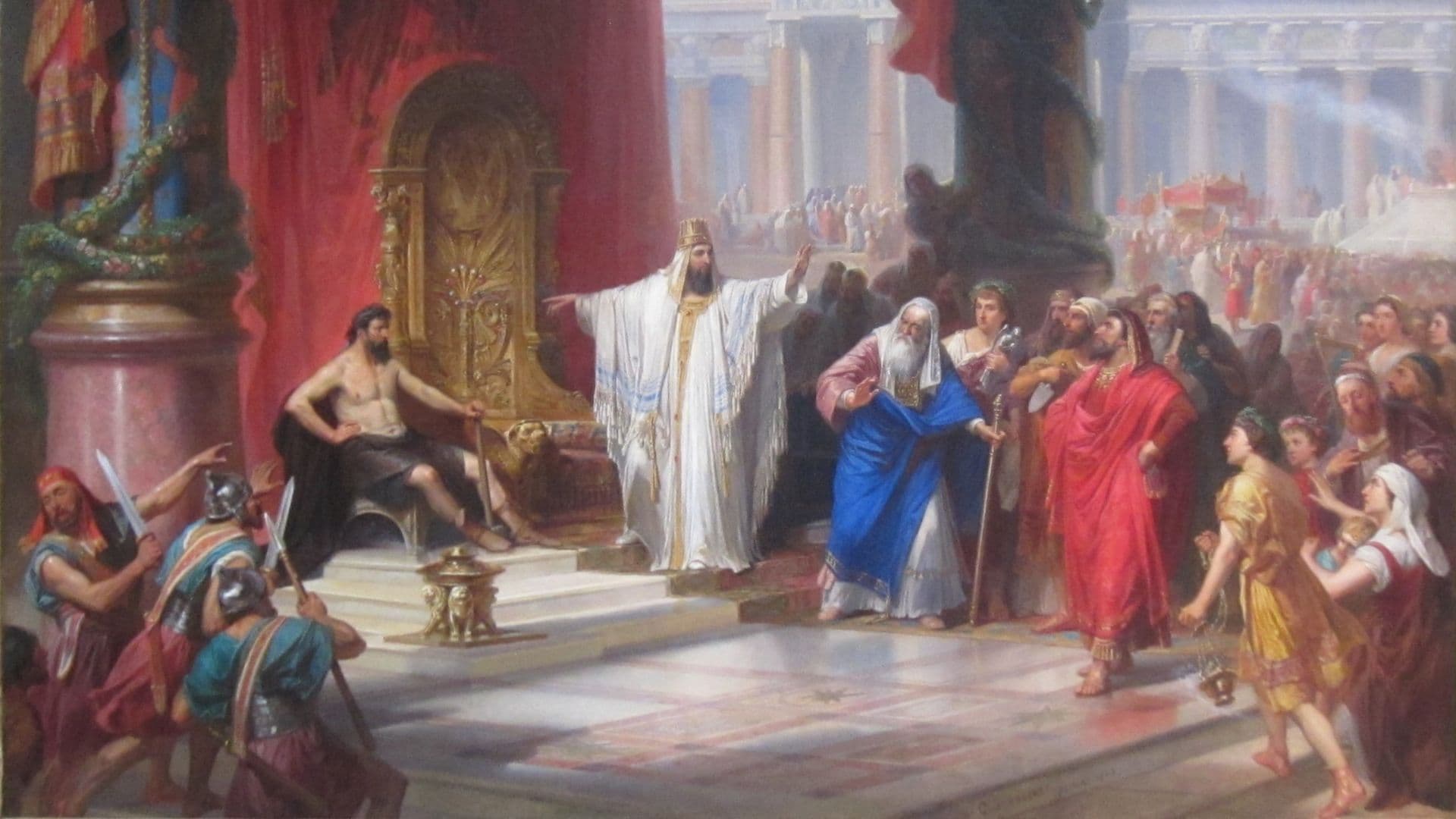
"And Solomon reigned over all kingdoms from the river unto the land of the Philistines, and unto the border of Egypt: they brought presents, and served Solomon all the days of his life." 1 Kings 4:21
The Know
1 Kings 4:21 states that Solomon’s reign covered all kingdoms from “the river,“ the Euphrates, on the north and east, to the land of the Philistines on the west, and to the border of Egypt to the south. The kingdoms in this envelope brought tributes and “served Solomon all the days of his life.” Did Solomon fully control this broader area or did he simply collect tribute from a variety of disunited tribes who all nominally owed him their allegiance? A distinctive type of pottery suggests that Solomon did indeed have a significant amount of control over the areas he governed.1
Prior to the time of David and Solomon, each region of Israel had different kinds of pottery, and archaeologists can easily tell the difference between them.2 These varieties of pottery likely reflect the loose confederation and lack of unity throughout the land during the time-period covered by the Book of Judges. After the time of David and Solomon, the archaeological record primarily contains two kinds of pottery: a distinctive type of pottery in the north, and another distinctive type of pottery in the south.3 This likely reflects the division of the Solomon’s kingdom into Israel and Judah after his death.
In contrast, for a brief period of time, a more uniform version of Israelite pottery appears throughout the land.4 From large cities in heavily populated areas to small towns in the countryside, a distinctive burnished red slip pottery appears. This kind of pottery only begins to appear during the time of Solomon, around 950 BCE.5
One good explanation for the uniform presence of this pottery is that a relatively strong central government helped to maintain roads and establish connections between settlements across the region, leading to a certain popular pottery type which was used throughout the country. Scholars have shown this kind of thing happening in other times and places as well, with similar pottery types being distributed within a radius of 155 miles from where it was produced.6 When one considers that the distance from the far northern part of Israel, a city called Dan, and the far southern part of Israel, a city called Beer Sheba, is around 152 miles, it makes sense that a strong central government is a likely cause for the distribution of this similar pottery style. 7 The distinctive burnished red-slip pottery appears all along ancient Israelite trading networks, but as soon as one crosses over into the Philistine territory such as Ashdod, this kind of pottery is nowhere to be found.8 This pottery style appears to be distinctly Israelite and reflects a strong central government during the time of Solomon.
Even the tombs ancient Israelites created during this time suggest a sudden unification of previously separate tribes. Before the time of Solomon, it was common for people to be buried in cist graves, which are small stone boxes set into the ground, or in caves.9 But around Solomon’s time people all over Israel began to build a new kind of tomb called bench tombs. These were tombs which were hollowed out of the rock with stone “benches” on either side where bodies of the deceased could be laid out. After a while, the bones would be collected and moved to a pit in the middle of the tomb.10 The sudden spread of tombs like this during the time of Solomon also suggests a level of centralization that ancient Israel had not seen before.
Solomon’s kingdom may even have extended into the Negev desert in the southwest. In this area one finds several fortified stone towers with small houses and animal pens nearby. The pottery finds from these settlements suggest that these sites were occupied during the time of David and Solomon and were abandoned when the Egyptian Pharaoh Shishak/Shoshenq I invaded the area in 925 BCE.11 The buildings at these sites resemble Israelite buildings from this time, and the pottery here is similar to Israelite pottery farther north. It is unlikely that settlements like the ones found in the Negev could have supported the comparatively large populations one finds in them if they were not bolstered by a centralized state, as the limited water and agricultural land would have kept these settlements from being self-sufficient.12 These settlements, most of which were built on ridges to allow for control over a wide area, would have helped to fortify the southern borders of Judah against invasion and to guard trade routes coming from the Red Sea area in the south. Trade appears to have been extensive, with imported Phoenician pottery and imported iron objects becoming common during this time.13
The Why
This archaeological evidence all suggests that King Solomon had significant control over a united kingdom that stretched at least from Dan to Beer Sheba. Rather than being a king who nominally controlled a large area but took tribute from chieftains who checked in with him once a year, this evidence suggests that he ruled over a large kingdom and exerted significant control over it. This raises the question as to why Solomon was able to create such a large kingdom. The Old Testament suggests one possible answer: the desire to be a good ruler.14
In 1 Kings 3:5, God tells Solomon He will give him anything he asks for. Solomon, nervous about ruling over so many people, does not ask for wealth or power, but instead says, “I am but a little child: I know not how to go out or come in. And thy servant is in the midst of thy people which thou hast chosen, a great people, that cannot be numbered nor counted for multitude. Give therefore thy servant an understanding heart to judge thy people, that I may discern between good and bad: for who is able to judge this thy so great a people?” (1 Kings 3:7–9).
It is because of his desire to be a good ruler, a desire that is more important for him even than a desire for power, that allows his kingdom to become so large and successful. God tells him, “Because thou hast asked this thing, and hast not asked for thyself long life; neither hast asked riches for thyself, nor hast asked the life of thine enemies; but hast asked for thyself understanding to discern judgment; Behold, I have done according to thy words: lo, I have given thee a wise and an understanding heart” (1 Kings 3:11-12). And in addition, God told him: “I have also given thee that which thou hast not asked, both riches, and honour: so that there shall not be any among the kings like unto thee all thy days” (1 Kings 3:13). Solomon’s desire to be a good ruler is what led to him having real control over a large and prosperous kingdom. This is a good reminder for all who lead. If one does not seek for power, but simply wants to lead well, God will help people succeed in that righteous endeavor.
Howard W. Hunter, “An Understanding Heart,” Improvement Era 65, no. 6 (June 1962): 442–443.
Ryan Combs, Old Testament Minute: 1 Kings, ed. Taylor Halverson, Old Testament Minute, vol. 16. (Book of Mormon Central, 2022).
- 1. For more on Solomon’s reign, see Ryan Combs, Old Testament Minute: 1 Kings, ed. Taylor Halverson, Old Testament Minute, vol. 16. (Book of Mormon Central, 2022).
- 2. Carol Meyers, “Kinship and Kingship: The Early Monarchy,” in The Oxford History of the Biblical World, ed. Michael D. Coogan (Oxford University Press, 1998), 185-186.
- 3. Meyers, “Kinship and Kingship,” 185-186.
- 4. Meyers, “Kinship and Kingship,” 186.
- 5. Meyers, “Kinship and Kingship,” 186.
- 6. Meyers, “Kinship and Kingship,” 186.
- 7. Meyers, “Kinship and Kingship,” 186.
- 8. Meyers, “Kinship and Kingship,” 186.
- 9. Meyers, “Kinship and Kingship,” 186-187.
- 10. Meyers, “Kinship and Kingship,” 186-187.
- 11. Meyers, “Kinship and Kingship,” 184-185.
- 12. Meyers, “Kinship and Kingship,” 184-185.
- 13. Meyers, “Kinship and Kingship,” 184-185.
- 14. For more on this, see Howard W. Hunter, “An Understanding Heart,” Improvement Era 65, no. 6 (June 1962): 442–443.