KnoWhy #839 | February 17, 2026
Why Might Similarities Between the Expulsion of Hagar and Abraham’s Near-Sacrifice of Isaac Be Meaningful and Significant?
Post contributed by
Scripture Central
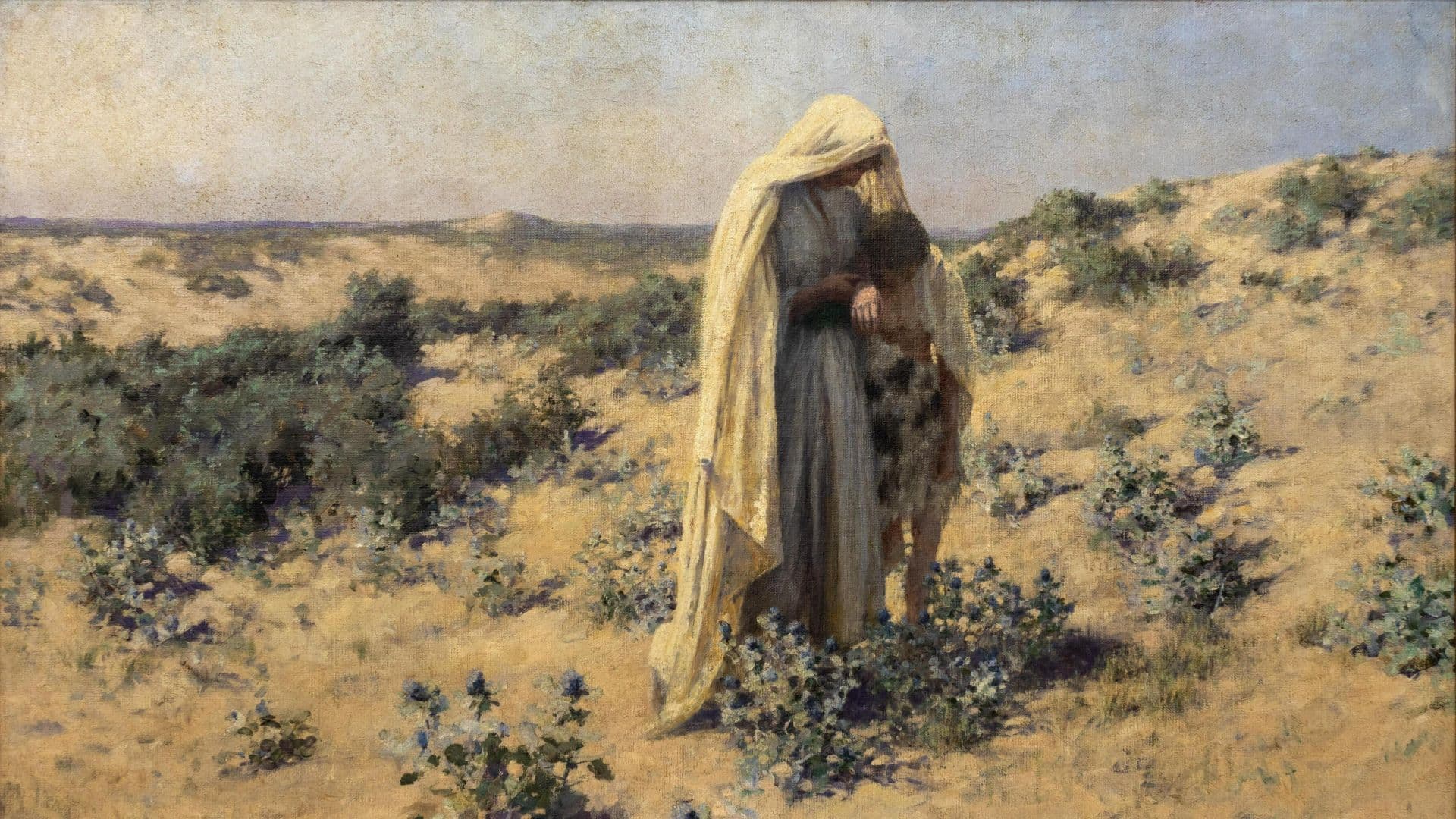
And she called the name of the Lord that spake unto her, Thou God seest me: for she said, Have I also here looked after him that seeth me? Genesis 16:13
The Know
Readers may be vaguely familiar with the stories about Hagar in Genesis 16 and 21. As they read Genesis 22, certain similarities between that story and details found in the story known as the “binding of Isaac” quickly become obvious. Reading these two narratives together allows readers to see the Hagar material in a new way.1 The similarities (not necessarily in the same order) between the narratives in Genesis 21 and 22 are as follows:
Table 1: Hagar and the Akedah2
Abraham sends Hagar away into the wilderness | Abraham takes Isaac away into the wilderness |
Abraham rose up early in the morning and placed bread and water upon Hagar | Abraham rose up early in the morning and placed wood upon Isaac |
Hagar goes into wilderness with Ishmael | Abraham goes into wilderness with Isaac |
An angel intervenes at last minute and talks to Hagar from heaven | An angel intervenes at last minute and talks to Abraham from heaven |
Hagar’s eyes are opened and she sees water | Abraham lifts his eyes and he sees a ram |
Name of the well related to seeing (Genesis 16:13-14) | Name of the mount related to seeing (Genesis 22:14) |
In Genesis 22, God tells Abraham to take his son Isaac to a far-away mountain and offer him up as a burnt offering. Abraham does so, taking his son and some servants to the mountain. When he gets there, he leaves the servants, taking only Isaac up the mountain. On the way, when Isaac questions his father where the animal for the offering might be, Abraham responds, and they continue up the mountain. Once at the top, Abraham binds Isaac and nearly sacrifices him, but is stopped by an angel. They sacrifice a ram in Isaac’s place and return home.
But shortly before this narrative about Isaac one finds similar narratives about Ishmael. Genesis 16:4–16 and Genesis 21:9–21 revolve around the near-death of Hagar and her son Ishmael. In Genesis 16, Sarah gives Hagar to Abraham so that Abraham can have an heir. But when Hagar conceives and boasts against Sarah, Sarah "dealt hardly” with her, and Hagar flees into the wilderness. God encounters her there, reassures her, and sends her back home. Later in Genesis 21, after Ishmael and Isaac are born and Ishmael mocks Isaac, Sarah tells Abraham to cut off Ishmael as an heir. Abraham does not want to do this, but God reassures him, and Abraham sends them away with some supplies. When they run out of water and it seems that Ishmael will soon die, an angel saves them from death.3
The parallels between the Hagar narratives and Genesis 22 are significant. Both Abraham and Hagar depart into a wilderness (Abraham sent by God, Hagar sent by Abraham and Sarah with God’s approval). Both Abraham and Hagar go into the wilderness from Beer-Sheba. Isaac almost dies directly at the hand of his father, who is about to kill him, and Ishmael almost dies indirectly at the hand of his father, who sent them into the wilderness. An angel saves both sons from death at the last moment by keeping Abraham from killing Isaac and providing water to Ishmael.4 One finds similar phrases in both accounts as well. Genesis 22:11–12, states that “an angel of the Lord called to him from the heavens” (Genesis 22:11), referring to the angel who called out to Abraham to save Isaac. Genesis 21:17 likewise states that “an angel of God called to Hagar from the heavens,” saving Ishmael.
In both texts, Abraham arises early in the morning and places something on the person going into the wilderness that is related to their impending deaths. In Genesis 22:3, 6, Abraham arises “early in the morning” and puts wood “on his son Isaac” foreshadowing his near-death as a burnt offering. In Genesis 21:14 Abraham also gets up “early in the morning” and puts water on Hagar’s shoulder, foreshadowing Ishamel’s near-death from thirst.
Both narratives also refer to seeing the deity and name a place after this experience.5 Genesis 22:11–12 recounts that Abraham hears God’s voice (here referred to as the Angel of the Lord) and verse 13 tells how Abraham responds to this: “Abraham lifted up his eyes, and saw.”6 Although Abraham sees the ram he will soon sacrifice, verse 14 suggests he saw the being who was speaking to him as well: God, “And Abraham called the name of that place Jehovah-jireh: as it is said to this day, In the mount, the Lord will be seen.”7 Something similar happens to Hagar. Genesis 21:19 states, referring to Hagar, that “God opened her eyes, and she saw,” similar to Genesis 22:13. If the well in chapter 16 is the same as the well in 21:19, the connections become even more significant. In Genesis 16:13–14, Hagar states, “Have I also here looked at the one who sees me? That is why the well was called Beer-lahai-roi [literally ‘Well of the Living One Who Sees Me’].” As can be seen, both narratives depict God speaking to the protagonist from the heavens who then provides something to save the son, namely a ram in the case of Isaac and water in the case of Ishmael.8 In both narratives, the protagonist sees God and they name a place with a name that relates to “seeing.”9
The Why
Reading these two narratives together can help readers in several ways, particularly to see Hagar with even more sympathy and appreciation. Readers may often identify and sympathize more with Abraham and Isaac, because people often read the Bible from the point of view of the direct ancestors of the Israelites. But by seeing that Ishmael and Hagar are put through a trial remarkably similar to what Abraham and Isaac also go through, readers can come to feel greater sympathy for all of these people. This full story reminds readers of God’s abundant love and full support for all people, regardless of their background.
Readers of the Bible may not be surprised when figures like Abraham or Isaac see God, but they do not usually expect to find that Hagar also saw God, as she also does in this narrative. Indeed, the enslaved woman, who could easily be overlooked or discounted by readers, was not overlooked by God. Indeed, God was clearly seen by her and He clearly also saw her in her distress and came to help her.
The Bible will later tell the story about the flight of the Hebrews from Egypt, but the Hagar narrative tells the story of the flight of Hagar, an Egyptian, from the ancestors of the Hebrews, reminding the reader that God knows and cares about all of His children, regardless of who they are or where they might be from. All people who are willing to accept His love can receive it from Him, just as Hagar does.
Jonathon Riley, “Two Views of the Foreign Women: Reading 1 Kings 19 with the Pentateuch,” in Tension in Resistance, Paradox in Freedom: Slavery Texts in the Bible and Their Readers, edited by Soo Kim Sweeney (Atlanta, GA: Society of Biblical Literature, 2026).
Andrew C. Smith, "Hagar in LDS scripture and thought," Interpreter: A Journal of Mormon Scripture 8 (2014): 87-13.
Hugh Nibley, Abraham in Egypt, (Salt Lake City, UT: Deseret Book and FARMS, 2000), 356–359.
- 1. Benjamin J. M. Johnson, “What Type of Son is Samson? Reading Judges 13 as a Biblical Type-Scene,” Journal of the Evangelical Theological Society 53 (2010): 269–86.
- 2. For more on this, see Bruce K. Waltke, Genesis: A Commentary (Grand Rapids: Zondervan, 2001), 303.
- 3. For more on this, see Phyllis Trible, Texts of Terror: Literary-Feminist Readings of Biblical Narratives, Overtures to Biblical Theology 13 (Philadelphia: Fortress, 1984).
- 4. For more on these parallels, see Phyllis Trible, “Genesis 22: A Sacrifice of Sarah,” in Women in the Hebrew Bible: A Reader, ed. Alice Bach (New York: Routledge, 1999), 271–92. See also Yael S. Feldman, Glory and Agony: Isaac’s Sacrifice and National Narrative (Stanford, CA: Stanford University Press, 2010), 7.
- 5. Talia Sutskover, Sight and Insight in Genesis: A Semantic Study (Sheffield: Sheffield Phoenix, 2013), 107–12.
- 6. Generally speaking, the Angel of the Lord in the Hebrew Bible is another name for the Lord himself.
- 7. This can also be rendered as, “In the mount of the Lord it will be seen,” but the translation I have provided makes more sense in the context.
- 8. Thomas L. Brodie, Genesis as Dialogue (Oxford: Oxford University Press, 2001), 238–39.
- 9. The specific phraseological parallels above draw from S. Nikaido, “Hagar and Ishmael as Literary Figures: An Intertextual Study,” Vetus Testamentum 51 (2001): 219–42.