KnoWhy #837 | February 3, 2026
Why is the Story of the Great Flood in Genesis Similar in Certain Ways to Other Ancient Flood Stories?
Post contributed by
Scripture Central
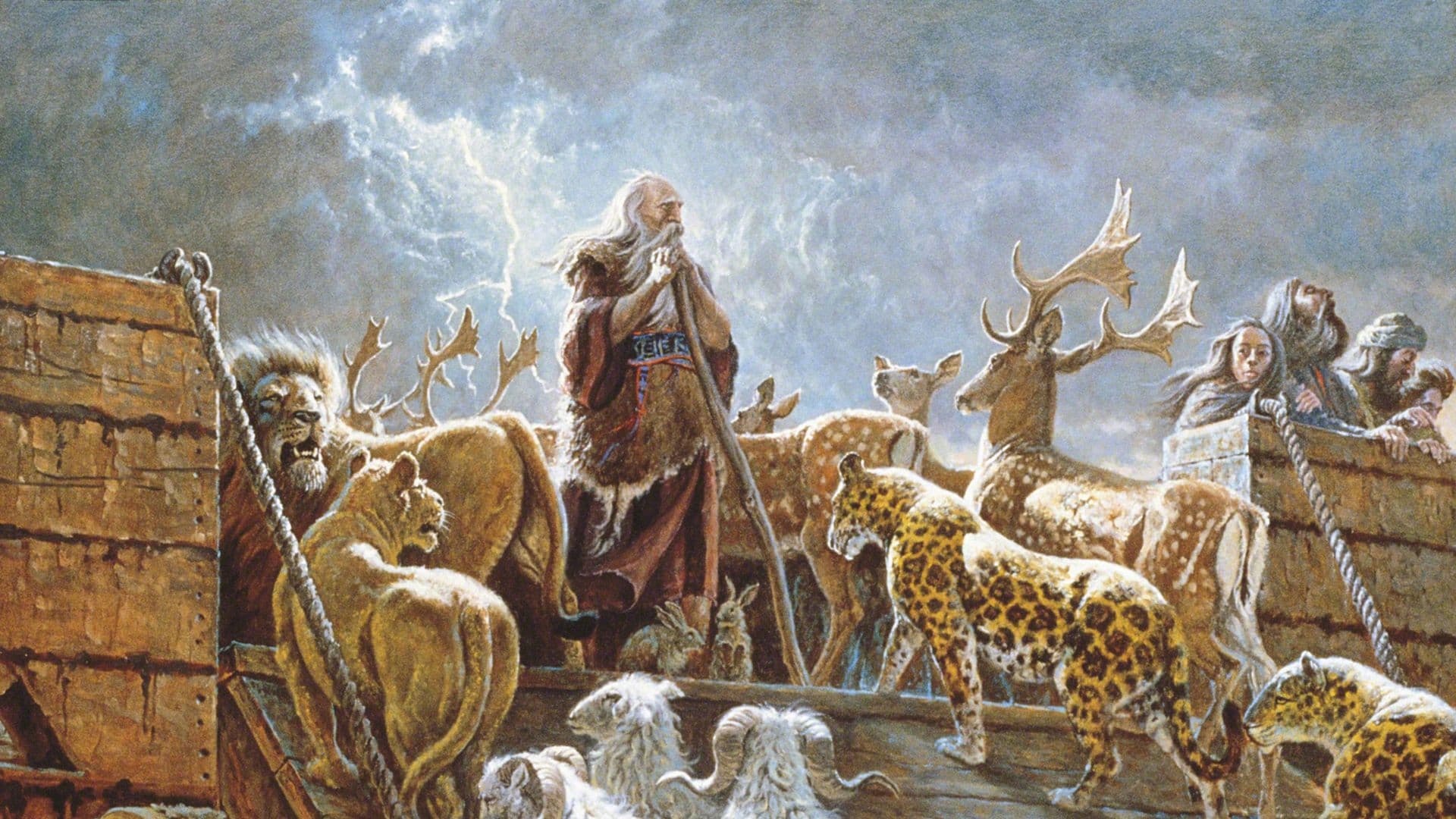
“And the Lord said unto Noah, Come thou and all thy house into the ark; for thee have I seen righteous before me in this generation.” Genesis 7:1
The Know
Many people are familiar with the story of Noah, in which a catastrophic flood sweeps over the earth, sparing only Noah, his family, and the animals on the ark. However, what many people may not know is that the Bible is not the only ancient Near Eastern text to contain such a story. Several versions of the story have been preserved in Mesopotamian sources that are much older than when the biblical text is thought to have been written. Consider the following three cases.
Atra-Hasis
This is the name of an ancient flood story coming from Ninevah in northern Iraq. It dates back to the 1700s BC. This traditional Mesopotamian story tells of a time when the gods created humans so they could do the difficult manual labor that the gods did not want to do.1 That idea worked well at first, but the humans eventually became too loud.2 Annoyed at all the noise, the gods decide to destroy all humans with a giant flood, and the main god, Enlil, started to go ahead with this plan and prepared to send a flood.3 However, the god Enki takes pity on humans and wants to tell a man named Atra-Hasis about the impending flood. But since Enki had sworn not to tell anyone about the deluge, his plan to save humanity seemed hopeless at first. Eventually he realizes that if he talks to the reed wall of Atra-Hasis’ house loud enough for Atra-Hasis to hear him, he can still let Atra-Hasis know the flood is coming indirectly without violating his oath.4 He does this, and his plan works. Atra-hasis builds a massive ark and puts the animals and his family onto the ark.5 The gods then send a huge flood, destroying most of humanity. However, the flood and storm soon become too terrifying even for the gods, and they regret what they have done.6 The gods cause the storm to stop and the flood to subside, and Enki reveals to them that he saved them from their own rashness by preserving Atra-Hasis and his family. Enlil, however, is still upset, and so Enki instructs the gods about other ways to limit the growth of the human population without destroying all of humanity.7 Parenthetically, this text comes from about the same time and place as did Abraham in today’s northern Iraq.8
The Eridu Genesis
A Sumerian text from southern Mesopotamia around 1600 BC, known as the Eridu Genesis, comes close to the time of, and is similar to what one finds in, Atra-hasis. In this text, the god Enlil is unable to sleep because of the noises made by humans and decides to destroy humanity with a flood. Enki tells a man named Ziusudra that the earth is going to be flooded and tells him to build an ark to save his family and two of each animal.9 He does this, and then the flood comes. A massive storm continues for a full week until the sun finally reappears.10 Ziusudra then opens a window in his ark, bows down, and offers sacrifices.11 He is apparently given eternal life for preserving humankind. Ziusudra’s boat floats down the Euphrates River to the Persian Gulf, and he settles in Dilmun, near where present-day Bahrain is now found.12
The Epic of Gilgamesh
A third interesting example of the widespread ancient Near Eastern flood story, that also resembles the biblical Noah story, is found in the Epic of Gilgamesh. This version of the flood story likely dates to about 1300 BC and is also similar to Atra-Hasis.13 Just as in Atra-Hasis, the great god Enlil decides to cause a flood, and the other gods promise not to reveal the secret. But Ea decides to reveal the plan to the flood hero, in this case named Utnapishtim, through the reed wall of his house.14 Ea tells Utnapishtim to demolish his house and build a large boat. The god gives him specific instructions about the dimensions of the boat and how to build it. Utnapishtim exactly follows Ea’s instructions and builds the boat, including sealing it with pitch.15 He then loads his family and the animals onto the boat, along with some of his craftsmen. Then a giant storm comes, and the waters begin to rise.16 Utnapishtim then boards the ark and the entrance is sealed shut. Even the gods are terrified and disturbed at what they have done.17 The storm lasts for seven days after which there is finally a calm. Eventually, the boat lands on a mountain and Utnapishtim releases a dove, a swallow, and a raven to see if the water has receded from the land.18 The dove and swallow both come back to him, but the raven found dry land and did not return. Upon realizing that the flood has receded, Utnapishtim leaves the ark and offers sacrifice, upon which the gods smell the sweet smell of the sacrifice and gather all around it “like flies.”19 Ea and Enlil then argue over the fact that some humans escaped destruction, and Enlil eventually realizes that he over-reacted in killing all of humanity. Utnapishtim and his wife are then granted immortality.20
The Why
Some people might conclude that the Bible simply plagiarizes the Epic of Gilgamesh or these other ancient stories. However, the relationship between these flood narratives and the biblical flood story is more complicated than any such simplistic characterization. It is true that there are several similarities between these ancient Near Eastern flood narratives. For example, both Gilgamesh and Genesis recount that a god gave the flood hero specific instructions about how to build the ark, including dimensions.21 Both recount that animals and humans were taken onto the ark.22 Both recount that the flood hero releases a dove and a raven, with one of the birds not coming back.23 They both even recount that a god smells the sweet smell of the sacrifice offered by the flood hero after leaving the ark,24 and both even make significant use of chiasmus.25 So, they clearly share a common basic tradition telling of their ancient origin.
However, the differences between these accounts are crucial. In Gilgamesh and Atra-Hasis, the gods cause the flood because they were simply annoyed by the humans, not because of serious human sin, as is the case in Genesis.26 In addition, the Mesopotamian stories depict the main god as seeking to obliterate all of humanity, with the flood hero and his family being saved by another god.27 In Genesis, the flood hero is saved by the main god himself who wishes to save and not to completely destroy humanity.28 Thus, rather than plagiarizing Gilgamesh, it appears that all these texts are simply telling their versions of an earlier and commonly understood primal event.
Moreover, the accounts found in Genesis and in the Book of Moses give a significantly different version of the well-known ancient Near Eastern story concerning the great primeval flood. These two scriptural accounts emphasize important elements in order to teach something crucially important about God. Rather than being a god who destroys all of humanity for frivolous reasons, the true and living God forewarned the people and then used the flood to punish humanity for their pervasive sinfulness, which included doing “wickedness,” being “lifted up in the imagination of the thoughts of [their] heart[s], being only evil continuously,” seeking to kill Noah and making the earth “corrupt before God,” so that “all flesh had corrupted its way upon the earth” and “the earth [was] filled with violence.” For those reasons, God found it necessary to “destroy all flesh from off the earth” and start anew (see Moses 8:22, 26, 28-30). God intentionally and justly saved Noah and his family so they could start humanity anew. The flood narrative of Genesis may seem harsh when seen in isolation, but when compared to the ancient Near Eastern narratives, the Israelite flood account presents to the world a God who cares about righteousness, repentance, and justice, as well as humans, animals, and the destiny of this earth.
Hugh Nibley, An Approach to the Book of Mormon (Salt Lake City, UT: Deseret Book and FARMS, 1988), 340–358.
Scripture Central. “Flood Stories,” Evidence 122 (December 15, 2020).
Paul Y. Hoskisson and Stephen O. Smoot, “Was Noah's Flood the Baptism of the Earth?,” in Let Us Reason Together: Essays in Honor of the Life’s Work of Robert L. Millet, ed. J. Spencer Fluhman and Brent L. Top (Provo, UT: Religious Studies Center; Salt Lake City: 2016), 163–36.
Steven R. Scott, “Chiastic Structuring of the Genesis Flood Story: The Art of Using Chiasm as an Effective Compositional Tool for Combining Earlier Chiastic Narratives,” in Donald W. Parry and John W. Welch, Chiasmus: The State of the Art (Provo: BYU Studies, 2020), 35-66.
- 1. Dalley, Stephanie, Myths from Mesopotamia: Creation, the Flood, Gilgamesh, and Others, Revised ed. Oxford: Oxford University Press, 2008, 18.
- 2. Ibid. 18.
- 3. Ibid. 28.
- 4. Ibid. 28-29.
- 5. Ibid 29-31.
- 6. Ibid 31-33.
- 7. Ibid 33-35.
- 8. See generally, Gary A. Rendsburg, “Ur of the Chaldees: Where Is Abraham’s Birthplace?” in Jeffrey M. Bradshaw and others, eds., Abraham and His Family: In Scripture, History, and Tradition (Salt Lake City: Eborn, 2025), 1:1-22.
- 9. Jacobsen, Thorkild. The Harps That Once...: Sumerian Poetry in Translation. Yale University Press, 1987, 147-148.
- 10. Ibid., 149.
- 11. Ibid., 149.
- 12. Ibid., 150.
- 13. Dalley, Stephanie, Myths from Mesopotamia: Creation, the Flood, Gilgamesh, and Others, Revised ed. Oxford: Oxford University Press, 2008, 46.
- 14. Dalley, Stephanie, Myths from Mesopotamia: Creation, the Flood, Gilgamesh, and Others, Revised ed. Oxford: Oxford University Press, 2008, 109-110.
- 15. Ibid., 110-111.
- 16. Ibid., 111-112.
- 17. Ibid., 112-113.
- 18. Ibid., 113-114.
- 19. Ibid., 114.
- 20. Ibid., 115-116.
- 21. Collins, John J., Introduction to the Hebrew Bible, Third Edition: The Torah/Pentateuch, 3rd ed., 1517 Media, 2018, 94-95.
- 22. Collins, John J., Introduction to the Hebrew Bible, Third Edition: The Torah/Pentateuch, 3rd ed., 1517 Media, 2018, 94-95.
- 23. Ibid.
- 24. Ibid.
- 25. See Steven R. Scott, “Chiastic Structuring of the Genesis Flood Story,” in John W. Welch and Donald W. Parry, eds., Chiasmus: The State of the Art (Provo: BYU Studies, 2020), 35-66.
- 26. Römer, Thomas. “The Narrative Books of the Hebrew Bible.” In The Hebrew Bible: A Critical Companion, edited by John Barton, Princeton University Press, 2016, 117-118.
- 27. Collins, John J., Introduction to the Hebrew Bible: The Torah/Pentateuch, 3rd ed., 1517 Media, 2018, 94-95.
- 28. Ibid.