KnoWhy #843 | March 10, 2026
Why is Judah Blessed with a Scepter Until Shiloh Comes?
Post contributed by
Scripture Central
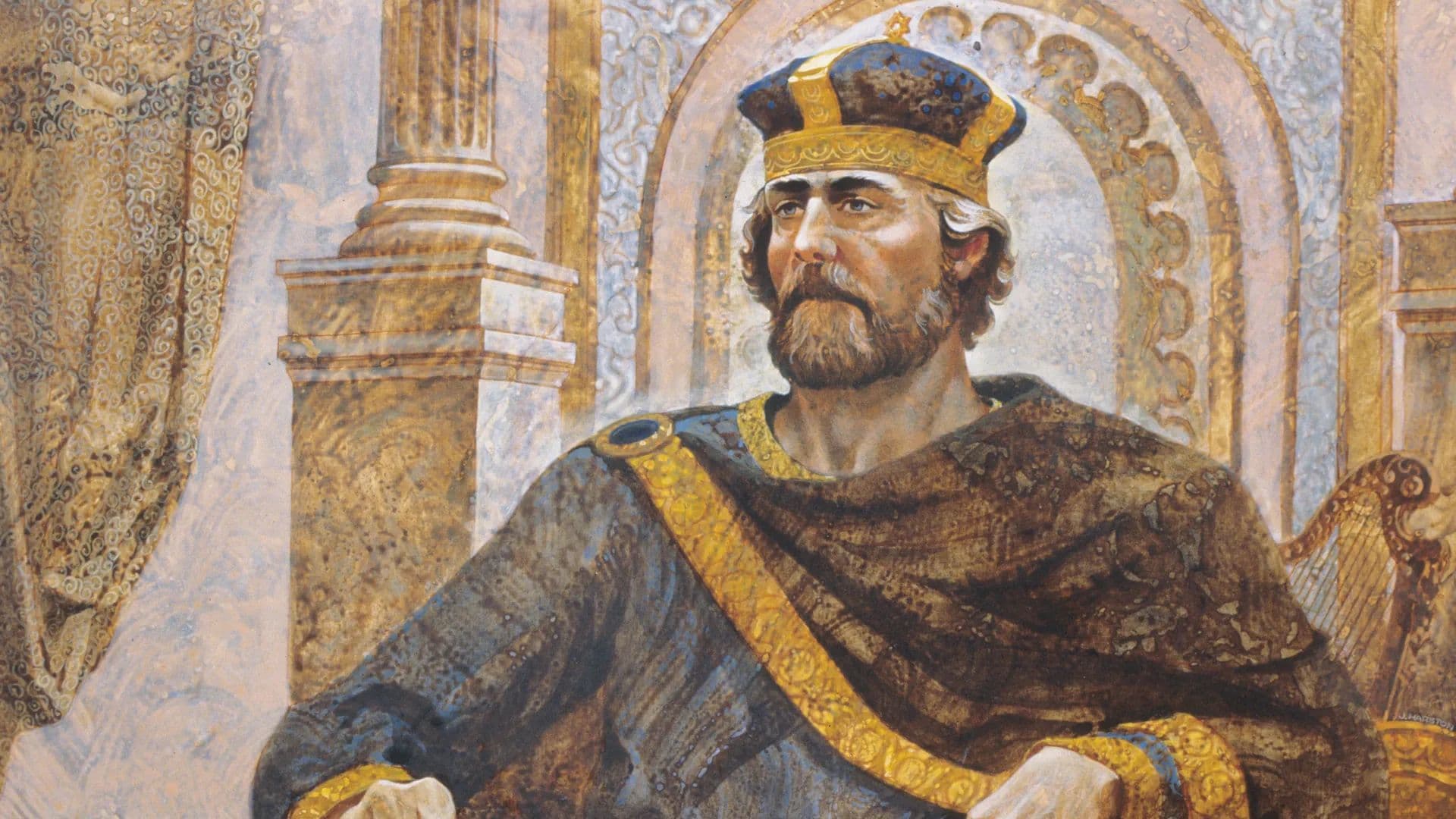
The sceptre shall not depart from Judah, nor a lawgiver from between his feet, until Shiloh come; and unto him shall the gathering of the people be. Genesis 49:10
The Know
Genesis 49 contains Jacob’s blessings to his sons before his death. He begins with the oldest son, Reuben, and then blesses all the sons in the order of their birth, ending with the last son, Benjamin. The blessing of Judah, however, is somewhat cryptic, and requires some explanation. Thankfully, a careful examination of the history and geography of ancient Israel can help make sense of these otherwise difficult verses, if they are read in light of the two preceding blessings.
The first blessing, the blessing to Reuben, explains why Reuben was not blessed to become the dominant tribe, even though Reuben was the firstborn, and Jacob’s doing so makes sense in light of material found earlier in Genesis. Genesis 35:22 states that Reuben “went and had relations with Bilhah, the concubine of his father, and Israel heard about it.” Genesis 49 appears to refer to that sin. In verses 3–4 Jacob says to Reuben: “my firstborn, my strength, and the beginning of my vigor, preeminent in rank and preeminent in power. Reckless as water, you will be preeminent no more, because you went up onto your father’s bed, then defiled it. He went up to my couch!” Because Reuben was the firstborn, he would have been entitled to the primary birthright blessing.1 However, that did not happen, and his father’s “blessing” explains why.
The second blessing, the blessing to Simeon and Levi, does something similar to Reuben’s blessing. “Simeon and Levi are brothers, instruments of cruelty are their swords. O my soul, do not come into their secret council, to their assembly, my honor, do not be joined. For in their anger they killed men, they hamstrung oxen on a whim. Cursed is their anger, for it is fierce, and their wrath, for it is hard. I will divide them in Jacob, and scatter them in Israel” (Genesis 49:5–7). At first, this appears to also be straightforward. This blessing appears to explain why Simeon and Levi, sons two and three, were not chosen as the honorary firstborn after Reuben was passed over for that privilege. The reference to the violence of Simeon and Levi appears, at first, to refer to Genesis 34. In that chapter, Simeon and Levi conspired to destroy the town of Shechem after the prince of Shechem sexually assaulted their sister Dinah. This explains references to a secret council and their fierce anger. However, it does not explain what it means to be divided in Jacob and scattered in Israel. For this, one needs to look at a map of the cities inhabited by Simeon and Levi. The cities assigned to Simeon are scattered throughout the southern part of Israelite territory, intermixed with the cities of Judah.2 The cities of the Levites are similarly scattered across all of Israelite territory.3 Thus, they are “divided” and “scattered” across the country.
These two blessings help to explain the third blessing, the blessing of Judah. Although Joseph is ultimately considered the firstborn, Judah is described here as something of an “honorary” firstborn after Reuben, Simeon, and Levi were passed over for the reasons explained above.4 Judah’s blessing tells readers that Judah is the one who will become the dominant tribe: “Judah, you are he whom your brothers will praise. Your hand will be on the neck of your enemies. Your father’s children will bow down before you. Judah is a lion’s cub. On prey, my son, you have grown strong. He stooped down, he stretches out like a lion, like a lioness. Who dares to cause him to stand up?” This verse explains that the tribe of Judah is the one who will dominate over the other tribes, referred to here as “the brothers” and the “father’s children.” This is brought to pass when the Davidic kingdom comes to dominate all the tribes.5 The verse also states that the tribe of Judah will triumph over its enemies, presumably groups like the Philistines to the west and the Amalekites to the south, against whom Judah frequently fought wars.6 Here, in the imagery about lions, the tribe is described as being like a young lion who has grown strong on the animals it has eaten over the years and who will eventually be strong enough that nobody will dare disturb it, just as nobody would dare to disturb a lion who is stretched out on the ground, resting.7 He elaborates on this idea of stability, stating that “the scepter will not leave from Judah, nor a lawgiver from between his feet, until Shiloh comes, and the obedience of the people is his” (Genesis 49:10). This states in a symbolic way that the ruling line of the kings of the southern Kingdom will always come from Judah, and that this will remain stable.8
Judah’s blessing then concludes with, “Tying his foal to the vine, and his donkey’s colt to the choice vine. He washes his clothing in wine, and his garments in the blood of grapes. His eyes are darker than wine, and his teeth whiter than milk.” This likely refers to the area that the tribe of Judah will inhabit, part of which is excellent for growing grapes. The Hebrew word for “choice vine” here is sorek, which is also the name of a valley in Judah which is good for grape-growing.9 The idea here seems to be that the grape vines would be so thick and luxurious that one could tie a donkey to it (something which would destroy lesser grape-vines, either through the donkey eating them or pulling them out trying to get free of his restraints).10 There would be so many grapes that when a person stomped the grapes into wine, the juice would dye all the person’s clothing as though they had washed their clothes in it.11 The reference to Judah’s eyes being darker than wine is likely a pun on the word ayin, which means both “spring” and “eye” in Hebrew, presumably referring to unusually large springs like the Gihon spring which water important parts of Judah, as well as the limestone outcroppings which spread across much of the area, reminding one of teeth.12 Likewise, the meaning of the coming of Shiloh in this chapter is difficult to pin down, and it can mean a variety of things.13 It could be referring to the place Shiloh, perhaps stating that the borders of Judah would one day reach all the way north to this city.14 And because Shiloh was the place where the Tabernacle was located for many years, it may also be a reference to Judah becoming a religious center for the kingdom, which it did when David brought the Ark to Jerusalem and Solomon built the temple there.15 And so yet another translation of the phrase could be, “until tribute is brought to him.” This could relate to King David having tribute from other nations brought to him as his kingdom becomes stronger and more established.16
The Why
The foregoing explanations, however, may be looking in the wrong direction. Another interpretation of Shiloh sees it as a prophecy of a coming king.17 In the Syriac Peshitta (roughly 2nd century A.D.) the word Shiloh is given the meaning “the one to whom it belongs.”18 If the word shiloh in Genesis 49:10 can be understood this way, as “the one to whom it [the scepter mentioned earlier in the verse] belongs,” this suggests that a future king will come to whom the power to rule over the kingdom rightfully belongs and that all people will be obedient to this new king.19 This is how the phrase has been understood by Christians generally at least since the days of Justin Martyr, an early Christian Father. Likewise, it was understood even more strongly this way by Joseph Smith. In JST Genesis 50:24, Shiloh is explicitly declared to be the Messiah. In this light, Jesus can be identified specifically as the figure to whom this word Shiloh refers.
This blessing given to Judah, and particularly its reference to Shiloh, is especially important for Christians, as it reaffirms the identity of Jesus as the Messiah, the ultimate anointed king who would come from the line of Judah. Revelation 5:5 employs imagery from this blessing and refers to Jesus as the “Lion of the Tribe of Judah.” However, when Jesus was born into the world, Judah no longer had royal power but rather was subject to Rome. Jesus was not made a king and given a scepter, and He was eventually crucified as “King of the Jews” only in mockery. So, it would appear that the Shiloh of Jacob’s blessing on Judah still remains to be fulfilled. As many Christians have long said, Jesus will fulfill this prophecy of the ultimate king, “the one to whom [the scepter] belongs,” and to Him people all over the world will gather as they acknowledge Him as their Messiah in the Second Coming and Millennial Day. At that day, He will truly be acknowledged as the King over all the earth, the one to whom this earth rightfully belongs. At that day, all the world will bend the knee to Christ and give their obedience to Him, just as Jacob declared.
Jeffrey M. Bradshaw, “How Should We Understand the Rich Symbolism in Jacob’s Blessings of Judah and Joseph?” KnoWhy OTL12A, 2018.
Edward J. Brandt, “Why are oxen used in the design of our temples’ baptismal fonts?,” Ensign 23, March 1993.
Eldin Ricks, "Judah must return.,” Ensign 2, May 1972.
- 1. For more on this motif in the Hebrew Bible, see Bradford A. Anderson, “The Inversion of the Birth Order and the Title of the Firstborn,” Vetus Testamentum 60, no. 4 (2010), 655–58.
- 2. Ian Barnes and Josephine Bacon, The Historical Atlas of Judaism, Updated ed. (Chartwell Books, Inc., 2009), 41.
- 3. For an overview, see Stanley Gevirtz, “Simeon and Levi in ‘The Blessing of Jacob’ (Gen. 49:5-7),” Hebrew Union College Annual 52 (1981), 93–128.
- 4. Just as the firstborn received a double-portion (Deuteronomy 21:17) so Joseph received a double-portion, in a sense, because both his sons Ephraim and Manasseh received an inheritance with the other sons of Jacob.
- 5. Nahum M. Sarna, Genesis: The Traditional Hebrew Text with New JPS Translation, 1st ed. (Jewish Publication Society, 1989), 335-336.
- 6. Ibid, 335.
- 7. Ibid, 336.
- 8. For a discussion of how this is understood by other biblical authors, see Richard C. Steiner, “Four Inner-Biblical Interpretations of Genesis 49:10: On the Lexical and Syntactic Ambiguities of עַד as Reflected in the Prophecies of Nathan, Ahijah, Ezekiel, and Zechariah,” Journal of Biblical Literature 132, no. 1 (2013), 33–60.
- 9. Nahum M. Sarna, Genesis: The Traditional Hebrew Text with New JPS Translation, 1st ed. (Jewish Publication Society, 1989), 337.
- 10. Ibid, 337.
- 11. Ibid, 337.
- 12. For the significance of the Gihon, see Ronny Reich, and Eli Shukron, “The History of the Gihon Spring in Jerusalem,” Eretz-Israel: Archaeological, Historical and Geographical Studies (2007), 211-18.
- 13. This has long been considered one of the more difficult passages in the Old Testament. See William L. Moran, "Gen 49,10 and its use in Ez 21,32," Bib 39 (1958), 405, as well as Ernst Sellin, "Zu demdem Judaspruch im Jaqobssegen Gen 49:8-12 und im Mosesegen Deut 33:7,” Zeitschrift für die alttestamentliche Wissenschaft 60, (1944), 57.
- 14. For more on this interpretation, see Johannes Lindblom "The Political Background of the Shiloh Oracle," in Congress Volume: Copenhagen 1953, Vetus Testamentum Supplement 1 (Brill, 1953), 78-87 as well as Otto Eissfeldt, "Silo und Jerusalem," in Volume du Congrès: Congrès: Strasbourg 1956, Vetus Testamentum Supplement 4 (Brill, 1957), 140-41, John A. Emerton, "Some Difficult Words in Genesis 49," in Words and Meanings: Essays Presented to David Winton Thomas on His Retirement from the Regius Professorship of Hebrew in the University of Cambridge (Cambridge University Press, 1968), 86-88, and Erhard Blum, ”Die Komposition der Vatergeschichte,“ Wissenschaftliche Monographien zum Alten und Neuen Testament 57 (Neukirchener Verlag, 1984), 261-63.
- 15. On the plausibility that this would be a reference which people would understand, see Serge Frolov, “Judah Comes to Shiloh: Genesis 49:10bα, One More Time,” Journal of Biblical Literature 131, no. 3 (2012), 420–21.
- 16. Richard C. Steiner, "Poetic Forms in the Masoretic Vocalization and Three Difficult Phrases in Jacob’s Blessing,” Journal of Biblical Literature 129 (2010), 219-26.
- 17. This is how it was often understood in ancient times. For an in-depth investigation, see Adolf Posnanski, Schiloh: Ein Beitragzur Geschichte der Messiaslehre (Hinrichs, 1904).
- 18. For other ancient readings that agree with this rendering see Ezekiel 21:27 and Testament of Judah 22:1–3.
- 19. For another example of this reading, see Targum Onqelos, Genesis 49:10.