KnoWhy #861 | July 14, 2026
Why is Chronicles in the Bible?
Post contributed by
Scripture Central
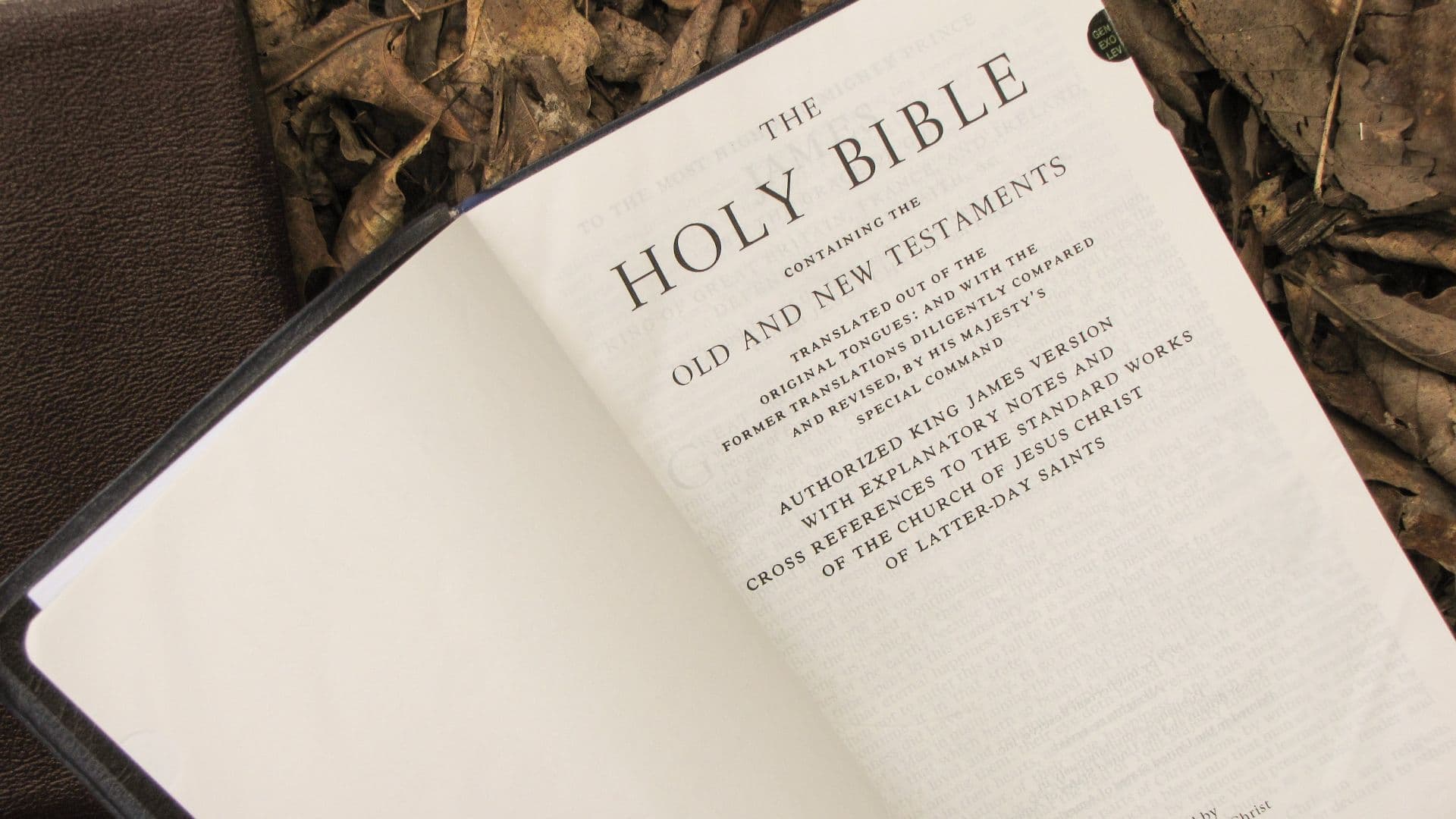
"Now be ye not stiffnecked, as your fathers were, but yield yourselves unto the Lord, and enter into his sanctuary, which he hath sanctified for ever: and serve the Lord your God, that the fierceness of his wrath may turn away from you." 2 Chronicles 30:8
The Know
When reading the Old Testament, Chronicles may leave some readers confused as it repeats much of the material from 1 and 2 Samuel and 1 and 2 Kings. Given the repetitions, some readers might wonder why Chronicles is even in the Bible at all. One explanation for the presence of Chronicles in the Bible is that it appears to provide a slightly different perspective on Israelite history.
In the sixth century BC, Nebuchadnezzar’s armies destroyed Jerusalem and its temple, killing and deporting thousands of people. In the wake of this tragedy, the Judahites struggled to explain how something like this could have happened, and two different perspectives can be found in the Old Testament. The broad question that the books of Joshua through 2 Kings, often referred to as the Deuteronomistic History, appears to address is "Why did God let our nation get destroyed and our temple burned?" The answer given is largely political and moral: because the kings and the people repeatedly broke their covenant with God. In contrast, the question Chronicles appears to address is “Are we still God's people and does the covenant still stand?" The Chronicler writes to give hope, to create an identity based on worship and the ideals of the kingdom, and to legitimize their newly rebuilt temple.1
Joshua through 2 Kings explains much of Judah’s history by stating that Judah will be blessed if it obeys God and cursed if it does not.2 The Deuteronomistic History sometimes takes the idea that Judah will be blessed for righteousness and cursed for unrighteousness and applies it to whether people will be victorious against invaders. Gideon, for example, obeyed God in destroying the altars of Baal and was therefore successful in a war against the Midianites (Judges 6:4–5, 25–26). Thus, righteousness leads to success against enemies.
However, for the Deuteronomist, the opposite is also true: punishment comes from disobedience, even if that punishment is delayed for a time. 2 Kings 23:26 states that Jerusalem was destroyed because “the Lord did not turn from the fierceness of his great wrath, and his anger that was hot against Judah, because of all the provocations with which Manasseh had provoked him.” This verse might seem strange at first, because Manasseh was long dead by the time Jerusalem was destroyed, and the king shortly before the destruction of Jerusalem, King Josiah, had kept the commandments (2 Kings 23:25). However, the Deuteronomistic History suggests that God had allowed Jerusalem to be destroyed because King Manasseh was so wicked that even the righteousness of King Josiah could not compensate for it, and the punishment had to eventually come, even if it was delayed for a time.3
The Chronicler gives a slightly different perspective on the event.4 Both Chronicles and the Deuteronomistic History are in broad agreement on the issue of blessings for righteousness and punishment for unrighteousness, but Chronicles nuances the Deuteronomistic understanding of the timing of these events. 5 Likely because of hindsight, as scholars believe Chronicles was written many decades after Kings, rewards and punishments are not usually delayed in Chronicles, and people are often punished for sins or rewarded for righteousness immediately.6
One good example of this is the way the Chronicler describes the death of Josiah. 2 Chronicles 35:21–24 records that Josiah came to fight the king of Egypt at Megiddo despite being warned by God not to intervene. Because Josiah ignored God, the Egyptians killed him. Thus, righteousness is punished and wickedness is rewarded in a timely manner.
This leads to the Chronicler’s answer to why Jerusalem was destroyed: the people at the time of the destruction of Jerusalem were wicked, such that:
[All] the heads of the priests, and the people, transgressed very much after all the abominations of the heathen; and polluted the house of the Lord which he had sanctified in Jerusalem. . . . [and] mocked the messengers of God, and despised his words, and abused his prophets, until the wrath of the Lord arose against his people, till there was no remedy. Therefore he brought upon them the king of the Babylonians, who killed their young men with the sword in the house of their sanctuary. (2 Chronicles 36:14–17).
According to the Chronicler, God punished the wicked inhabitants of Jerusalem for their sins by not protecting them from the Babylonians.7
The Why
When the perspectives of the Deuteronomistic Historian and the Chronicler are taken together, a new picture emerges. The delayed punishment depicted by the author of the Deuteronomistic History may seem strange at first. However, anyone who has witnessed the negative impact of people’s poor decisions across multiple generations knows that people sometimes suffer because of the sins of ancestors, and in this sense, the perspective of the Deuteronomistic Historian is useful. If read in light of Chronicles, it is possible that King Manasseh may have created conditions in society that future people were not able to overcome, leading to the people continuing to sin, and their eventual destruction.
The Chronicler’s perspective that people get punished for their sins and blessed for their righteousness is similar to what one finds in the Book of Mormon, which states that Jerusalem was destroyed “because of the wickedness of the people.”8 However, the Chronicler’s view that people are always obviously punished for sins and always obviously blessed for righteousness also requires nuance. Sometimes blessings for righteousness and punishment for sin happen in much more complex ways than the Chronicler implies. For example, the Book of Mormon portrays a delayed captivity of all the people under wicked King Noah. Their captivities came at a time when they had largely repented and were being led by a righteous king, Limhi, and a righteous priest, Alma. But their earlier wickedness had inescapably condemned them to bondage, according to the words of Abinadi. Fortunately, their bondages were not permanent, but neither was Israel’s.
Both Kings and Chronicles are necessary to form a nuanced view of the history of Israel and the destruction of Jerusalem. Sometimes people are punished for iniquity or blessed for righteousness immediately, but sometimes they are not. People are not punished for the sins of others, yet the sins of others can cause terrible things to happen in people’s lives. Reading both Kings and Chronicles together allows readers of the Bible to understand the complexity of Israelite history and relate the events of Israelite history to their lives today.
Bruce Satterfield, “The Divine Justification for the Babylonian Destruction of Jerusalem,” in Glimpses of Lehi’s Jerusalem, ed. John W. Welch, David Rolph Seely, and Jo Ann H. Seely (Foundation for Ancient Research and Mormon Studies [FARMS], 2004), 561–94.
David Rolph Seely, “Sacred History, Covenants, and the Messiah: The Religious Background of the World of Lehi,” in Welch, Seely, and Seely, Glimpses of Lehi’s Jerusalem, 381–420.
David Rolph Seely and Fred E. Woods, “How Could Jerusalem, 'That Great City,' Be Destroyed?,” in Welch, Seely, and Seely, Glimpses of Lehi’s Jerusalem, 595–610.
- 1. The unique perspective of Chronicles as compared to Kings is discussed by the following scholars:
E. L. Curtis and A. A. Madsen, A Critical and Exegetical Commentary on the Books of Chronicles (Charles Scribner’s Sons, 1910); W. A. L. Elmslie, The Book of Chronicles (2d ed.; Cambridge University Press, 1916); R. H. Pfeiffer, Introduction to the Old Testament (Harper and Brothers, 1948); W. Eichrodt, Theology of the Old Testament (2 vols.; Old Testament Library [OTL]; Fortress Press, 1961); E. J. Bickerman, From Ezra to the Last of the Maccabees: Foundations of Post-Biblical Judaism (Schocken Books, 1962); O. Eissfeldt, The Old Testament: An Introduction (Oxford University Press, 1965); C. Westermann, Handbook to the Old Testament (SPCK Publishing, 1969); G. Fohrer, Introduction to the Old Testament (SPCK Publishing, 1970); O. Kaiser, Introduction to the Old Testament: A Presentation of its Results and Problems (Basil Blackwell, 1975); S. B. Berg, “After the Exile: God and History in the Books of Chronicles and Esther,” in The Divine Helmsman: Studies on God’s Control of Human Events, Presented to Lou H. Silberman, ed. J. L. Crenshaw and S. Sandmel (Ktav, 1980); R. L. Braun, 1 Chronicles (Word Biblical Commentary [WBC] 14; Word Books, 1986); S. J. De Vries, 1 and 2 Chronicles (Forms of the Old Testament Literature [FOTL] 11; Eerdmans, 1989); R. B. Dillard, 2 Chronicles (Word Biblical Commentary [WBC] 15; Word Books, 1987); William Johnstone, Chronicles and Exodus: An Analogy and its Application (Sheffield Academic Press, 1998); Louis C. Jonker, Reflections of King Josiah in Chronicles: Late Stages of the Josiah Reception in 2 Chronicles 34 f (Gütersloher Verlagshaus, 2003); Steven Schweitzer, Reading Utopia in Chronicles (T & T Clark, 2007).
- 2. Lissa M. Wray Beal, The Deuteronomist’s Prophet: Narrative Control of Approval and Disapproval in the Story of Jehu (2 Kings 9 and 10) (T & T Clark International, 2007), 2–3.
- 3. For delayed and immediate retribution in Kings and Chronicles, see Ehud ben Zvi, “Are There Any Bridges Out There? How Wide Was the Conceptual Gap between the Deuteronomistic History and Chronicles,” in Community Identity in Judean Historiography: Biblical and Comparative Perspectives (Eisenbrauns, 2009).
- 4. This Knowhy will refer to “the Chronicler” in the singular as a matter of convenience, despite the possibility that the books of Chronicles were written by more than one person. See Mark A. Throntveit’s “The Relationship of Hezekiah to David and Solomon in the Books of Chronicles” in The Chronicler as Theologian: Essays in Honor of Ralph W. Klein, ed. M. Patrick Graham, Steven L. McKenzie and Gary N. Knoppers (T & T Clark International, 2003), 105–21.
- 5. Louis C. Jonker, “The Disappearing Neḥushtan: the Chronicler's Reinterpretation of Hezekiah's Reformation Measures,” in From Ebla to Stellenbosch, ed. I. Cornelius and Louis C. Jonker (Abhandlungen des Deutschen Palӓstinavereins 37; Harrassowitz, 2008), 116–40.
- 6. Peter B. Dirksen, 1 Chronicles (Historical Commentary on the Old Testament; Peeters Publishers, 2005), 5–6.
- 7. For more on punishment for wickedness in Chronicles, see Ralph Klein, 1 Chronicles: A Commentary (Hermeneia—A Critical and Historical Commentary on the Bible Series; Fortress Press, 2006), 46–47.
- 8. 1 Nephi 3:17; see David Rolph Seely and Fred E. Woods, “How Could Jerusalem, 'That Great City,' Be Destroyed?,” in Glimpses of Lehi’s Jerusalem, ed. John W. Welch, David Rolph Seely, and Jo Ann H. Seely (Foundation for Ancient Research and Mormon Studies [FARMS], 2004), 595–610.