KnoWhy #840 | February 24, 2026
Why Does Rachel Want Leah’s Mandrakes?
Post contributed by
Scripture Central
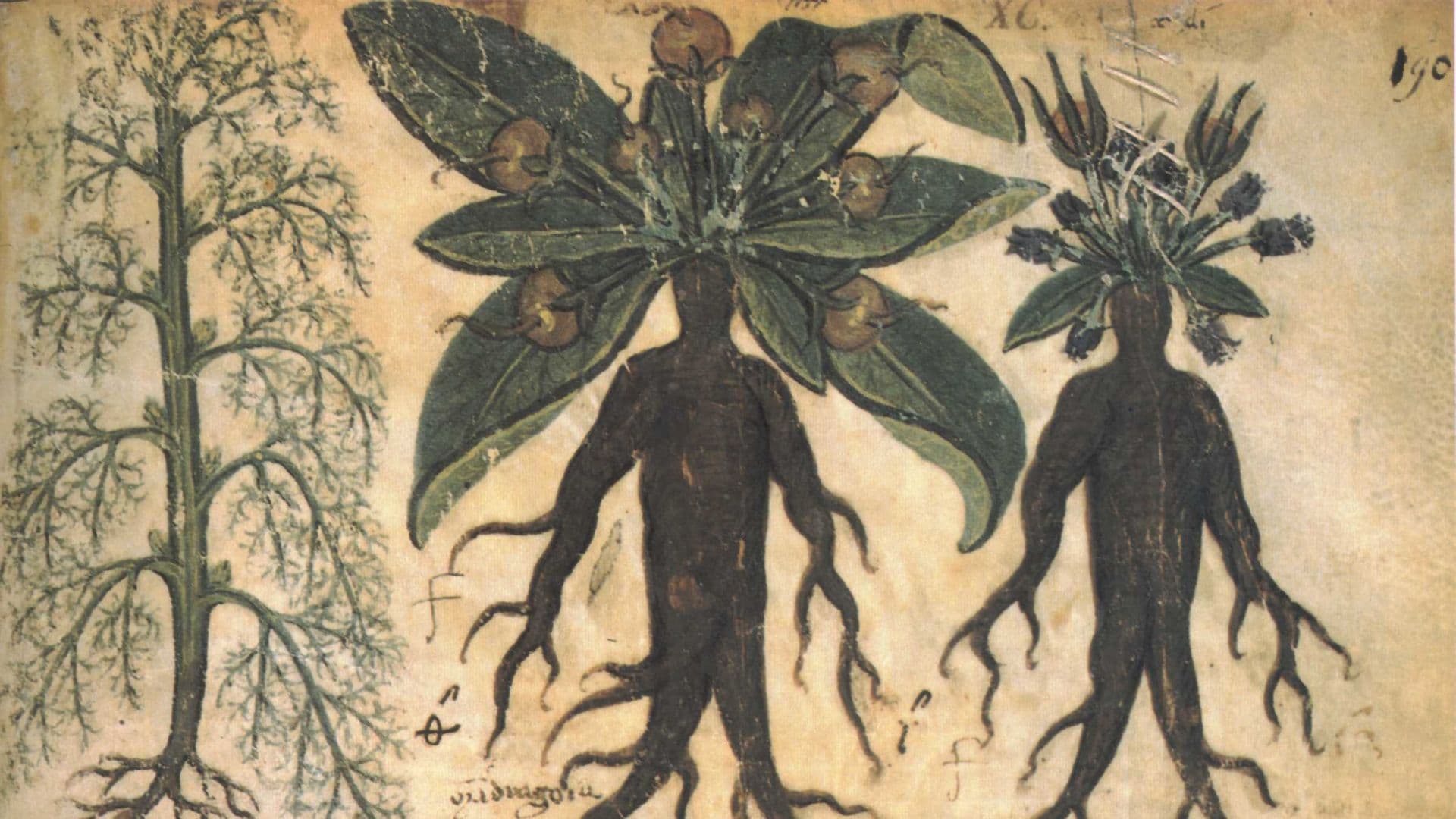
And Reuben went in the days of wheat harvest, and found mandrakes in the field, and brought them unto his mother Leah. Then Rachel said to Leah, Give me, I pray thee, of thy son’s mandrakes. Genesis 30:14
The Know
Genesis 30:14-18 contains a story which might seem unusual to modern readers. Reuben, the son of Leah, is out in the fields during the wheat harvest and finds some mandrakes who he gives to his mother Leah. Rachel asks for them, but Leah initially refuses. Rachel tells Leah she will let Leah sleep with their husband Jacob that night in exchange for the mandrakes. They do so, and Leah conceives Issachar. Modern readers might wonder what these mandrakes were and why Rachel seemed to want them so much. Ancient evidence suggests that these plants were thought to improve fertility.
The etymology is uncertain, but the Hebrew word dûḏay “mandrake” may share the same root with the word dōdîm “love,” allowing a mandrake to be understood as “love plant.”1 But even if their roots are not the same, they sound similar enough that they were equated in poetry and culture (a “folk-etymology”). However, it is difficult to know from the Hebrew Bible alone exactly what these plants were thought to do. The only other place mandrakes are mentioned in the Bible is in Song of Songs 7:13, “The mandrakes produce scent, and above our doors are all choice fruits which I have hid away for you, Oh my beloved one.” Thankfully, ancient Egyptian sources help explain what these plants were and why Rachel and Leah might have wanted them.
The variety of mandrakes which grow in the Holy Land, mandragora officinarum, were likely brought from Egypt along with captives who knew of their significance during Egyptian military incursions into the Levant.2 They were a popular plant for gardens and were common in Egyptian art. Thanks to this art, it is apparent that mandrakes were likely considered an aphrodisiac and associated with female anatomy.3 In one scene, a king is holding a mandrake in one hand while pouring water into the cupped hand of the queen, in a scene clearly meant to imply life and fertility.4 These depictions in art appear to connect mandrakes with fecundity, suggesting that both Rachel and Leah may have been conditioned by culture to believe that the plant would help them to become more fertile. That the root of the mandrake plant has long been thought to resemble a human baby adds a visceral touch to the notion of fertility associated with mandrakes, a reminder of what is at stake in the narrative.5
The Why
Rachel understood that the covenant of the Lord promised she and Jacob would have seed. And like Abraham and Sarah before her, she sought to do all in her own power to have that promise fulfilled, but to no avail. She became desperate. Like many people in her time and place, she likely assumed that mandrakes could help her have children and turned to this folk-remedy for help.
Even though the mandrakes seemed an important avenue of hope, they do not seem to do Rachel any good. Genesis 30:18-24 reports that Leah bears Jacob three children, Issachar, Zebulun, and Dinah, before Rachel finally bears Joseph, long after the time when any supposed benefits of these mandrakes would have worn off. It was probably pleasing to the Lord that Rachel was attempting to do something, to act in faith, to overcome her situation; but, in the end, the report of Joseph’s birth suggests that God, not the mandrakes, was what finally allowed Rachel to conceive. Genesis 30:22 states that “God remembered Rachel, and God listened to her, and opened her womb.” The text could have simply stated that Rachel conceived, but it does not do so. The text specifically states that God, not the mandrakes, opened Rachel’s womb and allowed her to have children.
The story of the mandrakes reminds the reader of the desperation Rachel must have felt after so many years of hoping for children, as the covenant promised, but not seeing that hope fulfilled when she expected it to happen. Willing to try anything to have children, she bargains for the mandrakes but watches her sister have three more children instead. Finally, in the timing that sometimes only the Lord understands, the desire of her heart and the covenant promise was fulfilled. This is an important reminder for every reader of the Bible. Sometimes, in despair because of unfulfilled hopes, people may desperately attempt all sorts of things to have their desires fulfilled right away. However, even in these most desperate times, it is good to remember that one should fix their trust and hope upon God, for He hears and responds to the prayers of His children and fulfills the promises He has made to them, but in His own timing.
Dallin H. Oaks, “Timing,” BYU Speeches (January 29, 2002).
- 1. Ludwig Koehler, Walter Baumgartner, and Johann Jakob Stamm, The Hebrew and Aramaic Lexicon of the Old Testament, trans. and ed. M. E. J. Richardson, 5 vols. (Brill, 1994–2000), 1:215.
- 2. Kate Bosse-Griffiths and John Gwyn Griffiths, Amarna Studies and Other Selected Papers (University Press Fribourg Switzerland, 2001), 90.
- 3. Kate Bosse-Griffiths and John Gwyn Griffiths, Amarna Studies and Other Selected Papers, 85, 91-92. This connection may not have been lost on the ancient Israelite audience, either. The LXX version of Song of Songs 7:12-13 directly connects female breasts with mandrakes.
- 4. Kate Bosse-Griffiths and John Gwyn Griffiths, Amarna Studies and Other Selected Papers, 92-93.
- 5. Emanuele Casini, “Rethinking the Multifaceted Aspects of Mandrake in Ancient Egypt,” Egitto e Vicino Oriente 41 (2018), 106.