KnoWhy #870 | September 15, 2026
Why Does Isaiah Say There Will be a Pillar in Egypt?
Post contributed by
Scripture Central
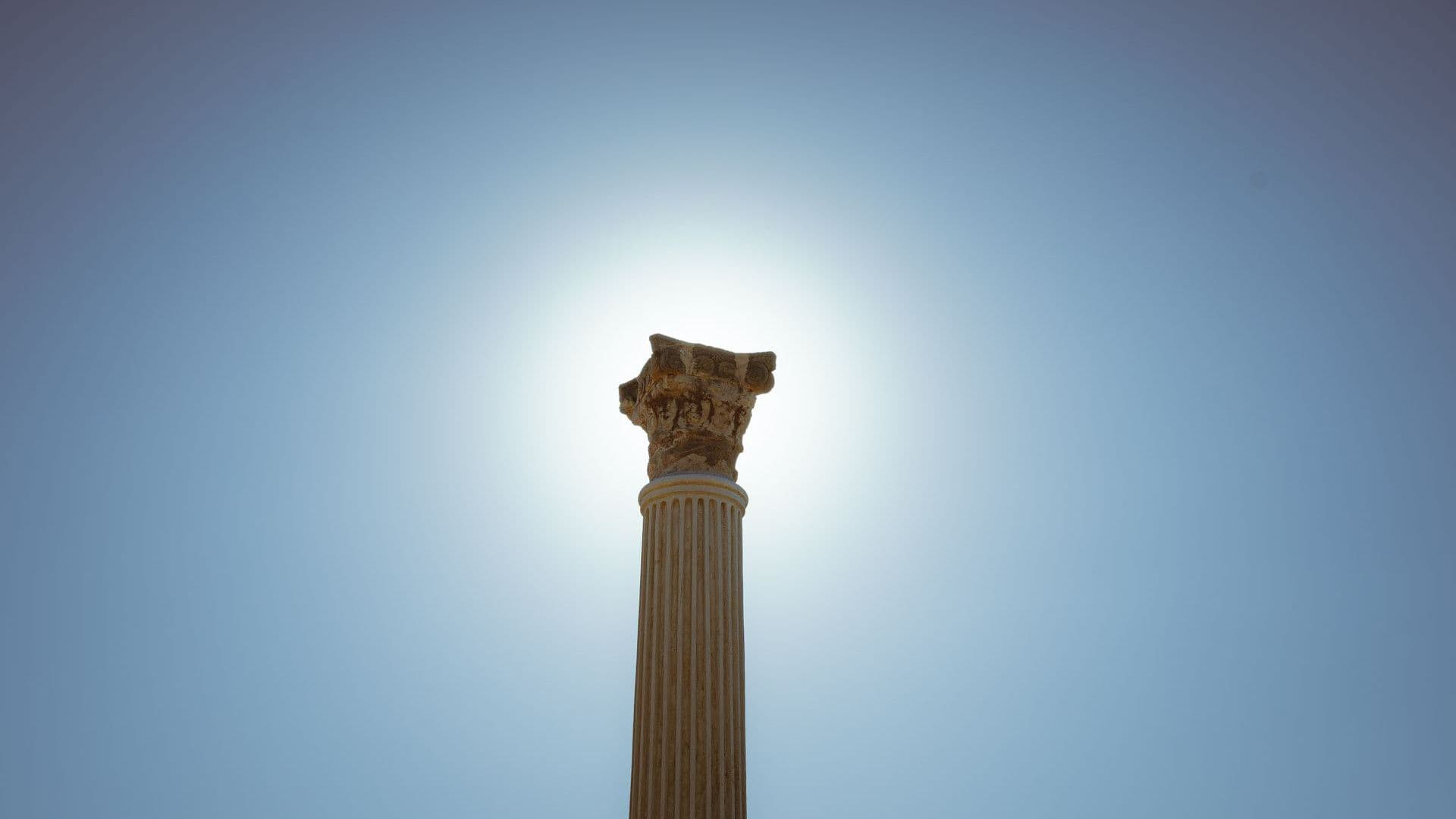
“In that day shall there be an altar to the Lord in the midst of the land of Egypt, and a pillar at the border thereof to the Lord.” Isaiah 19:19
The Know
Isaiah chapters 13–23 contain prophetic oracles declaring the end of various nations and the expansion of God’s kingdom. Chapter 19 focuses on Egypt and makes an unusual reference to a pillar: “In that day shall there be an altar to the Lord in the midst of the land of Egypt, and a pillar at the border thereof to the Lord” (Isaiah 19:19). Although the Egyptian nation will fall, Isaiah appears to be indicating that an altar and pillar to the Lord will eventually be established in that land. But what is this pillar Isaiah is referencing? A careful examination of both archaeology and the Bible shows that these pillars were important in ancient Israel.
The word translated as “pillar” in this verse is the Hebrew word matzevah, and it is used 34 times in the Hebrew Bible to denote some kind of stone or stele that humans have erected for devotional purposes.1 Stones that have been erected in this way are common throughout southern Levant. Most often matzevot are discussed in the context of other cultic objects and are often viewed negatively in Deuteronomy through Second Kings (typically translated as “image” in the KJV as in 2 Kings 3:2). They are generally paired with foreign altars that the righteous Israelites must destroy or as objects that wicked kings erect (see Deuteronomy 7:5). Chronicles, Jeremiah, Hosea, and Micah support the view that matzevot were cultic objects of some kind which were erected, often for worship.2
In Genesis 28:10–18, Jacob dreamed of a ladder reaching to heaven, and the Lord stood above it and made a covenant with Jacob. The next morning, when Jacob awoke, he concluded that the place where he slept “is none other but the house of God, and this is the gate of heaven.” He then “took the stone that he had put for his pillows, and set it up for a pillar [matzevah], and poured oil upon the top of it.” This passage supports the notion that matzevot were used to commemorate sacred space or mark that a covenant had occurred.
Most significant may be the use of matzevot in Exodus 24:4, “And Moses wrote all the words of the Lord, and rose up early in the morning, and builded an altar under the hill, and twelve pillars, according to the twelve tribes of Israel.” Israel had already seen that the presence of the Lord was on the mountain earlier in the text, so Moses may have erected matzevot to commemorate the area as sacred space. Additionally, each tribe made a covenant with the Lord at that moment, so the twelve stones likely commemorated that event.
Matzevot have also appeared in archaeological finds. Among the most significant examples are those discovered at a site in Arad. Scholars have concluded that two matzevot appear in the Holy of Holies of the Israelite temple there.3 They are against the back wall, with nothing between them (see image below).4 Their position seems remarkably similar to the location of the cherubim in Solomon’s temple as found in 1 Kings: They were close to the back wall of the Holy of Holies, on either side of the Ark of the Covenant. In some places, God is even referred to as the one who “dwells between the Cherubim” (2 Kings 19:5). It seems possible then, that these matzevot were meant as protection for the presence of God, as aniconic guardian figures, just as the cherubim were statues that protected the presence of God. In this temple, Yahweh would be the god who “dwells between the matzevot.” Arad provides strong evidence that matzevot were employed in cultic settings and thus would naturally be grouped with altars.
In light of this information Isaiah 19:19-20 makes more sense: “In that day shall there be an altar … and a pillar at the border (of Egypt) to the Lord.” Similar to border stelae, which were highly charged ideological, legal, and theological monuments designed to project royal authority, demarcate sacred or political space, commemorate treaties, and invoke divine or royal enforcement over a specific territory, a matzevah at the border of Egypt suggests the Lord’s majesty is there and that Egypt is now under the care of His sovereignty: “And it shall be for a sign and for a witness unto the Lord of hosts in the land of Egypt: and he shall send them a saviour, and a great one, and he shall deliver them.”
The Why
In today’s world, outsiders or foreigners are sometimes seen in a negative light. It is easy to identify people from other places as the evil “other” who are not like “us” and therefore must be viewed with suspicion. Chapters like Isaiah 19 present a different view, in which people who are different, even the Egyptians who enslaved the Hebrews in the early days of the Israelites’ history, can one day worship the Lord and enjoy his presence, having sacred stones and altars dedicated to His presence on their own land.
As President Gordon B. Hinckley stated, “Racial strife still lifts its ugly head. I am advised that even right here among us there is some of this. I cannot understand how it can be. It seemed to me that we all rejoiced in the 1978 revelation given President Kimball. I was there in the temple at the time that that happened. There was no doubt in my mind or in the minds of my associates that what was revealed was the mind and the will of the Lord.”5
He continued, “Throughout my service as a member of the First Presidency, I have recognized and spoken a number of times on the diversity we see in our society. It is all about us, and we must make an effort to accommodate that diversity. Let us all recognize that each of us is a son or daughter of our Father in Heaven, who loves all of His children… there is no basis for racial hatred among the priesthood of this Church.”6 This counsel is reminiscent of the teachings of Isaiah years earlier, reminding everyone that God loves all His children, no matter where they live.
Carl F. Graesser, “Standing Stones in Ancient Palestine” (The Biblical Archaeologist, Vol. 35, No. 2, 1972).
Avram R. Shannon, “Matzebot” in Old Testament Cultural Insights (Scripture Central, 2022).
- 1. Johannes Botterweck, Helmer Ringgren, and Heinz-Josef Fabry, eds. Theological Dictionary of the Old Testament (William B. Eerdmans Publishing Company, 1998), 519–529.
- 2. Wigram, George, ed. The Englishman's Hebrew Concordance of the Old Testament: Coded with the Numbering System from Strong's Exhaustive Concordance of the Bible. Peabody, MA: Hendrickson Publishing Company, 1996. s.v. "Msbh"
- 3. Aharoni, Yohanan. “Arad: Its Inscriptions and Temple” The Biblical Archaeologist 31 (1968): 5.
- 4. http://ferrelljenkins.wordpress.com/2008/08/28/the-arabah-road-and-arad-in-the-negev/
- 5. President Gordon B. Hinckley, “The Need for Greater Kindness,” Ensign, May 2006.
- 6. President Gordon B. Hinckley, “The Need for Greater Kindness,” Ensign, May 2006.