KnoWhy #856 | June 9, 2026
Why Does Goliath’s Height Matter?
Post contributed by
Scripture Central
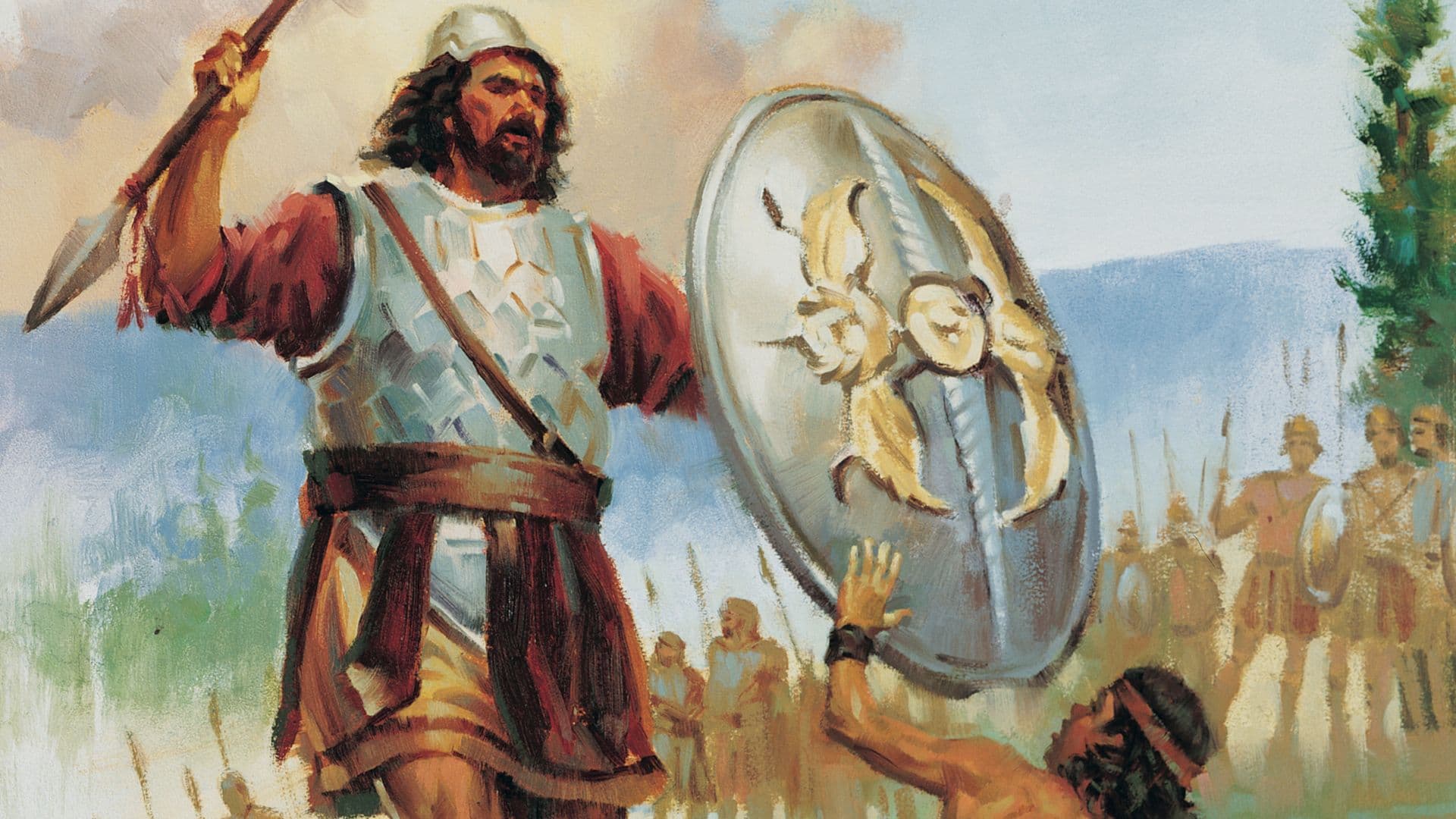
“And there went out a champion out of the camp of the Philistines, named Goliath, of Gath, whose height was six cubits and a span.” 1 Samuel 17:4
The Know
Most readers of the Bible are familiar with the story of David and Goliath, in which the young shepherd, David, kills the Philistine giant, Goliath. Many people will also remember that the Philistine warrior is described as over nine feet tall (see 1 Samuel 17:4 where a “cubit” was understood as the tip of the middle finger to the elbow, or about 18 inches, and a “span” was the span of the spread hand from tip of the thumb to the tip of the pinky finger, or about 9 inches). This is about a foot more than the tallest recorded human in modern history, Robert Wadlow, at 8 feet 11 inches. However, in both the Greek (Septuagint) and Dead Sea Scrolls versions of 1 Samuel 17:4, Goliath is described as only six and a half feet tall.1 This may seem like an insignificant difference at first; however, a careful examination of the story suggests that the shorter height may provide an implicit condemnation of Saul.
1 Samuel 9:2 describes Saul as being “from his shoulders and upward” taller than “any of the people.” Considering that most men in ancient Israel were only five and a half feet tall, a man who was taller than everyone else “from his shoulders and upwards” would have been about six and half feet, or the same height as Goliath in the sources noted above.2 These similar heights of Goliath and Saul give new meaning to 1 Samuel 17:8, in which Goliath asks for an Israelite to come fight him: “Why are ye come out to set your battle in array? am not I a Philistine, and ye servants to Saul? choose you a man for you, and let him come down to me.” The Israelite giant, Saul, would have been the obvious choice to fight the Philistine giant, Goliath.3 In fact, the Israelites had previously declared that they wanted a king to “go out before us, and fight our battles” (1 Samuel 8:20), which would have been Saul’s responsibility once he assumed the role. However, he refused to fulfill this responsibility, and left it to David, the smallest person in his family (1 Samuel 16:11–12), to do the job for him (1 Samuel 17:37).
Although Saul was the clear choice to fight the Philistine giant, Saul let fear, not faith, prevail and did not fulfill his responsibility (1 Samuel 17:11). In contrast, the text demonstrates that David was not afraid, saying to Goliath: “Thou comest to me with a sword, and with a spear, and with a shield: but I come to thee in the name of the Lord of hosts, the God of the armies of Israel, whom thou hast defied” (1 Samuel 17:45).
The Why
When examining the David and Goliath story, one often focuses on the faith of David, which is a completely reasonable response to the story. However, the height of Goliath reminds the reader to also keep in mind the lack of faith shown by Saul. For readers of the Bible today, it might be easy to be like Saul. It can be easy to push responsibility onto someone else, perhaps because of fear or a lack of faith. However, when we are tempted to be like Saul, we can remember that God will always be there to help us, no matter how terrifying the task ahead of us.
President George Q. Cannon put it well: “No matter how serious the trial, how deep the distress, how great the affliction, [God] will never desert us. He never has, and He never will. He cannot do it. It is not in his character… He will stand by us. We may pass through the fiery furnace; we may pass through deep waters; but we shall not be consumed nor overwhelmed.”4
Spencer W. Kimball, “The Davids and the Goliaths,” Ensign 4, no. 11 (November 1974): 79-83.
Thomas S. Monson, “Meeting your Goliath,” Ensign 17, no. 1 (January 1987): 2-5.
Morgan W. Tanner, “1 Samuel 17,” Old Testament Minute: 1 Samuel, ed. Taylor Halverson (Book of Mormon Central, 2022).
- 1. See Benjamin J. M. Johnson’s article “Reconsidering 4QSama and the Textual Support for the Long and Short Versions of the David and Goliath Story,” Vetus Testamentum 62 (2012): 540. For more on this issue, see Johan Lust, “The Story of David and Goliath in Hebrew and in Greek,” in The Story of David and Goliath: Textual and Literary Criticism; Papers of a Joint Research Venture, eds. Dominique Barthélemy et al. (Vandenhoeck & Ruprecht, 1986), 5–6. For broader considerations of the textual problems in the David narrative, see Joseph Lozovvy, Saul, Doeg, Nabal, and the “Son of Jesse”: Readings in 1 Samuel 16–35 (T & T Clark International, 2009), 34–35.
- 2. Benjamin J. M. Johnson, Reading David and Goliath in Greek and Hebrew: A Literary Approach (Mohr Siebeck, 2015), 75.
- 3. Johnson “Reconsidering 4QSama,” 540.
- 4. George Q. Cannon, “Remarks,” Deseret Evening News, Mar. 7, 1891, 4.