KnoWhy #874 | October 29, 2026
Why Does God’s Throne Have Wheels in Ezekiel?
Post contributed by
Scripture Central
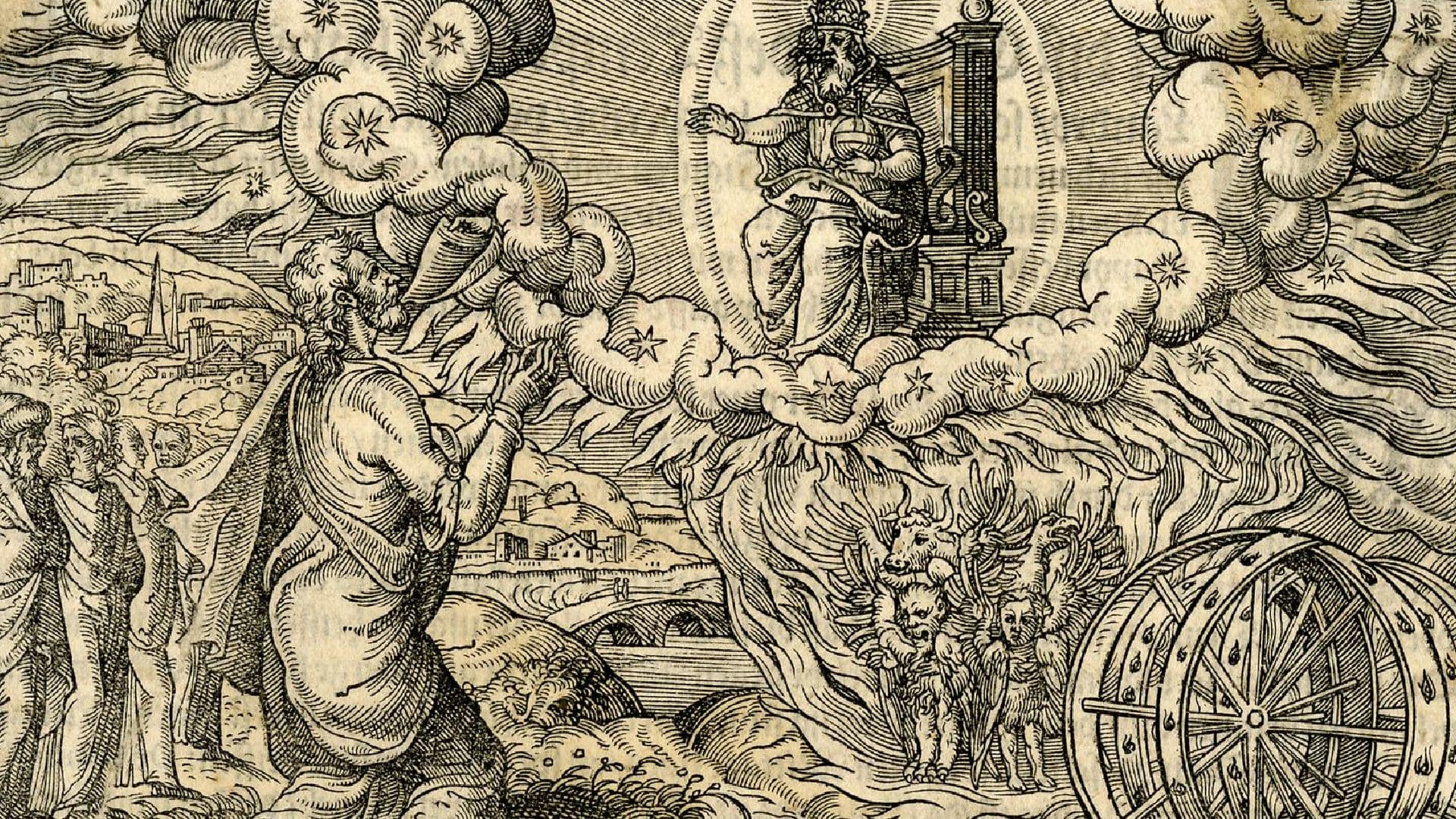
“Now as I beheld the living creatures, behold one wheel upon the earth by the living creatures, with his four faces.” Ezekiel 1:15
The Know
Ezekiel 1 contains what is, at first, a baffling scene: four composite beasts and a giant supernatural wheel next to each (Ezekiel 1:15-21). As one continues to read the chapter, it becomes clear that the four wheels are attached to a giant throne, upon which God sits (Ezekiel 1:26). Why would God have a throne with wheels? The wheels are likely symbolic, teaching Ezekiel and those in exile, that God was still with them, no matter where they traveled in the world.1
Most people in the ancient Near East spoke of various gods ruling over a specific land, nation, or similar geographical location.2 In Judges 11, for example, the less-than-righteous Israelite Judge Jephthah tells his foreign counterpart, “Wilt not thou possess that which Chemosh thy god giveth thee to possess? So whomsoever the Lord our God shall drive out from before us, them will we possess” (Judges 11:24). In other words, Jephthah thinks that the Moabite deity Chemosh would take care of the Moabites, and Jehovah would take care of the Israelites. In other words, people spoke of deities only being active in their own “territory.”
1 Kings 20 reflects this idea as well. After losing a battle against the Israelites, “the servants of the king of Syria said unto him, Their gods are gods of the hills; therefore they were stronger than we; but let us fight against them in the plain, and surely we shall be stronger than they” (1 Kings 20:23). Likewise, Naaman, the Syrian captain that Elisha healed, assumed he could only worship Jehovah on Israelite soil. 2 Kings 5:17 states “And Naaman said, Shall there not then, I pray thee, be given to thy servant two mules’ burden of earth? for thy servant will henceforth offer neither burnt offering nor sacrifice unto other gods, but unto the Lord.” In other words, Naaman believed the God of the Israelites could only be worshipped on Israelite soil, and he therefore asked for a two-mule load of Israelite dirt to take with him, so he could worship Jehovah on it.
Some people during the time of Jeremiah seem to have thought the same thing. They claimed God would protect Jerusalem simply because it was His land, where His people and temple were. Jeremiah tells the people, “Thus saith the Lord of hosts, the God of Israel, Amend your ways and your doings, and I will cause you to dwell in this place. Trust ye not in lying words, saying, The temple of the Lord, The temple of the Lord, The temple of the Lord, are these” (Jeremiah 7:3–4). In other words, people are claiming they will not be coast out of their land simply because the buildings of the temple complex (“are these”) belong to their God and surely He would not let them be destroyed.3 God reminds them that the Ark of the Covenant used to be at Shiloh, but that the temple at Shiloh was now in ruins, “But go ye now unto my place which was in Shiloh, where I set my name at the first, and see what I did to it for the wickedness of my people Israel. And now, because ye have done all these works, saith the Lord … Therefore will I do unto this house, which is called by my name, wherein ye trust, and unto the place which I gave to you and to your fathers, as I have done to Shiloh” (Jeremiah 7:12–14).
After the temple is destroyed by the Babylonians and the people are scattered from their land into foreign lands supposedly governed by other gods, worshipping the Lord seems impossible. Psalm 137 states, “By the rivers of Babylon, there we sat down, yea, we wept, when we remembered Zion…For there they that carried us away captive required of us a song; and they that wasted us required of us mirth, saying, Sing us one of the songs of Zion. How shall we sing the Lord’s song in a strange land?” (Psalm 137:1, 3–4).
Ezekiel’s vision of God’s chariot-throne on wheels radically challenged the perspective that a god is limited to one location.4 This vision symbolically taught that people that God did not only reside at the temple in Jerusalem, but could travel with the Israelites wherever they were, even in exile. God was the God of the whole earth, and not a regional deity, and so could be with the Judahites no matter where they were.
Never miss a KnoWhy
Get Scripture Central's latest research and resources delivered straight to your inbox.
The Why
Depicting the divine throne as a chariot reminded the people that God was not bound to one place, like the temple in Jerusalem. Although strange to modern readers, the scene in Ezekiel 1 is an important reminder to everyone that God is not limited in his ability to help any of his children: He can rescue them from distress and trial, no matter how far away from Him they may have wandered.
This is not to say that people need not attend sacred spaces such as the temple or churches. However, it reminds everyone that these are not the only places where God’s influence can be felt, and one does not leave God behind as they leave a temple or a church. God can be with everyone in their homes, at their workplaces, on the road, and anywhere else people find themselves. God is the God of the whole earth and can be present wherever His children exist.
John Gee, “The Wind and the Fire to Be My Chariot”: The Anachronism that Wasn’t," Interpreter: A Journal of Latter-day Saint Faith and Scholarship, Vol. 50 (2022), Article 15. Available at https://scholarsarchive.byu.edu/interpreter/vol50/iss1/15
William J. Hamblin, "Temple Motifs in Jewish Mysticism," in Temples of the Ancient World: Ritual and Symbolism, ed. Donald W. Parry (Salt Lake City: Deseret Book and FARMS, 1994), 440–476. Available at https://scholarsarchive.byu.edu/mi/76/
- 1. For more on this, see LAUNDERVILLE, DALE. “Ezekiel’s Throne-Chariot Vision: Spiritualizing the Model of Divine Royal Rule.” The Catholic Biblical Quarterly 66, no. 3 (2004): 361–77.
- 2. For an overview, see Mark S. Smith, The Early History of God: Yahweh and Other Deities in Ancient Israel, 2nd ed. (Grand Rapids, MI: William B. Eerdmans, 2002), 60–61.
- 3. See A. R. Pete Diamond, “Jeremiah,” in Eerdmans Commentary on the Bible, ed. James D. G. Dunn and John W. Rogerson (Grand Rapids, MI: Wm. B. Eerdmans, 2003), 562.
- 4. See Allen, Leslie C. “The Structure and Intention of Ezekiel I.” Vetus Testamentum 43, no. 2 (1993): 145–61.