KnoWhy #842 | March 5, 2026
Why Do the Details of the Joseph Story Matter?
Post contributed by
Scripture Central
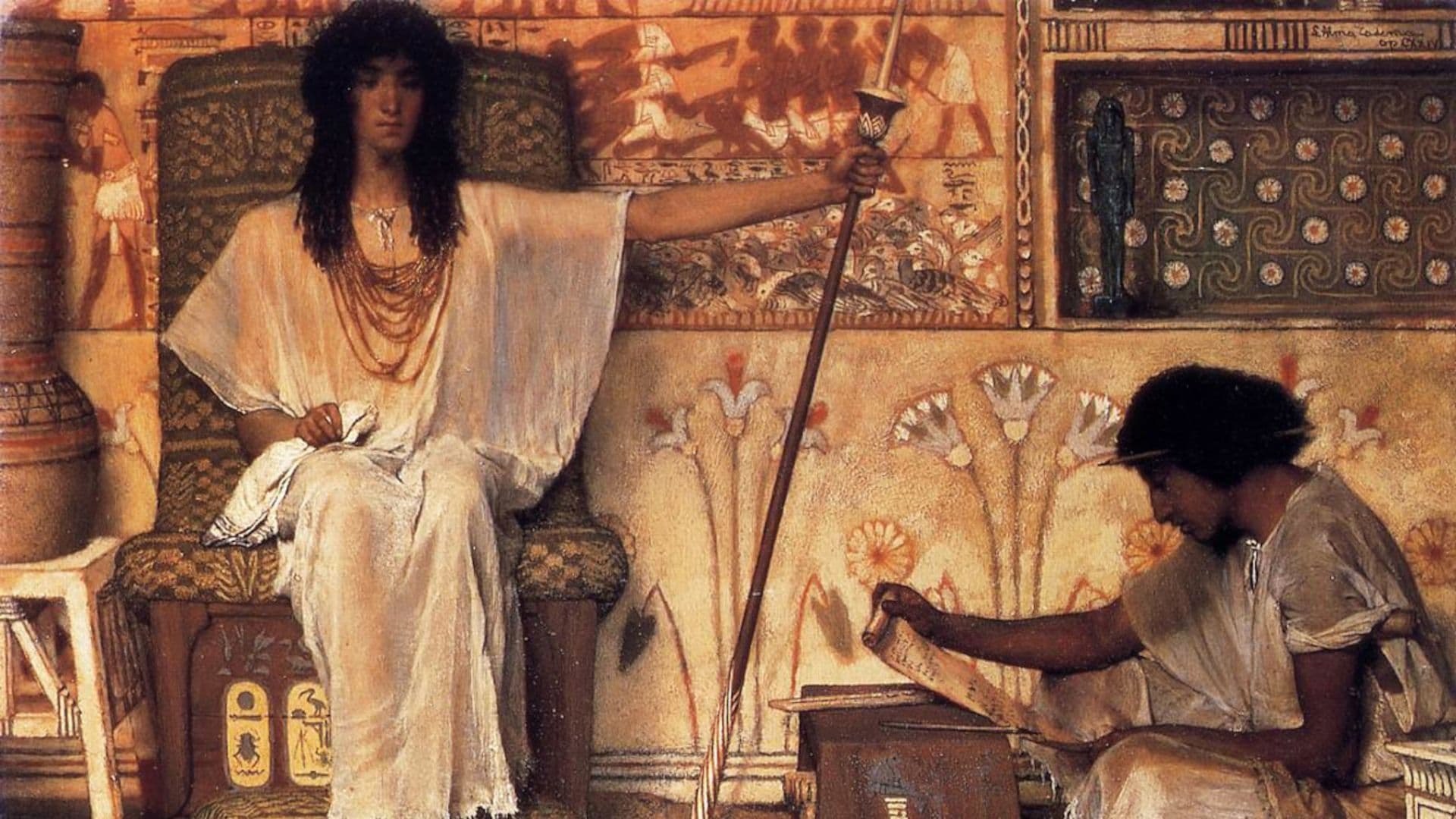
"And they drew and lifted up Joseph out of the pit, and sold Joseph to the Ishmeelites for twenty pieces of silver." Genesis 37:28
The Know
Genesis 37-50 records the story of Joseph who is sold into slavery by his brothers and eventually rises to become a leading figure in Egypt. While the broad outlines of this story are clear upon a first reading of Genesis, several of the details in Joseph’s experiences are not familiar to modern readers. Knowing what one would expect someone to experience in that time and place helps modern readers to see what the Joseph narrative teaches about God.
In Genesis 37:28, Joseph is sold into slavery for twenty pieces of silver. One might wonder whether that amount was the normal price one would expect a buy a slave in that time or were the brothers selling him off for less just to get rid of him. Thankfully, historical evidence helps to answer this question. Based on ancient Near Eastern evidence, twenty pieces appears to be historically accurate for the 1700’s BC, roughly the time of Joseph.1 According to Hammurabi’s law code, from around that time, the average price of a slave was twenty pieces of silver.2 One sees the same thing at Mari, where evidence for slaves being sold for exactly twenty pieces of silver also exists.3 The average price in some Old Babylonian documents is twenty-two pieces of silver.4 Before this time, the price of an enslaved person was lower, and after this time, the price rose. In Third-Dynasty Ur of Southern Mesopotamia, the price was usually ten pieces of silver.5 By the fifteenth century BC, an enslaved person could be purchased for thirty pieces of silver in Nuzi.6 The same was true in the fourteenth century in Ugarit.7 By the 700’s an enslaved person could be purchased for fifty pieces of silver.8 By the Persian Period, the price had risen to over ninety pieces of silver.9 But during the time of Joseph, twenty pieces of silver was the going rate for enslaved people: Joseph was sold at the price one might expect.
Another culturally relevant part of the Joseph story concerns some of the names appearing in it. For example, Genesis 41:45 mentions the names of Joseph’s wife and his father-in-law, Asenath and Potiphera respectively, and Joseph himself is given a new name by the Pharaoh: Zaphenath-Pa'aneah.10 These are Egyptian names that have linguistic and culture parallels from the time of Joseph. The Egyptian name ’Af-en-et, “He belongs to you,” is attested in Egypt, and ’As-en-et would be the female version meaning “She belongs to you.”11 Potiphera almost certainly reflects the Egyptian Pa-di-pa-Re, meaning “The gift of the Re,” an Egyptian form dating after the time of Joseph but has an equivalent form (Didi-Re) from earlier times.12 Zaphenath-Pa'aneah is likely the Hebrew equivalent of the Egyptian phrase djad(u)-naf (I)pa-ankh meaning ”Who is called The One Who Lives.“ The formula ”X who is called Y” and the name (I)pa-ankh, “the one who lives” or “living one,” are attested starting in Egypt’s Middle Kingdom.13
In Genesis 41:42-43, one reads that Joseph is clothed in fine linen and a gold collar, is allowed to ride in a chariot behind the king, and is given a signet ring. These details also fit with the kind of thing one would expect in Egypt during the time of Joseph, as depicted in Egyptian art from his time.14 In addition, the text states that Joseph was embalmed and put in a sarcophagus, which is not what one might initially expect from someone who was not an Egyptian. However, there is evidence from the time of Joseph for Canaanites in Egypt being embalmed and put into a sarcophagus.15
The Why
The details noted above all give useful impressions about the story of Joseph in Egypt. First, these details increase confidence that the account in Genesis has been handed down accurately, even in seemingly insignificant details. How would later authors have known of these details from Joseph’s time and place? Indeed, Joseph was sold for exactly the expected amount of money, and people in the Joseph story have names that one would expect from that time period, and Joseph was treated the way officials in Egypt were treated at that time.
Moreover, these historical details serve to highlight the miraculous nature of the story. The brothers did not sell Joseph cheaply. If they had, that would have explained why they were able to send him off to Egypt so easily. If they had demanded more money than usual, it would have appeared that they were doing this to get lots of money. Because Joseph was sold into slavery for the usual price of a slave during his time and place, we are left to look for a stronger reason why that transaction occurred. In fact, the human motives pale in light of the plans and motives of God. He needed Joseph to succeed on his own in Egypt in order to save his people from famine. Joseph needed to rise on his own so that he would have the respect and official authority in Egypt necessary to relocate his family there. As he would eventually explain to his brothers, “Now therefore be not grieved, nor angry with yourselves, that ye sold me hither: for God did send me before you to preserve life” (Genesis 45:5).
Likewise, the seemingly-unusual names, which turn out to be common forms of Egyptian names during Joseph’s time, highlight further the miraculous nature of God’s helping Joseph to thrive in a society with people whose culture, including their names, was different from his own. But the names he heard there certainly would have given him reassurances that God had indeed preserved his life so that he could be an instrument in the hand of the Lord. One name told him that he belonged in Egypt. Another name must have helped him feel grateful for his lot in Egypt and for the gifts of God that turned hardships into joy. As he said to his brother that he had been enabled to “preserve [their] life,” Joseph was possibly even familiar with people around him with names such as “the one who lives,” or “the living one.” Eventually, because of his noble character and spiritual gifts, Joseph earned the respect of high officials in Egypt.
As President Ezra Taft Benson and others have said, “Whom the Lord calls, He qualifies.”16 Miraculously, God took Joseph, an enslaved Hebrew, and helped him to be promoted to a position of authority in ancient Egypt, so that he could be the needed instrument in the hands of God in helping to fulfill the Lord’s covenant promises to his father, grandfather, and great-grandfather. Although there is no record of God appearing to Joseph in vision anywhere in the book of Genesis, Joseph was blessed with several other spiritual gifts. As insignificant details in this story can help modern readers see, God was clearly there with Joseph throughout his ordeal, helping him to become the man God needed him to become in order to save his family and God’s covenant people from death or extinction.
Matthew L. Bowen, ““Thou Art the Fruit of My Loins”: The Interrelated Symbolism and Meanings of the Names Joseph and Ephraim in Ancient Scripture,” Interpreter: A Journal of Mormon Scripture 28 (2018): 273-298.
Joseph Fielding McConkie, “Joseph, son of Jacob,” in Encyclopedia of Mormonism, 4 vols., ed. Daniel H. Ludlow (Macmillan Publishing, 1992), 2:760–761.
Edward J. Brandt, “Joseph in Egypt,” Ensign 3, no. 9 (1973).
- 1. For an overview, see Kenneth Kitchen, On the Reliability of the Old Testament (Eerdmans, 2003), 344-345.
- 2. J. B. Pritchard, ed., Ancient Near Eastern Texts Relating to the Old Testament (Princeton University Press, 1950; and ed., 1955, 3rd ed., 1969), 170, 175, 176.
- 3. G. Boyer, Archives royales de Mari, Textes Vlll (1958), 23, no. 10:1-4.
- 4. M. van de Mieroop, Archiv für Orientforschung 34 (1987), 10, 11.
- 5. D. O. Edzard, Sumerische Rechtsurkunden des III Jahrtausends (Beck, 1968), 87, tab 5.
- 6. B. L. Eichler, Indenture at Nuzi (Yale University Press, 1973), 16 and n. 35, and texts listed on 17-18.
- 7. J. Mendelsohn, Slavery in the Ancient Near East (Oxford University Press, 1949), 118 and 155 n. 181.
- 8. C. H. W. Johns, Assyrian Deeds and Documents III (Cambridge University Press, 1924), 542-46.
- 9. B. Meissner, Babylonien und Assyrien I (Winter, 1920), 365-66; B. Meissner, “Warenpreise” in Babylonien (Akademie der Wissenschaften, 1936), 35-36.
- 10. For an overview, see Kenneth Kitchen, On the Reliability of the Old Testament, 345-347.
- 11. Kenneth Kitchen, On the Reliability of the Old Testament, 346.
- 12. Kenneth Kitchen, On the Reliability of the Old Testament, 346-347.
- 13. Kenneth Kitchen, On the Reliability of the Old Testament, 345–346.
- 14. For an overview, see Kenneth Kitchen, On the Reliability of the Old Testament, 349.
- 15. For some examples, see G. Daressy, Annales du Service des Antiquités de l’Égypte 7 (1906): 118-19; P. Lacau, Sarcophages anteriears an Noavei Empire II (Service des Antiquites, 1906), 86-87, pls. 19:1-2, CGC no. 23108.
- 16. ” Whom the Lord Calls He Qualifies,” Ensign 43, no. 7 (2013), https://www.churchofjesuschrist.org/study/ensign/2013/07/whom-the-lord-calls-he-qualifies?lang=eng; see also Amanda Williams, “Who God Calls He Qualifies: Unpacking The Meaning Behind The Saying,“ Christian Website, updated April 24, 2024, https://www.christianwebsite.com/who-god-calls-he-qualifies/.