KnoWhy #838 | February 10, 2026
Why Did the Lord Tell Abraham That Neither His Servant Nor Ishmael Would Be His Heir?
Post contributed by
Scripture Central
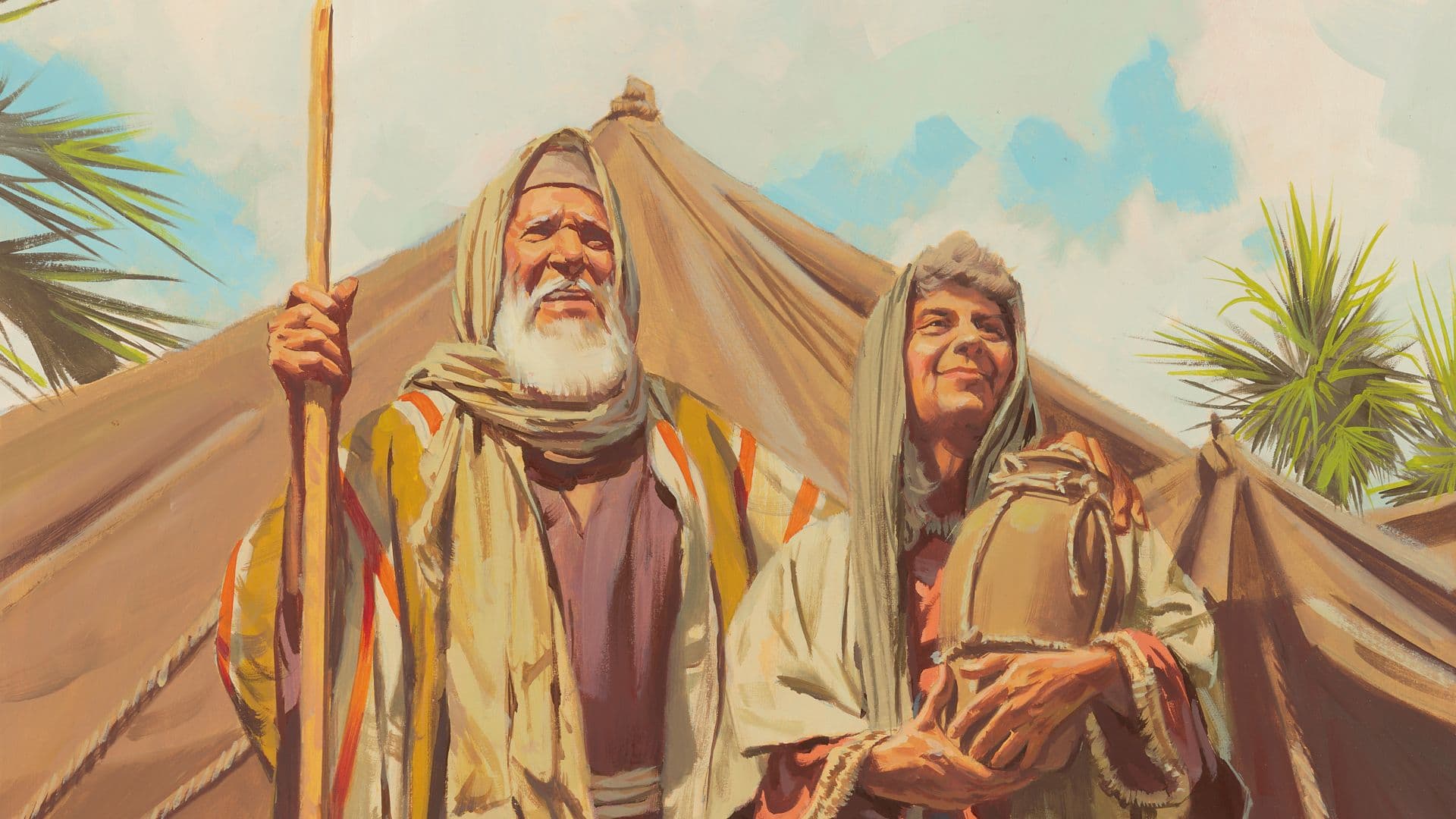
“And, behold, the word of the Lord came unto him, saying, This shall not be thine heir; but he that shall come forth out of thine own bowels shall be thine heir.” Genesis 15:4
The Know
The Abraham narrative in Genesis contains some unusual details in relation to who would be his heir. Because he and Sarah were childless and now old, Abraham assumes that his steward Eliezer of Damascus, whom he identified as “one born in my house,” is his heir (Genesis 15:2-3). However, God declares that Eliezer is not to be the heir and assures Abraham that he would still father a son through his “own bowels” (Gen. 15:4). But later when Sarah still “bare him no children” (Genesis 16:1), she gives to Abraham her Egyptian household servant, Hagar, to be his second wife with whom he could have children (Genesis 16:2-4). Hagar gives birth to Ishmael, Abraham’s firstborn and apparent heir (Genesis 16:4, 11, 15). But then the Lord promises that Sarah would still give birth in their old age, which she does, and Isaac is born (Genesis 17:16-17; 21:1-5). On two occasions, Hagar and Ishmael appear to make themselves equal to or better than Sarah and Isaac, and so Sarah tells Abraham that Ishmael is not to be an heir with Isaac, which the Lord affirms, and Abraham sends Hagar and Ishmael away (Genesis 16:4-6; 21:9-12). Looking at some ancient Near Eastern inheritance laws and practices can help make sense of what is happening.1 Even though events should ideally be examined in the laws of their own nation or location, neighboring city-states can at least reflect ideas that existed in the area at the time, especially if law-codes in the immediate area have not all been discovered.
Section 191 of the Babylonian law-code of Hammurabi, dating to shortly after Abraham’s time, provides some legal guidelines with respect to any childless man who adopts a son, but then later has natural children.2 This law-code demonstrates that adopting an heir was a legitimate practice of the time, but if the couple decides to disinherit an adopted son in deference to a natural child that was born later, they could do so, but Hammurabi’s law required that the father give some gifts such as money or animals to the adopted but now disinherited son. However, real property such as family fields, orchards, or houses should not be given as these were part of the inheritance. In short, an adopted son who was no longer to inherit was not to be sent off entirely “empty-handed.”
In the nearby city of Mari, a private adoption contract appears to have been written to prevent the adopted son from ever being disinherited. According to it, a boy named Yahatti-el had been adopted as a couple’s first son, but the agreement stated that if the couple were then to “have many sons, Yahatti-Il is the heir [to their estate], and he shall take two shares from the estate of Hillalum, his father. His younger brothers shall divide the (remaining estate) in equal parts.”3 So, it appears that families were free to make whatever contractual arrangements they found to be appropriate for their circumstances, but legal boundaries like Hammurabi’s code could also occur to ensure all parties had some protections. Other Old Babylonian documents contain similar legal provisions dealing with family and estate complications arising from adopting a son and making him one’s heir.4
Given Abraham’s declaration that Eliezer was his heir, it is likely that he was a servant who was legally adopted as Abraham’s son. What happened to Eliezer after Ishmael was born is not stated, but it is clear that Ishmael superseded him as heir. Given the neighboring law-code and Abraham’s effort to give non-inherited gifts to all his other sons when Isaac superseded them as heir (see Genesis 25:6), it is likely that Eliezer did not go away empty-handed either.
The practice of trying to have a natural heir through a secondary wife, the maid-servant of the first wife, was commonly permitted around the time of Abraham as well.5 In the nineteenth century BC, an Assyrian contract stated that when two people married, “If within two years she does not produce children for him, she herself may buy a slave woman. Even after she [the latter] has had a child by him, the man may sell her off as he wishes.”6 Hammurabi’s Code 145-146 provides other scenarios:
CH §145 If a man married a nadītum [a free, consecrated woman typically associated with a temple – a priestess] but she did not help him acquire children … said man may marry a šugītum [concubine]; he may bring her into his house; said concubine [however] will not compare herself with the priestess.
CH §146 If a man married a priestess and she gave her husband a slave and she has born children, [and] later on that slave has compared herself with her mistress, her mistress will not sell her, since she bore children; she will give her a slave’s hairstyle and include her with [the rest of] the slaves.7
These laws and contracts show that, while childless couples in Abraham’s world had various options to try and remedy their lack of an heir, this was not a simple matter. Indeed, in those cultures, certain choices and duties arose when a first wife, especially a temple priestess, had not produced children who could inherit the land and priesthood office of their father. One option was for the couple to arrange to have children via one of the priestesses’ maid-servants. Sons born to this second wife could be designated as the heir of a father’s estate; but, in some cases, the servant woman could also be sent away or demoted, especially if she had “compared herself to her mistress,” making herself of equal status similar to what Hagar did.8 Some laws even stipulate that the children of the first wife are not to be superceded by the children of a maid-servant, even if they were born first.9
While none of these legal provisions from the ancient world cover exactly the same situations and needs which Abraham and Sarah faced, these cultural norms and legal precedents provided solutions that were, in fact, similar to actions ultimately taken by Abraham and Sarah in Genesis. It would appear that Sarah’s primary position was not superseded by Hagar as the second wife, even if she bore an heir first; and in return Sarah may have had no right to give or sell Hagar to anyone else, once she had given birth to a male child for Abraham, similar to what we see in Hammurabi’s Code 145-146. Also to be noted is that it fits within some customs of the time that the privileges of primogeniture belonged anciently and inherently to Isaac as the firstborn son of a first wife, even if Isaac was actually born after Ishmael. That rule settled a legal issue that could arise in any polygamous family.
The Why
Why had Abraham and Sarah not simply made use of all the apparently legal ways to solve their problem of a lack of an heir before they grew old? Perhaps it was due to their faith in God’s covenant wherein Abraham was promised seed as numerous as the dust of the earth and the stars in the heavens (see Gen. 13:16; 15:5). Abraham and Sarah waited together on the Lord for many, many years. As they grew very old and still had no children, Abraham and Sarah together took steps which were available under the laws and customs of their day, allowing a man in Abraham’s situation to adopt or to take a second wife, with Sarah’s approval, in order for him to have a male heir. This was consistent with the norms in the law codes of the day but were also acts of faith as they tried to fulfill the Lord’s promises.
Following their example, all can strive to have increased faith, patience, and ask more often of God, who gives to all people liberally. In the temples of the Most High today, the blessings of the covenant continue to be sealed upon couples for both time and eternity. Indeed, God affirmed to Abraham and Sarah that the blessings of seed promised in their covenant would indeed be theirs in time, not just eternity: “I will bless her, and she shall be a mother of nations; kings of people shall be of her. . .. Sarah thy wife shall bear thee a son indeed; and thou shalt call his name Isaac: and I will establish my covenant with him for an everlasting covenant, and with his seed after him” (Genesis 17:16, 19). As the Letter to the Hebrews declares “Through faith also Sara herself received strength to conceive seed, and was delivered of a child when she was past age, because she judged him faithful who had promised” (Hebrews 11:11).
God has said, “For my thoughts are not your thoughts, neither are your ways my ways” (Isaiah 55:8), and his ways are the ways of love, law, and miracles (see 2 Nephi 27:23). In the words of Ronald A. Rasband, “Miracles, signs, and wonders abound among followers of Jesus Christ today, in your lives and in mine. Miracles are divine acts, manifestations and expressions of God’s limitless power, and an affirmation that He is ‘the same yesterday, today, and forever.’”10 The lives of Abraham and Sarah bear witness that the promises of God in his covenant will indeed be fulfilled in time, either through immediate miracles or in the Millennial day when all things are restored previous to eternity. Our job is to press forward doing all we can until all those promises are fulfilled.
Further Reading
E. Douglas Clark, The Blessings of Abraham: Becoming a Zion People (Covenant Communications, 2005).
Hugh W. Nibley, "The Sacrifice of Sarah," in Abraham in Egypt, 2nd Edition, edited by Gary P. Gillum (Deseret Book, 2000), 343-381.
Truman G. Madsen, "Power from Abrahamic Tests," in Five Classics by Truman G. Madsen (Deseret Book, Eagle Gate, 2001), 232-240.
Footnotes
- 1. For more on contextualizing Abraham in his own time and place, see Kenneth Kitchen, On the Reliability of the Old Testament (Eerdmans, 2003), 325-328.
- 2. Martha Roth, “The Laws of Hammurabi” in The Context of Scripture, 3 vols., ed. William W. Hallo (Brill, 2003), 2:348.
- 3. Archive Royal de Mari VIII (1958), No. 1, adoption contract of Yahatti-El, Old Babylonian period (18th c. BCE). Translated in Karen Rhea Nemet-Nejat, Daily Life in Ancient Mesopotamia (Greenhaven Press / Gale, 1998), 19-20.
- 4. See, for example, E. C. Stone and D. J. Owen, Adoption in Old Babylonian Nippur and the Archive of Manmum-meshu-lisser (Eisenbrauns, 1991), 3-11, texts 1-8 (38-45).
- 5. For an overview, see Kenneth Kitchen, On the Reliability of the Old Testament (Eerdmans, 2003), 326.
- 6. See B. Hrozny, Symbolae Koschaker ll (Brill, 1939), 108ff; James B. Pritchard, ed., Ancient Near Eastern Texts Relating to the Old Testament. Supplement (Princeton University Press, 1969), 543.
- 7. Adapted from John Huehnergard, Key to a Grammar of Akkadian. Third Edition (Eisenbrauns, 2013), 88, 124.
- 8. According to Hammurabi’s code 170 – 71, sons of enslaved wives inherited if they were acknowledged as heirs. If they were not acknowledged, however, they did not inherit anything. See Martha Roth, “The Laws of Hammurabi” in The Context of Scripture, 3 vols., ed. William W. Hallo (Brill, 2003), 2:346.
- 9. For example, see the Laws of Lipit-Ishtar 25—26 in Martha Roth, “The Laws of Lipit-Ishtar” in The Context of Scripture, 3 vols., ed. William W. Hallo (Brill, 2003), 2:412-413.
- 10. Ronald A. Rasband, “‘Behold! I Am a God of Miracles’,” Ensign (May 2021), 109–112.