KnoWhy #846 | March 31, 2026
Why Did Moses Have to Walk a Sacred Path Before Delivering Israel?
Post contributed by
Scripture Central
The Know
Before Moses could lead Israel out of Egypt, through the sea, up to Sinai, and onward toward their promised land, the scriptural narrative first portrays him walking a sacred path of descent and ascent himself. Based on a recent study by Dr. John S. Thompson, it appears that Moses’s early life is not presented merely as background biography but functions as a divine blueprint showing how one moves from divine origin, through exile, and back to the presence of God.1
Moses’s story begins with imagery suggestive of more than an ordinary birth. Moses is drawn from the Nile among the reeds by Pharaoh's daughter (Exodus 2:5-10). Such a scene evokes other royal-divine birth traditions in the ancient Near East in which the hero is saved from certain death as an infant, such as Sargon, who was sealed in a basket and put into a river as an infant before he was drawn out, adopted, and grew to become king of Akkad.2 Even in Egypt, a tradition persisted that Horus, the threatened heir of Osiris’s throne, was born and hidden in the marshes among papyrus plants by Isis.3 Even Moses's name fits the Egyptian world relative to divine birth. Although Exodus 2:10 connects his name to the Hebrew root meaning “to draw out,” the name is also Egyptian, built on the root msỉ “give birth,” “be born,” as seen in names like Thutmose “born of Thoth” and Rameses “Ra has borne him.” Moses is thus introduced amid markers that portray him as a child of unusual, even divine, origin.
Next, Moses is raised in Pharaoh's house as a royal son. According to Stephen in Acts 7:23-24, Moses the prince already saw himself as a deliverer to Israel when he killed the Egyptian who was wrongly causing an Israelite to suffer, but Moses and the people were not yet fully ready for deliverance at this point. As a result, Moses had to flee for his life from Egypt.
The narrative goes on to portray the royal son becoming an exile in Midian, where he lives as a shepherd and names his son Gershom, meaning “a foreigner there.” The narrative deliberately traces his descent from divine origin, to a royal palace, and finally to a fall in a wilderness estrangement. That exile, however, becomes the turning point where he begins his ascent and is made fully ready to deliver Israel.
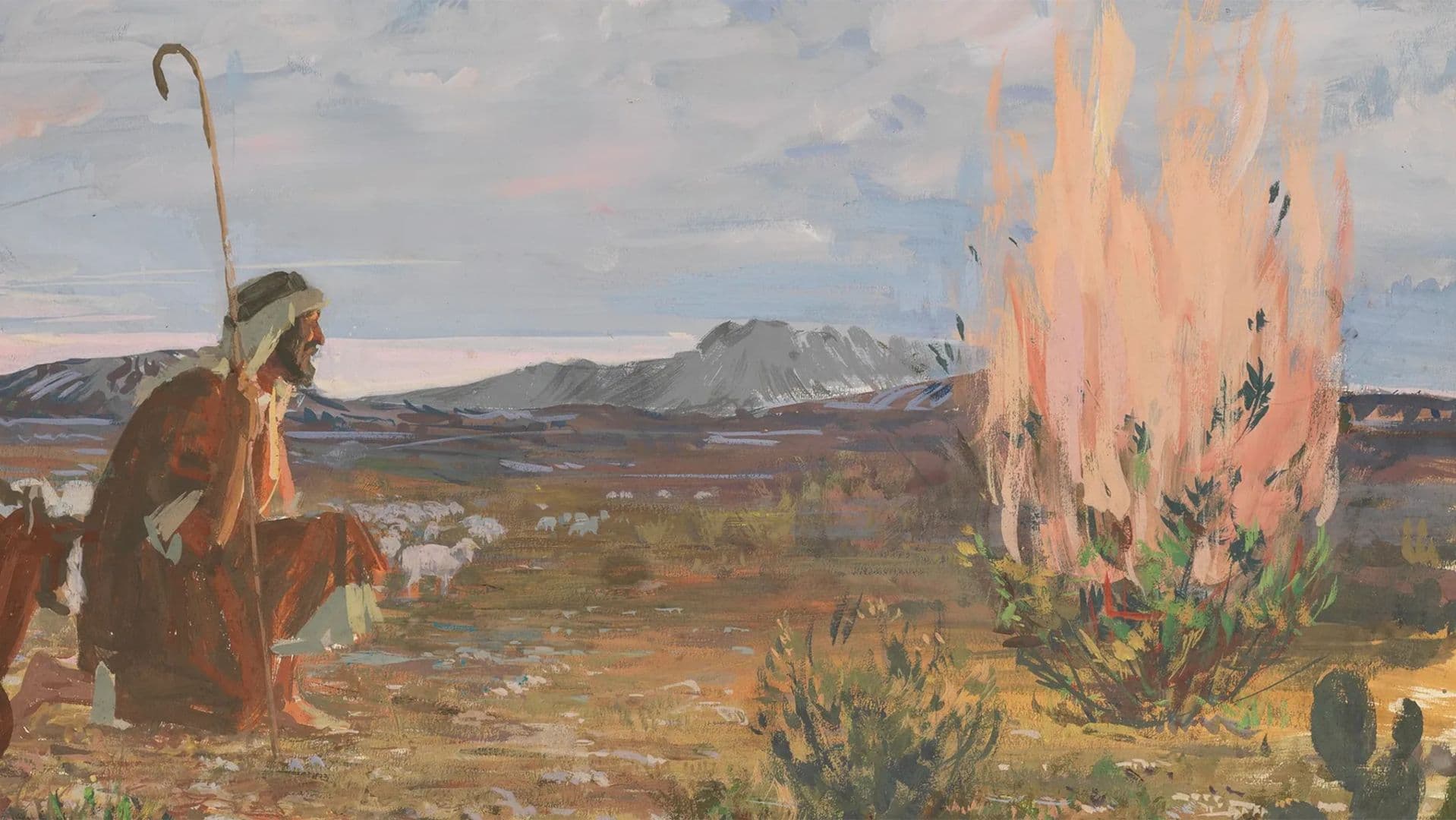
Moses’s preparation for ascent first occurs in a desert plain by the mountain Horeb where he sees a burning bush. However, he does not go directly to the bush. Instead, he is told to “draw not nigh hither” but to remove his shoes and receive instruction (Exodus 3:1–4:17). Instead of immediate entry, this scene emphasizes distance, preparation, and an initial commissioning. In this setting, Moses receives instruction as well as a divine name, signs, and tokens of recognition. Additionally, he has his mouth, ears, and eyes opened to do the work of the Lord (see Exodus 4:10–12).
Many readers have long seen the burning bush as a reflection of the temple lampstand, the menorah, found in the Hekal, the Holy Place which represents an elevated sacred space and signals that Moses is preparing for an ascent back into the presence of God. Moses does not fully approach the tree, but appears to prepare for that ascent, similar to a priest preparing in a courtyard to enter the temple where the menorah stands.4
Moses’s sacred ascent into the holy place is recorded later when he is “caught up into a high mountain” as recorded in Moses 1:1 of the Pearl of Great Price—a Restoration detail that otherwise leaves the divine pattern incomplete. This high mountain experience occurs after the burning bush but prior to going into Egypt to deliver Israel. In this mountain, Moses is shown the entire plan of salvation from Creation to the end of the earth, likely including the pre-mortal spirits which “were created” (Moses 1:8), and he passes through three tests of increasing intensity to see if he will somehow be drawn away to worship Satan (Moses 1:9–23).
Finally, after overcoming Lucifer, Moses is filled with the Holy Ghost, and God gives him power to command the elements “as if thou wert God” (Moses 1:24–25). Moses is now ready to go and deliver Israel with a mighty deliverance.
Pattern | How It Appears in Moses’s Narrative | |
Descent | 1. Divine origin | Moses is drawn from the waters like Isis’s son Horus and named in an Egyptian royal setting. |
2. Royal son in palace | He is raised in Pharaoh's household with princely status. | |
3. Exile | He falls into exile, becoming a shepherd and foreigner in Midian. | |
Ascent | 3. Preparation in a plain | In a desert plain, next to Mount Horeb and the burning bush, Moses is halted, commissioned, and given signs and tokens of recognition as a preparation. |
2. Ascent in a mountain | He ascends a high mountain, is shown the divine plan from beginning to end, passes through three intensifying temptations with Satan | |
1. Becomes like God | Moses is filled with the Holy Ghost and given divine power |
The Why
Seeing the narrative of Moses this way matters because it turns a familiar story into a pattern for dedicated discipleship. Deliverance is not portrayed as a shortcut. Even Moses had to pass through loss, obscurity, holy preparation, and testing before he could deliver others. Scripture therefore frames spiritual growth not as random hardship, but as a meaningful descent and ascent shaped by God.
This reading also helps modern readers connect temple symbolism with scriptural narrative. Ancient temples often encoded movement from the outer world toward increasing holiness. Moses's story mirrors that motion: royal origin, descent into the wilderness, preparation at holy ground, and a higher mountain ascent where he receives power and vision. In that sense, the life of Moses becomes a lived temple text--a story that teaches how God brings fallen people home.
This pattern is especially relevant because it is repeated in the life of Jesus as He prepares to deliver all mankind. Luke presents Christ not only as a new deliverer but as one who fully walks the sacred path: beginning with a descent from a divine state into mortality (Luke 1:31–35), being a child in His Father’s house (Luke 2:46–49), then going “down” to Nazareth and being “subject” (Luke 2:51), followed by an ascent up out of the waters of baptism (Luke 3), three ascending temptations (Luke 4:1–13), and finally returning “in the power of the spirit” ready to begin His ministry. The Gospel of Matthew similarly begins with this divine pattern, including a genealogical line running back to the covenant of God with Abraham (Matthew 1:1), efforts by evil forces to kill the infant Jesus (Matthew 2), the visit of priests bringing precious temple gifts of gold, incense, and myrrh (Matthew 2:11), Jesus being taken to Egypt, as Israel had been (Matthew 2:14), being known as a covenant-making Nazarene (Matthew 2:23), ascending out of the waters of baptism, with the voice of the Father declaring, “This is my beloved Son, in whom I am well pleased” (Matthew 3:17), followed by the three temptations or tests (Matthew 4), all in preparation for the commencement of Jesus’s covenantal ministry and atoning sacrifice. For believers today, the repetition of this pattern suggests that the way of Christ is also the way His disciples themselves must walk. Periods of exile, delay, or testing need not mean abandonment; they may be the very means by which God prepares a person for greater service.
Finally, the story offers hope. Moses begins as a vulnerable child, becomes a displaced outsider, and yet is transformed into one who can stand in God's presence and speak in God's name and with His power. His journey suggests that divine calling is not canceled by weakness, exile, or waiting. God can turn wilderness into preparation and trial into an endowment of power, glory, and eternal life. That sacred message remains deeply relevant for anyone seeking personal meaning, purpose, holiness, along with the strength to help others find freedom from worldly bondage.
John S. Thompson, “How Luke’s Gospel Portrays Jesus as the Exodus or Way of the Temple,” in Proceedings of the Sixth Interpreter Foundation Matthew B. Brown Memorial Conference, 4–5 November 2022, edited by Stephen D. Ricks and Jeffrey M. Bradshaw. Temple on Mount Zion 7 (The Interpreter Foundation and Eborn Books, 2024), 407-448.
Jeffrey M Bradshaw, In God’s Image and Likeness 1: Creation, Fall, and the Story of Adam and Eve, Updated edition (Eborn Books, 2014), 32–81.
- 1. John S. Thompson, “How Luke’s Gospel Portrays Jesus as the Exodus or Way of the Temple,” in Proceedings of the Sixth Interpreter Foundation Matthew B. Brown Memorial Conference, 4–5 November 2022, edited by Stephen D. Ricks and Jeffrey M. Bradshaw. Temple on Mount Zion 7 (The Interpreter Foundation and Eborn Books, 2024), 406-413.
- 2. See William W. Hallo & K. Lawson Younger, The Context of Scripture, vol. 1 (Brill, 1997), 461–463
- 3. Coffin Texts Spell 148 preserve the idea that Isis needed to hide Horus from his enemy, Seth, who sought to destroy him. Later traditions, like that preserved in the Metternich Stela, indicates that she hid him in the marshes along the shore.
- 4. Nahum M. Sarna, Exodus, The JPS Torah Commentary (Jewish Publication Society, 1991), 12–18, 161–176.