KnoWhy #867 | August 29, 2026
Who Wrote the Psalms?
Post contributed by
Scripture Central
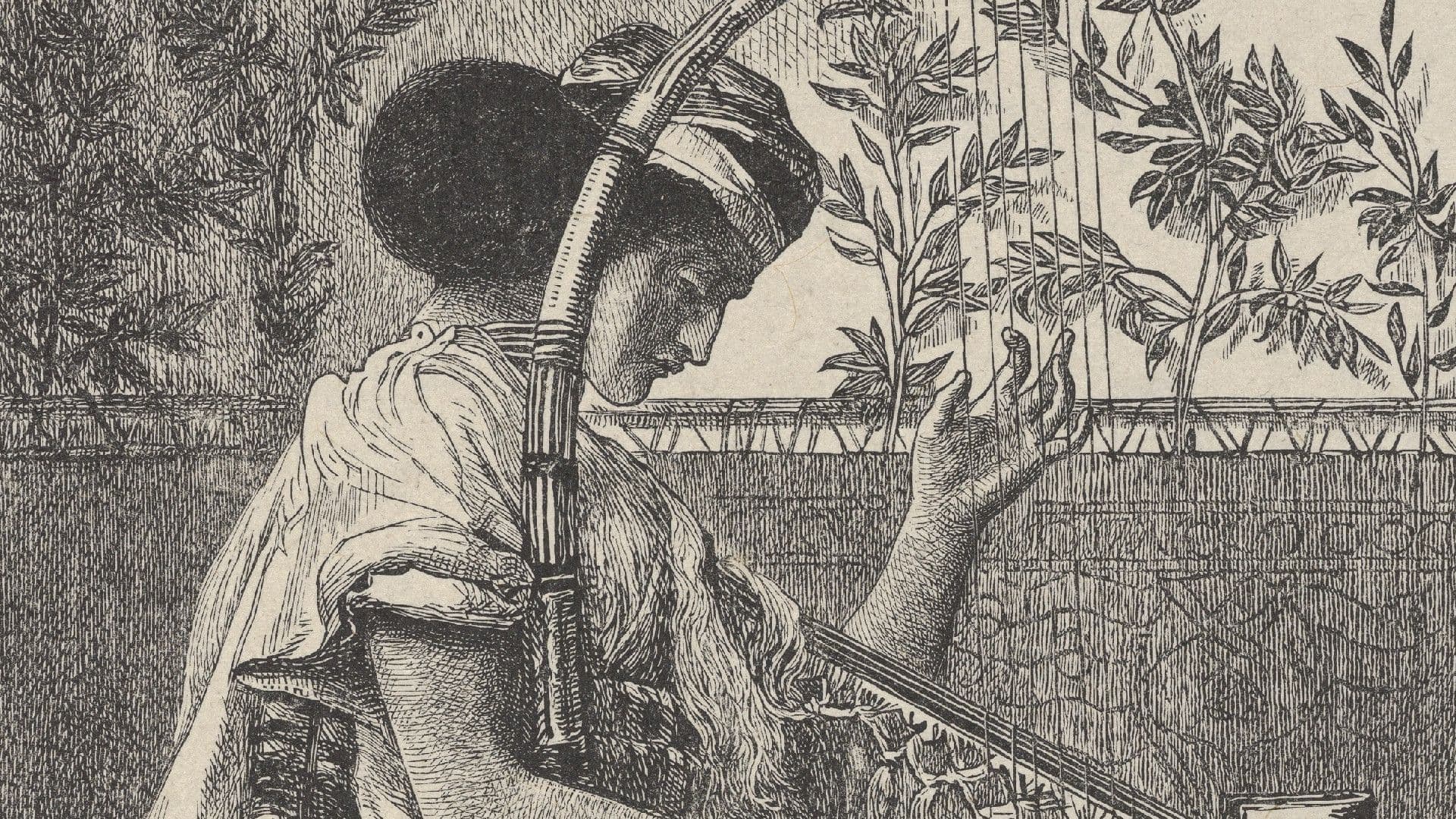
“O praise the Lord, all ye nations: praise him, all ye people.” Psalms 117:1
The Know
It has long been asserted that much of the Hebrew Bible was transmitted orally before ever being written down.1 Some believe the oral components of the Bible must have been passed down by professional bards or people in the court of the king, and then professional scribes eventually wrote the material down.2 However, there are indications that men and women from many walks of life may have been involved in composing or transmitting some of this material, especially the Psalms.
When seeking to understand how people may have transmitted stories in ancient times, one can examine other cultures with oral traditions. Seeing how they do things today can help modern readers understand how people may have done things in the past. Some African societies can be helpful in this regard. Some societies in parts of Ethiopia, for example, have people who were not professional scribes transmitting material which is similar to the Hebrew Bible. People from across the community, including beggars, will often perform funeral dirges which are similar to Psalms of mourning, known as Lament Psalms, found in the Psalter.3 This opens the possibility that people from various walks of life in ancient Israel could possibly have been involved in creating or transmitting similar content.
This supposition is strengthened by other examples from the ancient world. Ancient Greek sources depict weavers who preserve stories through weaving cloths that tell the stories they wanted to pass down.4 Ancient Mesopotamian sources state that the earliest author whose name is recorded was a priestess named Enheduanna. It is difficult to know if she was a real person or not, but the mere existence of the tradition suggests that it was not outside the realm of possibility for an ancient Sumerian woman to be an author, in this case writing material similar to what one finds in the biblical Psalms.5
With these examples in mind, one can turn to the Old Testament for more concrete evidence for the creation and transmission of religious texts by a range of people in ancient Israel. One example of this comes from Judges 5. This chapter is a poetic rendering of the events recorded in Judges 4, in which the Israelites win a great victory over their enemies through the guidance of a leader named Deborah and the key assistance of another woman named Jael. Judges 5:1 states that two military leaders, Deborah and Barak, sing the song about God delivering Israel, very similar to what finds in the Book of Psalms.6 Thus, a story about God delivering the Israelites was transmitted by a man and woman who are military leaders, not scribes.
Exodus 15 is a song sung when God parted the Red Sea for the Israelites to let them cross on dry ground. Although the song is introduced in Exodus 15:1, the singing of the song is described in Exodus 20–21: “Then the prophetess Miriam, Aaron’s sister, took a hand-drum and the women all went out behind her dancing with hand-drums. And Miriam sang to them: “Sing to Yahweh, for he has gloriously triumphed, the horse and his rider he has thrown into the sea.” 7 This suggests that Miriam and a group of regular Hebrew women were the people who composed and originally sang the song, a song which is similar to material one finds in the Book of Psalms.8
One sees something similar in 1 Samuel 18:6–7, when low-status people from across Israel’s cities came out to meet Saul, singing “Saul has killed his thousands, and David his ten thousands.” When read in light of other material noted above, these examples suggest that regular people from off the street in ancient Israel composed songs about God’s defeat of Israel’s enemies. 1 Samuel 2:1–10 records a song sung by Hannah, the mother of the prophet Samuel, celebrating his birth after being barren for many years.9
The Why
This evidence strongly suggests that regular people in ancient Israel were involved in the creation and transmission of material that was like the Psalms. Consequently, the same may be true for the material in the Book of Psalms.10 Although some of the Psalms are attributed to people like David, many of them may have been written by anonymous ancient Israelites from various walks of life.11 In some ways, this changes how one looks at the text. One might initially simply associate the Hebrew Bible with elite male scribes who were likely the ones who physically wrote the text down. However, when one realized that the portions of the text were written by both men and women from all walks of life, it makes it more relatable for all people reading the text today.
In this sense, the Book of Psalms, which is reminiscent of the ancient Israelite hymnal, is like the hymns used in The Church of Jesus Christ of Latter-day Saints today. One finds hymns by men and women from all walks of life and from varying professions all collected into the hymnal of the church. Apostles (Bruce R McConkie, among others), general relief society presidents (Eliza R. Snow, for example), and members of the general board of the Primary (Naomi Harriet Ward Randall) have written hymns, but so have printers (W. W. Phelps) and organists (James Welch).
In ancient times, as now, men and women from across the church, regardless of their callings of places in society, contributed to the songs sung by the people in their community. This wide array backgrounds and life experience possessed by the people who wrote the hymns contribute to their richness for the people who have loved and sung these songs throughout history.
Janet Ewell, "Seeing Psalms as the Libretti of a Holy Drama." Interpreter: A Journal of Latter-day Saint Faith and Scholarship 31 (2019): 259-276.
Larsen, David. “Psalm 1-20.” In Old Testament Minute: Psalms, edited by Taylor Halverson, Vol. 19. Springville, UT: Book of Mormon Central, 2022.
Rodney Turner, “Why the Psalms—how were they used, how did they come to be?,” Ensign, November, 1973.
- 1. For more on the orality of the Hebrew Bible, see Miller, Robert D. Oral Tradition in Ancient Israel. Eugene, OR: Cascade Books, 2011. See also R. C. Culley, see, "An Approach to the Problem of Oral Tradition", VT 13 (1963), 113–125. See also his Oral Formulaic Language in the Biblical Psalms (Toronto, 1967), and "Oral Tradition and Historicity", J. Wevers and D. Redford (eds.), Studies on the Ancient Palestinian World (Toronto, 1972).
- 2. For scribal culture in Ancient Israel, see Shaus A, Gerber Y, Faigenbaum-Golovin S, Sober B, Piasetzky E, Finkelstein I (2020) Forensic document examination and algorithmic handwriting analysis of Judahite biblical period inscriptions reveal significant literacy level. PLoS ONE 15(9).
- 3. See J. H. K. Nketia, Funeral Dirges of the Akan Peoples. (Achimota and Exeter, 1955) 51–73.
- 4. The Iliad, for example, depicts Helen as weaving a cloth which tells the story of the Trojan War (Il. 3. 121–28). Euripides similarly depicts Iphigenia as weaving the story of Thyestes and Atreus (IT. 811–17). The ancient Greek author Corinna does the same thing, but in writing, and not a visual medium (664b PMG).
- 5. Gadotti, Alhena. “Portraits of the Feminine in Sumerian Literature.” Journal of the American Oriental Society 131, no. 2 (2011): 195–206. One finds something similar among ancient Jewish women as well. According to Mishna Yoma, Helene, the mother of King Monobaz, “made a golden candlestick for the entryway of the Sanctuary, and in addition, she made a golden tablet on which the passage concerning the sotah was written” (Mishna Yoma, 3:10). Although it is impossible to know whether this portion of the Mishna is factually accurate or not, the idea that a woman would be responsible for preserving a portion of the Hebrew Bible suggests a relationship between women and the biblical text that one might not necessarily assume. This is discussed in some detail in Sarit Kattan Gribetz, “Consuming Texts: Women as Recipients and Transmitters of Ancient Texts,” in Rethinking ‘Authority’ in Late Antiquity: Authorship, Law, and Transmission in Jewish and Christian Tradition, ed. A.J. Berkovitz and Mark Letteney (Routledge: New York, 2018), 178–185.
- 6. Note that it is not just about them, but by them, as Judges 5:7 reveals that Deborah is being depicted as singing some of the song in the first person.
- 7. J. Gerald Janzen, “Song of Moses, Song of Miriam: Who Is Seconding Whom?” The Catholic Biblical Quarterly 54, no. 2 (1992): 211–20. For an overview of the Song of the Sea, see Brian D. Russell, The Song of the Sea: The Date of Composition and Influence of Exodus 15:1–21 (New York: Peter Lang, 2007), 1–59.
- 8. Lee, Nancy C. “Miriam and the Song of the Sea.” In Hannevi’ah and Hannah: Hearing Women Biblical Prophets in a Woman’s Lyrical Tradition, 1st ed., 59–87. The Lutterworth Press, 2015.
- 9. Proverbs also contains material which states that it was transmitted by a mother. Proverbs 31:1 states that the mother of a man named King Lemuel taught him the material which now comprises this chapter Andreasen, Niels-Erik A. “The Role of the Queen Mother in Israelite Society.” The Catholic Biblical Quarterly 45, no. 2 (1983): 192–193.
- 10. This is the common view among scholars. For a summary of the position from a Latter-day Saint perspective, see Rodney Turner, “Why the Psalms—how were they used, how did they come to be?,” Ensign, November, 1973.
- 11. Psalms 134-137, for example, show an interesting cross-section of life experience on the part of the authors.